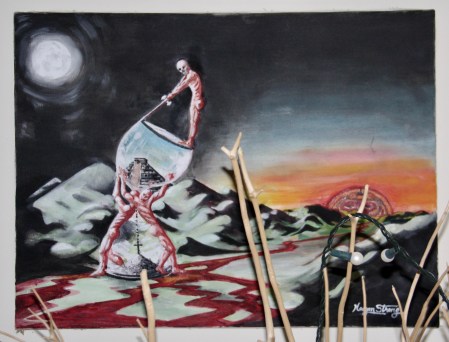
Mont Blanc

IMG_0026 (3)

Mont Blanc
(for Chuck Bowie)

“But what is that stick-like thing
between notebooks and mouse?”

“That stick-thing by my mouse,
as you so elegantly phrase it,
is my Mont Blanc fountain pen.

It’s also a metaphor app.
You stick the blunt end in your ear
to wind up your brain,
then you carefully clean
the tip on a piece of paper.

If it leaves suitable marks,
you read them like Runes
and use them to create metaphors.

You can also use it to conduct music
or to take a thin, blue line for a walk.
It’s very useful for poets who don’t like
staring at computer screens, and with one
they rarely suffer from writer’s block.”

Return to KIRA: Thursday Thoughts

IMG_0087.JPG

Return to KIRA
Thursday Thoughts
27 July 2017

“You cannot step in the same river twice,” according to Heraclitus. And he was perfectly correct. Yesterday I returned to KIRA. But it wasn’t the same. How could it have been?

Geoff, Hanna, and Cherry met me at the door. Geoff shook my hand, Hanna gave me a big hug, and Cherry pushed her wet nose into my crotch. Some things don’t change and one of them is a favorite doggy’s greeting. Mary sat at her desk just inside the door and she got a big hug too.

One Small Corner, the book that I wrote while at KIRA in June was in my hand. I had a signed copy for each of them. They also had a present for Clare and I: lunch at the Garden Café, courtesy of KIRA and a trip there on KIRA’s latest acquisition, a new golf cart, driven by Hanna. We were early for our lunch booking and Geoff suggested a quick tour of the gardens since Clare hadn’t seen them.

We all climbed into the Golf Cart, Mary and Hanna in front, and Geoff, Clare and I on the back seat, looking back as KIRA slowly vanished behind us. Another quote: “History,” said Marshall Macluhan, “is like looking at the past through the rear-view mirror of a rapidly advancing car.” This is a wonderful metaphor for my feelings at the time.

I had just met the young lady who had inherited my room, the Red Room, and my studio, #1. Neither the room nor the studio belonged to me anymore. They were now closed spaces, occupied by another. It didn’t hurt. It didn’t drive a spear through my still suffering heart. It did, however, underline that the waters of the stream had moved on and were not the same.

The gardens had changed too. Gone were the splendiferous rhododendrons of June, present were the multitudinous colors of Late July. The tiniest alpaca, born just before I left at the end of June, was now a sturdy one month old, larger and much more self-contained. Moe was a month older too as he sat on the roof of his shelter and nickered away at the world in general. Our lunch table was reserved for 12:30 and we would see them all later, parading on the lawn.

The gardens were fuller now than they were in June: more flowers, more blossoms, more color, more people, more children, more hazards for Hanna to slow for as we made our way back to the Garden Café, past the Sensitivity Garden and the Therapy Garden, past the Labyrinth and the Maze, past the Dutch Windmill, past all those magnificent sculptures … new sculptures had appeared … the blue piano wasn’t there earlier … this month’s artist had erected a new piece in the Secret Garden … change was all around me … and I viewed it from the backward-facing seat of a slowly advancing Golf Cart.

We had lunch in the shade beneath the apple tree. I looked around for Carlos, certain that he and his shadow were both close by … but I could hear no pipes. I spoke to Clare in Spanish, just to hear that language once again, but Carlos still didn’t appear. How could he? The river had flowed on and he was back with his family in Brazil.

Friends dropped in at the table to chat: Brad, Tim, Stefan, Mikah …lunch came and went speeded on by reminiscences and plans. After lunch, we visited the exhibition put on in the Garden Café by the latest group of resident artists. We admired the pencil drawings, loved the paper-maker and her art, and were wowed by the rug hooking and the photographs …

I thought of our own exhibition, held in the same place in June. We had our paintings, courtesy of Anne and Ruby, our sculptures, thanks to Elise, but the silence of July’s exhibition had been broken by the sounds of Carlos’s pipes and the viva voce reading of my own poetry. We were not a silent group, but a noisy, head-banging, drum-beating, piping, singing set of selfie-videophiles … the river had flowed on.

Ghosts of our voices clung to the back porch when we returned to KIRA. Hanna and Mary returned to their duties. Geoff, too, had things to accomplish. We met with two more of the new resident artists and complimented them on their skills. Then we slipped silently away to join the river of traffic that flowed down Water Street and up and away and back again to Island View.

Yes, I enjoyed myself. Yes, I will return again in August for I have promised to do that. But each trip will be different and no two trips will ever be the same, for old man river … well …he just keeps flowing along …

IMG_0080

IMG_0087 (2)

IMG_0092


Yesterday

Ay Ay Ayeres

Digging around in the photo files that I transferred from my old computer to my Google drive, I discovered this golden oldie composed of my words and Clare’s images. What a revelation: I had completely forgotten that this group of work existed. I’ll dig them out ne by one and post them from time to time. Ayer is the Spanish for yesterday, hier in French. The title “Ay! Ay! Ayeres!” with its multiple plays All our yesterdays and its reference to the old song “Ay, ay, ay, canta no llores” draws together a series of memories, some in the past and some in the future. ‘How can we have a memory in the future?’ you ask. By recognizing a present moment, or one that lies just ahead in a future that ill become soon enough a present, as one that has already occurred in the past, thus confirming the circularity of our lives and the idea that all time is time present, one of T. S. Eliot’s recurring themes.

Ocho Venado: Eight Deer is a central figure (war leader) in the Zouche-Nuttal, a pre-Columbian Mixtec Codex. He is the war leader in the Conquests recorded in the codex (circa 1050-1100).
Quesadillas: Oaxacan tortillas filled with cheese and flores de Calabaza, gourd flowers.
Reyes Magos: the three wise men or kings who visited the Christ Child on January 6, the traditional Spanish Christmas.
Murcielago: the bat and a symbol of death in Oaxacan mythology.
Nueve Viento: Nine Wind descends from heaven to separate the sky from earth and its waters. Nine Wind at Tule meeting with Cortes is mythical not historical, though the meeting of Cortes with the Mixtec chiefs (caciques) did happen.
Apoala: The Mixtec nation was born form a cave (sometimes a tree) in Apoala, Oaxaca.
Spinning the wheels in the snow: a reference to Jean Chretien and one of his famous images.

The piece is written in a surrealist style that mixes historical fact with creative writing. The distant past is recalled (1050-1100), then the middle past (1525-1530), and finally the present appears. This mixing of time and place (Mexico and Canada) is also related to the surrealist movement. Surrealism creates a dream world in which images float and change shape within a time-space conundrum where dream is more real than reality and creates its own new meanings that are individual to each reader.

Any comments on this rediscovered piece will be warmly welcomed.

Residency: Thursday Thoughts

Chaos

Residency
Thursday Thoughts
29 June 2017

Application:
I would not have applied for the residency at KIRA had I not have been encouraged to do so by my writing group friends and by a friendly voice on the Kingsbrae phone.

Acceptance:
I was surprised to receive notification of my acceptance. It arrived on 2 March 2017. On 3 March 2017, I started to peruse the Kingsbrae web page and make the first drafts of poems that I would later complete on site.

The Red Room:
I was lodged in The Red Room in the KIRA Residence and I had a small desk at a window overlooking Passamaquoddy Bay. I spent a whole month looking out of that window and writing at that desk … or was it the other way round?

Community Commitments:
These were multiple, but they were always art orientated and therefore most enjoyable. They included working with school children, attending various unveilings and openings, and being present in our studios and discussing our art with visitors. On 26 June we had an exhibition in which each one of us either showed our work or produced a live performance.

Evening Salons:
Most evenings we had a literary / artistic salon in which we discussed various aspects of our art. These lasted two to three hours and some were summarized while others were video-taped. These quick-fire exchanges provided a backbone to our daily work.

Trips:
There was time for local trips and we travelled, individually or in groups, to many places including Deer Island, Passamaquoddy, Campobello, St. Stephen, New River Beach, Holt’s Point, Greenlaw’s Mountain, Jarea, Minister’s Island, Ile Ste. Croix, and several other locations. The photographic records enabled us to build our creativity.

Artistic Development:
This was individual to each of us, but we all remarked on a widening of our perspectives, a new commitment to narrative and theme, and a broadening of our artistic horizons.

Returning Home:
On my return home, I turned to my everyday life in which art, in my case writing, was of secondary, not primary, importance. The need to cook, to shop, to do normal household duties suddenly conflicted, once again, with my need to be a writer.

24/7:
24/7 is indeed a cliché. But for 28 days it became the pattern of my writing life. It was indeed a fertile time. I wrote some 100 poems, 25% of which will be rejected, with a possible thematic structure and three revisions already completed. Sooner or later, I will produce a book about this experience..

Conclusions:
This type of time commitment turns us from budding /artists into the real thing. We must strive to re-create these last 28 days in what remains of our creative lives. There can be no lesser or secondary choice, if we are to be serious about our art.

The Journey:
If we wish to travel from Halifax to Vancouver by bus, we must make several decisions.
1. We cannot get off at Moncton.
2. We cannot get off at Montreal, nor at Toronto.
3. Winnipeg, Regina, and Calgary are beautiful; but we mustn’t get off the bus.
4. If we do, we will never get to Vancouver.

Conclusion:
Art is a life-time journey: don’t get off the bus.


Coming Together

Coming Together

A coming together of cultures,
these three statues,
placed equidistant,
forming an equilateral triangle,
all things being equal.

Three founding cultures:
English, French, Indigenous,
in alphabetical order.
They stand face to face to face,
a triangulation,
silhouetted in profile,
sharing positive and negative space.

At the center of their union,
at the still point where nothing moves,
a living, breathing space,
that takes away your breath.

When you breathe again,
you take in air
and light and sun and
hope renewed.

Faith runs tingling round your body,
hand in hand with joy and life
and love reborn.

Jarea

PEI + bockle 2008 101

Kingsbrae 25.1
25 June 2017

Jarea

This is a glimpse of
how it might be.

Surrounded by paintings,
snapshots and memories,
all we have ever done
hanging on the walls
as if we were visiting
a gallery of our lives.

Impressions from our childhood
line up beside
expressions of our adolescence
and
abstracts extracted
from our more mature years.

Time,
we are running out of time,
and our here and now is
a quality of deafness leading us
into the next dimension.

We will see our whole life,
in that blink of an eye.
Then there will be farewells,
a sudden silence,
and we will be gone.

Standing Stones

IMG0039_1

Kingsbrae 21.4
21 June 2017

Standing Stones

Standing in a stone circle,
surrounded by standing stones,
listening to their voices.

The reverberation of their uprooted rock
remembers its birthplace,
recalls the sculptor’s toil,
the polishing of granite and grain.

I’ll never forget those other stones:
bluestones at Stonehenge,
the Bronze Age tomb in Wick,
the toros de Guisando,
the danzantes at Monte Alban,
Hengistbury’s double-ditch and wall,
stone circles in Singleton
the Gorsedd ring in Caer Dydd.

Nor will I forget the deep-voiced
song of stone, here at the solstice,
standing in the middle
of three powerful granite statues,
their energies released
at this afternoon’s unveiling.

When I closed my eyes
I opened my mind and heart
to the deep earth-soul song
strummed in tune with the sunshine.

I breathed it in, retained it,
then allowed it to shine out
through the lantern of my heart.

Water Tower

IMG_0452

Kingsbrae 19.3
19 June 2017

Water Tower
(for Geoff)

Asked where he got the material
for his plays, Molière said:
“Je le prends où je le trouve,”
“I take it from wherever I find it.”

Here, before the water tower,
I find the tower to be a ground
level water tank, no tower at all.

The first steel band, the horizon,
is composed of yellow lilies.
Above them, the Kingsbrae Café shares
the second band with the gardens’ windmill.

Twin pointed roofs and the windmill’s
thin sails reach up to the skyline
with its background of trees
silhouetted against an egg-shell sky.

Art is in the eye of the beholder
or the artist and can be seen
wherever it can be found.


Mist

IMG_0009

Kingsbrae 19.1
19 June 2017

Mist

Full sail, the sailing ship, clawing
into the mist. For a moment, only
mast-head showing, then hazy at
last, vanishing, appearing again,
doubt in the beholder’s mind: is she
or isn’t she, real or apparition? So
easy to believe in ghosts and ghost
ships when mist deceives and eyes
grieve for the subtlety of a clear
day, not mist enveloping the bay,
holding the boat back with tenuous
tendrils, ghostly fingers, damp music
on sails and cordage, shallow the sea,
the channel through sand banks and
pebbles, half -seen, yet known about,
both sensed and scented, heard from
water –sound, wave-pitch changing
and lost again the schooner, grey ship,
grey camouflage blanket of clinging mist.

Sandman 3

IMG_0052

Kingsbrae 18.1
18 June 2017

Sandman 3

The sandman brings sand
to put in the sandwiches
we have packed for the beach.
It’s as coarse and fierce as salt
flowing through an hourglass,
or red sand in an egg-timer,
not clockwork and wound,
but the sort you turn upside
down. Sand: it counts each
minute of each day, turns
minutes into hours, hours
into days, sands the stone
block of our lives, like a sculptor,
into smaller, more manageable
shapes and chunks. Sand sticks
to our clothes, makes us wash
our hands and brush ourselves
thoroughly before we sit down
to eat the sand that has sneaked
into the lunch-time sandwiches
we brought to nibble on the sands.

Sand in the sandwiches:
grit in the machine.
Sand in the sand glass:
measuring our lives.
Sand on a childhood beach:
timeless.

Comment: My thanks to Dwight Roth, a fellow poet, for sowing the seed that grew into that last stanza. It’s funny how art can grow. A suggestion from a friend, a chance encounter, a moment of madness. As artists, we must keep our minds open for these moments when the small universe of the poem turns and changes, pivoting sometimes on a single thought or a seemingly careless word. A careless word: that is sometimes how and why the greatest books are written: “En un lugar de la Mancha, de cuyo nombre no quiero acordarme …”