Flower-power


IMG_0902 (2).JPG

Flower-power
or
Why should the young kids have all the fun?

So it’s children’s day at the local supermarket. As I push my shopping cart through the door, I see the face-painter with a young girl sitting before her, getting her face painted. Behind the willing victim, several young children wait, shuffling their feet in expectation. I go out to the car park, unload my cart, and push it back to the supermarket.
As I park my cart, I see that the line-up has disappeared and the face-painter sits alone, cleaning her brushes. I walk up to her table and ask “How much?”
“It’s free,” she tells me. “It’s children’s day.”
“Will you paint my face?” I ask her.
“You’re not a child,” she looks at me in astonishment.
“No, I’m not,” I reply, “but I’m in my second childhood.”
I pull out the chair and sit down.
“I’ve got some photos on my phone, or I can try and paint whatever you would like. Would you like to see some pictures?”
“No, thanks. Just  look at me and paint what you think I would like.”
“What are your favorite colors?” she looks at me and smiles.
“I don’t have any favorite colors, but I always avoid green, yellow, and gold.”
“Oh, well, how about a nice flower?”
“Great!” I say.
One of the trolley boys who return the shopping carts in great convoys walked by.
“You need a mirror,” he says, “so people can see themselves.”
“Great idea, stay here, I’ll go and get one.”
“Don’t worry. I’ve got a mirror in the car. I’ll have a look when I get there. Meanwhile, it’s a surprise. I’ll put a photo up on my blog when I get home.”
“Promise?”
“I promise.”

IMG_0903.JPG

I gave her my blog address and I kept my promise. Unlike many people I know, I usually do.

IMG_0903 (2).JPG

Commentary: with many thanks to Emily, the face-painter, who treated my second-childhood with humor and dignity. As I said to her at the time, ‘why should the young kids have all the fun?”
 

Dreamer

IMG_0826 (3)

Dreamer
Maindy Road
Cardiff

Dressed in clothes spun from the thinnest of air
I gave my dreams to any who would listen.
“A gift,” they called it, “for words.”

Yet, when the winds blew wrong
my words changed to smoke that stained
or flames that blistered and scarred.

My tongue twisted and forked until lies
lay heavy in my mouth and my words
were weighed down with hooks, and sinkers.

My life became a night-mare ridden full‑tilt
at a windmill with a great wooden sail.
On certain nights, when the sky was sprinkled

with seeds of living gold, I rose upwards
to the moon and my words become stars;
on lesser nights, I lay broken in the gutter.

Swansea

IMG_0898 (2).JPG

Swansea

To be Welsh in Swansea is to know each stop
on the Mumbles Railway: the Slip, the Rec,
Singleton Park, Blackpill, West Cross, Oystermouth,
the Mumbles Pier. It’s to remember where single
lines turn double by Green’s ice‑cream stall.

It’s to know where the trams fall silent, like dinosaurs,
and wait without grunting for one to pass the other.
As you wait you can hear the winter roar of the rugby
crowd or St. Helen’s summer “click” of ball on bat.

Today the tide is out and the nets are golden with starfish
as if a night sky stretched across day’s horizon.
Mudflats rule the bay beyond the sand, and banana boats
ride the distant waves, waiting for the tide to turn.

When it does, the Mumbles Railway has been sold
to a Texas millionaire and the brown and yellow busses
no longer run to Bishopston, Langland, Caswell,
Pyle Corner, Pennard, Three Cliffs, Ilston, Rhossili:
sweet names of sea and sand where my father fished
for salmon bass, his thin line cast defiantly at a rising sea
that would smash the walls of the sandcastles I built to last
forever, unaware that time’s rising tide would breach
their defenses, leaving them in ruins on the summer
beaches where I dreamed my buoyant boyhood away.

Commentary: The Mumbles Pier from Limeslade. This is the first water color painted by my father’s brother, my godfather after whom I received my second name. He took up painting after he retired and became a quite accomplished amateur water colorist. He gave me four of his water colors, I particularly wanted this, his first, and the later ones are excellent, especially the award-winning paintings, of which I have one.

Time-Spirits

IMG_0868.JPG

Time-Spirits

Zeitgeist

Zeitgeist is a concept from 18th- to 19th-century German philosophy, translated as “spirit of the age” or “spirit of the times”. It refers to an invisible agent or force dominating the characteristics of a given epoch.
Wikipedia

Those who cannot learn from history are doomed to repeat it.

“Plus ça change, plus c’est la même chose.”

Poems for troubled times.

Introduction

Our world finds itself in an incredible mess right now. Somehow, we have to sort it out. Images and metaphors tie past, present, and future together. We must pick our ways through the difficulties of these troubled times, as you must pick your way through the intricacies of these poems. Many of you will give up. Some of you, the chosen few, will make your way to the heart of each poem.

These poems are deliberately cryptic. Each one is a mind game I am playing with you. I do not underestimate you. I have placed clues throughout each poem and if you follow the clues you will arrive at many of the poem’s hidden meanings. Some poems are more difficult than others, their meaning more recondite. Others seem very straightforward, yet still contain secrets.

            This style of poetry has a long history going back to Anglo-Saxon riddles and way beyond, back into the mists of time. Luis de Góngora (1561-1627) and Francisco de Quevedo (1580-1645) specialized in similar forms of recondite poetry, often based on metaphor and the juego alusivo-elusivo, the game of alluding to something while eluding the act of saying what it is. Jorge Guillén (1893-1984) and Federico García Lorca (1898-1936) also played this game, as did Octavio Paz (1914-1998). In the works of all of these poets, the clues may rest in the poem or they may be found in a generic knowledge of the mythology of the poem’s exterior world.

             Always remember that “those who cannot learn from history are doomed to repeat it” (George Santayana). Otherwise expressed, in the words of T. S. Eliot: “Time present and time past / are both perhaps present in time future / and time future contained in time past” (Burnt Norton). The seeming anachronisms in these poems suggest that all time is ever-present and that each new day presents us with events that have already occurred on many occasions.

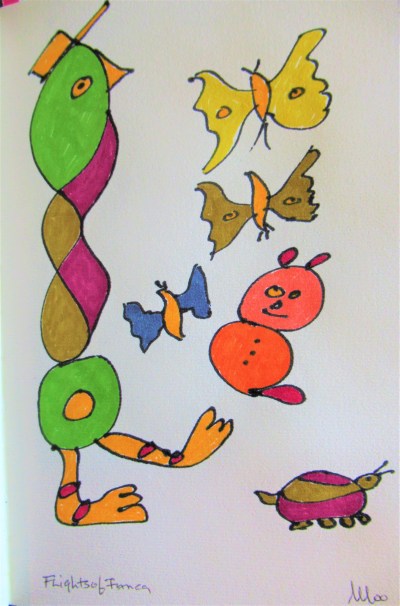
Commentary: The idea for Time-Spirits aka Zeitgeist was born around the kitchen table in Island View on Saturday, 22 December 2018, during a literary conversation between Gwen, Victor, and Roger. A poem at a time, one after another, grew from that table top chat. The result: 70 poems, not easy to read, deliberately difficult, that reflect our troubled times. My thanks to Geoff Slater, line-painter, who drew the cover picture: Robin Red in Claw and Breast, a symbol of nature ‘red in tooth and claw’. So are we in the words of Albert Camus who writes ‘nous sommes ou les meurtriers ou les victimes’ . Is it the early bird that catches the worm? Or is it the late worm that gets caught by the bird? Whichever: it’s the worm that gets eaten, until the robin bites the dust, when he is eaten in his turn. Just think of it as nature doing its regular recycling …


IMG_0865 (2).JPG


Elevator Pitch

IMG_0627 (2)


Elevator Pitch
Jean Chrétien

His enormous presence filled that tiny
space. His corkscrew smile, well-known tic,
semi-frozen face, that trick of wild speech

butchering language, misunderstood in
both English and French. “Bonjour,” he said. “Good
day.” I nodded, didn’t know what to say,

just shuffled my feet. I remember he
talked on the radio about our land,
how, in winter, with car stuck in snow,

we spin our wheels, forward and back, a bit
at a time until we emerge, content,
victorious. Time and the floors slipped by.

I thought of the elevator pitches
I had written for my films. Should I pitch
him about my latest film or should I

just keep quiet. The elevator stopped.
Jean Chrétien got out. “You’ll be back,” I
said. “Damn right,” he grinned, lop-sided.

Renaissance Hotel. Toronto. Nine-teen
eighty-five. Tongue-tied I had stood there.
Later I thought of all I might have said.

Vision

61958745_10157302398440522_1367573584830005248_n.jpg

Vision

Vision
appears from nowhere
holds you in its hands
molds you like putty
play dough or plasticine
till you bend to its will

62074164_10157302392400522_2936552509885382656_n.jpg

is it a conundrum
like chicken or egg
the final product
laid out in all its details
or is it a process
step by step along the way
sometimes even the artist
cannot really say
yet shaping happens

61873858_10157302392335522_4315892376666112000_n.jpg

maybe it happens each day
in a different way
a power descending
an angel entering
a vacant mind as if it were
an empty room
Lorca’s duende
alive and well
and living in St. Andrews

62071670_10157302392320522_4450451399947321344_n.jpg

Comment: The above verses express, in part, a conversation on the origins of inspiration and vision held around the dinner table at the KIRA residence in St. Andrews on 9 June 2019. Those who participated in the dinner discussion … de sobremesa, as they say in Spain, over the table top … included (clockwise round the table) Chuck, Masha, Heather, Susan, Geoff, Andrea, Roger, Evelyn, Perri, Faye, and Mel. If I have forgotten anyone, or placed them in the wrong seating order, please forgive me. I am growing old and my memory is not what it was. However, the arrival of inspiration, how we greet the artistic vision, what it means to each of us, whether it arrives in totality or in fragments, glimpses or a full vision, this varies for each one of us. More on this tomorrow when I write about Lorca’s duende, the dark earth power that takes over performance artists when they perform, filling them with fire and fury, then leaving them empty, drained of all essence, ripe for the old rag-and-bone man and his cart. The paintings, incidentally, are by my line-painting friend, Geoff Slater, who is also a muralist, indoor and out, and the photos are courtesy of Mary Jones, the much-beloved former Executive Secretary at KIRA.

Murals

IMG_0692.JPG

IMG_0659 (2).JPG

Murals
McAdam Railway Station #11

Painting a mural,
inside, interior
wall, knowing it will
stand time’s test.

Viaduct broken,
a tumbled engine,
Canadian workers,
railwaymen all,

some from Macadam,
pebbled the floor,
handrail, radiator
camouflaged for war,

part of the painting.
Depart from the station.
Turn right. Straight ahead,
flaked peeling paint.

So sad, this outside
mural, exposed to winter’s
snow, frost, winds, and ice.
So vulnerable

and so ephemeral.
Such a short-lived
summer, over in a day.
Butterfly on a rock.

IMG_0691 (2).JPG

image1 (2) - Copy.JPG

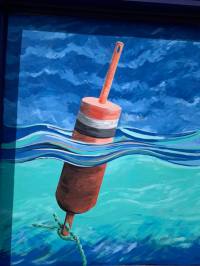
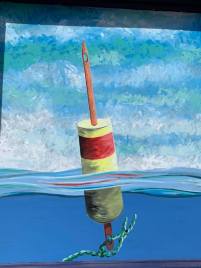
Comment: This sequence comes from the indoor and outdoor work (murals) of my friend Geoff Slater. Geoff told me how ephemeral were the outdoor murals with a life-span of about ten years before they needed redoing. After that, the paint starts to fade, then crack, then dry and peel away. Our Canadian winters with their icy cold and the ensuing springs with their frost and thaw do not help. The protection, no ice, no snow, no sun, no rain, afforded to the interior murals means that they will last so much longer. Our outdoor art, unless cast in the firmest stone, is ephemeral. Like a butterfly, it will not last much longer than a brief summer day. Hence the final metaphor.

In the Cave

9_Bisonte_Magdaleniense_polícromo.jpg

In the Cave
(514-520 BC)

one goes on a journey
knows where one’s been

reality returning
one tells what one’s seen

shadows dancing
on night’s silver screen

verbal sketches
from where one’s been

speaking other languages
heard not seen

the more one speaks
the more others think
‘dream’

a dream for those
who’ve never been
where one’s been


Murals

IMG_0664

Murals

Painting a mural,
inside, interior
wall, knowing it will
stand time’s test.

Viaduct broken,
a tumbled engine,
Canadian workers,
railwaymen all,

some from Macadam,
pebbled the floor,
handrail, radiator
camouflaged for war,

part of the painting.
Depart from the station.
Turn right. Straight ahead,
flaked peeling paint.

So sad, this outside
mural, exposed to winter’s
snow, frost, winds, and ice.
So vulnerable

and so ephemeral.
Butterfly on a rock.
Such a short-lived
summer, over in a day.

Comment:

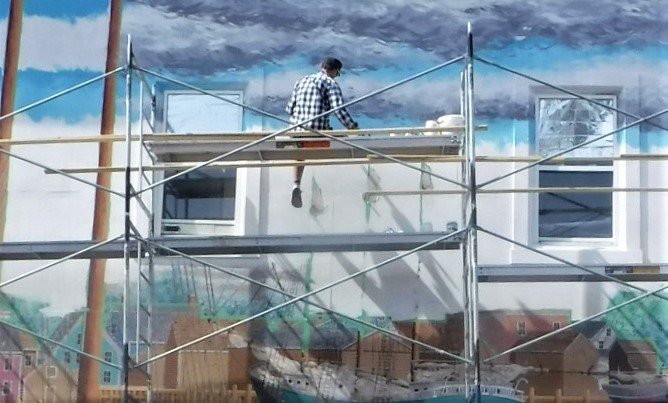
My friend, Geoff Slater, inventor of line painting and a renowned muralist, is painting a mural at Macadam Railway Station celebrating the role of Canadian railway engineers in WWI. Here are two fragments  from his unfinished mural. The poem above is based on his lamentation that his outdoor murals, subject to the slings and arrows of outrageous Canadian winter weather, are ephemeral, like butterflies, and cannot endure.

IMG_0692 (2)