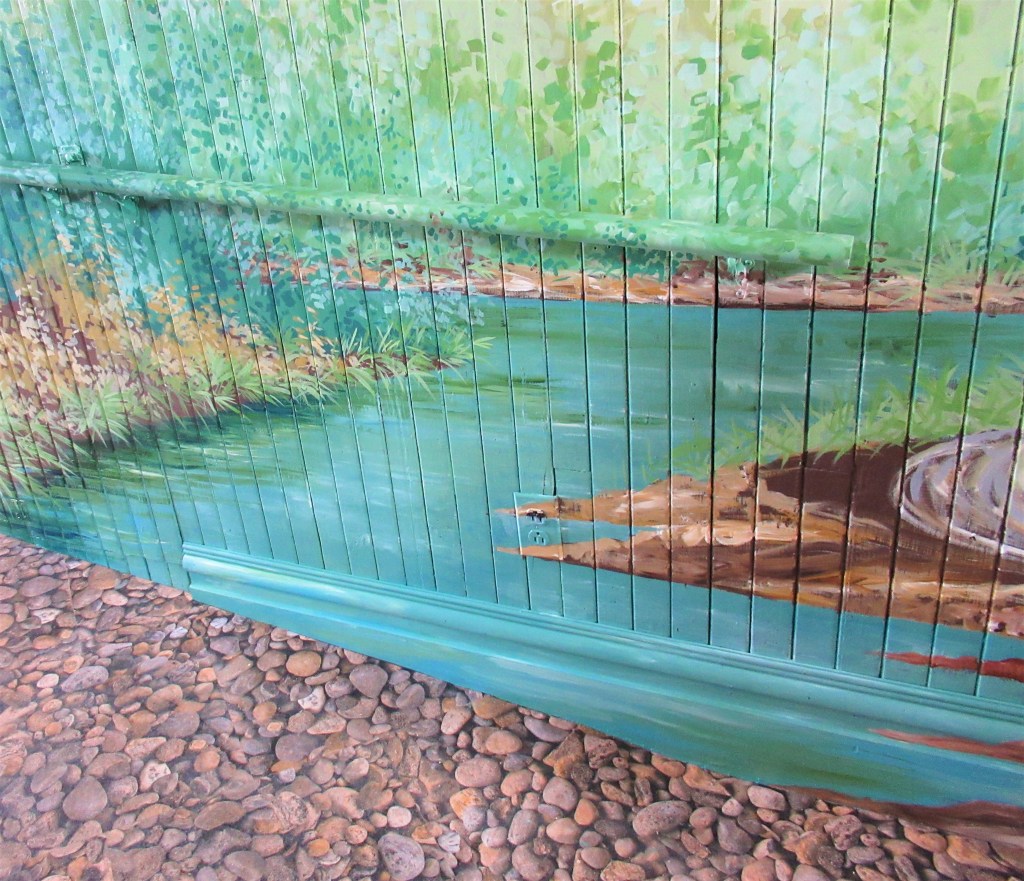
Geoff Slater’s mural at McAdam Railway Station. ‘You cannot step in the same river twice.’ Heraclitus.
Heraclitus
Nothing will ever be as it was before.
Time, like water, like these people marching, constantly flows, trickling through my fingers, uncatchable, unstoppable, sand filtering through the hour glass’ waist.
Water flows, currents shift, rocks wear down, banks slide and fall.
“You cannot walk in the same river twice nor ever attend the same demonstration.”
Nor can you recapture that first, fine, careless rapture, the touch of that first drop of river water.
Kneeling by the river bank, like St. Kevin and his Blackbird, I cannot recall the river’s name.
Comment: I love the reality of the river, its impressionist style of flowing water, impossible without the enormous presence of Claude Monet and his portraits of the Seine. However, what makes the mural, for me, is the brutal reality that breaks into the painting’s unreality. The boards covering the interior wall, the hand rail blended into the painting, the skirting board, the electric socket. I also like the intertextuality: art speaking to poetry, poetry replying to art, the links to Heraclitus, poetry speaking to poetry, the anonymity of the river, and the further poetic links to Robert Browning and Seamus Heaney. I often wonder if readers and viewers pick these things up. Or do they just speed-read, link to their own experiences, and move on with no further thought? You tell me. But what I will tell you is that artists reaches out to art, poets extend their hands to poetry, and our world is an inter-connected maze of thoughts and ideas, linking and unlinking, occurring and re-occurring, lapping like an incoming tide at the fingers and toes we immerse in those amniotic waters, often so long-forgotten, in which our creativity is berthed and from which it is born.
Searching for le mot juste, the exact word that sums it all up, catches the essence of the thing and holds it in the mind forever.
Think flowers. Think scent. Think of the limited ways we describe how daffodils lift and clematis clings.
I look across the breakfast table and see my wife of fifty years, a teenager reborn, walking into that café where we had our first date.
I search my memory and my mind for the words to describe that beauty, that surge of excitement, I still feel when she enters the room:
but find I cannot find le mot juste.
Comment: I shortened this poem from its earlier version. You can click on this link to compare the two versions. I am always puzzled by the dilemma of lengthening or shortening. My thoughts center on the longer and shorter versions of some Raymond Carver stories. Follow the editor’s advice and cut all material down to its essential bones or fill out the skeleton with flesh and blood and expand the creative process further. I also think of the exhortation to ‘stay in the moment’. Anything that takes the reader away from the central experience is superfluous. Experienced writers are aware of that moment and its importance. Writers at my stage are often baffled by it and need to be told yes, this is the moment or no, that is not the moment. I guess the more we write, the more we understand the process. Understand: do we work this out consciously or does it develop in unconscious fashion? Are some people just born with those skills or we must work hard to develop them? Sunt rerum lachrimae: tears are in all things and I guess hard work is all part of the process. As I was told a long time ago: genius is 99% perspiration and 1% inspiration. You have to put in the hard work for that little light bulb to go ‘pop’!
I saw my father yesterday evening. I walked through the zócalo, opened the main cathedral doors and walked in. The doors closed behind me. I looked towards the main altar and there my father stood, motionless. The evening light shone through the engraved glass panels and illuminated him as if he were some long passed saint come back to visit me. We stared at each other, but I couldn’t open my mouth to speak. The hairs on my neck stood on end and my hands shook. When I forced my mouth open, words stuck in my throat. He wore his best grey suit over a light blue shirt and a dark blue, hand woven tie: the outfit in which I had buried him.
Three old women, dressed in black, broke the spell. One stood in front of me and wouldn’t let me approach my father. She held a large bag of knitting in her hands and the wool spilled everywhere as she pushed me away. The second threatened me with a pair of scissors that she held in her left hand and thrust towards my face. The third smacked a tailor’s measuring rod against my father’s head. He nodded, smiled sadly, and they all turned their backs on me and hurried away out of the cathedral and into the square.
Just for a moment, I stood there in silence. Then I pulled the doors open and ran in pursuit of my father. The setting sun filled the square with shadows that whispered and moved this way and that, as if a whole village had come down from the hills to walk beneath the trees and dance in the rays of the dying sun. I stood on the cathedral steps and called out my father’s name, but I could see no sign of him among the cut and thrust of the shadowy crowd.
I ran out into that crowd and pushed at insubstantial people who stood firm one moment and then melted away the next like clouds or thick mist. I came to a side street and saw real people, flesh and blood beings, a group of villagers gathered behind their band. I stopped and as I did the village elder put a live match to the taper of the rocket that he clutched between his thumb and forefinger. The taper caught on fire and the rocket soared upwards with a searing whoosh. The village band marched forward and started to play a traditional dance as the rocket clawed its way into the sky to explode with a loud knock on the door of the gods.
Tired of grasping at shadows and afraid of this living phalanx of men that marched towards me I went back to the cathedral and knelt at the altar of La Virgen de la Soledad, the patron saint of Oaxaca. Real wax candles stood before her altar, not tiny electric lights, and I inserted five pesos in the slot, took a taper, and lit a fresh candle from an ageing one that had started to sputter. I knelt and, for the first time in years, I prayed. I prayed for the soul I had saved from extinction by lighting my candle from another’s flame. I prayed for my father and my mother and, above all, I prayed for myself.
On the way home to my second-floor apartment where I live alone, I bought two litres of mescal, one to send me to sleep, and the other so I would survive the next morning.
Comment: A Golden Oldie that I had forgotten about. I found it among the drafts of earlier work. Monte Alban is also known as Dani Ba in the indigenous language of the region. Click on the link for more on Monte Alban. And click on this link for another piece on my father and Oaxaca. It’s a funny thing about Golden Oldies: sometimes they stick with us and are ‘unforgettable’, but sometimes they were better off left in the pile that gathers dust, like a forgotten book on a forgotten shelf. Speaking of which, have I told you about the time when …
I met Milton Acorn in the photocopying room of the university in which I taught. I didn’t know who he was, but I soon found out. “Oy! You,” he waved his strong, carpenter’s hands, and stabbed me with a gnarled index finger. “Are you Milton Acorn,” I asked. “The poet?” “Yup. Make this machine work.” “I’m meant to be taking you to lunch.” “Got this job to do first,” he pointed at the machine. “Turn it on.” I typed in my code and the copier leapt into life. “Now go away. I need to be alone.”
A few minutes later, I returned to find him lying on the photocopier, eyes shut, face pressed against the glass. Lights flashed, the copier whirred, and a copy of his face emerged. He descended from the machine and added his face to the pile of photocopies that lay at his feet. “Tape,” he said. “I need tape,” he again stabbed me with his finger and held out his hand. “I’ll go and get some.” I went to my secretary’s office. “What the heck is he doing in there?” she asked. “I haven’t got a clue. But now he wants some Scotch tape,” I held out my hand and she handed me a roll of tape “Thanks,” I said.
I gave Milton the tape and watched as he taped the copies together. He had photocopied his whole body, arms, legs, back sides, feet. “Me,” he said happily. “That’s me,” Triumphant, he showed me his work: a self-portrait, shadowy and cloudy, still warm, with him all whiskered and worn, smelling still of photocopying ink, unique, unmistakable, uncouth, unseemly, but the real Milton Acorn, a jack pine sonnet self-grown in his own poetic image.
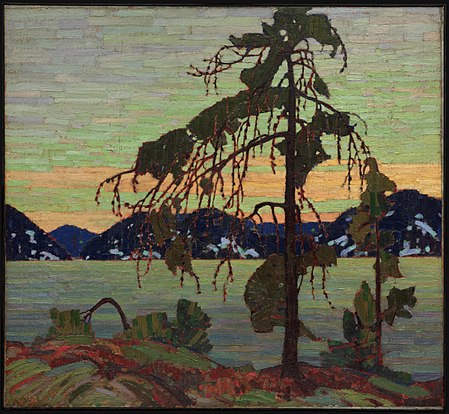
Sitting on the porch at Tara Manor, measuring the evening shadows as they lengthen and thicken, I study the jack pine’s wild, extravagant growth, the way it reaches out to reject the commonplace of ‘tree’, as Milton Acorn rejected the commonplace of ‘poet’. The jack pine grows in radical disorder, sprouting here, there, anywhere the sea wind blows and its capricious nature dictates. Each limb of the jack pine bears a thin layer of salt, borne in from Passamaquoddy Bay by thin fingers of air that sow salt on branches and needles. Broken branches, untidy crows’ nests limb-tangled like grim, bedraggled hair sprout out from on high. Lower down the tree extends a branch, held out towards me like a helping hand. Charcoal shadows fill in the gaps between darkening trees. Shy deer emerge, step by cautious step, drifting their sylvan ghosts, delicate, across footpath and lawn. Wrapped in a scarf of peace, I forget the city’s hustle and bustle. Stars poke peepholes in the dark. I try to name each constellation, as it traces its new-to-me path across the indifferent evening sky. I look around: more jack pines, no two the same. How could they be? There’ll never be another poet like Milton, another book like his Jack Pine Sonnets, no tale like his own tale told in his own inimitable way.
I did the memory test today. It’s hard to believe that tomorrow I may not know where I am nor what is the day. Others have passed this way, none to my knowledge in my family. Sorrow gnaws the red bone of my heart. The lady at the doctor’s counter says she is seventy. Her bed-ridden mother, for whom she seeks medicinal solace is ninety-eight. Her mind, she says, is as sharp as a needle or a knife, or a blade of grass. What dreams, I wonder, flit through her head at night? Does she recall her child hood with its pigtails, the first young man she kissed, church on Sundays, the genders carefully segregated, driving there in the family horse and cart? Thunder rolls and shakes my world’s foundations; a storm watch, followed by storm warnings, walks across my tv screen. Lightning flashes. Aurora Borealis daubs the night sky north of Island View with its paint-box palette of light. Memories, according to the song, are they made of this. But what is this? Is it these shape-shifting, heart-stopping curtains of shimmering grace? Or is it those darker shadows cast by firelight on the smoky walls of a pre-historic Gower cave where my ancestors gnawed the half-cooked bones of the aurox and never ever dreamed of Jung’s racial memories as they communicate information from the unconscious to the conscious mind.
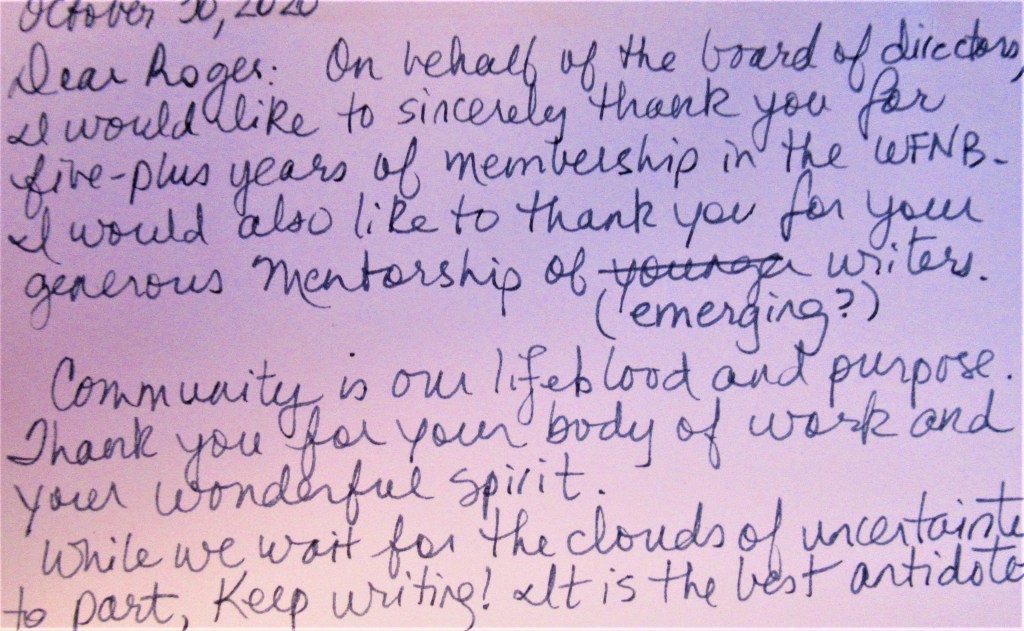
I have been a member of the Writers’ Foundation of New Brunswick for a long, long time. I am not a ‘founding member’, but I think I have been a member since around 1985, and I am sure I was a member in 1986, when Goose Lane Editions, Fredericton, published my second poetry collection, Broken Ghosts. I was most certainly a member in 1989 when my still-unpublished poetry manuscript Still Lives placed first in the Alfred G. Bailey poetry competition.
In the years between 1985-1986-1989 and 2020, I have never received a hand-written communication from any member of the WFNB Board, other than an official communication of one kind or another. Imagine, then, my surprise, when the above postcard, inserted in a hand-addressed envelope, arrived in my mail box yesterday. I was truly amazed and very grateful to the president who wrote these kind words to me. Amidst the panic and the pandemic, it is so nice to be remembered and in such a thoughtful way. Madam President: thank you so much for reaching out to me with this verbal gesture. And yes, you can count on my support for yourself and our Writers’ Federation, I hope for a long, long time to come.
I was in two minds whether to post this or not. However, I wish to emphasize several things: the importance of reaching out, the importance of continuing to believe in ourselves and our creative talents during these difficult times, the necessity of creating alternate communities and of supporting each other as much as possible, the need to avoid total isolation and to maintain human contact in different ways when the physical things — meeting, touching, holding, direct dialog — and the normal activities and relationships of healthy human beings are denied to us, and last, but by no means least, the need to encourage each other and to offer comfort and recognition whenever and wherever possible.
Seize the day. Squeeze this moment tight. Nothing before means anything. Everything afterwards is merely hope and dream.
A tiny child, you chased wind-blown leaves trying to catch them before they hit the ground Elf parachutes you called them and trod with care so as not to crush the fallen elves as they lay leaf-bound.
I stand here now, a scarecrow scarred with age, arms held out, palms up, in the hope that a leaf will descend, a fallen sparrow, and rest in my hand.
When one perches on my shoulder and another graces my gray hair, my old heart pumps with joy.
Comment:Autumn in the Garden was framed by Geoff Slater who gifted it to me this summer. Thank you Geoff. A double picture, it shows the flowers and the trees with that first touch of drifting snow. NB it snowed here in Island View early September this year while we still had flowers and leaves. The poem, Carpe Diem, is from a series of quasi-sonnets. Quasi, because they rarely have 14 lines! Oh Petrarch: shake in your shoes.
No Exit a line painting by Geoff for Andrea Slater
Where is the entry point, where the exit? This labyrinth of lines, straight, not circular, baffle the eye, confuse with a negative space that lightens colors and begs more darkness.
Mystery surrounds the sitter’s form: the board walk, no Dutch kitchen this, the chair on which she sits, the locket she wears, the landscape, seascape against which she is framed. White noise, perhaps,
but noise that turns to a single voice, a single line, that of the paint-brush tip-toeing, delicate its thread through interior, exterior meaning, just beyond
the viewer’s grasp. Yet walking past, each person stops, stands still, as the painting draws them in, ties them up, binds them with an ineffable thread, stronger than words,
mightier than the eye that traces its way along paths that deceive, disturb, throw us from the high-wire created by an artist who turns circular colors into linear space.
Comment:No Exit forms a part of my manuscript collection The Nature of Art and the Art of Nature that placed second in the WFNB’s Alfred G. Bailey Award (2020). This collection will soon be made available online at Amazon / KDP.
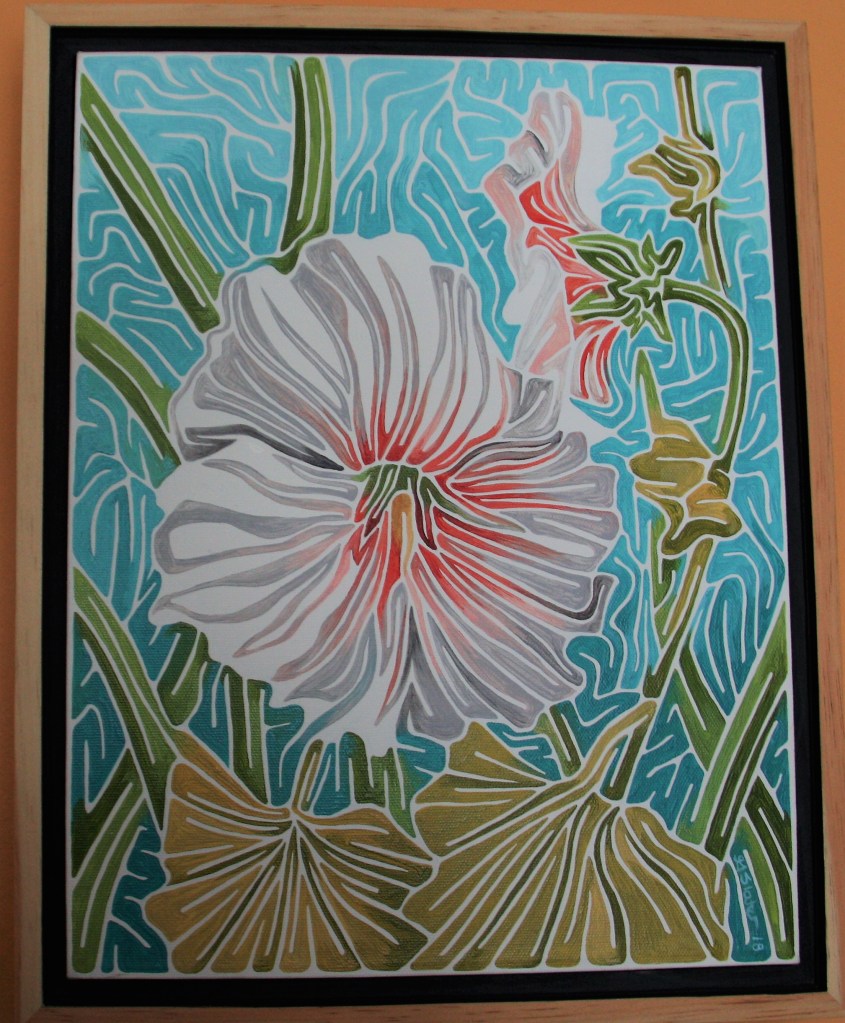
Geoff Slater the inventor of line-painting, gifted me this painting, one of my hollyhocks about two years ago. This is indeed a gift that keeps on giving.






 rogermoorepoet