I woke up yesterday morning to find frost on the ground and a white layer over the green, green grass of home.
The sun rose, and emerald patches shone through while the frost stayed layered, icing on the lawn’s Thanksgiving cake.
Occasional leaves lay a scattered orange carpet. White threads seemed to move as the breeze blew, shadows shifted, and the sun warmed my world.
Then I saw them, the ghosts of summer’s butterflies, long gone the live ones, but their spirits drifting over the grass gifting me with warm, sunny memories to contrast with that first fall frost.
“The only difference between a madman and me is that I am not mad,” Salvador Dali. It is a great honor to borrow his words and to be able to make the same declaration: the only difference between a madman and me is that I am not mad.
Mikhail Bakhtin: carnival, the world turned upside down, the world going bananas and those bananas dancing, as you can see in the painting above. It is a mad moment frozen in the still time of paint. And why shouldn’t bananas dance? Some one out there will remember Thunder Bay, 1981: ‘you just have to go bananas’ and the bananas duly appeared at half time instead of the oranges. Saint John, 1985: same thing.
And now the dancing bananas have emerged once more to fill your minds with pleasure and your hearts with joy. Go, bananas, go. Bananas-a-go-go. Way to go, bananas. And I tell you, given the current state of society, going bananas is the only way to go. So, in the next election, I shall form the Banana Party and we can all stand firmly, shoulder to shoulder and shout “Oh, Mighty Banana!” and “Go, Bananas!”
Ah yes, and my next painting? Maybe it will be Banana Custard or Banana Splits, not that I have ever done the splits!
So, the writing is back. I have reformatted The Nature of Art and the Art of Nature and am now checking it through one last time before I send it to the publishers. This feels good. I haven’t stopped painting though. Luckily the original, hanging on the wall, looks better than the photo. My angles are all wrong and the colours are definitely not as sharp as in the original. As I always said, when introducing Spanish Art via slides and photos: “Do not trust the imitations. Go back to the original.” Easier said than done, especially when the original may be tucked away in a foreign museum hidden in a small town. As Dylan Thomas once said of Swansea Museum: “it’s the sort of museum that ought to be in a museum.”
As for the Introduction of Art, and please note I do not write ‘the teaching of art’, here’s my article on my career as an art facilitator! ‘In the beginning was the picture and the picture was in the book.’ I guess my art career ran parallel to my career as a facilitator of Spanish literature, prose, theatre, and poetry. Some things you can present and introduce. But no, you cannot teach them, not unless you are completely without humility and understanding.
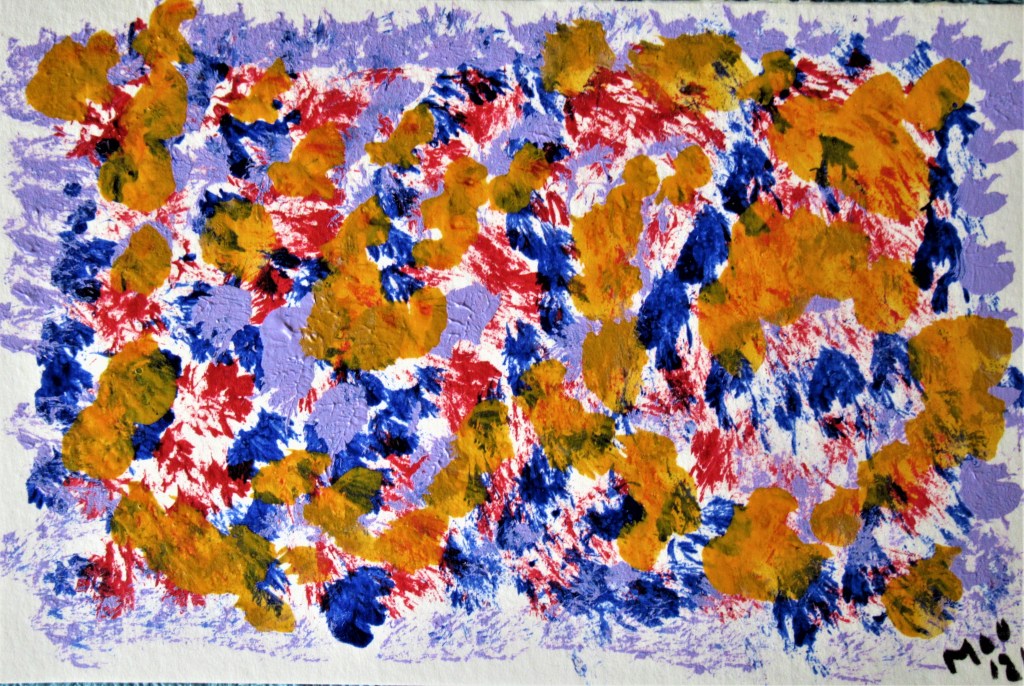
This is a painting inspired by one of Messiaen’s works: Visions from Beyond. His music inspired me to write the Meditations on Messiaen, and I have posted several of those poems on this page. For me, creativity is continuous: verbal and visual. The visual includes painting and photography, the verbal, short stories, poems, and short philosophical pieces on life and art. This is the link to the first poem from the sequence entitled Visions from Beyond. I should add that the audio reading is part of what I call creativity too: audio, visual, verbal. The complete package.
My Thursday thought: I feel that I have been blessed. To be able to see, speak, write, hear, and express some of the beauty of this world around me. I know there is ugliness out there, sickness, ill health, poverty and despair. So far, I have been spared. “Why me?” I think to myself, “Why me?” Then I cease to question and I just say “Thank you” to the Spiritus Mundi and to the Muse when she descends.
Every morning, when I wake, my mind runs through some of the hymns I used to sing as a child. “Songs of praises, I will ever give to Thee.” “Laud, bless, and praise Him all thy days, for it is seemly so to do.” “Good Shepherd may I sing Thy praise, within Thy house forever.” Meanwhile, until that time comes, I will do my best to celebrate and sing the beauties of this world in the oh-so-limited ways I know best, poetry and paint!
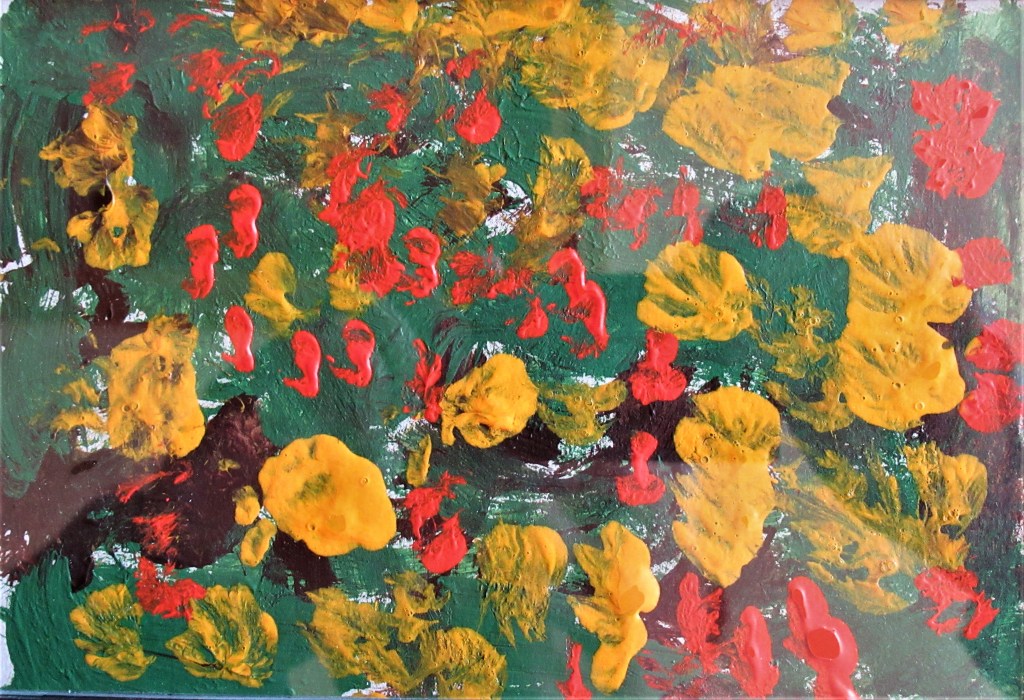
One of my good friends always greets me with the following phrase: “Still on the green side of the grass, then”. So, here’s my painting: Stay on the Green Side. Much better than the other side, from all that I am told by my more down-to-earth companions. I will not intrude upon the thoughts of some of my other friends, nor expose their beliefs. I’ll paint for them another day.
So, while you can, and while you may, Stay on the Green Side, my friends. Wake up each morning, smell the coffee, and gather ye rosebuds while ye may!
There is so much happening. It’s hard to keep track of it all. Reading and annotating the material I am working on for my online writing seminar. Painting: a delightful relief and relaxation. Who cares if I can’t paint? I can make meaning out of shape and color, like my friend Matisse. Writing: the poetry is back and I will start revising those short stories again soon. I may also go back to my first novel. I have abandoned it for too long.
Meanwhile, each dawn is a busy dizzy time. This morning I decided to lie in bed until 24 birds had flown past my new bedroom window, one for each new pane of glass. It took about fifteen minutes. I watched the mist rise and then the sun start to break through and when the sun came, so did the birds. Dizzy Dawn is now hanging on the wall, along with another set of paintings I have finished recently.
Life is good. I hope it stays that way for as long as possible.
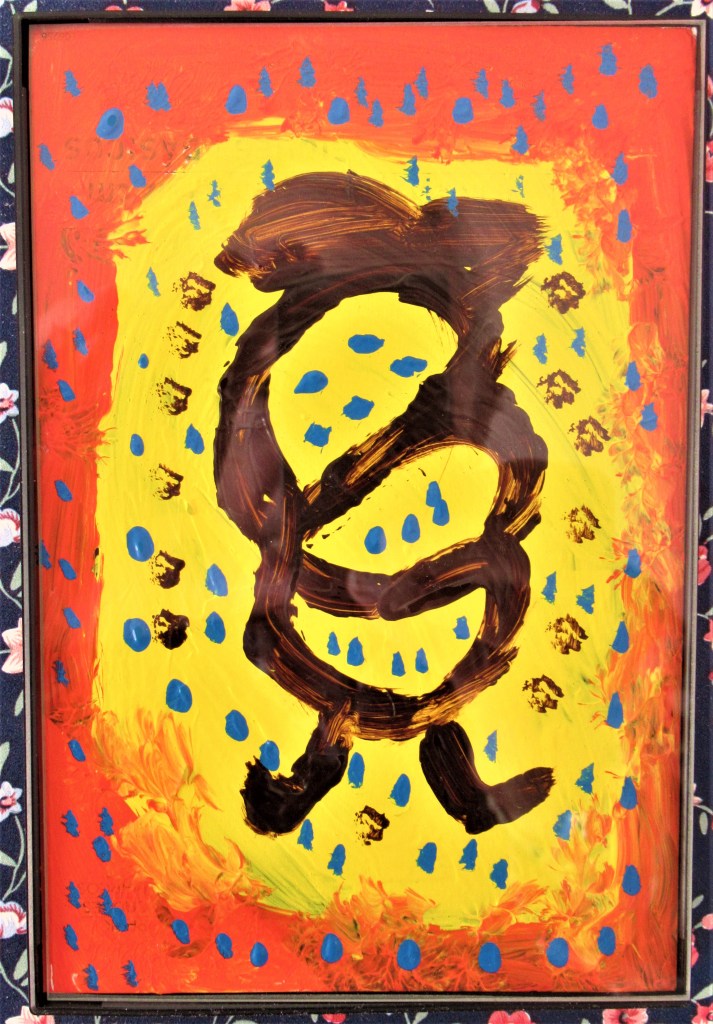
The Octo-Plus has eaten up all my words and the stream has run dry. When the words don’t flow, I let the paint flow instead. Sometimes it works and sometimes it doesn’t. That might actually be a self-portrait, lurking in the bottom left corner of the painting’s glass. Ah, the ghost, not in the machine, but in the painting. It’s a hard life, being a writer when the words dry up.
I remember the old school’s terms of abuse “Oh, dry up!” Well, 70 years later, I have done just that. Mind you, it’s only for a day or two, and look, miracle of miracles, I am writing again. Leave the keyboard, take up your pen. The words are flowing and you’re writing again.
Meditations on Messiaen Quartet for the End of Time
6
Crystal Liturgy
Here, in the abyss, where song-birds pluck their notes and send them, feather-light, floating through the air, here there are no tears, no fear of shadow-hawks, for all blackness is abandoned in the interests of sunlight and song.
Here, the crystal liturgy surges, upwards from the rejoicing heart, ever upwards, into the realms of light, where color and sound alike brim over with the joy that, yes, brings tears of release to head and heart.
Here, the seven trumpets will sound their furious dance that will announce the end of this singer, the end of time, but not the end of song itself.
Here, seven-stringed rainbows reign. Here, the harp is tuned and plucked. Here, the everlasting music cements the foundations of earth and sky. Here, the master musician conducts his eternal choir, their voices rising, higher and higher, until they reach the highest sphere, and song and voice inspire, then expire, passing from our eyes and ears into the realms of everlasting light.
Art has almost always told a story, even though, as in the case of the Cave Paintings in Altamira, Puente Viesgo, Lascaux, and elsewhere, we may not know exactly what that story is. On the other hand, many of the great paintings of the Spanish Golden Age (1525-1680) have a hidden narrative that we can often work out. Take, for example, Vulcan’s Forge (1630), painted by Diego Velázquez after his first trip to Italy (1629). On the surface, this is a painting of a typical Spanish Forge of the seventeenth century. Ordinary workmen labour away at their daily tasks, but, and there is always a but, the figure on the left is adorned with a god-like halo. Why? Because he is the bearer of a message. Vulcan’s wife, Venus, has been having an affair with Mars, the god of war. Vulcan has forged a net of fine, golden chains and placed it over the bed where they will loiter. Now, Mars and Venus are trapped in that net, caught in the act, so to speak. No wonder the mouths of Vulcan’s helpers are open in wonderment.
Bisonte Parado: Cenicero de Altamira.
Before the arrival of photography, painting was the only way to record the world, to make a picture of what was happening, to tell a story in paint. That is why a picture is worth a thousand words. I have retold the narrative of the painting of Vulcan’s Forge in 128 words. There is, of course, a great deal more to tell about his and other paintings and how they represent the artist’s narrative reality. The advent of photography changed the artist’s vision of the world. As photography developed and became quicker, faster, and offered what some might consider to be a more accurate version of reality, so artists rethought their role. Was it to capture, in paint, the world as they saw it, with a single visual entry point, and a constant perspective? Or was it to catch the way light fell upon objects (Monet), or to offer multiple entry points (Braque), or to paint the turmoil of the inner mind (Picasso, Miró, Pollock)? Artists could do such things. Until recently, with the advent of the computer, it was much more difficult for the camera to do so. The camera recorded, but artists created and re-created their own narratives of the world around and inside them. Now we can enter photoshop and the equivalent and play around with out own photos of reality, distorting them and twisting them as we please.
Verbal to Visual to Verbal
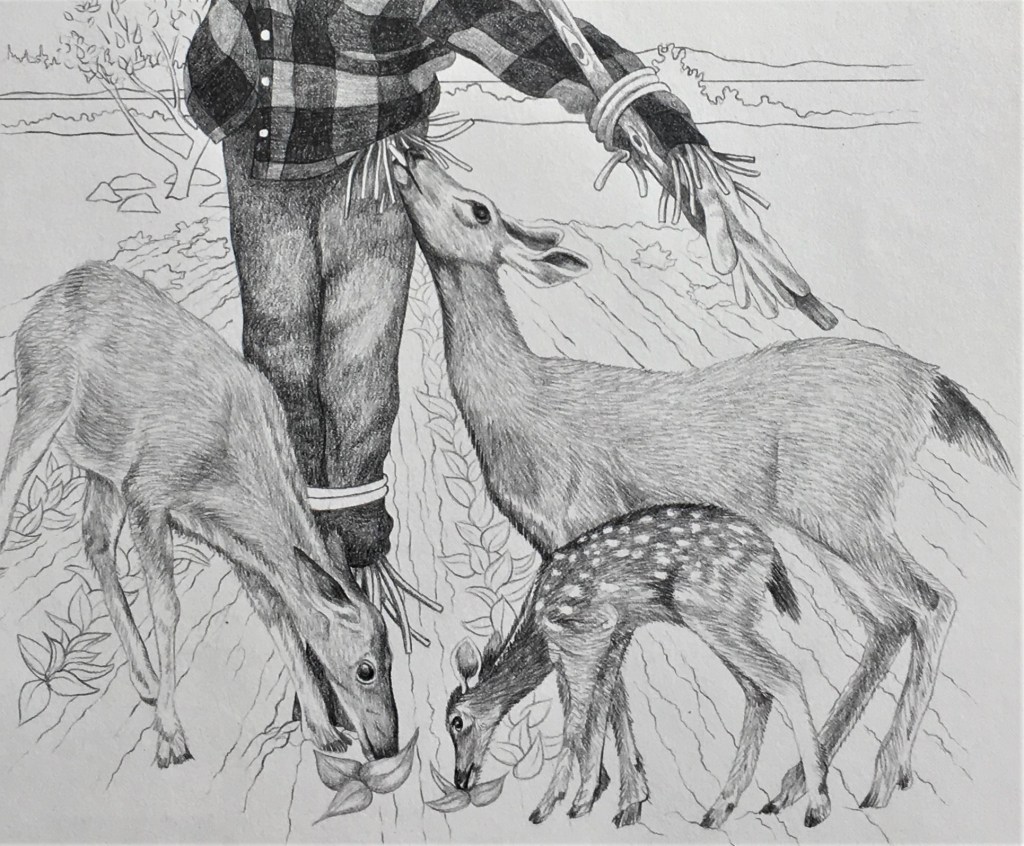
Which came first, the chicken or the egg, the verbal or the visual? Or was there a sort of spontaneous combustion? In the case of Scarecrow, the artistic collaboration between myself, the author, and Geoff Slater, the artist, the words came first: “In the beginning was the word.” He heard me reading my story, started to sketch the characters, and within six months we had produced an illustrated book.
Wonderful drawings. Thank you, Geoff.
Words and narrative first, then an artist’s rendition of key moments in the narrative. However, in the case of Twelve Days of Cat, our second artistic collaboration, Geoff sent me 12 drawings of a cat and I looked at them and worked out a narrative that would join them together in a symbiotic relationship. Scarecrow is an illustrated narrative in prose. Twelve Days of Cat is a narrative in poetry based on what was once an independent series of charcoal sketches. Who cares which came first, verbal of visual, when the results are so pleasing to ear and eye.







 rogermoorepoet