Deer, oh dear!

Deer, oh dear!


Deer

sitting here watching the deer
wandering through the garden
five six seven ten
never seen so many
twelve fifteen
a caravan
a convoy
one behind the other
walking in their footsteps
following on
so silent
then
ears pricked
turning watching listening
existential
here long before us
forever following old trails
knowing each change
each new direction
a connection
between us
and how it had been
for thousands of years
before we came here
to disturb them

Click to hear Roger’s reading on Anchor.

Goodbye

Goodbye

It is never easy to say Goodbye. Some goodbyes are easier than others. Some are indeed difficult. “In my end is my beginning and my beginning is in my end.” Conscious goodbyes are one thing. We say farewell knowing we will never be back that we will never see each other again. These are the hard ones.

I stood in the bar of El Rincon, in Avila, at 6:00 am, waiting for the taxi that would take me to Madrid and away for the last time. I was planning to return the following year and then it hit me – this was indeed my last goodbye and I would never return to that place. A tidal wave of emotion swept over me and I felt a deep, earthy sorrow – the sorrow of permanent loss.

It was matched on two other occasions. The first occurred when I drove to the sea shore of my childhood in Wales, with my mother’s ashes in the back seat and strict instructions on how and where to scatter them. Walking away was one of the most difficult things I ever did. Even more difficult was leaving my father, a widower now, in his bed, and saying that goodbye. It was not the final goodbye, but I knew I would never see him again, in that house, under those circumstances.

I cried in the taxi, all the way to the railway station. Great, heart-rending sobs that tore me apart, body and soul. The spill over from my nostrils reached the floor of the cab, a long, thick spider-thread of deep-seated despair, because I knew my life had changed forever, and the support on which I had always counted would no longer be there.

People and pets – both are difficult. Holding the paw of a beloved cat, while the vet slips the needle in, and the companion of ten, fifteen years, drifts quietly to sleep. Or watching a faithful dog, slipping slowly downhill, and knowing that someday, soon, the decision must be made, the dark deed done. The knowledge that one relieves suffering and brings an easy release does not decrease the heartfelt pain of that last goodbye.

I used to visit the Sappers Club in Toronto. In the basement of that establishment I discovered a wealth of photographs from WWI. The old men would lead me downstairs and, through thick salt tears, explain what each photo meant to them. Round about midnight, a group of them would stand before a photo called Goodbye Old Friend. It depicted a shell-shocked, broken horse, with a pistol held to its head. The men, they explained, had volunteered for war, and knew all about its suffering. The animals were innocent, and knew not the reason why. Ah, ending the sufferings of the innocent, human or beast, that is, perhaps, the saddest farewell, for some, but not for others.

We each will hold a private moment within our own hands and minds. To share or not to share – that is the question, for each of us – poor creatures, as Dylan Thomas says, born to die.

Movement

Movement

Incoming tide, a sparkling sea,
waves dancing beneath the sun,
white-maned ponies prancing.

Summer light changing as a cloud
moves its shadow over meadows
where cows graze, their advance slow,
gentle their movements, browsing.

Autumn wind, the dry leaves
casting a red-gold rainfall
over the lawn, shuffling along,
in time to the whispered wind song.

Silent, the deer, soundless as they move
through the trees at garden’s foot,
walking the tight-rope edge
dainty, between kempt, and wild.

Click for Roger’s reading on Anchor.
Movement

Cats and Dogs

Cats and Dogs

I remember my mother and father fighting “like cats and dogs” as my grandparents used to say. Now, my grandparents had a cat. It was black and white and striped like a zebra. They called it Spot. My parents had a dog. It was an English Cocker Spaniel, gold in color, and off-spring to a famous sire. They called it  Wimpy but it was by no means a wimp and fought with everything in sight, especially the cat.

So when my father and mother fought and the family cat and dog fought, I thought, quite reasonably in my opinion, that dogs (with their short hair) were male and cats (with their long hair) were female, and that was the reason why they fought like cats and dogs. And “never the twain shall meet” as my grandparents used to say about my mother and father and the cat and the dog. I guess it was too early to learn about the birds and the bees when, young and all too innocent, I was learning about the cats and the dogs.

And of course it’s only natural that the twain should meet. My mother and my father, the cat and the dog, had to meet somewhere, didn’t they? How else would I be here? We weren’t the sort of family that practiced contraception by throwing stones at the storks to keep the babies away. But I could never work out why the cat always had female kittens while the dog had all-male off-spring. That was a bit too much for me, and nobody ever explained anything in those days.

And look, in spite of the differences between them, even cats and dogs can sometimes live together in peace. And opposites can and do attract, don’t they?

Spirit of Boo

Spirit of Boo

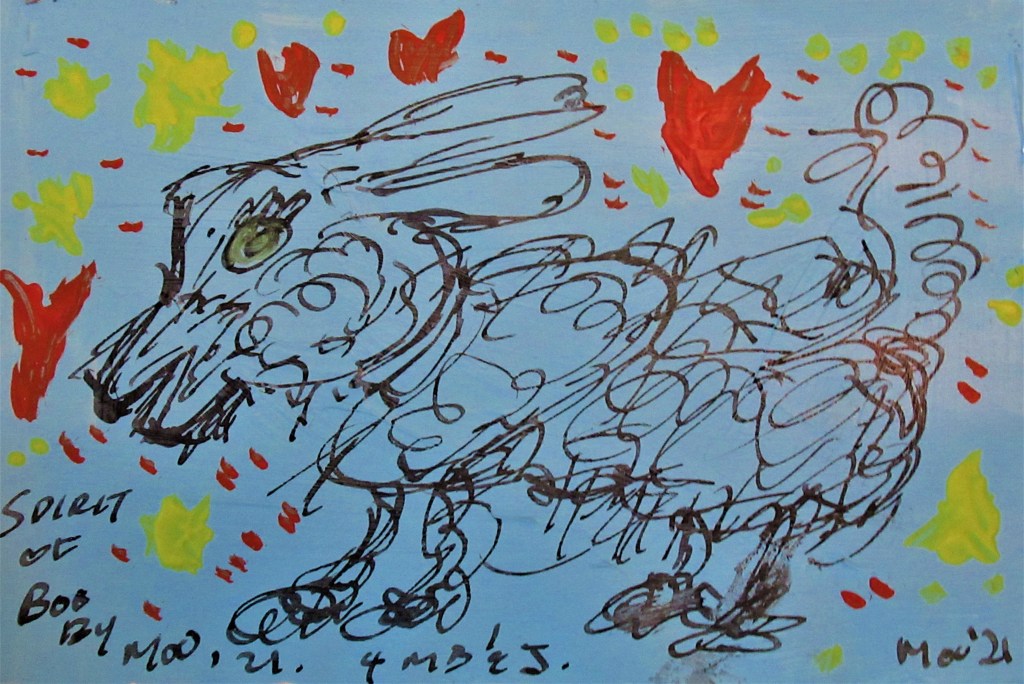
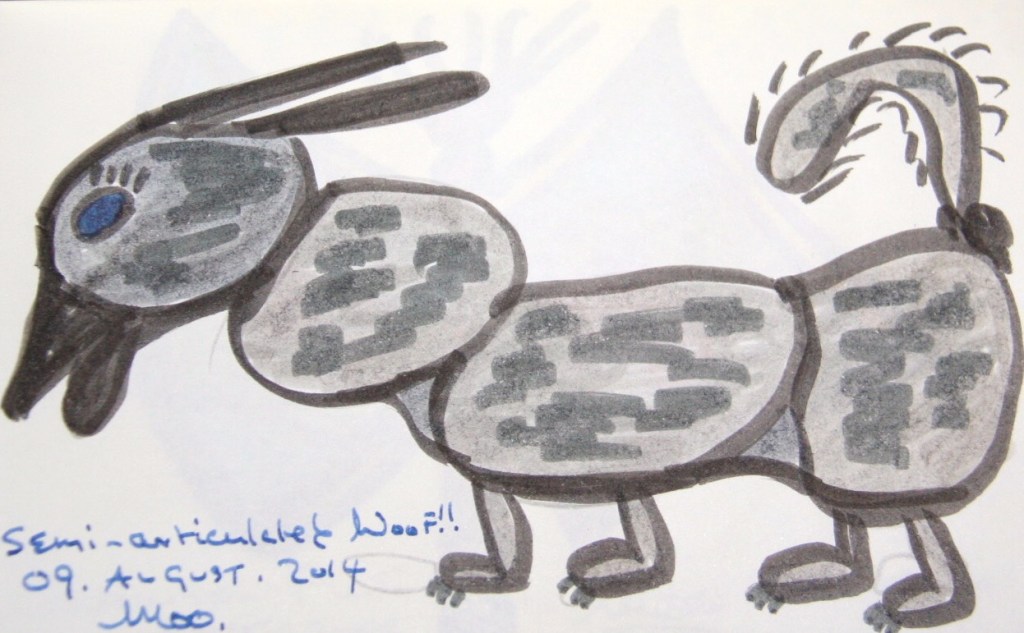
So, I can’t draw dogs, nor people, nor reality. But I can draw spirits, and moods, and emotions. This is NOT my neighbors’ dog. It is the spirit of their dog: energy, joy, happiness, and total and complete love. What more could a doggy want or an artist, however useless, do.

Boo: I salute you.
Woof!

Original drawing, dated 9 August 2014, can be found in my drawing notebook of that year. I used it as a model for the painting, was completed on Tuesday, 30 November 2021.

Welcome Guests

Welcome Guests

They arrived last night, late.
Bright moonlight. Soft silence.
I neither heard nor saw them.

I awoke to moonlight on snow.
Shimmering stars. Orion
proud among prancing planets
sparkling in frosted air.

I looked out. Nothing there.
White wilderness of snow,
unmarked, but shadowed.

Dawn. An anxious child
on Christmas Day, I peeped
under the tree, and yes,
I cried out, “He’s been.”
I remember brightly
wrapped packets of gifts.

Today’s gifts: hoof prints
emerging from dark woods,
circling beneath the ash tree,
leading to the bird feeders,
and back into empty woods.

“Yes!” I said aloud. “At Last.”
And joy filled my heart.

Click on this link to hear Roger’s reading.
Welcome Guests

Comment:

Reading the poem aloud, I changed some of the word order to the rhythm of my speaking voice. It’s reading before an audience and hearing their reaction that tells me when a poem is right or needs retouching. Alas, those live readings are gone for now. Anchor, Spotify, Facebook, Twitter, and this blog are good, but not quite the same. But, for a rhythm and voice poet, who loves live readings and welcomes a live audience, they are better than that midnight silence under dark trees.

Normality

Normality

In spite of grey skies,
blueish snow and early-
morning, under-cloud-
light combine to color
my garden several shifting
shades of blue-grey.

Light grows and the garden
starts to whiten. No deer as yet,
but they aren’t far away.

Two big ginger cats,
I think at first they are foxes,
stalk their marmalade path
through the trees towards the road.
I have never seen them
before. New neighbors?

One crosses the road
but the other hesitates, then flees,
as flashing school-bus lights
bring normality back to my early
-morning dream-filled world.

Click on this link for Roger’s reading.
Normality

First Snow

First Snow

Fell softly, quietly, soundless, in the night.
I knew it was there. A lightness in the air,
a subtle change in the quality of light.
Now everything has changed: yesterday’s bare
trees wear their winter dresses, frilly tresses
garnished with garlands of snow.

The deer will arrive, sooner or later.
They always do. They troop from right
to left, west to east, as day turns to night,
then troop back, east to west, in morning light.
They step dark and diligent, flitting shadows
beneath snowy trees, one after another,
forging a single passage from yard to road,
crossing it, then vanishing into dark woods.

I saw them one night in a midnight dream.
They stood on their hindlegs underneath
the mountain ash and danced, so delicate,
reaching up with long, black tongues,
to steal bright berries from lower branches.
They danced in a full moon’s spotlight
and filled my heart with joy and pain.
How I long to see them dance again.

Click on this link for Roger’s reading.
First Snow

Lolly Lady

Lolly Lady

I guess if she were a boy she’d be a Lolly Laddy, or a Loblolly Laddy, depending on the circumstances. Did this one at 4:00 am when I was non compus mentis, whatever that means at that time of the morning. Just trying to keep from falling downstairs, I guess. I love the colors: violet for tranquility, red for strength and energy, yellow for clarity, and blue for feeling blue at that time of the morning.

I suppose, if I were Rimbaud, I would be able to write letters instead of colors. Alas, now I no longer know where to hang these things: I am running out of wall space. And frames. And nails. “A nail, a nail, my kingdom for a nail”… Richard III aka the Hunchback of Loblolly Alley. Mind you, I think his nail was detached from the shoe that fell from his horse. “To lose one horse is a tragedy. To lose two is careless.” Oscar Wilde on parenting.

I love the sparkles though. We have several sparklers and we keep them for the sad times when the world needs brightening, as it does all too often nowadays. The seasons roll on. The year is trickling by. I have decided to sleep under my duvet. It is certainly warm under there and the Teddy Bears really appreciate it. They want to hibernate, but I refuse to let them. If I let them hibernate the cat will be up on the bed, and we can’t have that, can we? Not me, and definitely not the bears. And here’s why not: Teddies or Cats? Click and you’ll find the answer. Or maybe you won’t. So try clicking here: Teddy Bears FFS. Oh dear, I think there’s a typo there: a Teddy Bear Typo. Never mind. I am sure you won’t mind.

I wouldn’t go down to the woods today, if I were you. And I think you know why! You shouldn’t go alone, either. But if you venture out, think twice about taking your teddies. They might run away to join the picnic and leave you all alone with the Night Bumps, the acorn throwers, the wild folk, and the Wood Chuck wood-chuckers.

The Art of Narrative

The Art of Narrative

            Art has almost always told a story, even though, as in the case of the Cave Paintings in Altamira, Puente Viesgo, Lascaux, and elsewhere, we may not know exactly what that story is. On the other hand, many of the great paintings of the Spanish Golden Age (1525-1680) have a hidden narrative that we can often work out. Take, for example, Vulcan’s Forge (1630), painted by Diego Velázquez after his first trip to Italy (1629). On the surface, this is a painting of a typical Spanish Forge of the seventeenth century. Ordinary workmen labour away at their daily tasks, but, and there is always a but, the figure on the left is adorned with a god-like halo. Why? Because he is the bearer of a message. Vulcan’s wife, Venus, has been having an affair with Mars, the god of war. Vulcan has forged a net of fine, golden chains and placed it over the bed where they will loiter. Now, Mars and Venus are trapped in that net, caught in the act, so to speak. No wonder the mouths of Vulcan’s helpers are open in wonderment.

Bisonte Parado: Cenicero de Altamira.

            Before the arrival of photography, painting was the only way to record the world, to make a picture of what was happening, to tell a story in paint. That is why a picture is worth a thousand words. I have retold the narrative of the painting of Vulcan’s Forge in 128 words. There is, of course, a great deal more to tell about his and other paintings and how they represent the artist’s narrative reality. The advent of photography changed the artist’s vision of the world. As photography developed and became quicker, faster, and offered what some might consider to be a more accurate version of reality, so artists rethought their role. Was it to capture, in paint, the world as they saw it, with a single visual entry point, and a constant perspective? Or was it to catch the way light fell upon objects (Monet), or to offer multiple entry points (Braque), or to paint the turmoil of the inner mind (Picasso, Miró, Pollock)? Artists could do such things. Until recently, with the advent of the computer, it was much more difficult for the camera to do so. The camera recorded, but artists created and re-created their own narratives of the world around and inside them. Now we can enter photoshop and the equivalent and play around with out own photos of reality, distorting them and twisting them as we please.

Verbal to Visual to Verbal

            Which came first, the chicken or the egg, the verbal or the visual? Or was there a sort of spontaneous combustion? In the case of Scarecrow, the artistic collaboration between myself, the author, and Geoff Slater, the artist, the words came first: “In the beginning was the word.” He heard me reading my story, started to sketch the characters, and within six months we had produced an illustrated book.

Wonderful drawings. Thank you, Geoff.

Words and narrative first, then an artist’s rendition of key moments in the narrative. However, in the case of Twelve Days of Cat, our second artistic collaboration, Geoff sent me 12 drawings of a cat and I looked at them and worked out a narrative that would join them together in a symbiotic relationship. Scarecrow is an illustrated narrative in prose. Twelve Days of Cat is a narrative in poetry based on what was once an independent series of charcoal sketches. Who cares which came first, verbal of visual, when the results are so pleasing to ear and eye.