Settling Accounts

Empress 314


Settling Accounts

How did I earn my money? Let me count the ways.
Of madmen, priests and preachers, I sang the praise,
sinners all who tried to change my ways
by grooming me in all their awful styles
to share the sadistic rhythms of their wiles.

Then there were bosses, CEOs, and chief execs,
whose aim in life was troubling their employees,
the men for unpaid work, the women for sex,
and while we slaved, they lived a life of ease.

Senior teachers, department heads, and deans
reduced all genius to counting and recounting beans.
Those bean counters checking up on us, every hour,
flexing their muscles, overwhelming us with power.

Sometimes, at night, my nightmares fill with screams
as their abuse and privilege shake me from my dreams,
my dreams of freedom, sharing, caring, love, and joy,
all the small things I’d taken for granted when a boy.

In a twisted, corkscrew world we all must live
where the richest rob the poorest who work and give.
And even more shall be given to those who hold
while those who have-not labor and are sold.

A sad world this, but some things remain with me:
my power to dream, to create a legacy,
to mold still willing people with my voice,
to gift them beauty, thought, and power of choice.

Oh dreamers, join with me and sing, be it high or low,
but don’t forget your dreams, don’t ever let them go.

Comment: I went to pick up groceries today and sat in line, waiting in the car, rear hatch open, for 30 minutes. Unwilling to waste my time, I decided to write a poem. Oh dear: I had left my note book at home. I rummaged around the car and found a redemption slip from two years ago and a bank slip from last year. I wrote two poems, one on each of them, each poem thematically linked to the slip of paper it was written on. This is the bank slip poem. I’d say “Enjoy” except that this is what the waiter / waitress says each time s/he places a particularly unpalatable meal before me. Luckily this cannot happen anymore and I am eating delightfully well at home, thank you. I am not a Cordon Bleu Chef by any means, but I am a good one, having learned at my Welsh Grandmother’s knee when I was a tiny tot. Supper tonight: salmon and leek and potatoes! Cost: about $5. It would have cost fifty in a restaurant and it would have been half as good. So count your blessings: cooking and creativity are two of mine and yes, every time I look at what I have and see what so many others are missing … I break my heart.


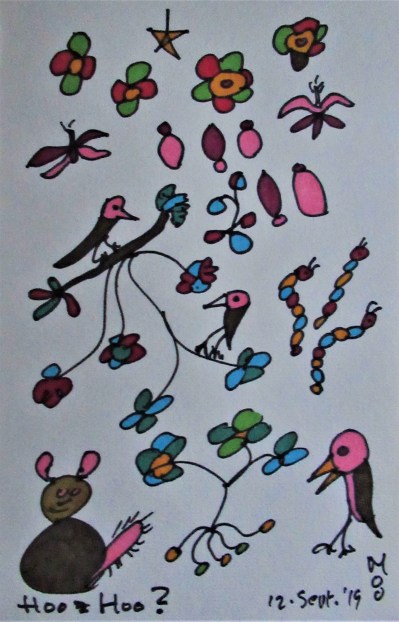
img_0003

Hope

image1-1

Hope

Faith, hope, and charity
help us see with much more clarity.

We have faith in a vaccine cure,
though when it will happen,
we can’t be sure.

Charity comes from the rank and file
serving in supermarkets with a smile,
doctors and nurses work the day round.
On night shifts too, they can be found.

The garbage men, patrolling the street,
keeping homes and gardens neat,
tidy, clean and rubbish free,
helping to restore our sanity.

Police and army play their part
keeping us six feet apart,
doing the work we cannot do,
helping all not just the few.

Essential people, women and men,
bringing life back to normal again.

Comment: Many thanks to line painter Geoff Slater for this wonderful drawing from Scarecrow, one of my favorites. Scarecrow is a joint production between Geoff and I, with his drawings illustrating my story. This is the moment when Scarecrow dares to dream and hope that he will soon find and dance with his own beloved. Even in this current world of stress and sorrow, we are still allowed to have our hopes and dreams. Dream on my friends. Hope on. Hopefully this nightmare will soon be over.

Earth Bounty

IMG_1238 (2)

Earth Bounty
by
Victor Hendricken

 The paradox of life: in order to survive, we must consume; by consuming, we create waste; however, we do not see our waste as detritus, but as the product of living. 

Deep beneath earth’s surface, a miner drills a one and one-quarter inch hole eight to twelve feet deep into a rock face that is roughly twelve feet square. The miner repeats his task until the rock face resembles a block of Swiss cheese. Each hole is stuffed with explosive material. Then a blasting cap shaped like a metal matchhead, containing a fuse and trailing a wire pair sheathed in plastic, is gingerly inserted into each hole, buried up to twelve inches inside the explosive.

The miner and his partner (miners always work in pairs) connect the wires from each cap to a common grounded wire. The pair retreats to a safe area stringing out the grounded wire behind them, where they meet up with other pairs of miners waiting for permission from the mine captain to connect the trailing wires to an electrical junction box wired directly to a throw switch on surface. When all miners are assembled, they travel by hoist to daylight, where they hang their personal identification tags on the appropriate tag board confirming they are no longer in the deeps. The board is rechecked and the captain sirens a series of warning alarms and when certain that everyone is safe on surface closes the switch initiating the blast.  All drilled faces explode as one.

The miners hang their work clothes to dry, shower and change into street clothes. Some head home to family; some go to the bunkhouse kitchen; some seek out the comfort of a pub and the company of their workmates. No one is allowed to go underground again until the air is purged of dust and noxious gasses.

A miner drilling into rock containing copper in sulphide, oxide or elemental form is not thinking about copper pots for cooking, or copper wire for electrifying his house, or copper tubing to carry water from well to sink. He is fully engrossed in the task at hand: break the rock into manageable sized pieces and transport it from the deeps to the surface.  He is acutely aware of his dependence on number of feet advanced in the drift today, in the volume of ore bearing rock extracted from the stope.  He gives no thought to the growing piles of waste rock strewn about the nearby surface.

Out on the greenish grey ocean the fisher sets his traps. The location of each cage is identified by a floating coloured buoy.  The day is long and the sea rough.  In nearby locations, trawler lines and weighted nets are released to scavenge the ocean at various depths herding schools of many fish species to a common fate.  Some nets scrape the ocean floor to capture creatures succored there. Occasionally, fishers are forced to overnight on the ocean surface as their prey migrates below to nibble at the bait within the traps, to gather in large schools before the nets.

As each trap is hauled up, emptied and rebaited, the fisher is not thinking about lobster rolls. As he hauls in the bulging net and empties it into the ship’s hold, he is not thinking about blackened cod or fish cakes, sole adamantine or tender filet with baked potatoes and butter.  He is focused on hauling the catch from the deep ocean and filling the ship’s hold; delivering the dead and dying sea animals to the fish plant for processing into human and other food.  He does not count the discarded carcases of species that contaminate his daily catch.

The logger fells another tree, trims the branches and saws the tree into cordwood lengths. He inhales deeply while admiring his day’s work.  Chainsaw in hand, he does not think about houses or furniture.  He does not measure in board feet, nor does he envision dimensional lumber as he hews, stacks and hauls.  He focuses on cords piled, loads counted. Trees are objects to devour, not treasures to be taken.  He does not notice the acres of clear-cut whose topsoil will soon become prey to buffeting winds and torrential rain.

At the end of the day, perhaps on the empty street or in the local pub, the miner’s thoughts may wander to home, to sitting at his wooden table inside his wooden house, to eating a banquet of sautéed fish knowing only the supermarket as the meal’s origin.  At the end of the day, the fisher may walk the dark street from dock to home, peer down an alley dimly lit by doorways leading to cavernous public drinking places. He may wonder at the hidden resources protected by the alley, exposed by the alley. He will not wonder about the light’s source, the tungsten filament in the lamp, or the clinking glasses as he enters the pub.  At the end of the day, the logger will lay down his saw, turn in his axe, enter the pub from the street and take a seat near the alley door. He does not question the source of the fisherman’s platter he is served, nor does he think about the metal in the barroom tables and chairs, nor what goes into making a beer glass.  He marvels at the burnished wooden bar rail, harbours a fleeting image of his chainsaw.

When the three, the miner, the fisher and the logger, by happenstance meet, they do not tell secrets of their trade.  They speak instead of trivia and sports, avoid politics and talk of home. The angry metal teeth on the logger’s saw, the sharply honed edge of his axe, the height and girth of trees felled are no more in mind than the metal and wooden boat into which the fisher loads his catch, than the living, mineralized stope from which the miner draws his bonus.  Each protects his space as surely as a mother holds her child from nosy passers’ by.

Stories of mining pass only between miners; stories of fishing remain solely with fishers; stories of lumbering are wedged into spaces between lumberjacks.  No word is spoken of farmers plowing fields and harvesting crops.

And while we blithely drive our vehicles of iron, steel, copper and zinc, barbecue pink salmon and grey mackerel, slather slabs of butter on thick slices of homemade wheat bread, dance on decks of wood and nails and screws, the miner puts on his slickers and dons his hardhat and lamp; the fisher steps into his waterproof garb and rubber boots; and the logger twice ties his cork boots, sharpens his saw, and shoulders his axe.  The farmer quietly steps into his worn overalls, mounts his high-powered four-wheeled tractor and attacks worn out fields with plow and harrow.

Comment: This morning’s piece by my friend Victor. I publish it here with great pleasure. Victor has a sharp mind and an elegant pen. Hopefully, he will continue writing for me and, always with his permission, I will continue to publish his oeuvre.

Aliens

IMG_1663 (2).JPG

Aliens

“I’ve got photos,” I said.

“Fake,” they replied.
“Doctored in photo shop.”

“I’ve got witnesses.”

“Bribed,
and equally deluded.”

“I’ve got letters.”
‘Forged,
handwriting and words.”

“Look,” I pointed.
“They’re out there now.
Looking at you through the window,
dancing, changing color, waving.”

“I can’t see them,” one said.
The others all shook their heads.

And now, they’re going to take me away.
There’s nothing left to say.


Writers’ Block

IMG_0182

Writer’s Block
(For Kentucky Blue Angel)

This is a golden oldie that I am re-posting. Today, several people talked to me abut writers’ block. Here are my thoughts on the topic.

Every day, well, almost every day, I meet people who tell me that they cannot write anymore. They have abandoned their current project. They sit in their work space and stare at blank screens or empty walls. They have come face to face with the dreaded Writer’s Block.

While some consider Writer’s Block to be an actual illness, others flaunt it like a flag or a badge of honor:

“Don’t touch me — I’ve got Writer’s Block: I wouldn’t want you to catch it.”

“I’m having a bad week: I’ve got Writer’s Block.”

“Sorry, I can’t make the writer’s meeting, I’ve got Writer’s Block.”

According to Wikipedia, “Writer’s block is a condition, primarily associated with writing, in which an author loses the ability to produce new work or experiences a creative slowdown. The condition ranges in difficulty from coming up with original ideas to being unable to produce a work for years. Throughout history, writer’s block has been a documented problem.”

We have probably all experienced the sensation of being unable to write, unable to think, unable to continue. As an academic, I found that something similar happens frequently in examinations with young students whose minds suddenly go blank when faced by a white page and an awkward question. This form of Writer’s Block comes at the most unfortunate times. Students need to be switched on just when their minds switch off. And something similar happens to writers.

Examination Block can be overcome. In many cases careful preparation for an exam will reduce or eliminate examination block. These preparations may well include correct note-taking and relevant revision procedures. There should be no last minute all-night study the night before the exam and a good night’s sleep, proper food, and water are essentials. Appropriate physical exercises before the exam starts are also useful as these make the heart beat and the blood flow. All these things prepare both body and mind and free the student for that most important task: the struggle with the blank page and the awkward question.

Will a similar set of preparations work for those who suffer from Writer’s Block?

In order to answer this question, I would rather take a different approach. Instead of seeing Writer’s Block as a physical / mental presence that stops us writing, why not look at it as an absence that can be overcome? What can we call that absence? Personally, I look upon it as an absence of creativity. If the creativity isn’t there, then writing creatively won’t happen. So what do we do?

Let us define creativity. For me, creativity is the expression of the creative principle that dwells within all of us. It is there, within us. We may suppress it or we may let it be suppressed. We may ignore it or we may deny it: but it is still there. It is always there. Sometimes it is beaten out of us; or we think it is. But it is still there, beneath the surface, waiting to be called on. The Roman poets spoke of it as Deus est in nobis … the god that dwells within us.

Creativity, for me, is like a river that vanishes underground and then reappears: it will be back.

The most important thing in my opinion is what you do when you’re not writing, what you do when you’re faced with that wall of blackness, what you do when you stare at that blank screen and nothing makes your fingers dance on the key board.

Here’s what I do. I make up my mind not to force myself to be creative. Forget about writing. Do something else. Ignore all idea of Writer’s Block, or the End of the World, or the Imminent Disaster of not being able to write. It may take a mental effort, but forget about it.

Now do something else, something positive. Different people respond to different stimuli. Here’s what I do.

(1) I read books
I read other people in their creative moments. I love reading people who write in other languages that I speak and read, because my own mind tries to recreate their images, their stories. This re-creation is a form of creation in itself. New words, new ideas, new combinations, rise to the surface of the mind, like bubbles on a river.

(2) I color and draw
As any who have seen my drawings know, I cannot draw. However, I can take a line for a walk. And that’s what I do. Then I color the spaces I create. My friends thought I was wasting my time and I believed them until I read one of Matisse’s sayings: “My ambition: to liberate color, to make it serve both as form and content.” Voilà: I have my raison d’être. Nature abhors a vacuum. When you create a space, color and meaning rush in.

(3) I take photos
The capturing of a moment: a sunset, a new bird at the feeder, deer wandering through the garden, a black bear visiting, rain on a spider web, sunlight through a prism, a cat made out of cherry stones … the re-creation of the moment is the creation of the memory. More bubbles flow on the surface of the stream.

(4) I go for a walk, look at nature and the world around me, people too
It is incredibly important to do this. A visit to the local coffee shop, a walk around the super-market or corner store, a seat in the park on a sunny day … just be yourself, believe in your existence, watch things as they happen, relax, look and listen, empty yourself, let the world flow back in … look at the ducks on the lake or the goldfish in the tank … more bubbles on the water, more ideas floating down the stream …

(5) I listen to music
De gustibus non disputandum … we can’t argue about taste. Where music goes, each person must make their own choices. The music I like fills my mind, relaxes me, flows out when it ends, takes my mind for a walk and leaves … a vacuum … into which dreams and colors, words and ideas, build like clouds …

(6) I cook
Cooking has always relaxed me. Sometimes the repeating of an old recipe helps clear my mind. Sometimes I have a need to invent something new. Hands and mind occupied, the secret, sacred underground river of creativity flows on …

(7) I sew
Last summer, an unexpected event led me to join a quilting group … oh what fun … a man quilting among a dozen women … I learned so many things … so many different ways of looking at the world … so many concepts that I would never have dreamed of on my own … Sewing runs in the family: I still have my grandfather’s sewing kit … darning and sewing needles that served him for two years before the mast … that darned his socks as he survived in the trenches of the First World War … it bears his name and I use it with pride … and what memories arise in my mind as I choose the needle … his needle … the one that will lead me into the next adventure, be it quilt, button or patch …

(8) I keep a journal
… and come hell or high water, I write in it every day and have done so since 1985. That’s 31 years during which I have scarcely missed a day. The writing maybe banal, it may be nothing but a note on the weather or a comment on a sporting event … but it’s there … a vital challenge to the idea that Writer’s Block can take me over and stop me writing. This journal is 95% drivel … maybe more … but bobbing along the stream of words are ideas, verses, rhyme schemes, choruses, stories, flashes of inspiration, jokes, memories, magic moments, falling stars, … the secret is to catch these falling stars, to recognize these rough diamonds and to return to them and polish when the moment is ripe … and it will be, sooner or later … for bubbles are buoyant and will lift you to the stars.

(9) Free Writing and the Creation of Metaphors
I also use the journal for free writing and automatic writing. These techniques, drawn from the Surrealists, allow the mind to wander at random. While wandering, the mind creates an interior monologue or a stream of consciousness that in fact turns up a series of delightful metaphors that can be polished and re-used at will. When I use this style of writing, I am reminded of Dalí’s saying (again and as always, from memory): “I don’t know what it means, but I know it means something.” My own theory of metaphor is that the metaphor is defined by two (sometimes more) points and rather than settling on one or the other (as in a simile), the mind moves and flickers sub-consciously between the two extremes so that meaning is sensed, but rarely can be grasped or stated in definitive terms. Thus, the marvelous line from André Breton, quoted by Mr. Cake,  “The wolves are clothed in mirrors of snow” has, according to my theory of metaphor, four defining points, namely, wolves … clothed … mirrors … snow. All four of these defining points creates an image, a very personal image, in the reader’s mind. The mind moves quickly between each defining point and meaning is lost in the rapid shift from image to image. Quite simply, “the hand cannot grasp it, nor the mind exceed it.” This means we have to return, as readers, to the unconscious level where the metaphors were first created. Then: “when we no longer seek it, it is with us.” This same analytical exercise can be performed for each line of Breton’s poem. When we indulge in free writing, much of what we write can be abandoned. The secret is to recognize and rescue the little gems we so often find.

(10) I believe
Through all this runs a thread of belief … belief that the black cloud of despair will not win. The Writer’s Block will go. Creativity will never be not lost. It is there, beneath the surface, always ready to be contacted, waiting to rise and take you over again. And all too soon and quite unexpectedly, one form of creativity slips into another and the creative writing (it never really went away because of the journal) comes back.

Writer’s Block: it does exist. It’s how we deal with it that’s important. Creativity rules: forget Writer’s Block and let creativity and the multiple ways back to creativity grow and flow. Sooner or later the clouds will lift, the sun will return, the block will unblock and the words will flow again.

Remember the words on the Roman sundial: Horas non numero nisi serenas … I count only the happy hours. And remember: the clouds will lift, the sun will return.

Trust me.
And believe.

Angel

IMG_0257

Angel

I thought for a moment that, yes,
I was an angel and I was dancing
on a pinhead with so many other
angels, and all of us butterflies
spreading our wings with their peacock
eyes radiant with joy and tears spark
-ling in time to the music that wanders
up and down and around with inscrutable
figures held spell bound in a magic moment
… and I still feel that pulsing in my head,
that swept up, heart stopping sensation
when the heavens opened and the eternal
choir raised us up from the earth, all
earthbound connections severed and all
of us held safe in an Almighty hand.

Comment: an old poem this, from 2015, when I was in Moncton at the Auberge Monsignor Henri Cormier. It was not the easiest of times. However, there was music and dancing every week. The band would start playing, and the room would slowly fill with  men and women. The bravest would dance first and then, slowly, others would join in, all our woes forgotten in an up lifting moment of movement. The ladies: high necklines, head scarves; the gentlemen: some moving slowly, all doing their best.

For a while, I felt warm and safe, protected somehow in a fantasy world where, just for one evening a week, all troubles were forgotten and we could all be normal again in spite of our suffering. That moment together with the warmth and comforting friendship of my fellow sufferers still stays with me.

Springle Dance

IMG_1258 (2)

Springle Dance

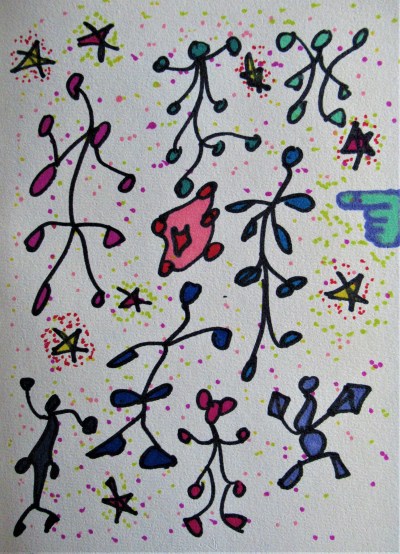
I guess the title comes from Tolkien where the Hobbits begin an energetic dance at Bilbo’s Party. Or something like that. Mine is a Fall Girl Dance. The hand on the right points to the poor misshapen heart as it moves between fall leaves and colorful dancing sprites and spirits that help it on its way. Where is it going? Who knows where the autumn leaves go once they leave the tree? The bodies fall to the ground, obviously. We rake them into dry, crisp piles and our children and grand-children dive into those leaf-piles, scattering them everywhere so we have to rake them up again. Think of them, the children, as forming leaf angels, a bit like snow angels, but, like the broken heart, a great deal more fragmented.

Try as I might with camera and photo shop, the colors are never quite what they were when I splashed them haphazardly, like September rain and wind-blown leaves, across the page. But life is like that: memories are discolored and distorted, old photos turn sepia, old folk turn white and grey and wrinkled and fragile, like withered leaves from the tree of life. And this is life, real life. We live it every day. Each dream, a flower, each moment a leaf, and every moment the only one we ever truly experience.

So savor those moments, both the good and the bad. They are yours and nobody else’s. Your like is what happens to you. Sometimes it is bitter with salt and vinegar and lemon juice. Sometimes it is toxic and poisonous. But it is yours. It is your chalice to drain as you stand in the garden, feeling betrayed. Like it or not, this is you. Then there are the dream moments: sugar and spice and everything nice. On those days, when the sun shines, it’s away with slugs and snails, and puppy-dog tails and hello hollow world, I see you for what you are and I welcome you for what you are. And yes, you can meet with triumph and disaster, and you can treat those two impostors just the same. You are more powerful than the forces around you. Centre yourself. Find yourself. Heal your broken heart as it wanders among the springle dancers sent to bring you peace and comfort.

Look for your self. Find your self. Be your self. You and your self are stronger than any woes that may beset you. Seek the light … and you will find it.

Beach Heat

IMG_0572 (2).JPG

Beach Heat

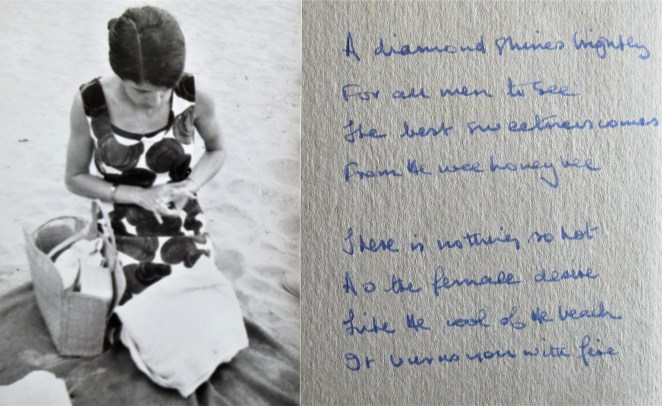
This is the beach at Goran Haven, with Clare, on the sands, trying not to lose her engagement ring. It’s still with us, in spite of having left it in a washroom on the 401. When one of the support columns of the solitaire broke, we found the stone lying on the floor of the car … that was another close call. As for the poem, well, I suppose it is one of mine.

The enlightened may recognize its structure as belonging to The Book of Good Love / El Libro de Buen Amor, written in the 14th Century (1330-1343, according to some, though it may be a little later, 1347?), by Juan Ruiz, El Arcipreste de Hita. This early verse imitates the rhythms and sequences of Juan Ruiz’s poem: In praise of small women. Not that Clare is small: she is taller than me, and always has been. She is also younger than me and hasn’t manage to catch me up yet. She is cleverer too, but don’t ever tell her that I told you that. Life might become unbearable. Not admitting that little secret is what keeps me going.

I take it you can read my handwriting. If not, ask politely, and I will add a typed version that is more understandable. Ask nicely, mind! None of that “yore ‘andritin’ is atrooshus’ stuff, sort of, loike.”

PS: I didn’t have a very good camera in those days. As for my current cameras: wow! How the world has changed. As we have changed with it.

PPS: Indeed I have received comments, not very complimentary, on my handwriting. Oh dear. Don’t worry I can’t always decipher it myself, even with my glasses on. Thank you all my friends and anonymous correspondents. So, here comes the translation into print.

A diamond shines brightly
for all men to see
the best sweetness comes
from the wee honeybee

There is nothing so hot
as the female desire
like the cool of the beach
it burns you with fire


Angels

IMG_1245 (2).JPG

Angels

So easy to believe in them when you see them dance, at midnight, when stars sparkle and the world seems dark. They light up everything you know, turn your world inside out, make you believe in things you never thought you would believe in.

So many people can no longer see them. For all too many, the angels have fled, have abandoned the world, leaving it in darkness. Where are they, where have they gone? They are still here, my friends, they are still with us. It’s a question of vision and belief, above all, belief.

So, what is holding you back? Why can’t you see them when they are there, before your eyes, dancing on moonbeams, sunbeams, fluttering before you, begging you to believe, to open your eyes, to seize them as they flit to and fro. Look at them, gathered on that pinhead, on the button of your blouse. They love you, they want you, they need you … and you need them, you know you do.

So hold out your hands, open your heart, let the sun shine in, let moonlight bless and caress you, and may all your dreams be filled, not with shadows, but with the bright light of angels.


Bubbles

IMG_1173 (3).JPG

Bubbles

Count them. Each day she was here, a bubble. Little did I know as I saw them floating in the sun across the porch against a background of leafy trees that they would so soon burst and vanish, one by one.

Lost now, her voice, gone her footsteps from the stairs, no more the scrape of her chair as she climbs up beside me, calling my name. When I wake in the morning, I wait for her joyful call. How she loved to bounce on my bed. Knees up, but no Mother Brown this, just my grand-daughter, four years old.

And now she is gone.