“A moment in your life,” she said, “a moment that changed you forever.”
A bad boy, banned from representing the school, condemned to acting as a servant to the chosen few, those who were good enough to go.
They gathered early in the refectory. I served them tea. But first I salted the tea pot with Epsom Salts, or something similar. The tea pot frothed and foamed , then settled.
Later, the house master called me. “Can you dance? he asked. “Yes,” I replied. “Show me,” he said. He handed me a chair and put a record on his gramophone. I danced, six legs, to his satisfaction.
“Put on your Sunday suit,” he said. “Be on your best behavior. It appears we have suffered a bout of gastro-enteritis.”
That’s where I met her. Age seventeen. At a school dance. The one. My one. The only one. Sixty years later, we’re still together. Writing this, I see us as we were back then. My chest goes tight. My eyes overflow with tears.
Paintings: doors you can walk through, windows that open onto visions of another, more beautiful life. Deeper than the paint, the thoughts and words that formed them, brushed them into life, an ephemeral life, so brief that butterflies seem to last longer and flowers live for all eternity.
Transience and insubstantiality. Change is all around us, we are surrounded by change. But the deepest changes, the ones that affect us most are internal, set deep within us, death’s eggs hatching slowly since the day we were born.
Life is indeed short, and art endures. Carved five thousand years ago, in stone, this magnificent henge, first Wood-henge, then Stonehenge, majestic at the dawn of time, with its sarsen stones, pillars, post-holes, and labyrinths, circling within circles, a frail spider-web of sunlit brilliance.
Lost now, the message, as my own message is lost, covered by paint, though words emerge in the strangest places, allowing us to peer in through windows as long-lost words and worlds whirl out through carved and painted windows and everlasting doors.
Doors First version
Paintings are doors you can walk through, windows that open onto visions of another, sometimes better, life. Deeper than the paint are the thoughts and words that formed them, brushed them into life, an ephemeral life, so brief that butterflies last longer and flowers live for all eternity, or so it seems.
Transience and insubstantiality. Change is all around us, we are surrounded by change. But the deepest changes, the ones that affect us most are internal, set deep within us, death’s eggs hatching slowly since the day we were born.
Life is indeed short, and art endures. Carved five thousand years ago, in stone, this Towie ball with its labyrinths and circles. Lost now, the message, as my own message is lost, covered by paint, though words emerge in the strangest places, allowing us to peer in through windows as long lost words and worlds walk out through carved and painted doors.
A great big thank you to Allan Hudson, editor of the South Branch Scribbler Blog. He e-mailed me on my birthday, last Sunday, and asked me if I had a story that he could use on his new blog page Short Stories from Around the World. These will be published every other Wednesday, starting today. I am very honoured and proud to be the author of the first story, One Goldfish, third place in the WFNB non-fiction award (2020), that opens the series. It was revised and reworked in the Advanced Writing Course, run by Brian Henry of Quick Brown Fox fame. I would like to thank Brian and all my fellow participants who helped me rework the story. On Allan’s blog you will find links to other contributions from me. You will also find a series of featured authors, from New Brunswick, the Maritimes, Canada, and all around the world. Allan does a great job for us minor, struggling literary figures, not just for the greats. I encourage you to follow his blog and support him.
Ephemera
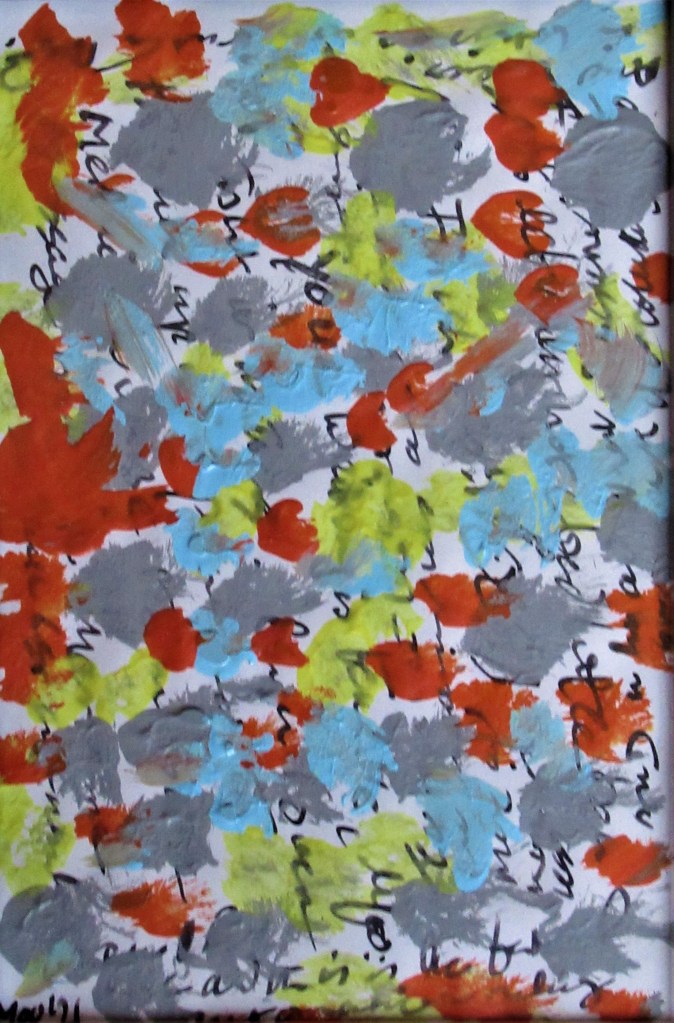
My painting (above) is entitled Ephemera. It shows a literary text semi-obliterated by various colors and devices. If we have learned anything from Covid it should be the fragility of life, the insubstantiality of existence, and the enormous powers of the natural world that surrounds us. My friends: take nothing for granted. Carpe Diem – seize the day – and “Gather ye rosebuds while ye may – for time it is a’flyin – and that poor flower blooming today – tomorrow may be dying.” This is Robert Herrick, of course. Here is my own version of the theme from The Nature of Art and the Art of Nature.
Daffodils
Winter’s chill lingers well into spring. I buy daffodils to encourage the sun to return and shine in the kitchen. Tight-clenched fists their buds, they sit on the table and I wait for them to open.
Grey clouds fill the sky. A distant sun lights up the land but doesn’t warm the earth nor melt the snow. The north wind chills body and soul, driving dry snow across our drive to settle in the garden.
The daffodils promise warmth, foretell the sun, predicting bright days to come. When they do, red squirrels spark at the feeder.
For ten long days the daffodils endure, bringing to vase and breakfast-table stored up sunshine and the silky softness of their golden gift.
Their scent grows stronger as they gather strength from sugared water. But now they begin to wither, their day almost done.
Dry and shriveled they stand this morning, paper-thin, brown, crisp to the touch, hanging their heads as oncoming death weighs them down.
And this has been a dialog with my time and my place. But what is time? A river flowing? A long line leading from my beginning to my end? Alpha and Omega? An instant held between finger and thumb and so swiftly forgotten? A dream I dream when I am awake or asleep? And which is my real dream, waking or sleeping, sleeping or lying awake?
And what is my place? This house in which I now live? The garden I watch from my kitchen window? My town? This forested area where I think I belong? My county? My province? My region? And how do I relate to my “time” or my “place” to this being called “Roger”, this dream-Roger who dreams this post-amniotic ocean of life in which he now drifts? I dream I am male yet when I read Carl Jung I learn that a large part of me is female. I always thought I was masculine / macho / male, yet when a large part of me is feminine / hembra / female, I am no longer sure what I am. And how much does it matter?
I have ten fingers yet I use only two to type. Two fingers manipulate twenty-six letters, selecting some, rejecting others, making careless mistakes, organizing and reorganizing, shuffling all those verbal cards. I turn this black-and-white keyboard world upside down when I think my subversive thoughts and type them onto the computer screen and then print them out on what starts as a snow-white page that slowly fills with ant-size letters. Time and place, male and female: I lay on my side in hospital and the young urologist shot me full of female hormones so my prostrate cancer would not take over my inner organs and destroy my life. Place and time: I lie awake at night and shape disturbing dreams, dreams I have never before dreamed of dreaming.
Some nights I sense the end is drawing near. I fear it. In my beginning is my end. Beginning and end: both belong to me as do time and space, so central to the story of my life. For life will continue with or without me even if I am not there to bear witness. But I have been here, and parts of my story will remain embedded in the mind of each and every one of those who knew me and heard me speak.
Beethoven took the Fifth and rewrote it in his own image. I want to rewrite my life. I want my youth to return. I want to be young and athletic and lithe … I do not want to be this old man with a stick who bends double when he walks and sticks a blue sticker in the windscreen of his car.
I want to refuse to open the door when the postman knocks to deliver my mail. I know that soon he will bring me that registered letter, for which I must sign, with that last fatal message, the subpoena from which there is no appeal. I guess that like the snow and the wild geese, he’ll be back tomorrow, or the next day, in spite of those voices telling me that tomorrow never comes. And so, on an unusually Odd Sunday in a bar they once called Corked, or at another table in another wine bar with a different name, raise a glass to me when I am gone and leave an empty glass on the table for me. If you do, I promise I’ll be there.
Comments: This, as promised, is the final chapter from On Being Welsh. Chronotopos is Bakhtin’s theory that all our writing is a dialog with our time (chronos) and our place (topos). “Know me, know my time and place.” When we discover and explore our time and place we begin to understand ourselves and our roles in life. Then we can start rethinking who and what we are, what we have been, what we want to be, what we need to do in order to change. But first, we must know ourselves, for without self-knowledge, we are ships adrift, floating rudderless on a rising sea, or driven by the forceful wind of others into places where we may not wish to go. My friends, I raise a glass to you, filled, alas, with orange juice, because it is breakfast time, here in Island View, on the first Sunday, damp and cold and wet of 2022.
Only the winners write the history of their conquests, only the winners. Am I a winner, then? Of course I am. I’m writing this aren’t I? Therefore, ipso facto, I am a winner. This means that although they trashed and thrashed me, they never broke me nor was I a loser. I survived. And in that world in which I lived, surviving without surrendering was a victory in itself. But this is no tale of a hero, of bloody deeds, of a great victory. It is a survivor’s tale. So, if I won, then they lost, and who knows now how the losers felt, history’s non-winners, their slates wiped clean now, their names anonymous, erased from my story, not carved in stone nor impressed into steel. What’s in a name? The Red Wings, the Black Hawks, the Braves, the Algonquins? Whose heart lies broken and buried at Wounded Knee? Why does the Wolastoq rise in the Notre Dame mountains and flow down through unceded land to the City of Fredericton that noble daughter of the woods, and on to the city of Saint John on Fundy Bay? Why Wolastoq, Notre Dame, Fredericton, Saint John? “Sticks and stones will break my bones, yet names will never hurt me.” But what if I am called Nemo and have no other name? No-name man, no-name woman, no-name child, no language to call my own, no culture, no history, except the one that others wrote and forced me to believe or the innocent who causes me to rebel
“Grandpa,” she says, climbing on my knee. “Tell me a story. Please.” “Once upon a time,” I begin. “There was this little girl …” She wriggles and giggles. “What was her name?” “I don’t know.” “Yes, you do.” “Don’t.” “Do.” “Was it me? Am I that little girl?” “You can be if you want.” “I want. How does my story end?” “I don’t know. You’ve only just started it.”
So, write your poems, write your stories, write your childhood, write your memories, write what you know, invent what you don’t know. You can’t remember your name? Give yourself a new one. You have forgotten your myths? Create new ones. You have forgotten your language? Seek and you will find, and when you have found, learn your language again, a word at a time, phrase by phrase, word-picture by word-picture, until you have renewed your world and your place in it. Let your ancestors stride through your veins again and again to stand in the spotlight that you shine upon them. Restriction, extinction, suppression of the weakest and poorest, survival of the fittest … You, you who are reading this, you who have survived, you can count yourself among the strongest and the bravest. Now name yourself for who and what you are. Pick up your pen and write. Lazarus I name you: step out from your living tomb, step out from your kennel-cave. Pick up your bed and walk and talk, and write your own story. And remember the words of Oscar Wilde, “Tell your own tale, and be yourself, my friend, because everyone else is taken.”
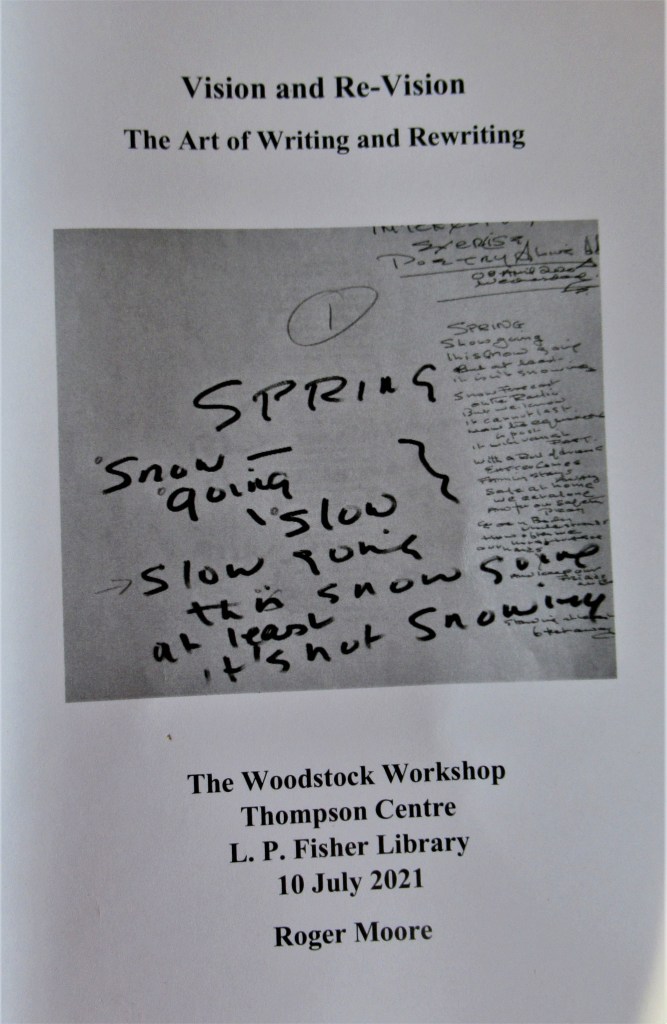
Comments: Limited edition. 40 copies. Self-published and printed by Covey’s, Prospect St., Fredericton. Free to workshop participants (all four of them!) and to anyone who asked for one. I also gave away free copies of my books to all participants as a reward for having the courage to brave Covid – masked and socially distanced – and to listen to me and share my ideas.
Comment: My first publication with Cyberwit.net. A pseudo-autobiography masquerading as a memoir. The original version of On Being Welsh was awarded first place in the D. A. Richards Prose Award (WFNB, 2020). It is available online from Amazon and Cyberwit.net.
Comment: My second publication with Cyberwit.net. allison Calvern helped me select and order these poems and my thanks go out to her for all her hard work. Geoff Slater and Ginger Marcinkowski also read and commented on the poems. Stars at Elbow and Foot covers 30 years of writing poetry, 1979-2009. It took a year or more to pull those thirty years together. It is available online from Amazon and Cyberwit.net.
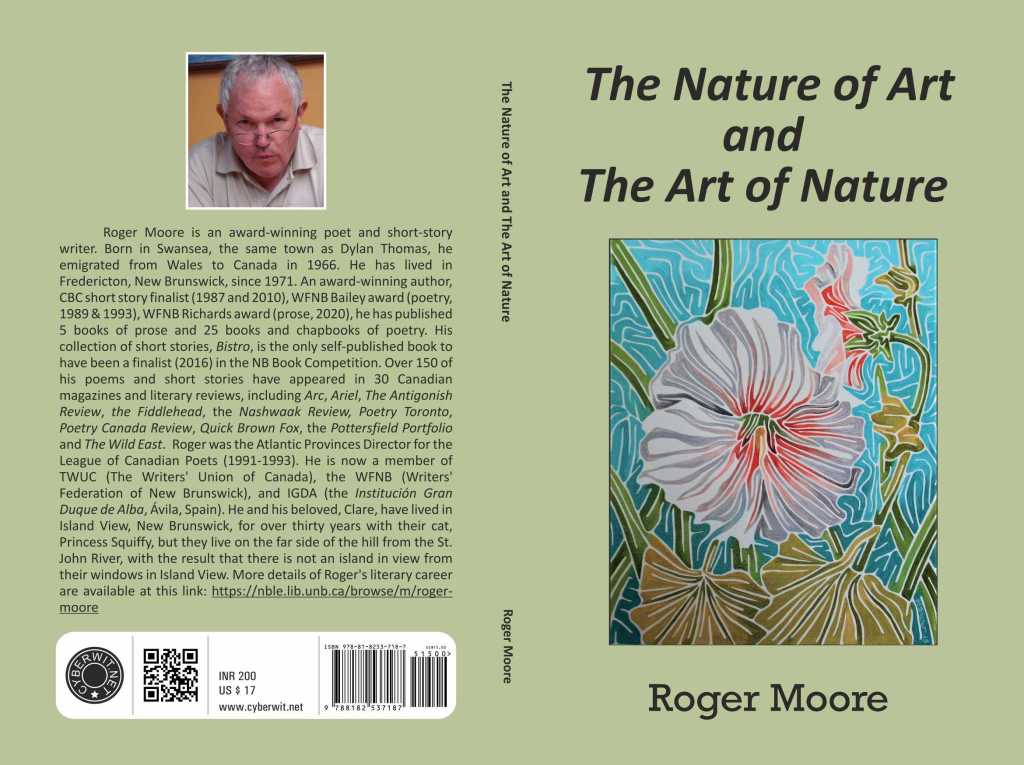
Comment: My third publication with Cyberwit.net. An early version of The Nature of Art and the Art of Nature placed second in the A. G. Bailey Award for a Poetry Manuscript (WFNB, 2020). I revised it during my second residency at KIRA (May-June, 2021), sharpening the vision and concentrating on the links between one creative form and another. Geoff Slater and Ginger Marcinkowski again read and commented on the poems and Geoff suggested that I write the Prelude: On Reading and Writing Poetry. It is available online from Amazon and Cyberwit.net.
Comment: My fifth book of the year, self-published and printed by Covey’s, Prospect St., Fredericton in a limited edition of 40 copies, once again given free of charge to my creative friends. Patti painted the flower on the poet-painter’s cheek and I thank her for that. Geoff Slater played a large role in my pain–ting and drawing by persuading me that my cartoons were not worthless. John K. Sutherland has long supported my cartoon art, and he encouraged me to ‘leave tangible footprints’ and to get some of my art work into print. I couldn’t have done it without Salvador Dali, though, and that’s my version of his watch going over the waterfall.
Comment: My comments on a year’s work as a creative artist would not be complete without a mention of the Kingsbrae International Residencies for Artists that take in the summer months in St. Andrews, New Brunswick. I received an invitation to attend KIRA in May-June, 2021. I would like to thank Lucinda Flemer and the KIRA support group for their kindness in inviting me back. The creative friendships that I have made with KIRA artists over the years have just been amazing and the whole atmosphere at KIRA is not just inspiring, but awe-inspiring. Just look at this. How could a writer not be inspired.
Dawn from the Red Room at KIRA
I would also like to mention the online workshops that I have taken with Brian Henry, of Quick Brown Fox fame. I attended the Friday morning advanced writers workshops from January to March, and again from September to December. His knowledge, skills, organization, and support are second to none. I have made many wonderfully creative e-friends across e-mail and our Zoom classes. My year’s work would not be complete without a tip of the hat and a great big thank you to BH & QBF.
Final Comment: I am grateful to Jan Hull, Stoneist, for her reminder that today is Old Year’s Day and that the Roman deity, Janus, is a two-faced deity, with one face looking back towards the old year, as I have just done, and the other looking forward to the future, as I am doing right now. All in all, a busy year and a very enjoyable one. Let us hope that next year is also an enjoyable and a very creative one.
I walk past the Jesuit Church where the shoe-shine boys store polish, brushes, and chairs overnight. I walk past the wrought-iron bench where the gay guys sit, caressing, asking the unsuspecting to join them.
Nobody bothers to ask me for a match, for a drink, for charity, for a walk down the alley to a cheap hotel.
The witch doctor is the one who throws the hands of all the clocks into the air at midnight, in despair. He’s the one who leaves this place, and returns to this place, all places being one.
The witch doctor sees little things that other men don’t see. He reaches out and flicks a fly away from my nose. “It too has lost its way,” he sighs.
I think I know who I am, but I often have doubts when I shave, rasping the razor across my chin’s dry husks. The witch doctor, my lookalike, my twin, stares back at me from my bathroom mirror.
Three witches dance on the waning soap dish. One spins the yarn, one measures the cloth, one wields the knife, that will one day sever the thread of I, who the same as all poor creatures, was born only to die.
You too must one day look in that mirror, oh hypocrite lecteur, mon semblable, mon frère.
Comment: My thanks to all those who click on earlier poems and express their liking for them. I am particularly pleased when an earlier poem lacks a voice reading. Then I can revisit it, rethink it, rewrite it, record it, and speak it aloud. Here’s the link to the earlier version of the poem Charles Baudelaire. Fast away the old year passes, and we must renew ourselves, our thoughts, and our poetry for the new year soon to be upon us. To all my readers, old and new, welcome to that world.
“Hoy cumple amor en mis ardientes venas veinte y dos años, Lisi, y no parece que pasa día por el.”
Francisco de Quevedo
“For twenty-two years my captive heart has burned.” Christ, what crap that is. The only heart burn I have known came from your cooking: African Nut Pie, as detailed in the cookbook I bought you for Christmas on our first wedding anniversary,
remember? And do you remember the ride to Kincardine on the train? A dozen coaches left Toronto and one by one they were shunted away until only you and I and an elderly man ploughed through the snowstorm in the one remaining carriage. Deeper and deeper piled the snow.
You looked through the window and started to weep: “What have I done?” you cried in shock and grief. Outside: Ontario lake-effect snow. Headlights from two waiting cars lit up the station. We drove to the homes of people you didn’t know, third generation cousins of mine.
You’re the only bride I know who was carried to church in the arms of the total stranger giving her away in place of the father she never knew. The snow lay six foot deep (eighteen inches fell on your wedding day alone) and you, with a white wedding dress and black boots
up to your knees. Cousin Walter carried you to the altar: how they laughed as they chanted that old song to us. Later, when they tapped the glasses and fell silent at the meal, I didn’t know what to do. And you, my love, standing up, kissing me, married after six days in Canada.
Comment: 55 years ago today. Where have they all gone? How quickly they slipped away. So many memories. So much happiness.
White flame, her hair, emerging from shadows, lighting her path downhill toward water’s edge. Wind-driven waves splash lake-side where she will wander. I watch her footsteps, not now as firm as once they were. Burgeoning age
grips hip and joint. Toes and heels no longer lift in the same old way. Component parts break down, arteries clog, arthritis worms, painful, into fingers, wrists, and knees. I recall nursery rhymes: “Jack be nimble, Jack
be quick,” but she isn’t anymore and neither of us could jump over candles. Candlelight, inner light, outer light, her hair, so pure, so white, her voice clear as a bell, soft yet luminous, as she picks her way on a perilous path through wayward
woods, not stumbling yet, nor lumbering, and still she lives, as I still live, in hopes to see each other, until earth stops our eyes and we can see, sense, touch, hear no more …
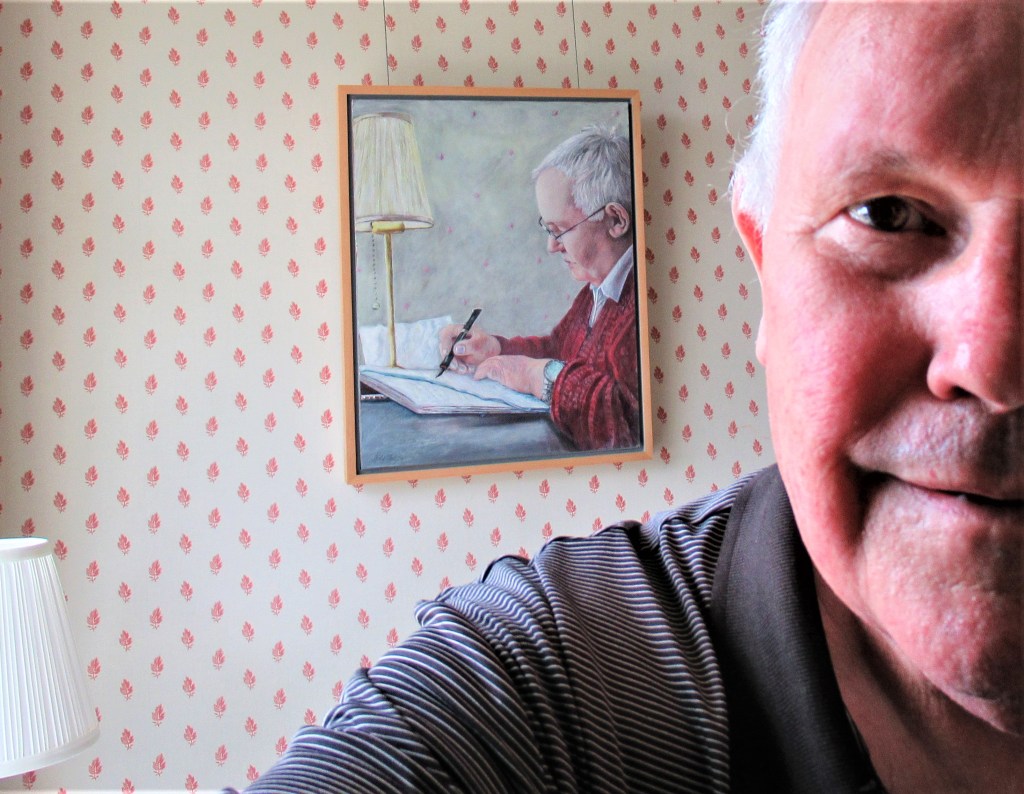
Comment: Yes, we got married 55 years ago today. This poem, written for Clare, appears on page 120 of The Nature of Art and the Art of Nature in the section entitled The Nature of Human Nature. I have written several very personal poems about Clare and our relationship and they can be found in Secret Gardens the chapbook I published in 1991 on the occasion of our 25th wedding anniversary. Several poems from that collection also appear in Stars at Elbow and Foot. Selected Poems, 1979-2009.(Cyberwit, 2021). The painting that decorates this page is also by Clare. She is a talented multi-media designer and several of my book covers were designed by her. This is one of her rare paintings. We have three of them on the wall, and they are all exceptional.
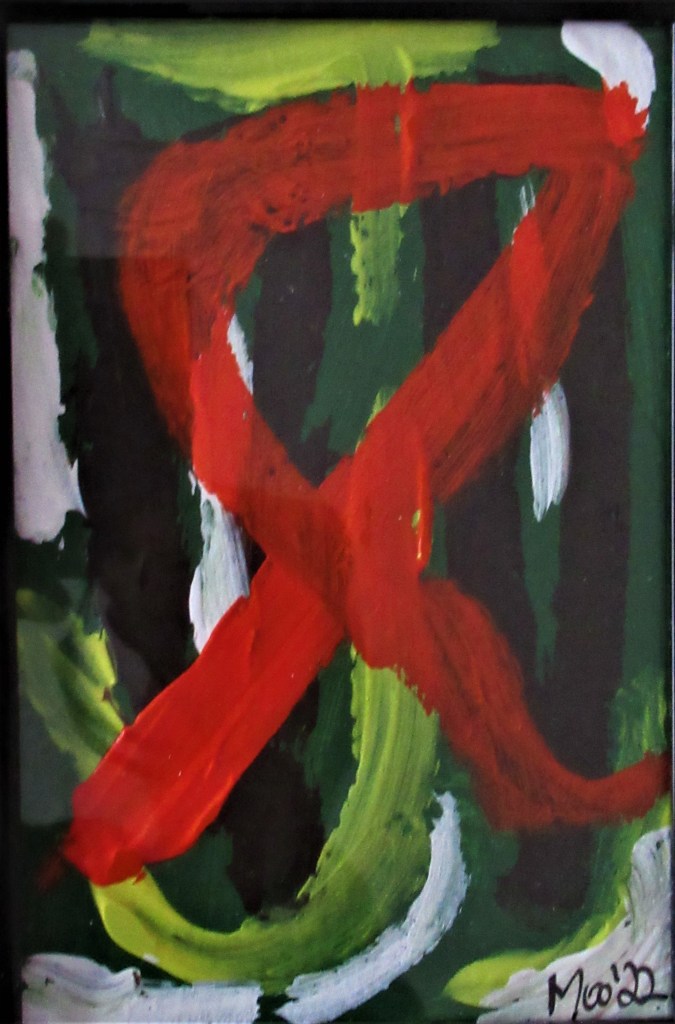
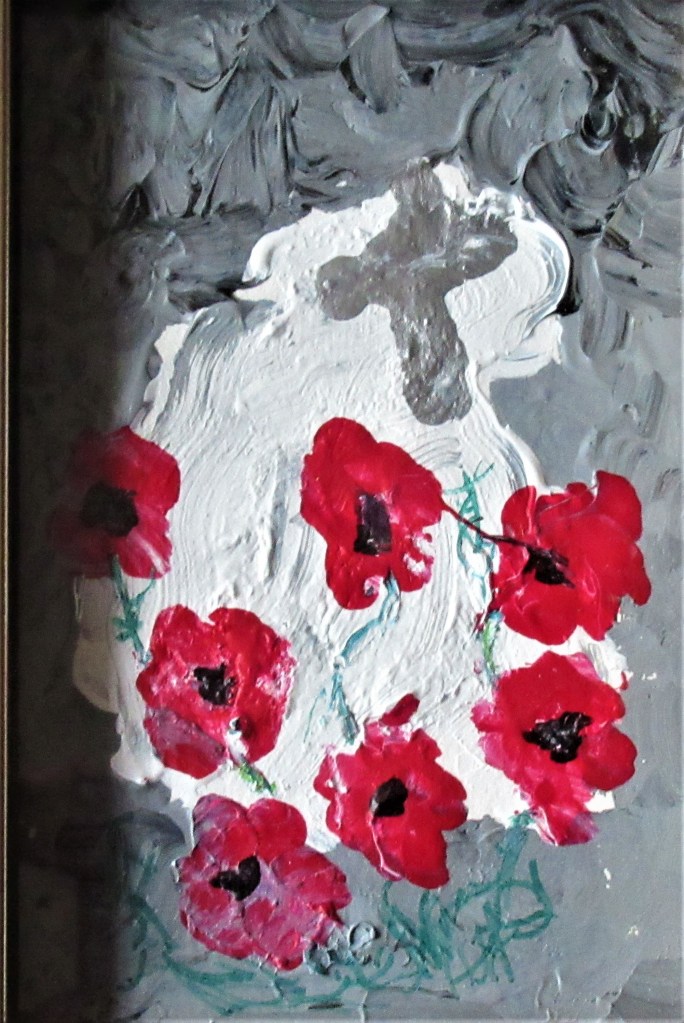
I love to be cryptic. Nothing better than a series of hidden messages concealed, or partly concealed, within a pair of paintings. And what have we here? Well, can you work it out for yourselves? Or do you need an explanation?
Okay: an explanation it is. First, the title of this blog post and of the painting on the left. LoVe. LV = Roman numerals for 55 / fifty-five. LoVe = love it. More, much more: I also love my beloved and, on Friday, 24 December, this year, we will have been married for 55 years, all of them spent in Canada, where we got married, all that time ago.
Perspective: so important, even in a painting that lacks perspective. So, let’s put it into perspective: that’s the year before Canada’s Centenary. And yes, we visited Expo in Montreal in 1967. Or, if you are a sports fan, that’s the Christmas before the Toronto Maple Leafs won the Stanley Cup (1967) for the last time. And we were living in Toronto. And I was studying at U of T. Wow and double wow: nobody in Canada, under the age of 54, was alive last time the Toronto Maple Leafs won the big one. And still the Maple Leafs, like our marriage, endure. We are the everlasting drum-beating bunnies, going on and on, for ever and ever.
Now look deeper. See what else you can see. I will assist you no further, except to add the initials – and title – of the right hand painting. AMGD. Work that one out, if you want to and if you can. And remember: presents for special anniversaries like ours come from the heart – not from a gift shop. So that is my anniversary present for my beloved. What a pity: she never reads my blog.








 rogermoorepoet