30 things that make me happy!

Daily writing prompt
List 30 things that make you happy.

List 30 things that make you happy.

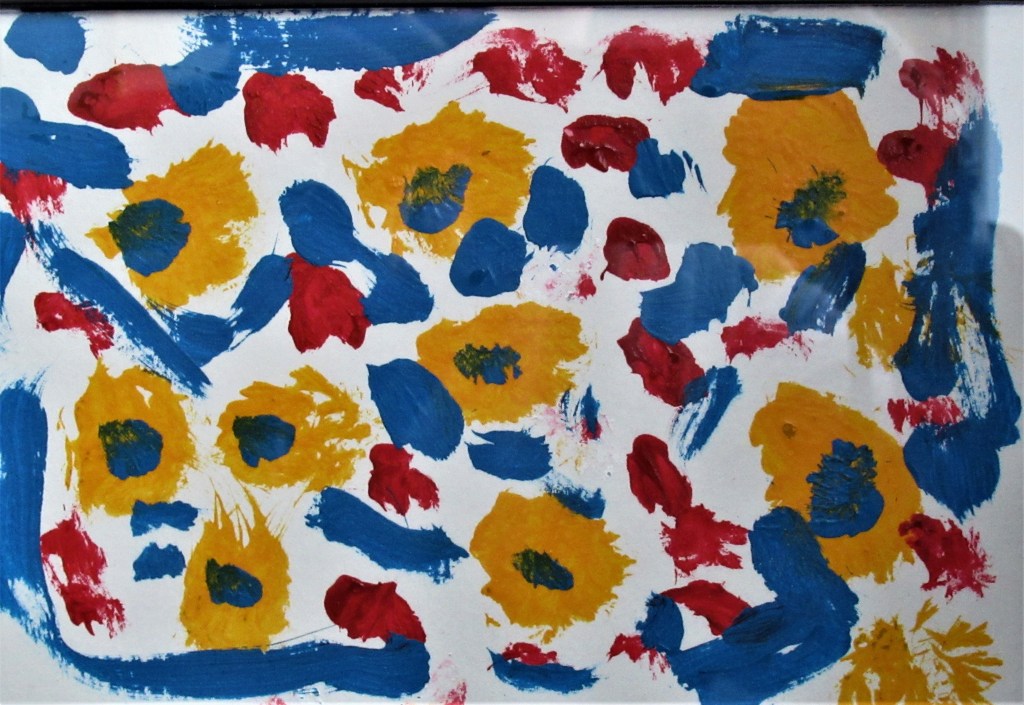
The first thirty dots I add to a dotty painting. As we all know, pointillisme drives one dotty. So, start counting each little dotty – when you get to thirty you can stoppy – and you’ll be as happy as a poppy. I do hope poppies are happy. I know poo-pees are. They wag their tales when they are hippy, happy, hoppy.

Oh yes, counting the ten toes on my feet when I have a double-trouble bubble bath. Then counting the ten toes on my grandson’s feet – that makes twenty. Then counting the toes on my other grandson’s feet. That makes thirty. Bubble, bubble, toil and trouble, hard to see those toes when the bubble baths bubble. Pinch each bubble, make them pop. When you get to thirty you can stop. Okay, okay, I hear you laugh – and that’s the joy of a bubble bath.

Apologia

Apologia
pro vita mea

The fairground’s distorting mirrors distort.
I change as I walk past one and then another.

Rage, rage against that hump-backed shape
that looks back at me from the bottle-glass.

Magic: eye of a newt, eye of a toad, cat’s
eyes at night lighting the road to bed.

Bedlam all around me. Absurd this world,
gone carnival mad in the blink of an eye.

I need a white stick to walk through
this fog that clings to my clay-bound soul.

This wine I drink, these thoughts I think,
life’s fountain pen soon runs out of ink.

Watch the tides as they ebb and they flow.
When your time runs out, pack up, and go.

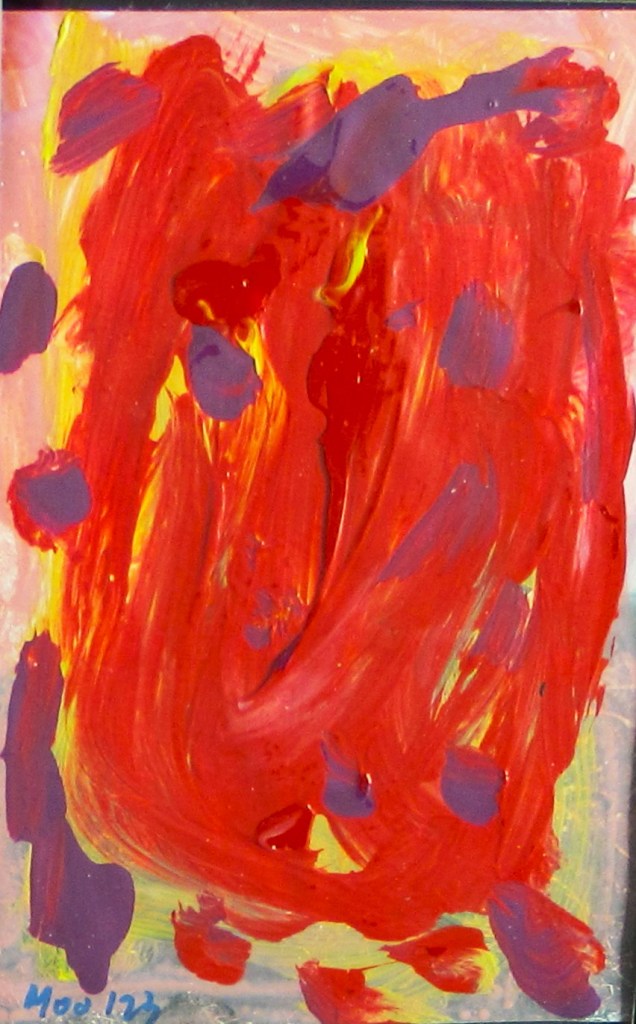
Comment: My friend Moo did himself proud with the above painting. What is it? I asked him. Dunno was his reply. I have shown it to several friends and speculation is rife: the dancer and the dance, dancer and diver, a blur of three figures, headless mermaid (I love that one). And yes, life is absurd (Albert Camus), a carnival (Bakhtin) in which knowledge is power and civilization is mad (Foucault).

Originality and imitation – how many genuinely original ideas are there? Very few. And the same goes for poetry – original poems are very rare. Most of our ideas come from elsewhere, even if we do not know it. The title of the above poem comes from Petrarch. It’s structure is traditional – a sonnet. Its ideas are borrowed from Camus, Bakhtin, Foucault. And yet, shuffle the cards (Cervantes) throw the dice (Mallarme’) and this poem and this post have both achieved a kind of originality and uniqueness by linking disparate ideas in a new unity.

Describe one habit that brings you joy.

Daily writing prompt
Describe one habit that brings you joy.

Describe one habit that brings you joy.

Creativity. I was told, a long time ago, that genius is 99% perspiration and 1% inspiration. When I started creating – poetry, mainly – I waited for the muse to arrive and lamented when she didn’t. Then I tried to force her to visit me – and that didn’t work either. Then, in 1985, I started a journal. I wrote in it every day that year and, as I wrote, I realized that most of what I was writing was gibberish. But – and it’s a big but – a few literary gems gleamed out from the rubbish. The question then became – how to recognize them. The answer to that has come more easily, the longer I have worked at writing. It’s not the muse who needs persuasion, it’s the artistic eye and mind that need to be trained so that they can see the creative art in the surrounding world.

Now, after 38 years of regular journaling – and I try not to miss a day – I can distinguish easily between art and rubbish. My poetic creativity, often via a streak of surrealism, has wormed its way from poetry, into poetic prose (short stories and novels), and from there into my style of quasi-surrealist, quasi-expressionist paintings.

Where is the joy? The joy lies first, in the work itself, the contemplation of the blank page, then the slow tidal flow of words that fill the empty spaces. Then comes the joy of recognition, followed by the joy of selection, followed by the joy of polishing, and eventually, the joy of publication. The same is true of painting. Here, the empty canvas, like a beach with the tide coming in, fills up with color and shape and, like Matisse, I try to make meaning out of those colors and shapes. Am I great artist? Of course I’m not. I’m a dibbler and a dabbler, unknown and unrecognized, but joyous in my joy of creating something that will stand, for a little while, against time’s rising tide.

Qué será

Qué será

Peace in the Peace Park,
here on the headland,
where cool grass slopes
down to the water’s edge.

Geese have nested close by
and gifted us with goslings.
Golden balls of fluff, they walk
on the land right now,
but soon will take to the water.

A thin, yellow line, they will
paddle behind their parents,
webbed feet invisible
beneath the water’s flow.

And I, in the metal coffin
of my over-heated car,
sit and watch them, envying
their freedom of movement,
waiting for whatever will come.

My beloved draws near.
I sense as much as see her,
as I covet her strong steps,
the ageless sway of her body.

Alas, I am growing old,
and not with any grace,
but fighting it all the way,
and qué será, será
is all that I can say.

Write about a random act of kindness you’ve done for someone.

Daily writing prompt
Write about a random act of kindness you’ve done for someone.

Write about a random act of kindness you’ve done for someone.

Sir Alex Ferguson, one of soccer’s greatest managers, once said that it wasn’t the victories he remembered, but the defeats. So it is with my own coaching career – it’s the losses I recall. Same thing with random acts of kindness. There have been many, too many to count. I will not paper my e-walls with glowing memories of past kindnesses. But what about those random acts of kindness I failed to do? Here’s one of them.

            Crave More: I hate those words. I always choose a cart with the shop’s name on the handle. I can handle that. I can’t handle a shopping cart that screams Crave More at me every time I stoop down and place another item in the wire grid. If stores were honest, they would inscribe their shopping carts with a sign that said Think More, Crave Less, and Save Your Money. I bet that would quickly cut into profits.

            Anyway, there I was, in La-La-Land, leaning on my cart, still half asleep, when this ghost drifted towards me. “Help me,” it said. “I’m hungry. I need food.” I woke up from my dream, looked at the ghost, tall, skeletal thin, cavernous eyes and cheekbones protruding, gaps in the teeth, grey face drawn and lined. The single word “Sorry” came automatically to my lips. Then I felt shame. I looked at him again. “I only carry plastic.” The excuse limped heavily across the air between us. I saw something in his eyes, I knew not what, and I turned away.

            Then, as I walked away, I added 100 lb of muscle to the scarecrow frame. Took forty years away. Filled his body with joy and pride, and remembered how he played when I used to coach him, hard and fast, but true. I ran my hand through the card index of former players that I had coached. I knew their moves, and attributes, the way they played the game, their stronger / weaker side, their playing strengths, their weaknesses. I remembered him holding up the Champion’s Cup. But I couldn’t remember his name.

            I pushed the cart all over the store in a frantic search for him. I went to the ATM and took out cash. I could hand it to him. I could tell him he had dropped it. I went through a thousand scenes. I could invite him to the snack bar. I could tell him to buy what he needed and follow me to the check out lane where I would add his purchases to my cart. I looked everywhere. He was nowhere to be seen.

            A single opportunity. One chance. That’s all we get. Miss it, and we blow the game. Take it, and we win the Championship and hold up the Cup.

If you could bring back one dinosaur, which one would it be?

Daily writing prompt
If you could bring back one dinosaur, which one would it be?

If you could bring back one dinosaur, which one would it be?

Probably my maternal grandfather. He was always a bit of a fossil, ostrich-like, with his head buried in the past. A great-story teller, he spun a web of intrigue about things that happened in his youth, like when he ran away to sea, age 12, Swansea in the old days, and his time in the trenches during WWI. I would climb up the back of his chair while he was sleeping, and blow on the bald spot at the back of his head to wake him up. Then I would climb onto his lap and say, “Grandpa, tell me a story.” And he would.

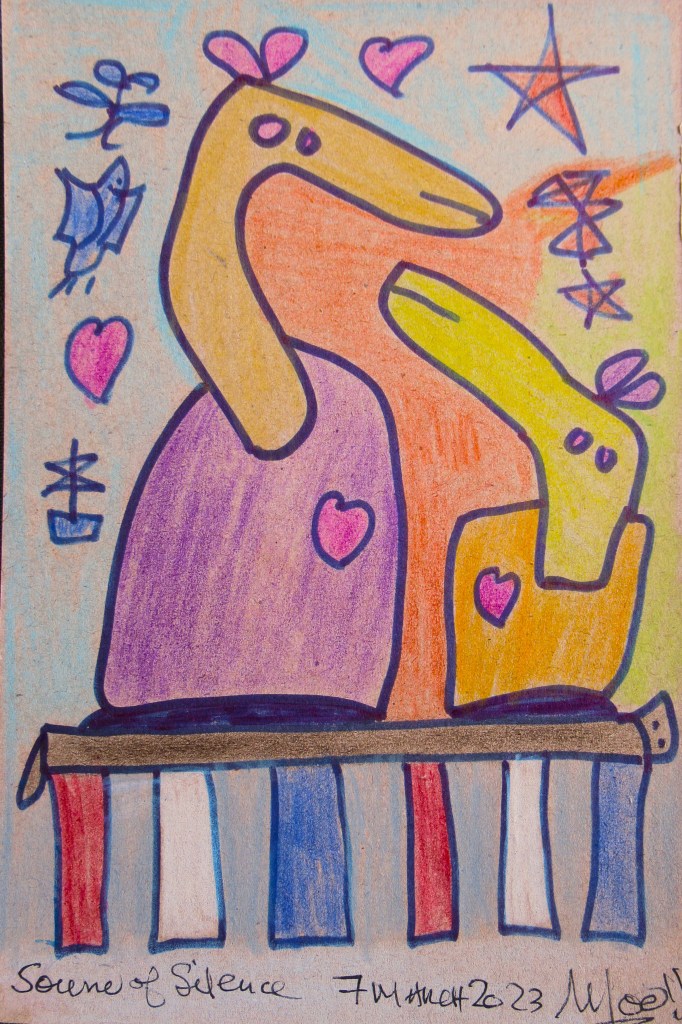
My friend Moo painted a picture of the two of us together when I was younger. That’s him, on the left. I am the smaller one on the right. He would walk with me all over Swansea Sands, telling me stories as we walked. “This is where the medicine man would pitch his stall,” he’d say. Then he would tell me about the fraudulent way the doctor sold his bottles of cough mix. A miner, with no voice would approach from the crowd. One sip of the magic potion and he’d be singing hymns and arias, voice fully restored. “Bribed, of course,” Grandpa would tell me.

Next to the snake medicine stall, a travelling dentist would pitch a stage with a small brass band and his chair. Patients would handover their three penny coins, the band would start to play, the patient would open his mouth, the dentist would wield his pliers, and out would come the tooth. Then doctor and patient would dance to the band music until the patient stopped screaming. “No anesthetic back then, see,” Grandpa would chuckle.

Oh yes, that’s the dinosaur I’d bring back. And I’d record his voice, and write down, in full detail, every story, each tall, or short, tale he told me.

What strategies do you use to maintain your health and well-being?

Daily writing prompt
What strategies do you use to maintain your health and well-being?

What strategies do you use to maintain your health and well-being?

Covid changed the world and my outlook on the world. Since the first rumors in 2019, I cut my own hair and stopped eating out. I avoided crowds, left home as little as possible, wore a mask everywhere, and maintained as much distance as possible between myself and other people. I stopped inviting people around to the house, and, as a result, we have hardly had a visit or a visitor in the last four years. We got regular shots and boosters. So far, with those precautions and a little bit of luck, we have avoided Covid.

My health care deteriorated during the Covid period. I had very few visits to my GP’s office, and most business, like prescription renewal, was done over the phone. Consultations were by telephone as well. I missed out on the regular blood tests that my urologist / oncologist had been scheduling for me, after a bout with prostate cancer. These picked up again in late 2021, and were resumed in 2022 and 2023. Things seem to be moving well currently. Thank heavens.

I interpret well-being as my state of mind, rather than my state of body. I would say that my well-being suffered from my lack of human contact, although I have slowly developed a series of online support groups. In this way, I was able to continue my writing, for example, in Zoom sessions. I also missed my family visits. I no longer travel well, and due to Covid restrictions, I did not see my daughter or my granddaughter from 2019 to 2022. Clearly, we all missed the family closeness and we were all affected. However, we are used to isolation from family. Boarding schools, travel abroad in the summer, emigration to Canada, saw our family connections broken. That said, the advent of social media, Skype, Zoom, Messenger, texting, free phone calls, have all lessened the miles between us and maintained a contact that we never had, post migration, with our parents and grandparents, and extended family. The isolation and loneliness have been hard. They are hard upon all ageing, isolated people. We have suffered less than most.

As for strategies, I really have only three: 1. to adapt 2. to survive 3. to create beauty via my writing and my painting. Painting, prose, and poetry – these I can share with my friends. Vita brevis, ars longa – life is short, but art endures. Pax amorque – peace and love.

What do you listen to while you work?

Daily writing prompt
What do you listen to while you work?

What do you listen to while you work?

While I was actually working, although I never called it work, because I thought of it as a vocation, I listened to the complaints of the administration (often about my way of work). I also listened to my students (all too often their complaints about the system and the way they were being taught and treated). And then I listened to the problems that were daily laid before me in my office by these same students. These, problems and students, were many and varied. One day, I designed a label for my door that announced: Office of Creative Solutions. And yes, I provided many innovative and creative solutions to problems that, to young people, especially my students, seemed almost impossible to resolve.

Then I retired. At least, like an ageing horse, or an unwanted donkey, I was put out to grass. And in that clover-filled meadow, I grazed at leisure and worked no more. But I did have time to write and so I became a creative writer. At first, when I started creative writing, I forced my characters into the roles that I had chosen for them. Sometimes they complained. Then, one day, or maybe it was one night when I was dreaming, a host of my characters, minor and major, came knocking on my door. They carried a big arrow that had, written upon it, Office of Creative Solutions. They pointed it at me and began to complain about how I was treating them. I remembered the poem I had memorized as a child – The owl, he was a wise old bird, the more he spoke, the less he heard. The less he spoke, the more he heard. There never was such a wise old bird.

I remembered how I had listened to my students and how, by listening, I managed to find creative solutions to their problems. So, I listened to those characters as they yammered away. One by one, they told me their woes, and their problems. Then, the following day, I rewrote everything I had written previously and wrote the stories down in their own words, instead of mine. When I listened to them, I allowed my characters to tell their own stories, and to speak for me and through me.

Sometimes, when I run out of voices that come in the night and tell me what to say, I cannot write. Then I take a paint brush, and I start to paint. What do I listen to when I paint? I listen to the brush as it moves itself over the canvas. I listen to the colors as they demand attention and tell me where to place them. I listen to the paint as it says ‘just here, not too thick, not too thin, a swirl please, gently now.”

Now, when I am not working, I listen to flowers, trees, the wind in the willows, the songs of the falling leaves, and the voices of birds.

Ghost Train

Ghost Train

I remember the little electric railway
that ran on a single loop around
the kitchen table, diddly-da-diddly-da,
just like a real train, except no smoke,
no puff the magic dragon, no sense
of a schedule or arriving and departing
when circular time is meaningless,
as are the numbers on the sundial
when the sun isn’t shining,
or the hands on the clock’s blank face
when the numbers are missing,
and you don’t know whether you are
looking in time’s distorting mirror
or are standing on your head
in the Antipodes, and all the while
the clock hands are marching round
and round, tick-tock, and there is
no track by which time can be tracked.

And the runaway hands go round the track,
and the electric train goes round the table,
 and the ghost train hoots whoo-hoo,
as it vanishes into the timeless tunnel,
then exits, the engineer, like Rip Van Winkle,
grown old with a long beard, and the carriages
all covered with cobwebs, and skeletons
leaping out of the compartments,
then sitting beside the travellers
as they snore on their seats.

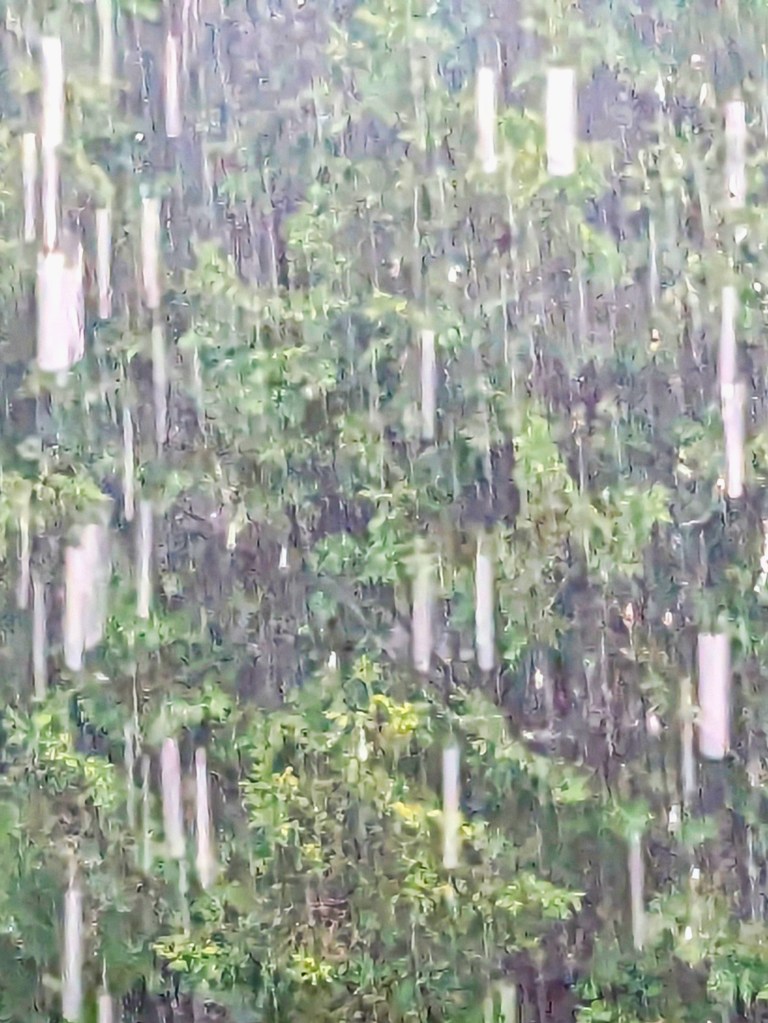
Comment: Another poem based on a prose prompt. What a great source for poetry those prompts can be, when you don’t take them too seriously and allow your imagination to run riot and your memories to flow. Not automatic writing, but writing that springs from an absurd, surrealist approach to the crazy world that surrounds us. Rain that causes the yucca plant to grow, then falls so hard that it is battered to the ground by the very thing that gave it life. And so it is with my memories of the many trains on which I have travelled and with which I have played. Once upon a time, I couldn’t conceive of life without the railway. Where is it now? I haven’t been on a train for more than fifteen years. Strange how their ghosts flit through my dreams at night: fast trains, slow trains, the wrong train at the wrong time taking me to the wrong place in time. Ah, the poetry of trains yet, “ni temps passés ni les trains reviennent.” And you can give yourself a glow of satisfaction – thank you Tommy Reed – if you recognize the quote, and two more if you know who Tommy Reed is. I use the present tense because, although long gone, he is ever-present in my mind.

Today’s painting – another gift from my friend Moo.

Window Pain

Window Pain

I live in a world beyond the material world.
At night, I swim, a silver fish, among the stars.
Constellations net me in their glistening hair.

By day I wander along a piano’s keys.
I replay life’s golden dreams again and again,
its quartets, concertos, and its symphonies.

A harmonious blacksmith, I no longer know
who, or what, I am. I only know I exist right here,
at my desk, looking out through my window,

a window in my mind, that serves as a mirror,
reflecting all I was, and am, and ever will be.
Sometimes, the sun shines. Often the rain

falls cold against that window pane, and I press
my nose against cold glass, and feel again the pain.