Silence

Silence

Pain stops at the edge of silence
and silence is the sound of sunlight
breaking against the walls of the room
in which I sit and listen, in silence,
waiting for the notes to begin again.

Silence, yes, yet my silence lies broken
by the renewed intrusion of the clock,
by the electric hum from lights and heating.

Ghostly noises break into my thoughts:
cheers from a distant tennis court,
those eternal advertisements
that invade my innermost being.

What triviality now shatters
the Messiaenic mood that wrapped me
for a moment in a many-colored cloak
woven from musical oblivion.

Time’s teeth start to gnaw again
and the grandfather clock
nibbles at my soul, extracting
its essence in a surge of sound,
tick-tock, tick-tock.

Westminster Chimes choke
life from the hour and ring
the tick-tock knell that files
my life away, second by second,
minute by minute, day by day.

Comment:

Silence is the fifth poem in the first sequence (Crystal Liturgy) of my poetry book Septets for the End of Time.

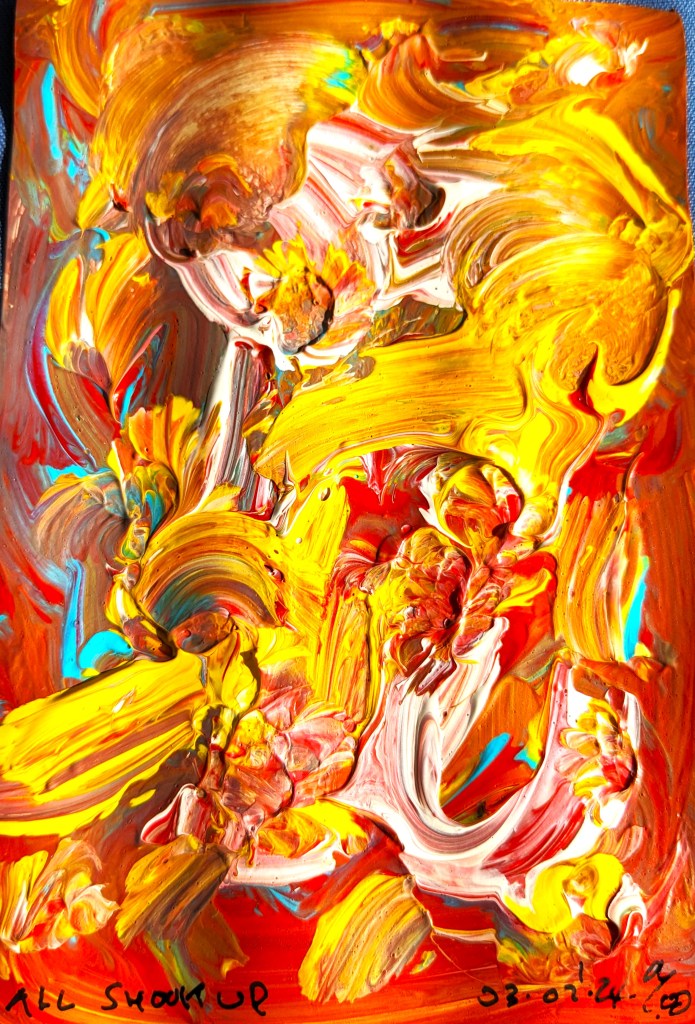
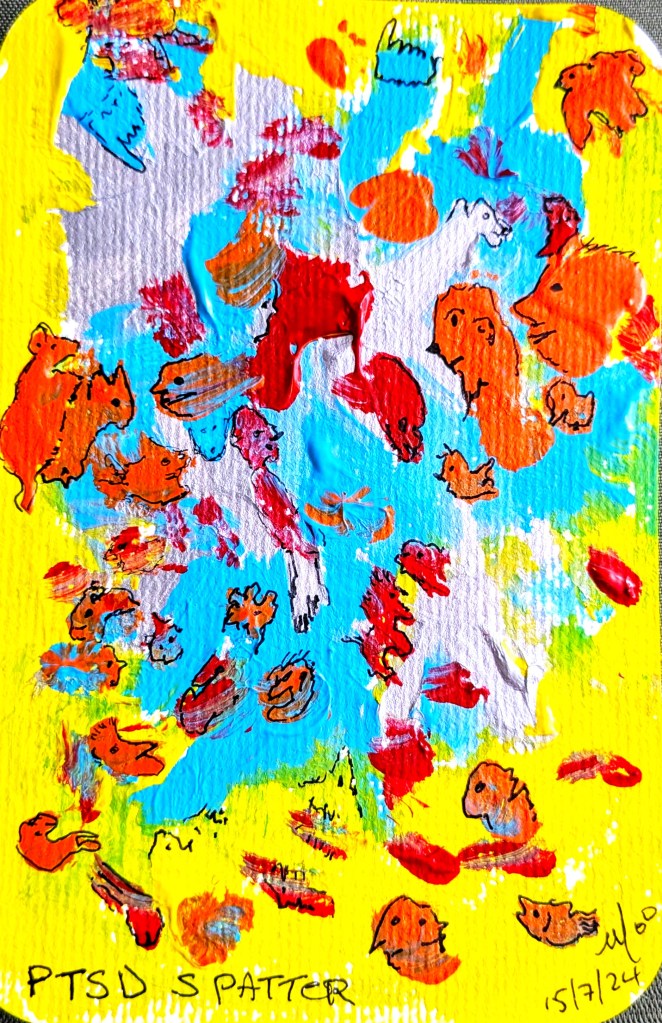
“So,” said Moo, “today I offer this painting where the title, Sound of Silence, fits well with the title of your poem. That said, I am not sure that the painting itself, qua painting, is as suitable as earlier pairings. De gustibus non est disputandum / there is no arguing about taste. I guess you either like something or you don’t.”

“It certainly isn’t in your usual style. In fact, it looks more like a colored pencil sketch than a painting. Where did you draw the title from?”

“Actually, it’s from one of your poems about Avila, in Spain, the city where, or so they say, you can hear the silence. You complained about all the noise that you found, especially the church bells, in that otherwise silent city.”

“Ah yes. I remember that poem. And I’ll never forget the sound of the bells echoing from wall to wall in those narrow, medieval streets. Bells from all the churches inside the walls of the city, tolling at exactly the same time, calling the faithful to prayer.”

“And that is one of the differences between us that I mentioned yesterday. My paintings, whatever they depict, are always silent. I have heard you read your poems out loud on Spotify and I have also heard other people reading them on your behalf, not always successfully. Poetry is designed not only to be read silently, but also to be read out loud, before an audience. Painting, on the other hand, is always silent. It does not speak, nor can it be heard. A painting is just there, in two dimensions, powerful, if you are lucky, weak and wobbly if the artist does not fulfill his task.”

“Interesting, dear Moo. And the images that I draw from Messiaen’s music are interesting too. For musical notes, without words, change into images within the listener’s mind, and then, when heard by the poet in me, become verbal images upon the page. Fascinating.”

“It is. Some time soo we must talk about intertextuality, the ways in which one artistic form or text can influence another. Hopefully, you’ll find a poem and I’ll find a painting that illustrate just that.”
Transitions

Transitions

Modes of limited transitions,
moods of time tapped in time
to time’s rhythmic piano.

Scales fall from my listening eyes
and all-seeing ears.
A transitory awakening,
this glimpse of the composer’s vision,
each note a new version
extracted from abstracts
perceived in color,
each note a hue, and chords
a rainbow spectrum of light
glimpsed darkly through
the raindrop’s distorting lens.

Birdsong and sunshine.
Notes perched
on the matinal branch,
each in tune with the other,
at times in seeming discord,
yet the morning chorus
diluting the day
with the liquidity
of light and sound.

Comment:

Transitions is the fourth poem in the first sequence (Crystal Liturgy) of my poetry book Septets for the End of Time.

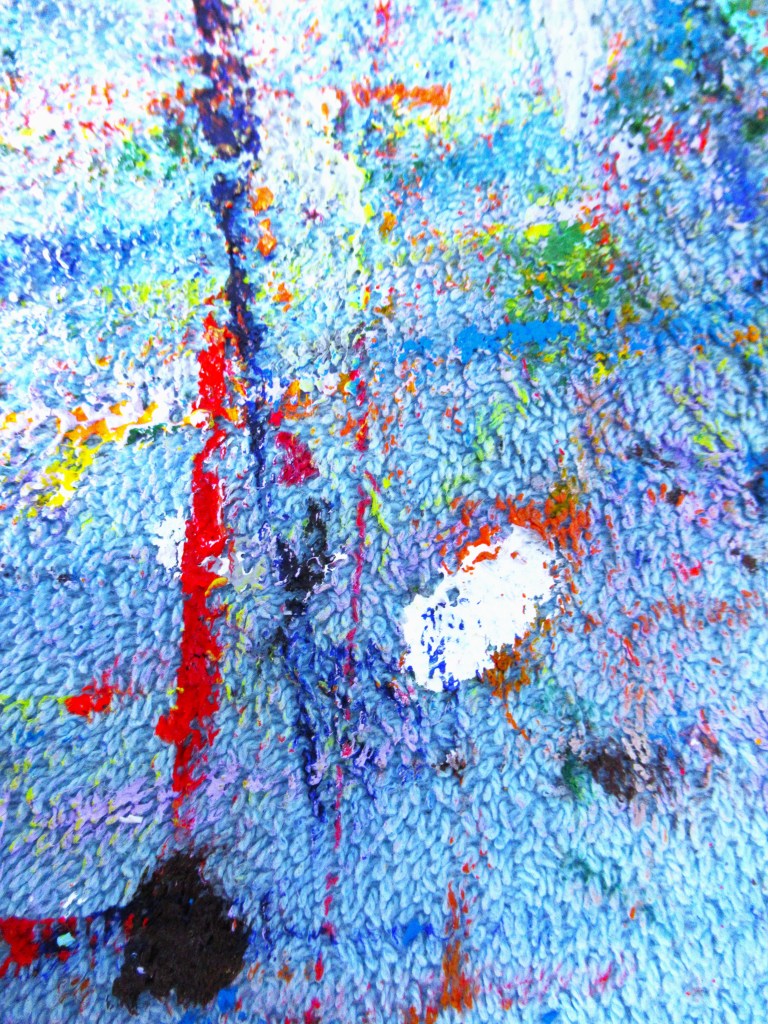
“How on earth did you create that painting?” I asked my friend Moo. “And how do you relate it to this poem?”

“Good questions,” Moo replied. “Difficult to answer, though.” First of all, this is not a painting. It is the background cloth, always changing, always in transition, upon which I create my post card paintings. The idea of transition summarizes the movement from paint, to brush, to painting, and the haziness of the creative moment. It relates directly to your lines ‘Scales fall from my listening eyes / and all-seeing ears.’ This is the point in time, the magic moment, when the painting declares itself. I assume you have the same moment when you write poetry.”

“The two processes are very different, I think. In my poetry, a thought leads to a verbal image, and then each of the words turn themselves into little worlds in which verbal gemstones appear. I try to catch those verbal gemstones and to transform them into poetry. If I listen carefully, then my ears see and my eyes hear the words forming themselves into the right order.”

“Interesting. And yes, that’s what happens in my painting too. The initial mood captured in that first color, and then the minor moods that emerge from the first one gradually woven into the painting.”

“That is somewhat similar to how I write – by listening to the words and doing what they tell me to do. Then I do what they want me to do, not what I want them to do.”

“Fascinating. But there is one huge difference between us.”

“What’s that?”

“I’ll tell you next time.”

Dark Angel

Dark Angel

He will come to me, the dark angel,
and will meet me face to face.

He will take all that I own,
for my wealth is only temporary:
health, wealth, possessions are all on loan.

My house, my wife, my car,
my daughter, my grand-child,
 my garden, my trees, my flowers,
my poetry, my works of art.
I use the possessive adjective
knowing full well that these things
are only on loan. I will never be able
to preserve and possess them.

I even rent this aching heart,
these ageing, migrant bones,
this death that has walked beside me,
step by step, every day
since the day that I was born.

My death alone is mine.
It belongs to nobody else.
It will be my sole possession.
It will soon be the only thing
I have ever really owned.

Comment:

Dark Angel is the third poem in the first sequence (Crystal Liturgy) of my poetry book Septets for the End of Time. The painting, by my friend Moo, expresses his impressions of how he reacts, in paint, to my poem, in words.

“Well,” I said to Moo, “you’ve gone and done it this time. Do you think that painting really represents my poem? I see no darkness in it and certainly no angel.”

Moo gave me a long, strange look. I felt like I was looking in the mirror and seeing parts of my own soul fragmenting and falling away, like scales from my eyes.

“It’s not what the poem says,” he replied. “It’s what I think you feel as you’re writing that poem. I see the tension, the cry from the heart, the struggle to accept, and the realization that, in the end, everything is inevitable and must turn out as it will. That said, more than anything, it is the cry, de profundis, from the depth of your self that I feel. My painting depicts that cry and your suffering.”

“What if it’s not my suffering? What if it’s the suffering of Messiaen and his musicians as they play the soul music that keeps them alive?”

“But surely,” Moo replied, “that’s the whole point. Orde Amoris, according to the recent Pope who has just passed away, is love felt for the person suffering, no matter who he or she is. Pope Francis spoke in praise of the parable of the Good Samaritan. When you see someone suffering at the wayside, you stop and help that person. You don’t just walk on by. Your suffering is my suffering. When I paint your suffering I also paint my own suffering and when you grieve, then I grieve with you.”

“And when that happens, when we all grieve together, we do not grieve alone and in vain.”

“Exactly.”

The End of Time

The End of Time

A thin violin crying
its cat-gut heart out
in tears of sound, falling,
rhythmic raindrops,
down a grey-streaked face
tight with stress and taut with pain.

Such concentration,
such soulfulness packed
into each mindful note.

An audience of one,
I sit, head bowed, meditating
on the meaning of meaning
and the nothingness
of a being condemned
to oblivion, yet oblivious
of the how and when.

Each note a hammer-blow,
then, the piano pounding nail
after nail into this living coffin,
this body I drag through the motions
of extracting meaning
from this meaningless life.

Comment:

The End of Time is the second poem in the first sequence (Crystal Liturgy) of Septets for the End of Time. The painting, by my friend Moo, expresses his impressions of the nature of the end – but he doesn’t tell me the end of what. Certainly not of our friendship, I hope.

I am always worried by those last two lines: extracting meaning from this meaningless life as I don’t think that life is meaningless. However, there are times when it certainly feels that way. Those are the times when we need our beliefs in truth and the purity of art to survive. But how do you define them, you ask me. In all honesty, I don’t. I can’t. Art changes. What we consider to be true changes. Relativism? Yes, to a certain extent. I know what I believe. I don’t know what you believe. But I would never try to inflict or enforce my beliefs on to you. That is not how I work.

As for Moo, I don’t know how his mind works. I think he just sees things in color and shape and in the creation of movement within the stillness of a two dimensional illusion. I also think he thinks like a child. Maybe, like me, he has entered his second childhood, though I don’t really remember ever having had a first one. Oh dear – the meaning of meaning – one of the great enigmas of this wonderful world in which we live.

Crystal Liturgy

Crystal Liturgy

Here, in the abyss,
where song-birds pluck their notes
and send them, feather-light,
floating through the air,
here, you’ll find no vale of tears,
no fears of shadow-hawks,
for all blackness is abandoned
in the interests of sunlight and song.

Here, the crystal liturgy surges,
upwards from the rejoicing heart,
ever upwards, into the realms of light,
where color and sound alike
brim over with the joy that, yes,
brings release to head and heart.

Here, seven-stringed rainbows reign,
the everlasting harp is tuned and plucked,
and an eternity of music cements
the foundations of earth and sky.

Here, the master musician conducts
his celestial choir, their voices rising,
higher and higher, until they reach
the highest sphere, and song and voice
inspire, then expire, passing from our eyes
and ears into unbounded realms of light.

Here, the seven trumpets will sound
their furious dance, a dance that will announce
the end of this singer, the end of his song,
but never the end of song itself.

Comment:

Crystal Liturgy is the first poem in the first sequence of my poetry book Septets for the End of Time. My friend Moo, the painter, supplies the paintings for the book covers. He and I have decided to hold a dialog on our views of how the painting and the poem relate to each other. Hopefully, we will continue this dialog throughout Septets for the End of Time.

“I have tried to join the ideas of sound, light, song, and voice to the idea of the Platonic Universe, where the planets dance to the music of the spheres. I wrote these poems listening to Messiaen’s Quartet for the End of Time. I allowed the music to flow through me and I responded, in words, to the images that came from the sounds, and the silences, of the music.”

“I see no sorrows here, no woes,” Moo told me. “I only see the the joy of light and existence. The shadows have been dispersed, and my painting contains a generous helping of sunshine and light. I find it very suitable for this particular poem. My painting’s starburst of energy enhances the poem’s sense of movement, strength, and light. It also contains the message that all will be well.”

Empty Nest

Empty Nest

Who are they, these ghosts who flit into my life
and leave me foundering in treacherous waters
as I search for enlightenment and meaning?
Why do they return, revenants, to disturb
my peace and quiet, and to trouble my sleep?

I watch them wandering through the coal mines
of my mind, while yellow canaries twitter rage
from their cages. Oh, praise the blind pit ponies
whose blinkered eyes will never see the light.

They are so lonely, so distant, so lost in deep-down
galleries that I no longer know them.
Memory’s fish-hook cannot snag them,
cannot haul them back into daylight reality
far from night’s net of silvery dreams.

A place… a time…the sudden scent not of presence,
but of absence. The absence of movement,
noise, of that other body that once walked the rooms,
floors, opening and shutting doors, windows, a robin’s
whistle, a thrush’s trilled song… gone now, gone, all gone.

We drift through silent sadness, avoid each other’s eyes,
sit with our heads in our hands or knit our fingers together
in desperate gestures that express our emptiness,
the emptiness of an empty nest…

Comment:
So many people, leaving, drifting on, out, and away, so many empty nests left behind. Why do I grieve, when I know that this is the natural path of life? And for whom do I grieve, for myself, or for them? I do not know. I only know that when that last visitor leaves the party and the door finally closes, the walls close in and I am left alone in this emptiest of nests.

To sleep, perchance to dream. And that is when they return, those broken ghosts who visit me at night and fill my empty head with memories, some happy, some beautiful, some ugly, and some of them sad. They fly, tiny silent birds, when the first rays of the sun, hit my window and awaken me. But they endow my day with memories – each morning marked by the rawness of a nightmare, or the sweetness of a midsummer night’s dream.

Where did my mojo go-go?

Where did my mojo go-go?

Wow! My first post since January 8, 2025. What on earth has happened to me? Good question – I just don’t know.

Today’s painting, from the last day of 2024, is taken from The Idylls of the King, Tennyson. “The olde order changeth lest one good custom should corrupt the world.”

This quote is used in my Old Boys magazine at the end of each school year when the students leave the college and go out into the real world. This happened to me in 1962 – 63 years ago. Certainly I changed, and for the better, without the college. Whether the college changed or not, in my absence, I really don’t know. I suppose it did. It became co-educational, quite the thing for a boys’ boarding school. It expanded into larger grounds. It tore down at least two of the old houses, including the one in which I boarded for four years. I read about these things, but I have only been back on one or two occasions, so I don’t really know. And living in Canada, I rarely see any old boys from the school. They don’t cross the pond to visit me.

I receive the old school magazine regularly, by e-mail. However, I no longer recognize faces or places, unless the places are totally unchanged since I was there. And not many of them are. The most important page for me has become the obituaries, and I study with care those who have passed on before me and those who remain. I grieve when I see the names of old friends. But I grieve even more when I see the names of people so much younger than me falling by the wayside.

As for that mojo of mine, well, I guess that writing on a regular basis has become more and more difficult. “Don’t sit with your head in your hands thinking of time past,” says the Spanish poet. Yet time past seems preferable, in many ways, to time future. I am beginning to feel a bit like a pin-cushion, on account of all the needles now being stuck into me. Perhaps that’s where all my mojo went? Still, for anyone interested, I am still here. Still happy. I am working on my latest novel and I have two books of poetry waiting to be published. So maybe my mojo hasn’t done a bunk, just my blog mojo! I shall have to kick start it. Or maybe I’ll get that little yellow duck who wears blue gumboots to stand on a brick and give me a hearty booted boost. Yup! That should do the trick.

And so, in the words of Dylan Thomas, “I’ll take a bow, and say ‘good-bye’ but just for now.