MT Warning and Prologue

img_0181

Monkey Temple

Warning

Any reference to any real monkey, living or dead,  is entirely coincidental. However, if you are a monkey and if the cap fits, please do not hesitate to wear it. 

Reader and listener discretion is advised.

 PS This manuscript  was begun at midnight  and completed  just before mid-day on April 1, 2012.


Prologue

These Monkeys Bite

A large sign at the entrance to Bristol Zoo, off Clifton Downs, announces to visitors the zoo’s motto: “Ask the animals: they will teach you.” My visits to Bristol Zoo always lead me to the Monkey Temple. It is an old, ruined, Indian Temple, half-hidden in the trees and populated by a colony of monkeys. Sometimes, the monkeys are playing in the open, sometimes they aren’t. Patience is everything: sooner or later, the monkeys will appear, revealing themselves in all their splendor.

I do not like to call these refuges from modern city life zoos; rather, I think of them in terms of nature reserves, preservation centers, museums, art galleries with living portraits, areas where human beings can break from the city’s restlessness and come face to face with a tiny part of a lost natural world, a world which we are so busily destroying.

Are monkeys people, you ask? Of course they aren’t. But they do have human qualities and there is no better place to see these human qualities than in the Monkey Temple. Do animals accurately reflect human qualities? Of course they don’t. The monkeys in the Monkey Temple are the distorting mirrors of fair ground, circus, and exhibition where bodies are fattened and flattened, thinned and skinned, turned inside out into falsified figures, stick creations bent out of woolly wires designed for cleaning pipes.

Please be reassured: the poems in Monkey Temple do not refer to any specific monkey, living or dead. If you see an aspect of yourself, or myself, twisted beyond the norms of reality, do not fret: it is entirely accidental, taken from the monkeys themselves.

Remember: “Ask the animals: they will teach you.”

But, be warned: do not place your fingers near the cages — these monkeys bite.

MT 1-1: Monkey Teaches Sunday School on Mondays

img_0181

Monkey Teaches Sunday School on Mondays
(With apologies to Pavlov and his dogs)

Younger monkeys e-mail elder monkey
and expect an answer within two minutes.
Elder monkey drools and writes right back.

He is turned on by the bells
and whistles of his computer.
“Woof! Woof!”
His handlers hand him a biscuit.

Elder monkey has grown to appreciate
tension and abuse:
the systematic beatings,
the shit and foul words hurled at his head.

The working conditions are overcrowded.
Elder monkey is overworked.

Yet he has managed to survive,
to stay alive and fight
what he once believed was the good fight.

Now he no longer knows:
nor does he drool anymore
when bells and whistles sound
and his handlers bait him
with an occasional, half-price biscuit.


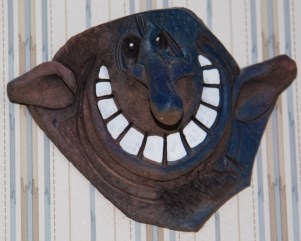
I will record and post the whole of Monkey Temple, poem by poem, with voice recordings. I’ll use two key trigger elements: first, the grinning monkey in the picture and second, the MT 1-1 designation, standing for Part 1 Poem 1 … this will continue 1-2, 1-3, 1-4 etc. If you are enjoying these poems and readings, keep your eyes open for those two triggers and catch your favorite monkey as he goes about his monkey business.

Monkey Temple

img_0181

Monkey Temple

The monkeys appear, as if by magic.
They tumble out of windows and doorways.
They clamber through the holes in the temple’s ruined roof.
They are quiet at first.
They inspect their surroundings.
They ogle the crowd gathering for the afternoon show.
They watch the watchers watching them.
They pulsate, for no reason at all, they pulsate, then ululate.
They jump up and down and swing from the temple’s roof.
They pontificate, gesticulate, and regurgitate.
They sit and sift for fleas.
They defecate and urinate.
They masticate cautiously.
They castigate and fornicate.
They ruminate. They masturbate.
They rush to the top of the temple
and on the uplifted faces of the crowd they ejaculate.

Monkey Temple is the first poem of the book of the same name. It serves as a Prologue. Below is my oral presentation of this poem.


Monkey’s Clockwork Universe

img_0181

Monkey’s Clockwork Universe

Some days, monkey winds himself up
like a clockwork mouse.
Other days he rolls over and over
with a key in his back like a clockwork cat.

Monkey is growing old and forgetful.

He forgets where he has hidden the key,
pats his pockets, and slows right down
before he eventually finds it
and winds himself up again.

One day, monkey leaves the key
between his shoulder blades
in the middle of his back.

All day long, the temple monkeys
play with the key, turning it round and round,
and winding monkey’s clockwork,
tighter and tighter, until suddenly
the mainspring breaks

and monkey slumps at the table
no energy, no strength,
no stars, no planets, no moon at night,
the sun broken fatally down,
the clockwork of his universe sapped,
and snapped.