Westminster Chimes

Empress 005

Westminster Chimes

Not all clock towers and churches ring out with Westminster Chimes, and that is particularly true of churches where the carillons are so distinctive and those who toll the bells are so unique. That said, the Westminster Chimes are probably the most famous in the world: 4 sets of 4 notes, striking on the full hour, followed by the clock tower striking the hour itself. The build up is basic: 4 notes for the quarter hour, eight notes for the half hour, 12 for the three-quarters, and 16 before the hour strikes.

Last night I awoke at 3:15, just in time to hear the hall clock strike the quarter. The initial sounds lost themselves in the mist of sleep and I only caught the last two notes clearly, hence the bell tower of Ste. Luce-sur-mer, above, partly disguised by the St. Lawrence river mists. Doze mode, I guess, and I heard the notes at half past, then again at a quarter to, and finally the hour. I wonder how many remember the rhyme that the clock chimes? I repeat it every night as I lie awake, listening: 1/4: All through this hour, 1/2 All through this hour, be by my side, 3/4 All through this hour, be by my side, and with thy power, 4/4 All through this hour, be by my side, and with thy power,  my footsteps guide.

Dozing through the night is a funny thing and the mists of sleep walk through one’s head in many forms. Often, I count the chimes, only to find that it is not three o’ clock, but four or five. The mists have crept into my head and I was sleeping when I thought I was waking and 1 and 2 and 3 are not always followed by four and I wonder if there is a life-lesson in there somewhere that will help us through this current upside-down world of carnival and topsy-turvy pan et circenses, predicted by Juvenal in his satires. The Wikipedia definition of the second-century phrase is fascinating: “In a political context, the phrase means to generate public approval, not by excellence in public service or public policy,  but by diversion, distraction or by satisfying the most immediate or base requirements of a populace— by offering a palliative: for example food (bread) or entertainment (circuses).” O tempora! O mores! (Cicero).

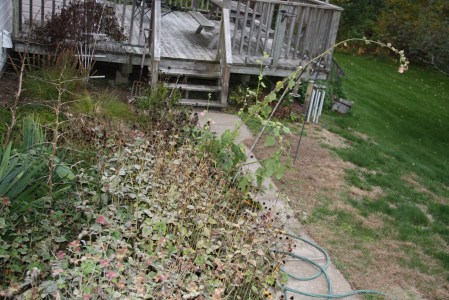
Sometimes we have to take steps backwards through time to fully understand the meaning of our own times. In the meantime, we can look out of the window, here in Island View, and see the ruins of the summer garden, slowly crumbling before our eyes. Then we can quote again, this time from Samuel,  ‘Ichabod, Ichabod, the Glory has departed.’


Friends

img_0146-3

Friends

Strange things, friends. What are they exactly? And how do we make them?  In fact, do we make friends, or do we just grow together, like gardens or trees? Birds of a feather, they say, but our feathered friends are flighty and the snow-birds leave in the hard times only to return when the sun comes back. Fair-weather friends, then, and I have known a lot of those.

I turned to Wikipedia, the source of all knowledge, but all I could find under FRIENDS was a series of articles on TV shows, every episode, every actor, every friendship, every situation, but no discussion of what friendship actually meant. FRIENDSHIP: I looked that word up and the results were much more satisfying. The article ranged from a definition: ‘a mutual attraction among people’ to a series of academic studies about friendship in childhood, adolescence, adulthood, and older adults. As we age, so our notions of friendship change. In addition, as we move from place to place, job to job, so our circles of friendship grow old, renew themselves, and gradually fade away. One study shows that in adulthood we rarely have more than two good, true friends. Our acquaintances are many, but our friends are few. Old age brings a different set of equations to bear and loneliness and isolation with the consequent absence of friends, all bring their own problems, including sickness and ill-health.

Empress 048

Here are some of my closest friends. Rosie is named after Rosie the Elephant in Bristol Zoo. Teddy is the Koala. Basil is the small one on the left with the pink ribbon. Chimney is the little one on the right with the orange skirt. Her name’s Chimney, but I call her Sweep. Don’t ask, I won’t tell. These friends summarize all the needs of friendship: they don’t beat me up, they listen when I talk, they don’t interrupt me, they nod silent agreement to my opinions, and they soak up my tears when I cry. They also keep me warm in bed at night. Well, Rosie and Teddy do anyway. These are not their real names, incidentally. Teddies, like cats, have secret names, and you cannot really call a teddy bear your friend until he or she has revealed that name to you. It may take years for that to happen. The speed or the slowness of the true name’s arrival has nothing to do with the success of the friendship.

IMG_0032

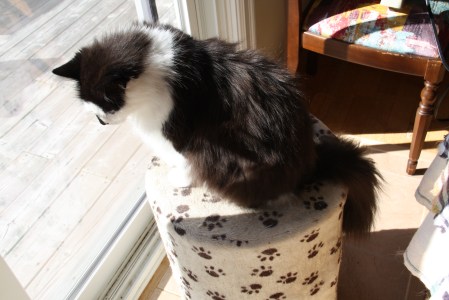
This is Princess Squiffy aka Vomit. She threw up beside my chair again yesterday and I am just not sure if that is a sign of friendship or not. At least she didn’t throw up in my chair, which is what she did last time my beloved was away visiting our daughter in Ottawa. So, how do your friends show their friendship? By sitting in silence and listening? By keeping you warm in bed at night? By throwing up in your chair? By presenting you with hairballs, so carefully formed and all gift-wrapped? I am not sure. I guess I’ll have to go back to Wikipedia and check it all out. In the meantime: here’s a picture of man’s best friend.

IMG_0139

I bet you weren’t expecting that!

Ruins

IMG_0040

Ruins

There are many types of ruins, ruined castles, ruined churches, ruined monasteries, old stone circles fallen into ruins, barns alongside the highway, backs broken, roofs caved in, old people beg, still clean and proud, outside the supermarket, proud, yes, but still more or less ruined. And then there are unkempt gardens that fall into ruin when summer crawls to the burnt out embers of  its heat.

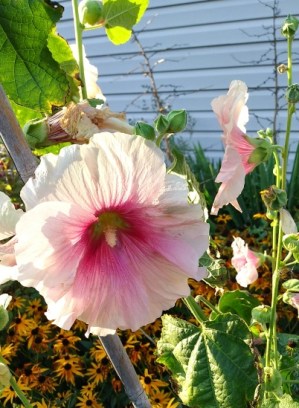
When I came back from my week’s creative retreat in KIRA, our garden lay in ruins. The hollyhock still stood, but it was on its last legs, drying up. It didn’t imitate the dead sticks of the yucca plant, four flowers this year, nor the dried up foliage of summer flowers. Nevertheless, wind and rain have now brought him close to his end, poor thing. I want to remember him in all his glory. I want to see beyond this bent, withered stick of a plant that slowly bows its head to look down at its roots. My hollyhock, please, in all his glory!

20180916_182952_HDR-1_resized

All our glories! I too am in decay and falling into ruin. I dug out an old photo of myself. Bristol University, 1964, running for the First Cross-Country VIII on the Bristol – Weston road relay. Hugh Arnold was just handing off to me and I was setting out on my 5 mile leg of the race. Young, fit, no grey hairs, no wrinkles, no limp, no stoop: it was a five mile leg that I would complete in about 25 minutes. Alas, slow is me: it takes me that long now to walk 400 metres. And I need rests and a stick to help me on my way.

Standing amidst he ruins of my life, yes. But I stand proud, my head held as high as I can hold it. I can honestly say I have done my best. And what more can anyone do? Athletics, rugby, coaching, research, publishing, teaching, facilitating workshops and retreats, travelling, editing, creative writing … it has been a crazy life, packed with fun and adventure and no, I do not regret a moment of it.

Come to think of it, unlike many people, I have actually lived many lives. My first took place in Britain and Europe. Then in September, 1966, I was reborn as a Canadian. Each subsequent Fall, at the beginning of September, as each new academic year began and the year’s cycle turned round to freshness and intellectual renewal, I was born again. Teaching, coaching, working with young people: what wonderful things to do. Now, I look at the ruined garden and remember the joys of summer. They will return. My hollyhock will also be back. He has sown his seeds throughout the flowerbeds and sooner or later he will return. I too have sown seeds: the seeds of joy, knowledge, learning, creativity. I too will live on in the many virtual children whose minds I have inhabited and helped to shape.  Winter is drawing near. The cold and the dark encroach: but, like my garden, I will be back.

The Painting Lesson

The Painting Lesson
KIRA 

image4

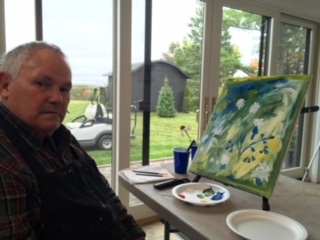
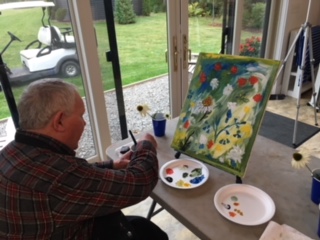
Geoff is teaching the participants in the creative retreat how to paint a cone flower. He plucked several on the way to the workshop and placed a couple in a cup of water so we could study them in close up. Mine are on the table just to my left hand. The golf cart outside is the main means of transport when it is time to move me from place to place. It’s so much easier to sit in comfort rather than to pick my way carefully over slightly uneven grass. Geoff has shown me how to paint the background to my flower. Alas, my background is nothing like his background. I often wonder if this is because I went to school in England, while he went to school in Canada. Certainly our backgrounds are very different. Geoff took the Golf Cart keys from Mad Max. Hence the drive over to Studio #1, where I wrote for a month in June 2017 was very smooth. Mad Max is very kind and gentle. Until he gets behind the wheel of a golf cart. Then he earns his nick-name: Mad Max. My plastic chair is about to collapse and land me on the floor. But I don’t yet know that. It will happen about three minutes after this photo was taken, but the camera had gone by then. Fortunately. Or the next picture would show my rear end raised into the air in all its glory with my little legs kicking.


image3

This next photo shows my painting with my lovely cone flower painted in. My cone flower does not resemble Geoff’s cone flower, nor does it look like the real thing that sits on the desk in front of me. I hope you can see my  cone flower in the painting, but if you can’t, don’t worry. My best advice is search for something that doesn’t look like a cone flower and you will find mine. We are not sure what happens when I paint. Whereas all the obedient students have only one large realistic flower in their painting, my painting sprouts flowers as if by magic. They just appear, like dandelions. They are everywhere and in all colors. It’s quite the bouquet, really, though that is not what it was meant to be. It was meant to be a cone flower. Geoff says I have a unique and powerful style of my own. I think this is instructor-speak for “Roger, you can’t paint for love or money and, as a painter, you are as dumb and stubborn and inflexible as a knot in a lump of wood, but shucks, I’m not a negative person, so I’ll call your messy message unique.” Thanks, Geoff. It’s nice to be unique. Much better than being an abject failure. When Clare saw my painting, she thought my eye-sight was going, so she made an appointment for me to see the optician, or whatever he’s called, next week. Or the week after. I couldn’t make out the date. Her hand-writing is so blurred. Maybe her hand-writing is unique, too. Either that or she also needs an eye-appointment.

image5

This is the final product. Geoff says it is very strong and demonstrates the strength of my personality. I think it looks like a cross between a Tangled Garden, a nightmare bristling on the facade of one of Monet’s Cathedrals, a Van Gogh flowery sky, and a walk in the park with Picasso when he was trying to relearn how to paint as a very young child would paint. The other participants say they like the energy of my brush strokes. Brush strokes, a lovely idea. I hold the brush like a carving knife and, pretending the canvas is a lump of recalcitrant cheddar cheese or a fierce Shropshire Blue, I attack it with my bristle sword, hacking it into colorful lumps that can be whatever the viewer thinks they might be. Speaking of cheese, this painting is the sort of dream that comes in the night to haunt me when I have eaten too much cheese. The slashing of the nightmare with the paintbrush sword brings a moment of release and a wonderful feeling of relief and relaxation when canvas and cheese are cheerfully hacked and the contents of their souls released into a heaven-haven of paint. Ah soul: I think you can see one or two souls flitting through my tangled garden. I’ll tell you a secret, though: I don’t know how they got there. I thought I was painting butterflies at the time.


Haircut, anyone?

SD 16

Haircut, anyone?

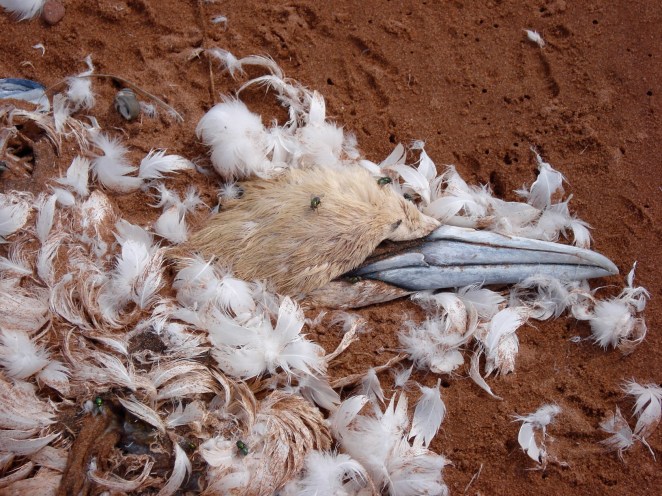
Well, it’s almost time for me to have my hair cut. When I looked in the mirror to shave this morning I looked a little bit like this: beaky nose, eyes closed, well, half-closed and squinting, anyway, and all lathered up. My grand-pappy told me there’d be days like these: usually just before he cut himself shaving at the kitchen sink with his old cut-throat razor. Then he’d disappear into the outside bathroom and reappear with little Vs of toilet tissue pushed into his chin to staunch the still-leaking wounds. All that’s missing here, in this photo, apart from life itself [nature morte: still life] is my grandfather’s pink shaving cream. And a sense of humor: wreckage on life’s beach, the common destiny that awaits us all, flies and all.

A Cobbled Life

PEI + bockle 2008 025

A Cobbled Life

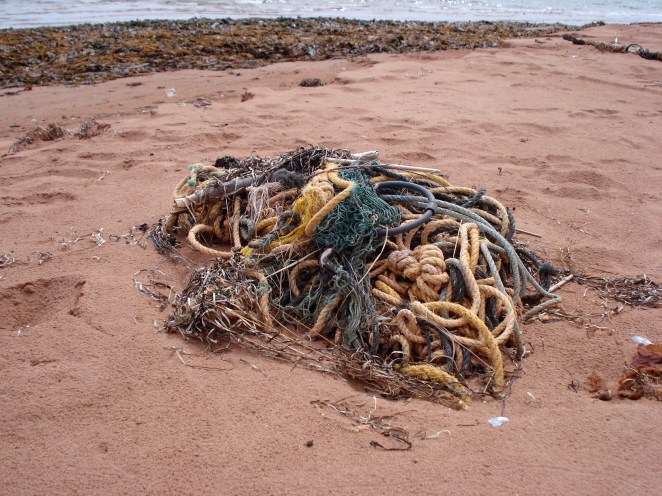
I have been writing away, but keeping it to myself. No more posting original material on Facebook or the Blog. I feel a little bit knotted and washed up by the tide, tied in knots, so to speak. Never mind. There’s lots of old material and photographs to work with. I am tired of reading “publishing on your blog or social media counts as a publication.” Like heck it does! Try going before the Promotion and Tenure committee with articles from blog, photos from Facebook, and a collection of letters to the editor of the local newspaper.

Obsolescence

img_0281

Obsolescence

The programs that no longer work.
The files you can no longer access.
Photos that vanish
leaving a blank space in the album.

Memory that goes on the blink.
Forgotten phone numbers,
the birthdays of family members,
that carton of eggs left in the store,
your cousin’s face, her name,
the parking spot where you left your car.

“What day is it today,” you ask,
for the second or third time.
“What time is it?”
“Who’s that coming for tea?
Are you sure I know them, dear?”
“Where did you say we were going?”

“Just round the corner, to visit a friend.”
Or should that be … round the bend?

Comment: Apparently I placed this poem on Facebook a year ago, but I have found no trace of it here, on the blog. This time last year, I lost both of my computers to what was diagnosed as obsolescence. Luckily I had most things backed up. The group who swore they could transfer 99% of my hard-drive material to the new machine, migrated just 1% (my desk top) and the other 99% went on walkabout. I was able to piece much of it back together, but obsolescent programs and out of date apps no longer functioned. So much material was deemed irretrievable. This experience made me realize, yet again, how fragile is our hold on our possessions, our memories, our sanity, and yes, our very lives. For me, it is a very sobering thought that, with a flick of a switch, I, like my computer, could be turned off, and 99.9% of the wonders of my beautiful existence would totally disappear from the memory-banks of this earth. Some say, and I believe them, that, like my computer, I will be re-cycled, recirculated. I will become a part of the wider oceanic world-consciousness. Alas, we can have faith in whatever we wish to believe, but sometimes, we really don’t know.

Knowledge

F1040022

Knowledge
Thursday Thoughts
9 August 2018

In response to yesterday’s post, The Curse of Cursive, I received this comment.

“I have always blamed my own illegible (except – well sometimes – to me) scribble on the hours sitting in college lectures attempting to make a record of what was being said. Consequently, I could only ever record about every 3rd sentence. Something which I claim accounts for all those gaps in my learning.”

This comment merits a Thursday Thought.

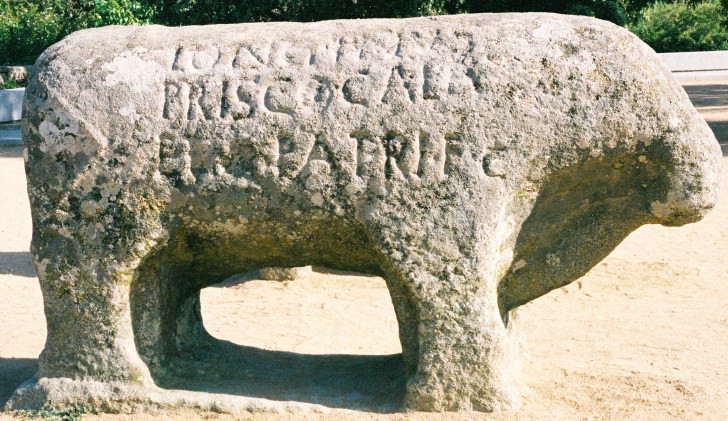
First thought: the whole process of note-taking. One of my professors in Bristol University, where I did my undergraduate degree, was in the habit of sipping Harvey’s Bristol Cream while munching his sandwiches, consequently his post-lunch thoughts were always most enlightening. Here is his post-lunch declaration on knowledge: “Knowledge is that which passes from my notes to your notes without passing through anyone’s head.” This statement was followed by a closing of the drowsy eyes and an enormous hiccup.

For me, the art of note-taking goes way beyond the copying down of another’s ideas. As  note-takers, we must sift the incoming information, break it into salient and important features, and get the main drift of the argument down on the page. And not just the argument, but our own questions and challenges as well. Much of what I was taught at the various schools I attended was, frankly, nonsense. However, I learned a great deal about teaching from those who taught me that nonsense. A dictated note from an early geography class, preserved for ever in the young student’s mind: “The earth is geoidal, ie, earth-shaped.” Good one, teacher. “Please sir, if the earth is earth-shaped, what shape is the moon?” “Don’t be cheeky, boy, I’ll see you afterwards.”

When I received my first important teaching award I realized that it came to me on account of what I had avoided (all those inadequate lectures and lessons) and that what I was doing was engaging students and challenging them to challenge me by developing their own questions and ideas, by doing their own background checks, and by establishing their own thought processes, rather than trying to imitate somebody else’s dictated and regurgitated notes with their partial pictures of (in)complete and often antiquated knowledge, and all this often dredged up and recycled in the form of ancient, dusty scrawlings from pre-historic graduate courses.

I realize that this is unfair to several lecturers I encountered over the years who were able to deliver riveting and thought-provoking adresses. However, these were few, very scarce, and much appreciated. Their names and ideas are engraved on my mind. They and their methods are not forgotten, even now, but, as I say, there weren’t many of them.

As for knowledge, it is so personal and becomes an integral part of who we are and what we do. I know people who received everything they knew about life with their first degrees. They thought they possessed everything, the complete tree of knowledge in one rolled up certificate. Alas, many of them spent their lives never progressing, standing still and contemplating their known world, neither learning nor needing to learn anything else.

Our knowledge is incomplete. If we are at all ‘thinking people’, we know this. We also know we can never get enough knowledge. A PhD is great: knowledge Piled higher and Deeper. But often it is Reinforced Ignorance, the false knowledge that this knowledge is the only knowledge, well, the only knowledge that matters to the individual who, at a substantial living wage, ekes it out with great care and tests other people on their ability to reproduce it in its exactitude. “And I never-ever thought for myself at all” (I am the Monarch of the Sea, the Ruler of the Queen’s Navy, HMS Pinafore).

And here we enter the world of clichés: life-long learning, an everlasting thirst for enlightenment, for more light, more knowledge. The only real knowledge that we simply must transfer to our students, our followers, is how they can gain knowledge and even more knowledge for themselves. A love of and a desire for life-long-learning is the teacher’s greatest gift. If the teacher can pass that on, then the world of ideas will not fail, knowledge will not become carved in stone, set in concrete, entrenched in notes ‘that pass from my notes to your notes without going through anyone’s head’.

Here ends my Thursday Thought. A rant, really, and a very satisfying one. Thank you, Roland of Roland’s Ragbag, for turning on the tap and allowing these refreshing waters to once again flow.

Comment: Opening photo, knowledge set in stone. One of the Bulls of Guisando (Province of Avila, Spain), with graffiti carved by a Roman legion.

Curse of Cursive

IMG_0004 (2)

The Curse of Cursive
Wednesday Workshop
8 August 2018

It appears we will no longer teach cursive writing in our schools. Instead, we will teach our children to print. I will not pass judgement on this decision. Quite simply, my handwriting has always been bad. Very bad. I have never worked out why, but I suspect that it is because I think very quickly and my hand tries to keep up with my brain, and the result is the scrawl that I call my handwriting.

I type with two fingers, too, and stare at the keyboard as I am doing so. I tried to follow a typing course one year. I worked at it for two months. At the end of that time, I tried my touch typing examination and managed a rate of 78 words a minute with an accuracy of  82%. I did the same test with my trusted two fingers: 114 words a minute accuracy rate 98%. Oh dear. I still type with two fingers and I still write badly and no, my thoughts have not slowed down.

Just glance through the above photograph, taken from the journal I keep everyday. “Almas de Violeta,” it reads, “an early poetry book by Juan Ramón Jiménez, the Nobel winning poet, was first published in violet ink. I have a copy of his complete works, Obras completas, in which these early poems still appear in purple, or violet rather, to match the color of the title. He published in green ink too, but personally I prefer the purple. Bruised clouds on an evening sky, dark depths of a rainbow glow, Northern Lights singing at the deep end of their scale … or just a desire to be different … slightly different, as if that one thing, the color of my ink, might tip the scales and turn me from mediocre to celebrity with a wave of a violet wand or the click of a pair of ink-stained fingers.”

Now, wasn’t that easy! And there’s so much personality in tone and color, ebb and flow, the link of a poet to the words on his page.

Once, in a faraway library in a distant, magical land, I was studying an autograph manuscript, written by Francisco de Quevedo (1580-1645). The hand-writing began very steadily. Then I noticed a red dot or two on the page. Then a larger stain. Our poet was a notorious drinker. The letters grew large and loopy. The paragraphs sprawled. Punctuation marks and accents, slashed and splashed, and missed their targets. By the end of his evening, with his bottle surely empty and gone, I could just about make out what the good man had written.

When I turned the manuscript folio, from recto to verso, it was a new day and the original handwriting was back, small and neat. I have noticed the same phenomenon when I write late at night. Unreadable words, occasional wine splutters, spelling and grammar mistakes, disjointed readability … but the thoughts and the ideas are still there, still clear. Sure, I need a bit of hard work to interpret some things, but that’s the curse of the cursive, I guess.

Procrastination

IMG_0146

Procrastination
for my friend, Mr. Cake

It’s old age, I think:
I can manage
one thing a day,
depends on the weather,
then I forget,
then I remember,
but the weather isn’t right,
so I put it off again,
start a story,
write a poem,
the phone rings,
someone texts me,
there’s a knock on the door,
the crows in the garden
make me procrastinate,
(crass  Latin joke*),
then I remember
and feel sad,
and hair leaks from my head
like straw from a scarecrow,
and my teddy bear brain
turns to sawdust
when I scratch,
and what was I saying?
I guess I’ve forgotten,
I’ll sleep on it tonight,
and write again
tomorrow.

Note:
Crass Latin joke*
Cras is the Latin for tomorrow. Cras is also the sound, in Latin, that the crows make. Hence Pro-cras-tinate: to leave things for tomorrow, or to abandon them for tomorrow’s crows. The joke probably doesn’t belong in the poem, but darn, it’s my poem and I’m leaving it in there.

Comment:
This collection of thoughts started in a casual online exchange with my good friend, Mr. Cake. Sometimes words flow and it’s impossible to stop them. Sometimes, they hover like crows or croak at us from the tree tops where they sit ungraspable. My spellcheck tells me that’s not a word, but if it isn’t, it ought to be. Whatever: the world and its words are sometimes surreal and if you are interested in the surreal, then Mr. Cake’s blog is the place to be. Here’s the link. The site comes highly recommended. Click on it now and don’t procrastinate. Mr. Cake’s Blog.