Scorched Earth

IMG_1783 (2)

Scorched Earth

A scorch mark
still scars this woodland
where deer grazed
until spring grass
fed the flames
sown by an unknown hand.

RCMP
cars blocked
the lower road,
uniformed officers
directed us to detour
up and away.

Below us we could see
smoke, no flames,
two firetrucks.
The acridity of ash,
breeze-borne,
filtered through the car
making us cough.

No more will the deer
roam this particular place
until wounds are healed
and all trace of the fire,
like them, has fled.

Comment: Driving to the head pond at Mactaquac, a week or so ago, we met an RCMP roadblock and were diverted by the officers. We ascended Mactaquac heights, and came down the other side, rejoining the lower road which was blocked by another set of RCMP cars. It was the week after the shootings in Nova Scotia. All we could think of was the respect we have for the RCMP. The knowledge that, if someone drove a police cruiser, stolen or faked, and wore an RCMP uniform, stolen, faked, or genuine, and flagged us down, well, we would have had no doubts and we would have obeyed that person implicitly. This was apparently what happened in Nova Scotia when the gunman, dressed like an RCMP Officer, flagged some of his victims down, then shot them as they sat in their cars. I guess the wounds of forest and deer will heal more quickly than those of the victims’ families. Pax amorque / peace and love. 

Garbage Day

image1 (17) - Copy.jpeg

Garbage Day
(1789 AD)

all the dustbins
dancing down the street
trying no doubt to achieve
a spring time copulation
so they can give birth
to even more dustbins

you can’t have a revolution
without dustbins
dusty … dusty … filthy
dusty dustbins
a sadistic way to look at
dustbins full of sawdust
heading off down the street
between potholes
and blowing bins
a right Danse Macabre
conducted by
St. Vitus

me sitting there knitting
Montreal Canadians
this Red Cap
I keep flying high

even though I stand
upon Gibraltar’s Rock so fair
not to mention Paris
the Place de la Bastille
with tumbrils rattling

Old Moll in a Moll’s Cap
toothless fairy
at a Goblin Party
watch out
for toad s’tools
[sick this poem
this joke

and all that’s in it]

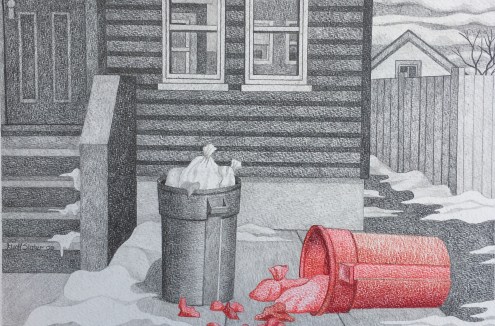
Comment: A wonderful drawing by my friend, line painter Geoff Slater. The poem, of course, represents the garbage in (and out of) the garbage can. 1789 is the date of the French Revolution. I found this poem in my discard file, so it was one of those that didn’t make it anywhere. Maybe it shouldn’t have made it here either. But it takes all sorts to make a world and Geoff’s red dustbin reminds me of the red caps knitted by the old women beneath the scaffold and the guillotine. Funny things, guillotines: invent them and they drop on you when you fall out of favor. There are so many allusions in this poem that I am ashamed to say I remember them all, and not all of them are pleasant. Mind you, few things are pleasant nowadays and remember: it is better to leave your dustbins out to roam the streets and be plundered by the crows and swept away by the high winds than to leave them festering and smelling bad and all cooped up in the locked down garage.

Why?

IMG_0446

Why?

“Where are you going?” I ask again. “To see a man about a dog,” my father replies.  “Why?” I ask. “Hair of the dog,” his voice ghosts through the rapidly closing crack as the front door shuts behind him. “Why?” I cry out.

I recall the mud nest jammed tight against our garage roof. Tiny yellow beaks flap ceaselessly open. Parent birds sit on a vantage point of electric cable, their beaks moving in silent encouragement. A sudden rush, a clamour of wing and claw, a small body thudding down a ladder of air to crash beak first on the concrete.

“Why?” I ask.

The age-old answer comes back to me. “Wye is a river. It flows through Ross-on-Wye and marks the boundary between England and Wales.” The swallows perch on the rafters watching their fledgling as it struggles on the floor, the weakening wing flaps, the last slow kicks of the twitching legs.

“Why?” I ask.”

Y is a crooked letter invented by the Green Man of Wye,” my grandfather says.

“Why?” I repeat. “I want to know why.” Silence hangs a question mark over the unsatisfied spaces of my questing mind.

Comment: A golden oldie. We would all like to know why. But there are no answers. Just riddles cast, like two trunk-less legs of stone, on the sands of time. Nothing beside remains. Yet still we ask the age old question? Why? And still we get the age old answer from the ageing masters who rule our childhood lives and teach us everything they know: “Because.”

Keeping Score


IMG_1337 (2)

Keeping Score

(‘… we blossom and flourish
like leaves on a tree
and wither and perish …’)

In the beginning was the number,
and that number was one:
number one.

Place it on the chessboard,
square A1,
bottom left corner,
black.

Next door,
on square B1,
white,
place number 2.
Next door,
C1,
place number 4.

The D1 square
claims number 8.
The players are abandoned
to their fate.
16 perch
on square E1.

32
land next door,
what fun,
and crowd into
square F1.

Square G1
sees 64
and H1
numbers
128,
each number a person,
forsaken of late,
and left to perish
in a perilous state.

Black on the left,
white on the right,
the numbers will soon rise
out of sight.

That’s just the start,
the first rank done.
Now we can really
have some fun.
A bean counter’s work
is never done.

H2 = 2-5-6.
Now we’re really
in a fix.

G2 = 5-1-2.
Whatever are we
going to do.

F2 = 1-0-2-4.
Now we’re rattling
up the score.

E2 = 2-0-4-8:
why did we procrastinate,
enjoying ourselves,
rich, young and wealthy,
thinking everyone
hale and healthy,
encouraging them
to drink and party.

D2 = 4-0-9-6.
‘What’s this?’
They cried.
‘It’s just the dead ones,’
we replied.
“Surely there can’t be
many more?”
We said we really
couldn’t be too sure,
though we all wished
it was somewhat fewer.

Body bags are not too pleasant,
laid out in rows,
or curved in a crescent.

“C2?”
We were asked
by a man in a surgical mask.
“8-1-9-2,”
came the reply,
“and there’s lots more
yet to die.”

“B2?”
“I’ll have to tell you later,
when I’ve checked
my calculator.”

We punch the numbers,
one by one.
Keeping score is so much fun.
“8192
multiplied by 2
gives us
1-6-3-8-4.”
“My God,” he said.
“How many more?”

A2
multiplies by two
the numbers laid out
on B2.
“We’re sorry,” we said,
“the news ain’t great:
now we’ve climbed to
32 thousand,
seven hundred
and sixty-eight.”

Don’t bother to give us any thanks.
We’ve got to calculate six more ranks.

Maybe when we get to square H8,
the dying will decelerate.
Then maybe we can celebrate.

Until then we’ll just keep score
and hope there aren’t too many more.

Beachcombing

image1 (53) - Copy.jpeg

Beachcombing

What’s this I see upon the shore?
A pile of books by Roger Moore.

What funny things the tide brings in:
to leave them there would be a sin.

All About Angels, Stepping Stones,
grinding down like old fish bones.

Broken Ghosts and Dewi Sant:
That’s enough to make me rant.

One Small Corner, Nobody’s Child:
I must choose between riled and wild?

But they are ordered carefully
with titles set so we can see.

Books at low tide by the sea?
Someone’s trying to tease me.

image3 (12) - Copy.jpeg

Fundy Lines and Sun and Moon:
the Fundy tide will rush in soon.

The Oaxacan Trilogy, the Obsidians too,
what on earth can an author do

when all those books are floating free
like a Granite Ship on a rising sea?

Comment: with many thanks to my friend Geoff Slater who organized this sea-side exhibition of my books and sent me the photos so I could choose which I liked. The exhibition took place on the beach by his home in Bocabec, incidentally. What fun we have when we are in isolation. There is so much to do and artists like us work hard to keep ourselves amused!


Outrageous Fortune

IMG_1186 (2)

Outrageous Fortune

When the Black Dog descends it is difficult to see beyond the latest slings and arrows. Everything hurts and everybody hurts you. “Sticks and stones may break my bones, but words will never hurt me.” But they do. They gouge into the brain, splinter the mind, and leave us gasping for air, mouths open like landed, stranded fish.
How do we stop the hurt? We hurt ourselves more, much more, and then what they do to us can never ever be as bad as what we have done to ourselves. That cut-throat razor, that pop-gun with the cut cord, that carving knife, that finger stuffed into the electric socket … why, they ask, why did you do it? Head down, in silence, I know the answer, but I will not tell them.
They send me to doctors with fancy names who ask strange questions that I fudge or will not answer. They take my family’s money and then write reports and say that ‘his behavior is quite normal for a child of his age’.
Have they checked the scars on my mind, the black holes in my heart? Does the local priest who tells my parents that all is well also tell them about what happens in and out of church, in and out of school? I think of the city watch walking on the castle walls: “Nine o’clock and all’s well!”
Hurt yourself, I say. Hurt yourself so badly that nobody else will ever again be able to hurt you.

Poem from the Cree

IMG_1056 (2)


Poem from the Cree

The Cree have retreated from the streets.
Their violinist has taken time out, leaving
his last notes dancing from a street lamp.
Only the Fire-Brave remains, inhaling thick
black oily smoke. He juggles twin balls of fire.

Bones gather together to gather dry dust. Hollow
metal buffalo: a cold wind blew and plucked out
his heart. Five climate controlled pedestrian
walkways cross the prairie, linking building
to building. A glass wheat field shimmers
and tinkles to the rhythm of air conditioning.

The black cow, cast iron hide set free from rust,
ruminates behind its plate glass window.
The night wind whisks white buffalo bones
pale across the sky. Oskana ka asasteki.

With these words, I will leave you, suddenly,
abruptly. A light going out. Now I am here.
Oskana ka asasteki. And now I too am gone.

PEI + bockle 2008 059

Continue reading

Aliens

IMG_1663 (2).JPG

Aliens

“I’ve got photos,” I said.

“Fake,” they replied.
“Doctored in photo shop.”

“I’ve got witnesses.”

“Bribed,
and equally deluded.”

“I’ve got letters.”
‘Forged,
handwriting and words.”

“Look,” I pointed.
“They’re out there now.
Looking at you through the window,
dancing, changing color, waving.”

“I can’t see them,” one said.
The others all shook their heads.

And now, they’re going to take me away.
There’s nothing left to say.


Writers’ Block

IMG_0182

Writer’s Block
(For Kentucky Blue Angel)

This is a golden oldie that I am re-posting. Today, several people talked to me abut writers’ block. Here are my thoughts on the topic.

Every day, well, almost every day, I meet people who tell me that they cannot write anymore. They have abandoned their current project. They sit in their work space and stare at blank screens or empty walls. They have come face to face with the dreaded Writer’s Block.

While some consider Writer’s Block to be an actual illness, others flaunt it like a flag or a badge of honor:

“Don’t touch me — I’ve got Writer’s Block: I wouldn’t want you to catch it.”

“I’m having a bad week: I’ve got Writer’s Block.”

“Sorry, I can’t make the writer’s meeting, I’ve got Writer’s Block.”

According to Wikipedia, “Writer’s block is a condition, primarily associated with writing, in which an author loses the ability to produce new work or experiences a creative slowdown. The condition ranges in difficulty from coming up with original ideas to being unable to produce a work for years. Throughout history, writer’s block has been a documented problem.”

We have probably all experienced the sensation of being unable to write, unable to think, unable to continue. As an academic, I found that something similar happens frequently in examinations with young students whose minds suddenly go blank when faced by a white page and an awkward question. This form of Writer’s Block comes at the most unfortunate times. Students need to be switched on just when their minds switch off. And something similar happens to writers.

Examination Block can be overcome. In many cases careful preparation for an exam will reduce or eliminate examination block. These preparations may well include correct note-taking and relevant revision procedures. There should be no last minute all-night study the night before the exam and a good night’s sleep, proper food, and water are essentials. Appropriate physical exercises before the exam starts are also useful as these make the heart beat and the blood flow. All these things prepare both body and mind and free the student for that most important task: the struggle with the blank page and the awkward question.

Will a similar set of preparations work for those who suffer from Writer’s Block?

In order to answer this question, I would rather take a different approach. Instead of seeing Writer’s Block as a physical / mental presence that stops us writing, why not look at it as an absence that can be overcome? What can we call that absence? Personally, I look upon it as an absence of creativity. If the creativity isn’t there, then writing creatively won’t happen. So what do we do?

Let us define creativity. For me, creativity is the expression of the creative principle that dwells within all of us. It is there, within us. We may suppress it or we may let it be suppressed. We may ignore it or we may deny it: but it is still there. It is always there. Sometimes it is beaten out of us; or we think it is. But it is still there, beneath the surface, waiting to be called on. The Roman poets spoke of it as Deus est in nobis … the god that dwells within us.

Creativity, for me, is like a river that vanishes underground and then reappears: it will be back.

The most important thing in my opinion is what you do when you’re not writing, what you do when you’re faced with that wall of blackness, what you do when you stare at that blank screen and nothing makes your fingers dance on the key board.

Here’s what I do. I make up my mind not to force myself to be creative. Forget about writing. Do something else. Ignore all idea of Writer’s Block, or the End of the World, or the Imminent Disaster of not being able to write. It may take a mental effort, but forget about it.

Now do something else, something positive. Different people respond to different stimuli. Here’s what I do.

(1) I read books
I read other people in their creative moments. I love reading people who write in other languages that I speak and read, because my own mind tries to recreate their images, their stories. This re-creation is a form of creation in itself. New words, new ideas, new combinations, rise to the surface of the mind, like bubbles on a river.

(2) I color and draw
As any who have seen my drawings know, I cannot draw. However, I can take a line for a walk. And that’s what I do. Then I color the spaces I create. My friends thought I was wasting my time and I believed them until I read one of Matisse’s sayings: “My ambition: to liberate color, to make it serve both as form and content.” Voilà: I have my raison d’être. Nature abhors a vacuum. When you create a space, color and meaning rush in.

(3) I take photos
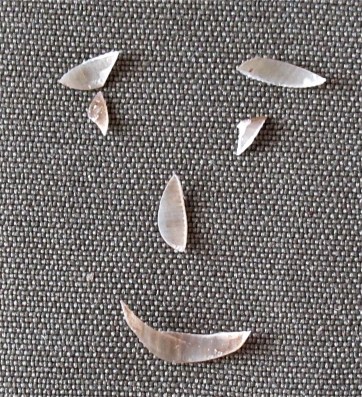
The capturing of a moment: a sunset, a new bird at the feeder, deer wandering through the garden, a black bear visiting, rain on a spider web, sunlight through a prism, a cat made out of cherry stones … the re-creation of the moment is the creation of the memory. More bubbles flow on the surface of the stream.

(4) I go for a walk, look at nature and the world around me, people too
It is incredibly important to do this. A visit to the local coffee shop, a walk around the super-market or corner store, a seat in the park on a sunny day … just be yourself, believe in your existence, watch things as they happen, relax, look and listen, empty yourself, let the world flow back in … look at the ducks on the lake or the goldfish in the tank … more bubbles on the water, more ideas floating down the stream …

(5) I listen to music
De gustibus non disputandum … we can’t argue about taste. Where music goes, each person must make their own choices. The music I like fills my mind, relaxes me, flows out when it ends, takes my mind for a walk and leaves … a vacuum … into which dreams and colors, words and ideas, build like clouds …

(6) I cook
Cooking has always relaxed me. Sometimes the repeating of an old recipe helps clear my mind. Sometimes I have a need to invent something new. Hands and mind occupied, the secret, sacred underground river of creativity flows on …

(7) I sew
Last summer, an unexpected event led me to join a quilting group … oh what fun … a man quilting among a dozen women … I learned so many things … so many different ways of looking at the world … so many concepts that I would never have dreamed of on my own … Sewing runs in the family: I still have my grandfather’s sewing kit … darning and sewing needles that served him for two years before the mast … that darned his socks as he survived in the trenches of the First World War … it bears his name and I use it with pride … and what memories arise in my mind as I choose the needle … his needle … the one that will lead me into the next adventure, be it quilt, button or patch …

(8) I keep a journal
… and come hell or high water, I write in it every day and have done so since 1985. That’s 31 years during which I have scarcely missed a day. The writing maybe banal, it may be nothing but a note on the weather or a comment on a sporting event … but it’s there … a vital challenge to the idea that Writer’s Block can take me over and stop me writing. This journal is 95% drivel … maybe more … but bobbing along the stream of words are ideas, verses, rhyme schemes, choruses, stories, flashes of inspiration, jokes, memories, magic moments, falling stars, … the secret is to catch these falling stars, to recognize these rough diamonds and to return to them and polish when the moment is ripe … and it will be, sooner or later … for bubbles are buoyant and will lift you to the stars.

(9) Free Writing and the Creation of Metaphors
I also use the journal for free writing and automatic writing. These techniques, drawn from the Surrealists, allow the mind to wander at random. While wandering, the mind creates an interior monologue or a stream of consciousness that in fact turns up a series of delightful metaphors that can be polished and re-used at will. When I use this style of writing, I am reminded of Dalí’s saying (again and as always, from memory): “I don’t know what it means, but I know it means something.” My own theory of metaphor is that the metaphor is defined by two (sometimes more) points and rather than settling on one or the other (as in a simile), the mind moves and flickers sub-consciously between the two extremes so that meaning is sensed, but rarely can be grasped or stated in definitive terms. Thus, the marvelous line from André Breton, quoted by Mr. Cake,  “The wolves are clothed in mirrors of snow” has, according to my theory of metaphor, four defining points, namely, wolves … clothed … mirrors … snow. All four of these defining points creates an image, a very personal image, in the reader’s mind. The mind moves quickly between each defining point and meaning is lost in the rapid shift from image to image. Quite simply, “the hand cannot grasp it, nor the mind exceed it.” This means we have to return, as readers, to the unconscious level where the metaphors were first created. Then: “when we no longer seek it, it is with us.” This same analytical exercise can be performed for each line of Breton’s poem. When we indulge in free writing, much of what we write can be abandoned. The secret is to recognize and rescue the little gems we so often find.

(10) I believe
Through all this runs a thread of belief … belief that the black cloud of despair will not win. The Writer’s Block will go. Creativity will never be not lost. It is there, beneath the surface, always ready to be contacted, waiting to rise and take you over again. And all too soon and quite unexpectedly, one form of creativity slips into another and the creative writing (it never really went away because of the journal) comes back.

Writer’s Block: it does exist. It’s how we deal with it that’s important. Creativity rules: forget Writer’s Block and let creativity and the multiple ways back to creativity grow and flow. Sooner or later the clouds will lift, the sun will return, the block will unblock and the words will flow again.

Remember the words on the Roman sundial: Horas non numero nisi serenas … I count only the happy hours. And remember: the clouds will lift, the sun will return.

Trust me.
And believe.