MT 2-6 Monkey Meets An Anarchist Ant

img_0188

MT 2.6
Monkey Meets An Anarchist Ant

(Memories of El Camino de Santiago)

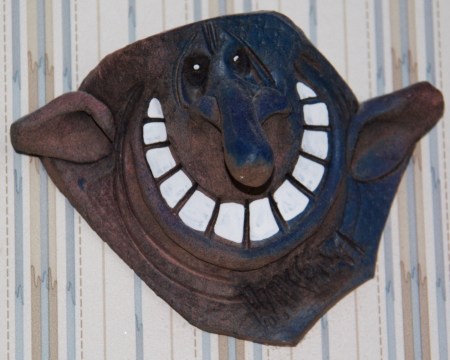
The anarchist ant dresses in black.
He wears a little red base-ball cap
backwards on his head.
His eyes are fiery coals.

“Phooey!” He says.
“It’s folly to go with the flow.”
So he turns his back
on his companions and marches
in the other direction.

Some ants call him a fool.
The Ant Police try to turn him.
The Thought Police try
to make him change his mind.

Others, in blind obedience
to a thwarted, intolerant authority,
first bully him, then beat him,
then bite him till he’s dead.

Comment: One of the legends of the Road to St. James, the pilgrim route across Northern Spain that I walked in 1979, states that if you do not walk the road as a human being, in your own lifetime, you will come back as an ant and be forced to walk it ant form, when you are dead. I stood on the hill outside Astorga, looking back at the city. On the old pilgrim road, at my feet, and beneath the old Cruz de Harapos, a colony of ants was busy walking in a long line towards Santiago de Compostela. One turned his back on the group and started to walk the other way, but he didn’t last long. “Go to the ant, thou sluggard.” Fair enough. But watch out for the ant-police and the thought-police. 

Obsolescence

img_0281

Obsolescence

The programs that no longer work.
The files you can no longer access.
Photos that vanish
leaving a blank space in the album.

Memory that goes on the blink.
Forgotten phone numbers,
the birthdays of family members,
that carton of eggs left in the store,
your cousin’s face, her name,
the parking spot where you left your car.

“What day is it today,” you ask,
for the second or third time.
“What time is it?”
“Who’s that coming for tea?
Are you sure I know them, dear?”
“Where did you say we were going?”

“Just round the corner, to visit a friend.”
Or should that be … round the bend?

Comment: Apparently I placed this poem on Facebook a year ago, but I have found no trace of it here, on the blog. This time last year, I lost both of my computers to what was diagnosed as obsolescence. Luckily I had most things backed up. The group who swore they could transfer 99% of my hard-drive material to the new machine, migrated just 1% (my desk top) and the other 99% went on walkabout. I was able to piece much of it back together, but obsolescent programs and out of date apps no longer functioned. So much material was deemed irretrievable. This experience made me realize, yet again, how fragile is our hold on our possessions, our memories, our sanity, and yes, our very lives. For me, it is a very sobering thought that, with a flick of a switch, I, like my computer, could be turned off, and 99.9% of the wonders of my beautiful existence would totally disappear from the memory-banks of this earth. Some say, and I believe them, that, like my computer, I will be re-cycled, recirculated. I will become a part of the wider oceanic world-consciousness. Alas, we can have faith in whatever we wish to believe, but sometimes, we really don’t know.

MT 2-5 Monkey Meets Pontius Parrot

img_0181

Monkey
Meets
Pontius Parrot
(With glorious  memories of Macarronic Latin)

 Pontius Parrot is very clever
and very pontifical.
He pontificates from his pulpit.
“Pretty Polly!”

His name isn’t Polly
and he doesn’t have a pulpit
but he parrots words
in Macaronic Latin:

“Caesar adsum jam forte.”

Pontius Parrot is
perky at the podium.
He bounces up and down,
preens himself prettily,
rattles his chains,
shakes his bars:

“Brutus aderat.”

 Shame and scandal
wear him down.
A dysfunctional family
of feathered friends
henpecked him
until he was black and blue
and threw up copiously:

 “Caesar sic in omnibus.”

He dips his wings in holy water,
calls for some soft soap,
and washes
feathers and claws.

Poor Pontius Parrot,
He can only say
“Repent!”

“Brutus sic in at.”

Comment: Anyone who suffered through school Latin, especially if they went to boarding school or grammar school, will recognize famous Macarronic Latin quotes such as the verb bendo, whackere, ouchi, sorebum, and the one the author of Monkey Temple reproduces in the above poem. If you are unfamiliar with Macarroni Latin and have had the good fortune to have avoided both grammar and boarding schools, just read the Latin normally in English and you will establish its Macarronic meaning.

MT 2-4 Monkey Visits the Chimpanzees’ Tea Party

img_0181

MT 2-4
Monkey Visits
the Chimpanzees’
Tea Party

Dressed to the nines in their gala outfits,
they have come here for the tea party.

Hairy penguins,
they waddle back and forth
across the temple,
then lunge for a table
with its jumbo shrimp,
smoked salmon,
scallops, baked oysters.

Faces slashed from ear to ear
by enormous grins,
“Food’s free!” they say
and stuff themselves
regardless of the consequences.

Serviettes tucked into collars,
they scoff lobster and crab.
Birds of Paradise,
subtle delicacies
flown in from half a world away,
decorate the tables.

There is something about them,
these chimpanzees,
gripping cup handles
between finger and thumb,
enormously pleased to be
the centre of attention,
however clumsily they walk
in their hired-for-the -occasion,
ill-fitting, black and whte
penguin suits.

MT 2-3 Monkey Visits the Poisonous Snakes

MT 2-3
Monkey Visits the Poisonous Snakes

img_0181

Monkey Visits the Poisonous Snakes

A swift death
was never their style,
the cobras, the vipers,
the adders and subtractors,
the bean counters and snatchers,
the diminutive dudes.

They prefer death
by blow-gun
their poison dart
injected through
hollowed fangs

or Chinese Water Torture,
the slow drip after drip
of poison inserted into ears
and veins, a drop at a time,
and slowly gathering …

… until their victim slows down,
ceases to struggle,
stands there, eyes open,
unable to move,
poisoned and paralysed.

Comment: with all the exciting things that are happening concerning my new poetry writing, I forgot all about my monkeys. It seems they have been bouncing up and down, fretting in their cages, bounding all over the ruined, broken-down temple, poor little blighters. Apparently, on their last visit to the rest of Bristol Zoo, they left the big snakes and decided to visit the little, poisonous ones. I guess they didn’t like them at all. Does anyone? I hope there are no ‘snakes in the grass’ near you, and I don’t mean grass snakes. And watch out for snake charmers, some of those snakes believe more in harm than charms.

PS Let me know if you want a voice text. I haven’t recorded this one yet.

Loss of …

IMG_0062.JPG

Loss of …

By the time I remembered your name,
I had forgotten your face. Then I couldn’t
recall why I wanted to talk to you.

I trace dark landmarks on the back of scarred
hands: blood maps, unremembered encounters,
dust covered photographs, grey, grim, anonymous,

not belonging in any family album.
At night I cruise among islands, emerald green
against sapphire seas. Why didn’t I visit

some of these places? Golden sand trickles through
night’s fingers and time’s hour glass, as stars
sparkle and planets dance in Platonic skies.

My memory fails. I wake each morning
unaware of where I have been the night before.
I track the sails of drifting ships, white moths.

I think I have caught them in overnight traps,
but they fly each morning in dawn’s forgiving light.
I give chase with pen and paper, fine butterfly nets

seeking wild thoughts waiting to be caught, then tamed.
I grasp at something just beyond my fingertips,
but I can’t quite remember what it is.

Comment: I first published this poem on July 31, 2018 (click here for the original post). Here it is now, in revised form. I find the revision process to be totally fascinating: the polishing of old ideas, the arrival of new ones, a different structure, a reshaping of the poem’s internal logic. So much happens in the revision process. Many great poets wrote and rewrote their poems, again and again.  I consider Francisco de Quevedo and Juan Ramón Jiménez to be poets who continually revised. A perusal of the variants to their poems (28 versions in the case of some of Quevedo’s poems) gives the reader an understanding of how the great poets think, of how they purge, intensify, sometimes simplify, usually improve their initial instincts. We lesser poets can learn so much from the greats. Above all, we can understand that poetry is a life-long practice, that it is a love of words and emotions, that it is a desire to catch and preserve the uncatchable that can never be completely caught. The critics say that the reader can never know the writer’s intentions. I agree with that, to a certain extent, as I never know why I am writing what I put down on the page. I guess I often have no intent. More important, my original intention can change as I write, and what I write is by no means what you understand I wrote when you read, for each of us processes the imagery, especially metaphors, in a different, and very personal, fashion. That said, when I rewrite a thought pattern emerges and my intentions become that much clearer, not from the words on the page, but from the footpath that led me in different directions until the final version emerged on the page.
Purple

IMG_0067

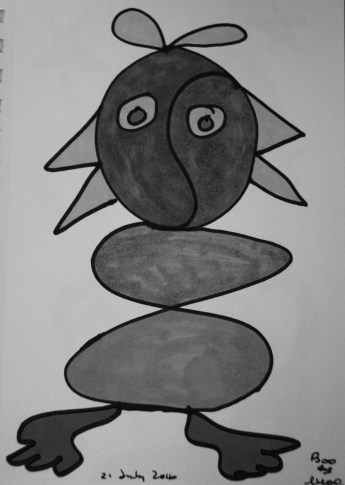
Purple

I write poems
in green ink,

but I prefer
purple.

Bruised clouds
on an evening sky,
dark depths
of a rainbow glow,
Northern Lights
singing at the deep
end of their scale …

or just a desire
to be different …
slightly different ..

as if that one thing,
the color of my ink,
might tip the scales
and turn me
from mediocrity
to celebrity

with a wave
of a violet wand.

or the click
of a pair
of ink-stained
fingers.

Welsh Miners

img_0184

Miners

What has become of the caged
canary who lit up my life?
I hear the pit pines creaking.
Now nobody dares strike a match.

Birds descending in an iron cage,
our lungs blackened and scarred,
scared, we sing dark hymns
knowing we are doomed.

On hands and knees, we crawl
to the coal-black altars of our gods.
Blind from birth, pit ponies
trust us in their solitudes.

Don’t they know that when
the canary falls from its perch,
we’ll abandon them and claw
our way, anywhere, to safety?

Within the chalk tomb-tunnels
of my calcined skull,
a lone thought searches
an abandoned mine for a memory
it can no longer find.

Procrastination

IMG_0146

Procrastination
for my friend, Mr. Cake

It’s old age, I think:
I can manage
one thing a day,
depends on the weather,
then I forget,
then I remember,
but the weather isn’t right,
so I put it off again,
start a story,
write a poem,
the phone rings,
someone texts me,
there’s a knock on the door,
the crows in the garden
make me procrastinate,
(crass  Latin joke*),
then I remember
and feel sad,
and hair leaks from my head
like straw from a scarecrow,
and my teddy bear brain
turns to sawdust
when I scratch,
and what was I saying?
I guess I’ve forgotten,
I’ll sleep on it tonight,
and write again
tomorrow.

Note:
Crass Latin joke*
Cras is the Latin for tomorrow. Cras is also the sound, in Latin, that the crows make. Hence Pro-cras-tinate: to leave things for tomorrow, or to abandon them for tomorrow’s crows. The joke probably doesn’t belong in the poem, but darn, it’s my poem and I’m leaving it in there.

Comment:
This collection of thoughts started in a casual online exchange with my good friend, Mr. Cake. Sometimes words flow and it’s impossible to stop them. Sometimes, they hover like crows or croak at us from the tree tops where they sit ungraspable. My spellcheck tells me that’s not a word, but if it isn’t, it ought to be. Whatever: the world and its words are sometimes surreal and if you are interested in the surreal, then Mr. Cake’s blog is the place to be. Here’s the link. The site comes highly recommended. Click on it now and don’t procrastinate. Mr. Cake’s Blog.

Butterflies

img_0189

Butterflies

“Poetry gives permanence to the temporal forms of the self.”
Miguel de Unamuno.

That is what my writing is all about,
those temporal forms, fluttering and changing.
Butterflies, they live for a day or two,
perch and flourish, spread their wings,
excel for a moment, catch my attention,
then blown by a sudden gust of wind,
they tear their wings on a thorn
and perish in the blink of an eye.

Reborn in ditches, they cluster and gather,
congregate, black and yellow, on bees’ balm,
smother Cape Daisies and Black-eyed Susans.

Like shadows they shimmer, butterflies by day,
fireflies by night, terrestrial stars, lost, wandering,
floating in their forest firmament, hackmatack,
black oak, bird’s eye maple, silver birch, fir …

Impermanence surrounds us, dances beneath stars,
sings with robins, echoes the owl’s cry through woodlands,
poetry, the elemental soul, our words capturing nothing,
turning it into eternity, holding it for the briefest moment,
then letting it go. Island View, New Brunswick, Canada,
my home in the woods, my dialog with my place and time.