Tracks

IMG_0777

Tracks
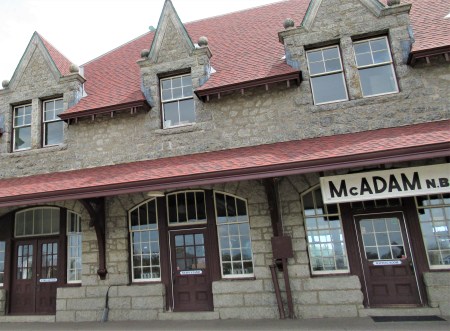
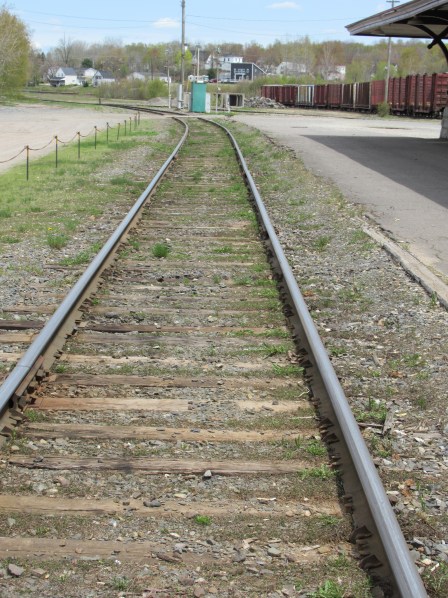
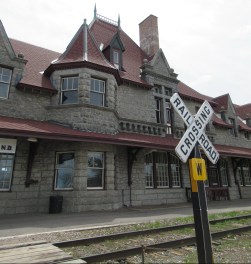
McAdam Railway Station #12

“Put your fingertips on the rail,
see if you can feel its pulsing beat.

No heart rail rhythm now. No tremble.
Put your ear on cold metal:

nothing but silence. No murmur,
however distant. Black fly whine.

No-see-ums flit. The train track’s
buzz of harmony is lost and gone,

replaced by careless nature. Listen
to the wind whistling in the woods,

hark to spring sounds, so subtle,
grass growing, rust accumulating,

sleepers turning over in their graves,
silent, rotting beneath forgotten rails.”

Comment: Nothing so lonely as an abandoned railway track, rusting beneath snow and rain, the wooden sleepers rotting into oblivion. That said, the Southern New Brunswick Railway still carries freight trains through McAdam, and it is the railway station that suffered, with the loss of passenger traffic, rather than the rails themselves. What a pleasure, incidentally, to hear the hoot of the approaching diesel, to count the wagons as the train came to a halt outside the station. Then came the joy of watching the engine separate wagons from the main train, shunt them into sidings, return, and take the freight train, slow at first, but rapidly gathering speed, out of the station and away into the distance. Such memories. So many ghost trains riding those rails. So many ghosts bewitching the windmills of the child’s mind that still inhabits the ageing brain.

IMG_0780


Faces

IMG_0258.JPG

Faces
McAdam Railway Station #10

“White at windows
when trains pass through
in June on their way
to summer and sand.

Wind-tousled, tanned
at summer’s end
returning home to
Boston and Montreal.

I remember them
waving their hands,
flickering white hankies
as they went by.

This station is a ghost train
that travels through time
instead of space. Stand
still as silent stone. Wait.

Look: there’s someone,
waving at us now
from that window
on the second floor.”


IMG_0782 (2).JPG


Hospital

IMG_0811 (2).JPG

Hospital
McAdam Railway Station #9

“I was here the day they
took the hospital away.
I gave some writing workshops.
Teachers upset, students in tears,

everywhere, fear and despair.
‘I was born in that hospital.’
‘My grandfather died there.’
‘Where will my child be born?’

I helped them write down
their memories and fears,
their hopes and dreams.
My lesson plans vanished.

How could they survive
when life’s rising tide
broke all bulwarks,
flooded open hearts.

A wounded community,
diminished by its loss,
they took me into their hearts.
Their loneliness wrapped me.

They wrote down memories.
Tears stained every page.”

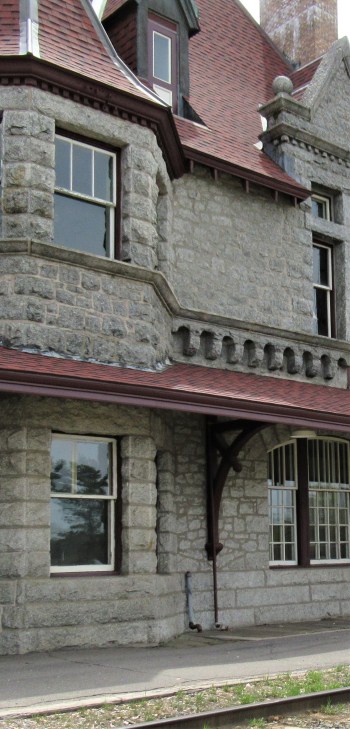
Comment: This is one of my memories of being in McAdam. I was invited to run a series of writing workshops there, under the Writers’ Federation of New Brunswick  (WFNB) WiSP (Writers in Schools Program). I arrived there the week the announcement was made that the local hospital would close. I remember all too well the effect that this announcement had on the local community and I have tried to express that anger, sorrow, despair, fear, resentment in the above poem. More than anything, I felt the sorrow and despair of students and teachers. It is so easy to make an executive decision, at a distance, to rip the beating heart out of a living community on financial grounds. It is so difficult to revive the patient after the act of removal. What amazes me about McAdam is the effort hat volunteers are making to rebuild their town. Their words and deeds are truly impressive: as impressive as their magnificent railway station, now declared a national heritage site.

S.O.S

IMG_0678 (2).JPG


S. O .S.
McAdam Railway Station #8

“Dozing in the cab, I was.
Smelt a different smoke.
It wasn’t my engine’s.

Looked around.
Saw flames. One, two,
three houses on fire.

Steam was up. Yessir.
Three short hoots I gave.
Three long. Three short.

S.O.S. Mayday. Mayday.
S.O.S. S.O.S. Kept going
till house lights came on.

People running. Leaving homes.
Jumped out of the cab.
Ran out to help them.

They thanked me.
Said I had saved their lives.
What else could I have done?”

Comment: This is a third hand poem. It came to me from Geoff who heard the story from the hardware store owner who witnessed the fire. The narrator is the anonymous engine driver who raised the alarm. Of course I don’t know exactly what he did, said, or thought. Our knowledge of history can be divided into two great moments: the momentous events, recorded by expert historians via diligent research, and intra-historia, as Miguel de Unamuno, that great Spanish philosopher and rector of Salamanca University called it, referring to those small, individual moments when history is made by anonymous human beings who did what they had to do and then faded into the anonymity of a distant past, now wrapped in silence, as is the store-keeper and the driver of the train.

IMG_0678 (2).JPG

Shunting

IMG_0777.JPG

Shunting
McAdam Railway Station # 7

So many memories
cling like hobos
to freight trains.

Tracks as always,
sleepers, steel rails
an optical illusion,

joining in the distance
where the miles
between now and then

knit themselves together
and we are young once more,
riding the rails,

dreaming of towns
beyond this town,
dreaming of the future,
not the past.

Comment: This is one of my own memories. We lived by the railway yards in Swansea and again in Cardiff. The trains were a regular part of my dreams. I lay awake one night waiting for the 3:20 to London, but it never came. I couldn’t sleep, waiting for that train. Next day I learned that there had been a railway accident. When I returned to boarding school after the holidays, I would lie awake at night waiting for trains that never arrived. We had a track close to the school, but we called it the Beetle Crusher because it was old and rusty and used so rarely that the beetles, who never knew when it was coming, would get crushed when it arrived. I have written a book about that train and that school, but I have yet to publish it. When I was very young and we travelled to London on the Great Western Railway (GWR) train from Swansea High Street, we had to go up to the engine driver and say ‘hello’. And then we had to thank the engine before we set off. Iron, steam, coal, inanimate to many perhaps, but live living animated beings young children who sat, like our ancestors in Gower caves, and watched the pictures the sea-coal flames painted in the fire.

Master Clock

IMG_0687 (3).JPG

Master Clock
McAdam Railway Station 4

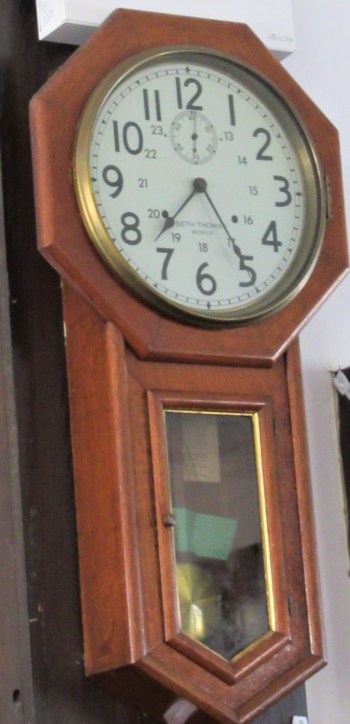
“It came from the Empress,
in Victoria. It won’t work here,
I’m afraid. It’s the clock
that runs all the clocks
and keeps them on time.

It needs a network.
ten, twenty, thirty clocks
that it can control
from its central circuit,
keeping them all on time.

Just like the railway.
The trains were always on time.
Except, just like this clock,
they don’t run anymore.”

Comment: I don’t have a picture of the Master Clock at McAdam Railway Station. I guess I’ll have to take one next time I visit McAdam. This clock can be found in the dining room. Like the Master Clock, it too has stopped. Known in Wales as Grandmother Clocks, these pendulum clocks are designed to hang on the wall rather than to stand on the floor like Grandfather Clocks. Can a Grandmother Clock be a Master Clock? I’ll leave that semantic conundrum to the experts in linguistics. While they are all arguing about it, I will just say that Elsie, who else, told the story of the Master Clock to a group of tourists from Nova Scotia while I was listening.

Defenestration


IMG_0781 (2).JPG

Defenestration
McAdam Railway Station 4

“When I first walked
by that tiny window,
right up there,
on the third floor,
I wanted to go up to it,
to stand there, to look out.

There was a young girl,
went up there one morning,
opened the window,
and threw herself out.

She must have been desperate.
Rejected by her lover,
who knows what state she was in.”

Defenestration?
It’s a funny word,
I had to look it up.

It’s from the Latin:
de means out from,
fenestra is the window,
fenêtre in French.

“She just opened the window
and threw herself out.”

Comment:  Geoff, in his role as tour guide, took Clare up to the third floor, showed her this window, and told her the story of the young girl who had jumped out, killing herself in the process. Clare said she was fascinated by the story and felt an urgent desire to stand there, and look out of the window. I am so glad she didn’t feel the need to throw herself out. Oral tradition: I love the way stories are passed from mouth to mouth, changing slightly all the while. Why did the young woman kill herself? Was she pregnant? We can only speculate and I guess we’ll never know for certain.

A Three Year Old Girl

img_0181

A Three-Year Old Girl
McAdam Railway Station #3

“I often see her, walking around,
standing in a doorway,
looking into a room.

She’s very curious
but never says a word.
Doesn’t ask questions.

She’s not scary at all,
like some of the others.

There are rooms here
where people won’t go
if they’re alone.

But they mean no harm,
these broken ghosts.

They’re lost, nowhere
else to go, I guess.
Just missed the last train”

Comment: Another story from Elsie, who says she often sees this young child in one room or another. The station is indeed filled with many memories and you can feel warm and cold presences throughout the building. Some rooms are filled with foreboding, while others are warm and comforting. Many old buildings have these qualities as do the old iron age walled camps scattered around the south of England. Maiden Castle and Badbury Rings spring to mind, as do Westbury White Horse, Corfe Castle and parts of Brownsea Island in Poole Harbour. Do I believe in ghosts? I echo the words of my mentor and fellow-countryman, Dylan Thomas: “I’d be a fool if I didn’t.”

Fourteen

IMG_0774.JPG
Fourteen
McAdam Railway Station 2

“Fourteen years old, he was.
Left school to work at the station.
Pushed brooms, did the cleaning.

Walked into the men’s washroom
early one morning to give it a clean.
Found a man hanging there, dead.

Took out his pocket knife,
cut him down, called for help.

I met him at the station
when he was ninety-three.

He told me all about it,
shrunk in size he did
as he told his story, shrunk

until he was the same size
he was at fourteen.”

Comment:
Another story from Elsie, one of the guides at the McAdam Railway Station and the President of the Macadam Historical Association. A true historian, she is gifted with an uncanny ability to condense a remembered incident into a minimum of poetic words. Thank you, Elsie, for allowing me to access your memory and repeat what you told me. It is an honor and a pleasure to do so.

Quill

IMG_0753 (2).JPG

Quill

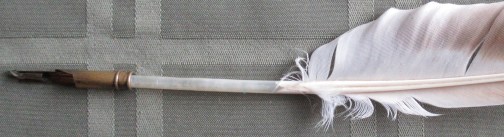
This old fashioned quill,
a goose feather, plucked,
trimmed, and split,
hare-lip of split hairs,
words and ideas cleft,
sucked in, thrown out,
no clout in the cloister
where the mind walks dry
amidst terminal showers,
meteors of rhyme and reason,
shootings stars falling,
filled with imperfections,
each star a still-born child,
running wild in some meadow,
a heavenly paradise
where walled-in imps
seek an exit outside the box
into which they have been boxed,
with mindless spiders
weaving webs of fine spun words,
filling the sails of pea-green boats,
laden with meanings
destined to set out
and never arrive.