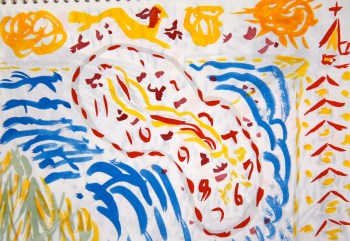
Reversing Falls

IMG_0158

Reversing Falls
Saint John, NB

Quietly, the tide turns,
holds back the river’s flow,
pushes fresh waters
backwards, holds them up
against their will.
The river builds and gains
in strength. The tide water
weakens, its muscles can
no longer support
the river’s weight. The tide
ebbs, flows out of the bay,
slowly at first, then with
ever quickening steps.
The river grows strong,
pushes back against the tide
and renews its seaward flow.

Comment: Just back from Saint John, New Brunswick and the WordSpring meeting of the Writers’ Federation of New Brunswick (WFNB): theme … Finding Your Voice. I gave two seminars, one on Friday night (30 participants) about choosing your text for a literary reading and the other on Saturday afternoon (25 participants) about meeting your metaphor and finding your voice. I had a great time and I hope the other participants did too. We finished the Saturday afternoon seminar with a sing-song, so I guess a good time was had by all. Oh yes, and I did a Blue Pencil Café and several one-on-ones that were wonderful. I attended some very fine sessions, too, heard some great people read, play the piano, and sing. Oh yes, the hospitality and food in the Harbour Hilton was excellent. It was a fabulous weekend and I would like to give a big thank you to all who made it possible, especially my guide, the poet Annette, and the chief organizers, Andrea, Cathy, Gwen, and Rosalyn. If I have missed anyone out, forgive me. The omission is by accident, not design.

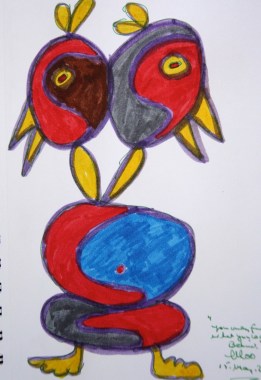
It’s Over

IMG_0188

It’s Over

The big top’s empty now.
The crowd’s gone home.
The trainer’s put down his whip
and lions and tigers are safely
asleep back in their cages.
Dim are lime and spotlights.
Yellow glow caravan windows
as juggler and clowns wipe
clean their grease paint smiles,
strip off their sequined clothes,
and prepare for bed. One by one,
the lights go out until darkness
rules menagerie and circus.
Only in the heads of little boys
and girls do the dancers still dance,
the ponies still prance, the tamers
still crack their whips and hold up
their chairs to keep wild animals
glued to their perches, while high
above, in the bedroom’s canvas roof
wire walkers strut their stuff, above
white sheets and the safety nets
of Teddy clutched, and mattress.

Ticks

img_0177-2

Ticks

Ticks, as a student, are never to be feared.
They are good for you,
mark your rites of passage,
never catch on your skin
or bite into your beard.

Ticks in the woods creep and crawl,
people really don’t like them at all.
They fall and they climb,
bring diseases like Lyme.

Leeches are bad and suck at your blood.
They swell up with your juices
as you well knew they would.
But leeches don’t kill, as tick bites might.
So get out your tweezers and squish ticks on sight.

Comment: Ticks are about. Watch out for them and be very careful with them. Announcement on CBC Radio, 19 May 2017.

Weird

img_0380-2

Weird

Weird these words
dropping in inky
drops from pen end
poised above paper:
a variety of poses.

Not for me the key
-board’s voluminous
vocabulary, nor the tap,
tap, tap, fingers on lap
top to search for a word,
an idea, a distraction
just a tap away.

For me, the slow flow
of thought, the clumping
together of the mind’s
pretty litter of ideas
milked slowly, one by
one from a cornucopia:
happy creativity.

Triumphs


Avila 2008 006.jpg

Triumphs

Now is the time of minor triumphs:
waking to birdsong in the morning,
making it safely to the bathroom,
shaving without cutting my face,
getting in and out of the shower
with neither a slip nor a fall,
drying those parts of the body
that are now so difficult to reach,
especially between my far-off toes,
pulling my shirt over sticky patches
still damp from the shower,
negotiating each leg of my pants,
tugging the pulleys that permit
my socks to glide onto my feet,
forcing my feet into my shoes,
hobbling to the top of the stairs
and lurching down them, left
then right, one step at a time …

Bears

Empress 048

BEARS

Think of pink salmon caught in pools,
plucked from water, tossed to air,
the catch stacked rainbow‑fired.

Winter now:
unsnubbable, lumbering overcoats
closeted, laid to rest;
seeking power in hibernation
till sun from summit melts frosty dark:
fresh heartbeats forged in forest’s night.

Think alchemy:
prime matter moved safely in flask or jar.

Think circus stars:
The Great Bear leads the Lesser,
dancing to the trainer’s whip,
tumbling from their pedestals.

Secure behind bars,
think fallen stars.

Punctuation in Poetry

img_0177

Punctuation in Poetry

Gardeners

when three bearded men
unbury winter’s bones they pick
at old wood scars dead trees and
their limbs now lying there lifeless

they dig deep at flowerbeds
uprooting a riot of Japanese
Knot Weed untangling roots
all tangled and twisted with
Bees’ Balm and perennials
that stray across borders
unwelcome immigrants neither
barriers nor fences can possibly hold

they probe between flag-
stones where wintering birds
and squirrels and chipmunks
cracked the seeds and wild weeds
that grow there and flourish

but where would the land be
and what would it accomplish
without helping hands
and the power of strong fingers
and fresh eyes that spot those
intruders who diminish
the space where good flowers
grow strong with fresh herbs
chives and oregano basil
and parsley peppermint sweet
crushed beneath feet

Comment: I posted this poem yesterday. It’s another raw poem. On re-reading it, I found it confusing. To punctuate or not to punctuate, that was my question. I decided to rewrite it and use punctuation. Here’s the new version.

Gardeners

Three bearded boys unbury
winter’s bones. They pick
at old wood scars, dead trees and
their limbs now lying lifeless.

They dig deep at flowerbeds
uprooting a riot of Japanese
Knot Weed, untangling roots
all tangled and twisted:
Bees’ Balm, Cape Daisies,
and quick-growing weeds
that run across borders,
unwelcome migrants
that barriers can’t hold.

They flourish between flag-stones
where wintering birds,
squirrels, and chipmunks
cracked seeds from the feeders.

Where would the land be,
and what would it accomplish
without helping hands,
the power of strong fingers
that pluck out the intruders
that infringe on the spaces
where proper plants grow
unthreatened by weeds?

Second Comment: Both versions work, but in different ways. The first version is more spontaneous and less logical. It allows thought and image to freely flow, but there’s some repetition and a certain lack of clarity. It does allow the  reader to be creative and to seek for alternate meanings and choose the combinations that please the most. The second version is more logical and expresses a slightly different train of thought. Punctuation forces revision and a revision that punctuates demands good grammar, less freedom of speech. The result is a tighter, much closer expression. By extension, the need to punctuate also demands more thought, more concision. Needless words are eliminated. Better combinations are possible. In addition, I find the rhythm becomes more prominent, but less spontaneous. To punctuate or not to punctuate: only the poet can decide, but any comments will be most welcome.

.

Gardeners

IMG_0486.jpg

Gardeners

when three bearded men
unbury winter’s bones they pick
at old wood scars dead trees and
their limbs now lying there lifeless

they dig deep at flowerbeds
uprooting a riot of Japanese
Knot Weed untangling roots
all tangled and twisted with
Bees’ Balm and perennials
that stray across borders
unwelcome immigrants neither
barriers nor fences can possibly hold

they probe between flag-
stones where wintering birds
and squirrels and chipmunks
cracked the seeds and wild weeds
that grow there and flourish

but where would the land be
and what would it accomplish
without helping hands
and the power of strong fingers
and fresh eyes that spot those
intruders who diminish
the space where good flowers
grow strong with fresh herbs
chives and oregano basil
and parsley peppermint sweet
crushed beneath feet

Comment: This was the day for Thursday Thoughts, but I don’t have any, save for those in the poem. How does Mother nature manage without us? What is the difference between a weed and a flower? Why do the dandelions dance in my garden and why so many, fresh every spring? What happens when the gardeners no longer garden and nature takes over? Is the wilderness that arrives really a wilderness? The garden that grows, does it really need us? Do we own the land, or does the land own us? The same with development: do we shape the land or does the land shape us? Was the wilderness a wilderness before we arrived? I watch the deer drifting past the trees in the garden. They are so tolerant, so aware of my presence. “Beware of the possessive,” my teddy bear tells me. “I’m not your Teddy and you’re not my master. The world exists without you possessing it. It will continue without you. And yes, I can hear you: ‘my flowers, my garden, my bees and my deer, my house and my grounds, my groundhog and my Teddy.”‘ “My God,” says the Teddy Bear who sits on my bed and hears me snore and watches me dreaming … “Whatever are you thinking?”

Battle Axe

img_0199

Battle Axe

Grim-faced, ageing,
wrinkles bone-deep
sculpting her skin
into unsightly waves,
a grimaced frown,
much practiced,
worn as a mask
to keep the world at bay.

Over her shoulder,
the mail-pouch slung,
brimful of letters,
bills, in all probability,
their content unknown
until the recipient’s
thumb or pocket knife
slits open the envelope
and reveals the secrets.

She carries more secrets.
They bob along in the streams
that flow beneath her skin
where joy and sorrow mingle.

Tomorrow, the surgeons
will perform their biopsy
and search out those secrets.
For now, she walks
with her eyes cast down,
unwilling  to meet
my all-seeing gaze.