In one room in my head my mother’s mother sits with me on her knee at the kitchen table playing patience.
Elsewhere, I stand on a stool beside my father’s mother helping her to mix the cake she will later bake in the coal-fired oven of the black, cast iron stove.
My mother’s father sits before the television. He leans back in the chair, raises his foot so he can’t see the adverts on the screen, and puts his fingers in his ears.
My father’s father lies in bed, downstairs, in the middle room. His dog lies beside him, licking his hand. We all wait for the death that has haunted him since he was gassed in World War One.
Clare sits at the computer, following the figures that track the pandemic. I sit here watching her, humming softly to myself: “¡Qué será, será!”
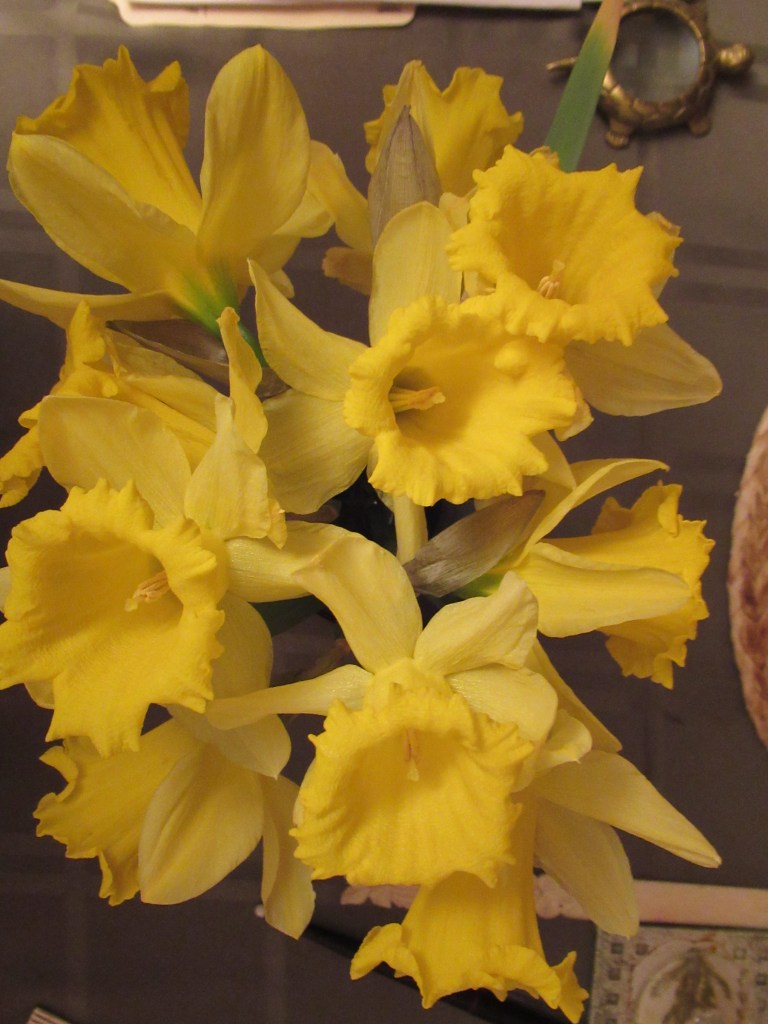
These daffodils were not painted by an unknown painter, but by a painter whose paintings are unknown. There is a subtle difference. There is also something sweet abut covering a blank space with color and shape, even if the hand is unsteady and the eye unsure. This painting is also unframed and belongs in a photograph album or a long-forgotten painting book.
“Fair daffodils, we weep to see thee.” Indeed we do, for they are so transient lasting but a week, or less, cut and placed on the table in a vase of water. So sad to watch them as they stiffen, turn slowly brown, dry up, and then hang their heads in the shame of old age. We are not so dissimilar, those daffodils and me. This photo will capture me forever, or until it is erased, because a photo isn’t a photo anymore. That painting will capture those daffodils too, for little while, until my subscription to the blog runs out and I forget to renew it.
“Poor daffodils, we weep to see you.” But weep not for us, they tell me. Our day is done. Our life is fulfilled. We have brought beauty and scent, however brief, and we have given light to enlighten your daysand joy to light up your heart. And that, I guess, is the message. “Gather you daffodils while you may, for Father Time is flying. And those sweet blooms you pluck today, tomorrow will be dying.”
Thus it is during the Corona Virus 19 pandemic, and thus it was during the Spanish Flu, the Black Death, and all the other plagues that have come to bring understanding and make us see reason. Our lives are as short as the lives of flowers. Seize your life, hold it in both hands, admire it, enjoy it, make the most of the mall things, for they are often, like the smiles of small children and the daffodil’s golden glow, the most important things of all.
“The flowers that bloom in the spring, tra-la, bring promise of merry sunshine …” Gilbert and Sullivan, from The Mikado, if I remember correctly, and not at all anonymous like the Anonymous Bosch artist who painted this painting. Still, I like it, and it certainly lends a little bit of color to the pale cheeks of these walls.
“And we merrily dance and we sing, tr-la, as we welcome the promise they bring, tra-la, of a summer with roses and wine …” I can remember my grandfather singing that in the kitchen in Swansea. He would conduct with one hand, and encourage me to join in with the other. And I did. Merry days, they were, before the fire in winter and out in the greenhouse in early spring.
So, where have all the flowers gone? Gone with the grosbeaks, everyone. Which reminds me, I saw an Evening Grosbeak at the feeder this morning. The first one in years. There used to be several nesting nearby and they were regular visitors, as were the Gray Jays, aka Whisky Jacks, aka Gorbies, aka Ghosts of the Woods and all of them long, long gone.
Will they naw come back again? Who knows? The world is changing even as I sit at my window and watch it go by. February, March, April, May, June, and now July. The lock down has been lifted, but the fear of going unmasked in the great outdoors is still with us, as are the anonymous givers of the virus, a donation I do not want, and nor does anyone else, in their right minds, compus mentis, and not yet willing to on the anonymous ranks of the Gorbies, the Grosbeaks, the Swallows, and the other birds that have fled elsewhere, leaving our yard to the crows, the blue jays, the squirrels, the chipmunks, and the occasional more colorful visitors.
“Ah, would some power thegiftie ge us / to see ourselves as others see us.” Robbie Burns, a Scottish Poet.
And sometimes I think the flowers would like to be seen as they see themselves, not as we see them with our imperfect eyes, not with the cataracts of the Elderly Monet, not with the blunted vision of many artists who have stopped, and sniffed, and bent their heads, and wondered at the colors that entered their paint brushes through the nostrils. Vision and reality: the photo versus the objects as we see and sense them. The reality versus our own version of it.
So who is this anonymous artist who delivers these visions to my blog and allows me to glimpse alternate realities that are so different to my realities. I think of Lorna Crozier, The Garden Going on Without Us. I think of Kingsbrae Gardens, at night, when the flowers are alone and talk only to themselves. I think of Monet at Giverny as his vision lessened and his instincts grew. Who are we? What are we? Do we see ourselves as others see us? Do others see what we see? Color, shade, light, hue … El ojo que ves no es ojo porque lo ves, es ojo porque te ve / the eye you see is not an eye because you see it, it is an eye because it sees you (Antonio Machado). Does the man or woman looking out at us from the television set see him or herself as we see them?
The night before last I sat alone in a hotel room. The television screen was much, much wider than it was high. All the facial images were greatly distorted. I didn’t recognize the people I saw, except by their voices. Who will distinguish the reality of the flowers, each by each and one by one, privatim et seriatim? Who will listen to their floral voices and call them by the names they have given themselves, rather than by their horticultural names?
Tell me, what reality do we see when we see the flowers? What reality do the flowers see when they see us? The anonymous painter who painted this picture that Geoff Slater, my anonymous friend, framed so nicely did not see those flowers the way that I saw those flowers. Why not? Why can’t I see like him (or her)? and why can’t she (or he) see like me?
Every trip to Kingsbrae Garden in St. Andrews, New Brunswick, opens my eyes to more beauty. Yesterday, I brought back this painting, Night Garden, and placed it on the wall by the garage door so I would see it regularly when entering and leaving the house. Alas, I caught the reflection from the window in the photo, but the night flowers and their colouring make up for any lapses in my amateur photography.
The painting is neither signed nor dated, so this night artist will have to remain anonymous for now. My friend Geoff Slater framed the painting but my photo does not do justice to the beauty and skill of the frame. My apologies. Alas, I must live with my inadequacies, but at least I am aware of them!
I spent a wonderful day in Kingbrae / KIRA, incidentally, chatting over a glass of wine with some exceptional local visual artists who are spending four weeks (June and July) in day residencies and working out of the artists’ studios at KIRA. Geoff Slater, the Director of Art at KIRA, led the conversations and I joined in, as did Alana, Ann, Simone, Stephanie, and Simone’s visiting friend, Renate. When artists gather at KIRA to discuss their art, the conversation is wide ranging and varies from the intensely personal to universal theories of creativity. Visiting KIRA is an experience like no other and one that I delight in every time I visit.
This isn’t Blueberry. It’s Purple Martyn the Purple Peril. Never mind. He looks sad. Perhaps he’s feeling blue.
Blueberry and the Night Bumps
Blueberry is a nocturnal teddy bear. At night he stands by the side of my bed and protects me all night long. Before I get into bed, I take Blueberry from the dresser and place him beside my bed. Only when he is there, on guard, do I get into bed tuck myself in.
“Goodnight, Blueberry,” I say to him, but he never replies. He has a job to do. As I drop off to sleep, he comes alive. Some nights I pretend to fall asleep. When I start to fake snore, Blueberry begins to walk around the bedroom.
He walks to the door and makes sure it is properly shut. Then he looks under the chairs and behind the dresser. Next, he opens the closet door, looks in, and checks that no Night-Bumps are hiding in there waiting to go BUMP in the night.
I am afraid of those Night-Bumps. One night, when Blueberry wasn’t there, a Night-Bump came and sat on my head and went bump-bump-bump all night long. I couldn’t get any sleep. Next morning, my head ached and I didn’t want to eat my breakfast. Nasty Night-Bumps.
The last thing Blueberry does is to check beneath the bed. Sometimes he crawls right underneath it. One night, I woke up to hear an awful noise, squeaking and screaming and a gnashing of teeth. Then silence fell.
Blueberry emerged from beneath the bed holding something that once had wriggled but that would never wriggle again. He walked to the waste-paper basket in the corner, took out and old sheet of paper, wrapped his little bundle in it, dropped it into the basket, then came over to see me.
“That’s the last Night-Bump,” he said. “It struggled wildly, but I got it before it could go bump. You can go back to sleep now. No Night-Bump will go bump in here again. They are all too afraid of me to come back. And don’t worry: if there’s anything else comes in, I’ll get it.”
“Oh Blueberry,” I said, and reached out to hug him.
“Can’t do it,” he sat down and showed me the soles of his feet, one by one. LOVE YOU: these words decorate Blueberry’s two back paws, with one word sewn into each. Usually, I can only read the message by day, when Blueberry sits down and rests.
LOVE YOU stood out as he sat down and raised his legs to show me his message. Then he got back up.
“No hugs. I’m on duty. No nightmares. No worries. Sweet Dreams. And back to sleep you go now.”
And I did.
Next morning, I picked Blueberry up, gave him a big hug, and set him down on the dresser, feet up. LOVE YOU, his feet said.
“Love you too, Blueberry,” I said. And then I added: “Everybody needs a Blueberry.”
Rosie, Teddy (BR, LR) Basil, and Orange (FR, LR). They are on holiday in Ste. Luce-sur-mer. Blueberry gets car sick and refused to travel.
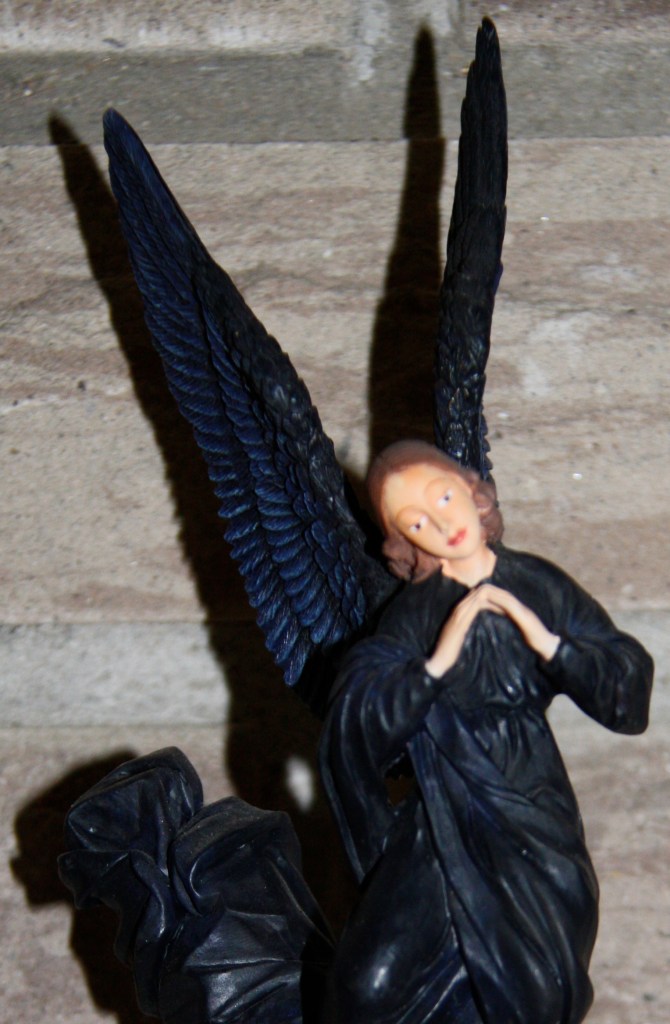
Teddy and the Angels
Warm in Bed. Cozy. I roll over and the flashlight clipped to my Teddy Bear’s ear drives its hard, metal lump into my face. “Are you awake?” Teddy’s soft voice lilts across the pillow. “I am now.” “Look!” Teddy points with his little leather paw. “The moon: it’s climbing the fir tree.” Sure enough, a thin fingernail of gold is perched on a branch. It hides its face among the fir’s darkness and vanishes for a moment. “The maple tree has a garland of tiny Christmas lights,” says Teddy, pointing again. “Those aren’t Christmas lights, they’re stars.” “Spoilsport. Look, that one’s moving. I think it’s an angel.” “What time is it, Teddy?” “I don’t know.” “Here, lend me your flashlight.” I pull him towards me, switch on the torch, and focus its light on my wristwatch. “4:55 AM. That’s the early morning flight from Toronto. It’s a plane.” “I’d much rather it was an angel.” “Me too.” “Can we pretend it’s an angel?” “Of course we can. But it’s gone now.” “Perhaps angels don’t live long when they come to earth.” “I think they live for ever. Especially if we believe in them.” “Do you believe in angels?” “I was taught to believe in my guardian angel.” “What’s a guardian angel?” “He’s the one who looks after you when you sleep at night.” “But you don’t need a guardian angel. You’ve got me.” “But you’re a teddy bear, not a guardian bear.” “That’s true, but you’ve got Blueberry. He’s your guardian bear. Look at him standing there, on guard, all night long to protect you from the Night-Bumps.” “Ah yes, good old Blueberry. I’ve got a busy day today. I need some more sleep.” “Okay. Blue berry and I will watch over you. I’ll watch over you. I’ll let you know if any more angels climb the tree.” “That would be nice. Now I’m going back to sleep.” “Good night. Or should that be ‘good morning’.” Some days, when I wake up, I think I have dreamed all of this. Other days, I believe in talking teddy bears and angels. Today, I’m not so sure.
I can’t put a real ice-cream up here, it might melt and spoil the computers, yours and mine, so here’s a cardboard one instead!
… after my grandfather died I slept with my grandmother in her large double bed when I was there on my own … but when all the cousins were there we shared a double bed and three or four of us slept at the top and three or four of us slept at the bottom and we were so small and short in those days that our feet never touched in the middle and the bed was like an earth worm … an octopus earth worm with several heads and no feet … or all the feet in the middle … like a centipede … and sometimes my parents would have to snuggle in with us too … though we scarcely woke up when they arrived or departed … and with tears we would go tired to bed … and the grown-ups would promise that it was only for an hour or two … for a little rest … and we were so far north that the summer sun was in the sky until late at night … but sleep we did and they never woke us up … and we didn’t wake up until the dawn chorus of birdsong … bird after bird chirping and singing in the hedge with its bluebells and primroses … the hedge that divided one bungalow field from the other …
… and we were in the first bungalow field, which was the best one, obviously, because we lived in it … and there was another bungalow field behind us and we could look through the gaps in the hedge and occasionally there were gaps we could crawl through … but they were well guarded because there was an all out war between the two fields and we didn’t like the boys in that second field and they didn’t like us … and we fought our skirmishes through the hedge and at the gaps in the hedge and the people in the field behind us would rent out their bungalows to boys with strange accents who would be instant enemies the moment they opened their mouths or heard us talk and vice versa, the other way round … and it was the silent arrow or spear shot or thrown through the hedge … and the long trailing root set out to trip the unwary, and once we tied a rope across the field, a trip wire to trip those foreign warriors, and we meant to take the rope down before it got dark, but we forgot and we missed the enemy but we caught my father and all the uncles walking back home in the dark from the local pub … and didn’t they trip and all fall down in a great big squealing piglet pile … and the aunties thought it very funny because once they were down, they couldn’t get up again … and the aunties said it had nothing to do with the rope … that they were all falling down anyway, falling down all the way home from the pub they were, and stumbling … but we had hoisted our allies with our own petard and next day we were brought to justice and the justice was severe … and what, they said, if we had caught one of the farmer’s cows … and if it had broken a leg … then who would be responsible then, to the farmer, for payment, and we all hung our heads in shame for those days everyone was big on responsibility and being responsible was a big thing … and even the dog, our scout and protector, our war horse and chariot, for we were Ancient Britons that summer, sat there silent and serious and hung his head in shame at the hot bitter words and he wasn’t even wagging his tail … and the adult jury, twelve sober uncles, tried men and true, all pronounced us guilty and sentenced us to a day without cricket, a day with no jam on the bread, a day in which we must eat up all the greens, a day with no puddings, a day with no sweets, no treats, no ice cream …
… but summer was ice-cream! Who wants ice cream in winter when the hands are cold and the ice wind blows straight down from the Arctic? But in summer, to rob a child of ice-cream is to commit a capital crime against childhood … and the ice cream was miles away, and to run to get it and to bring it back before it melted was a rare adventure that had to be carefully planned … go to the end of the field, run through two sets of lanes, stop at the first ice cream shop and if there was no ice cream there because it had all been eaten by that awful foreign army, run another mile to the next shop … and if you were lucky there would be some ice cream there … and no we didn’t want cones … cones were for the babies … the tiny children who couldn’t control their ice creams … we wanted wafers, like the big boys we were, although we were all still in short trousers … and there were three penny wafers and six penny wafers, and even chocolate bars with thin chocolate on the outside and the ice cream inside … and there were lollipops and other marvels … like Cadbury’s ’99’ … but that day all this was forbidden … forbidden because we had set a trip wire for the enemy and caught, by accident, our very own men … oh the injustice, the burning injustice of it all …
Autumn mists in Island View and maybe, just maybe, there’s a conker tree out there, somewhere.
Autumn in Wales … well now, let me think: autumn was conker season and the national anthem overnight turned from Land of my Fathers to Eye-tiddley-onker… and singing or saying it first — : my first conker — allowed you to challenge anyone who had a conker and that was always fun, but not so much fun as getting your conker from the conker tree, the horse-chestnut tree, with all its conkers spread across the upper branches, much too high to reach, of course, because all the lower branches had already been picked clean, so you had to throw sticks up high up into the tree at the loftiest conkers in order to bring them down to earth, but it wasn’t much fun trying to catch them as they fell because they came in their little brown autumn jackets with prickles all over them and if you grabbed them in the air, then you got the prickles in your hand and that wasn’t a great idea … though it didn’t hurt all that bad … especially if you wore gloves … so up in the air went the sticks and down came the conkers … then there was a mad rush to pick them up off the ground and to prise open their bright, shiny jackets … and there they lay, the inedible fruit of the horse chestnut tree, a lovely, rich brown chestnut colour, young warriors dormant in their little beds … and that was step one …
… and step two was to prepare them for battle … and there were ways to prepare conkers, secret family ways, passed down from generation to generation … some of us baked our conkers in the oven … others soaked them in vinegar … or oil and vinegar … before we baked them … and still others left them out in the sun or on a window ledge to slowly dry out until they were hard and vicious and great warriors which could conquer other conkers …