Bottle House, PEI

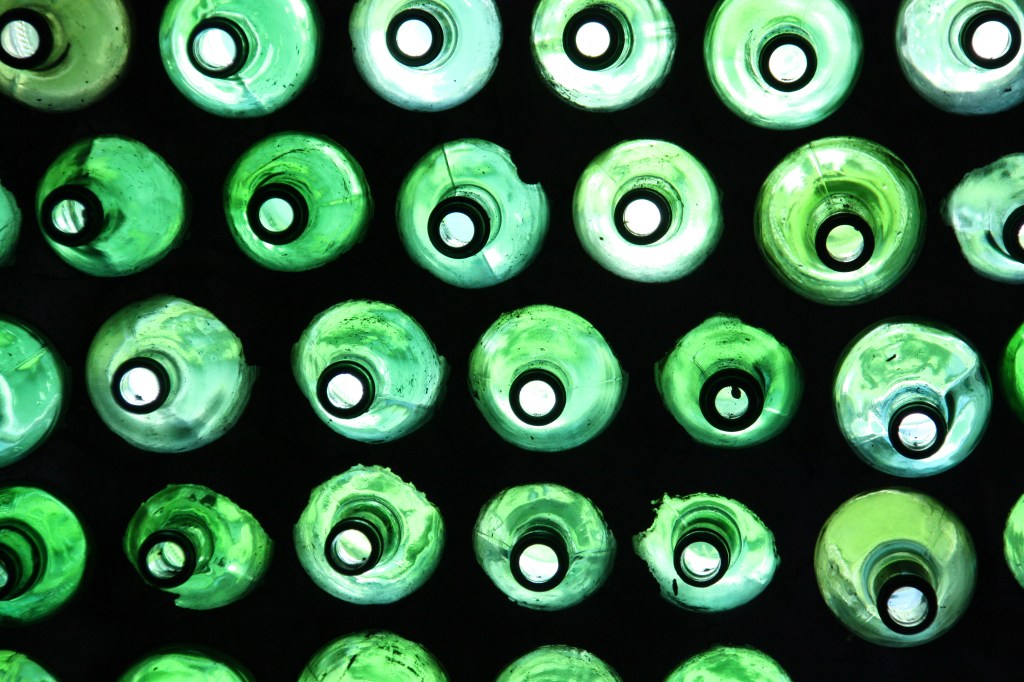
Light through glass, darkly: bottles set in one of the bottle house walls in PEI. The gardens are wonderful and well-worth a visit.

Bottle House, PEI
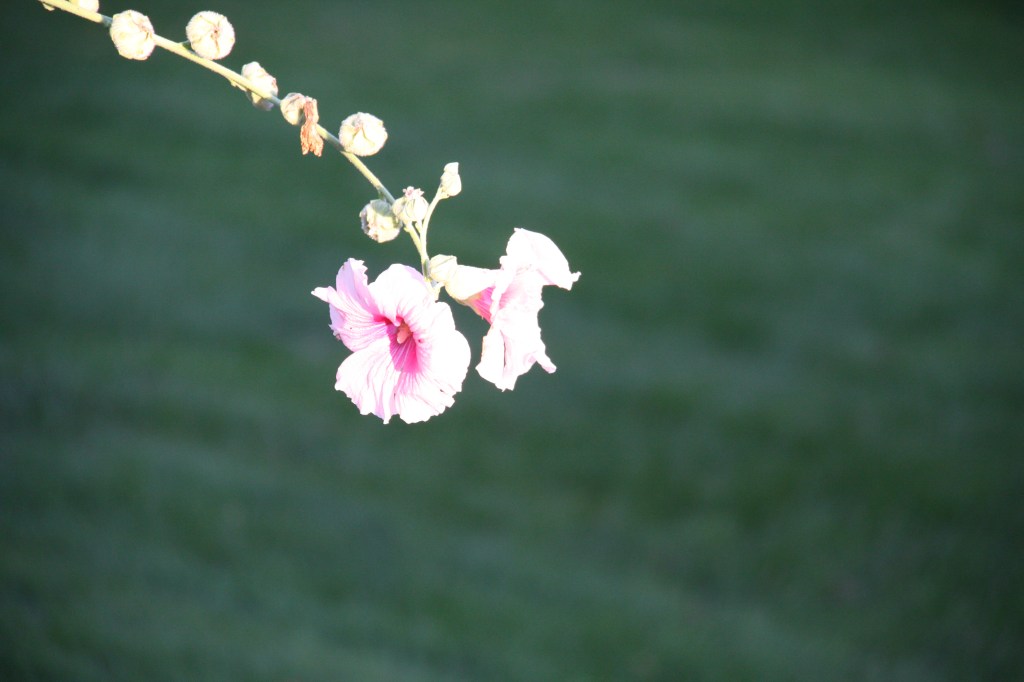
            The day begins with flowers: at the entrance, beneath the windows, flowers everywhere, a delicacy of scent. Beyond these flowers, even more flowers, then playthings in the garden: a child’s paradise, these sculptured faces, this glass among the trees, sun and shade, the fountain’s water, this dream of an old man, kept alive now by his children, a dream of health and sanity and peace out by the bay, where the mud red waters roll and the tide’s hand grasps at the land and pulls it down with watery fingers.
            Everywhere: faces and elements of faces: a nose, eyes, a mouth, open in surprise. Carved wooden faces, glass faces, pottery faces, flesh and blood faces, grandma’s face, grandpa’s face, then the grandchildren.
            Tourists travelling, old islanders returning to see family and friends, young islanders returning to visit the almost forgotten farms which their families worked a generation or three ago, before their exodus from the land.
            “This was grampy’s house!” they say or “that was my grandmother’s farm!” as if a life could be reborn in that pointed finger, those casual words. How many memories are snapped in each picture? How many lives are caught in this snapping of the fingers as the past is instantly summoned and perfection is bottled for a second or two in the magic of this house, this garden where the builder’s spirit roams. Sit still awhile. Be silent: you may hear him breathe, glimpse him, for a second, staking out the flowers, extracting a weed, checking the set of the concrete foundations, polishing a bottle, resting on a wooden seat, avoiding the slow snail on the path bejewelled by rain-drops from the trees or spray from the fountain. For where there are flowers, there must be water and rain and peace and happiness and all good things, glimpsed darkly through smoked glass yet grasped so smoothly in the sun’s bright light.
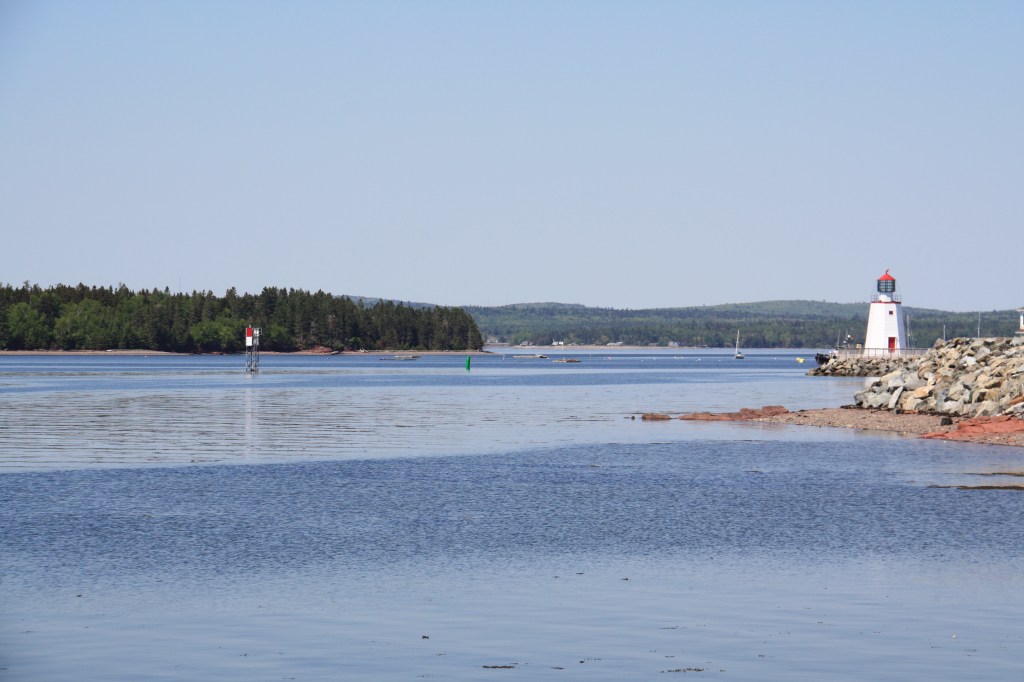
            This is the house of bottles, the glass house, where rough winds are shunned and the bottles are set in concrete. It is a museum of light and dark, the creation of sun and shadow as sunshine fails and the lighthouse’s flashlight beam reverberates from glass to stone and back again. Shapes, shadows, memories curved and carved in glass, set in glass, this shimmering beacon this glass house, this light house built as a heaven-haven for harboured ships and the soul’s refreshment, here, in these gardens, among these bottles, and at the chapel door, an angel-in-waiting.

Angel or fairy? It doesn’t matter. She was a gift one morning, when we visited. In this photo you can see how the bottles are set in the wall.

Three links to the Bottle House, PEI.

https://moore.lib.unb.ca/poet/Bottle_House.html
https://moore.lib.unb.ca/poet/Bottle_House_2.html

https://moore.lib.unb.ca/poet/BH3_Gardens.html

R.I.P.

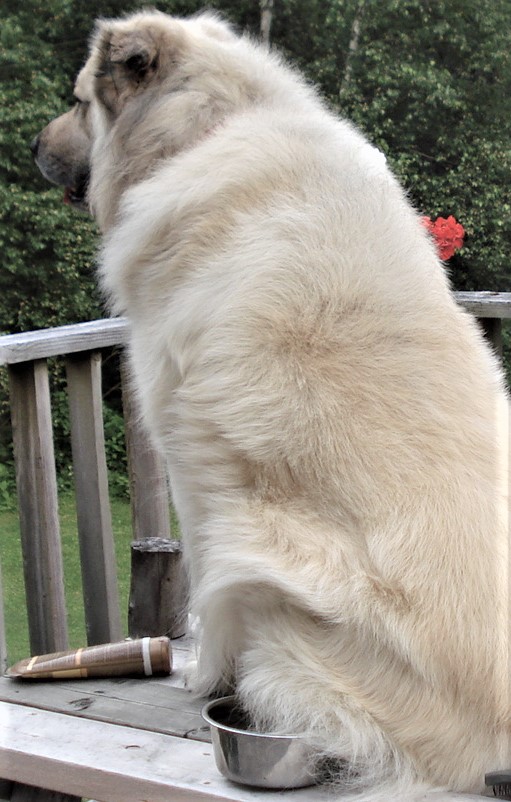
Tigger blowing his coat in Spring and waiting on the picnic table for his daily grooming. Some days I am convinced he is still out there, waiting for me.

What’s in a name?
            At the Farmer’s Market there are fourteen puppies in a cardboard box. One of the puppies, still blind, clambers whimpering over the side of the box and totters toward me. An elderly lady picks him up, thrusts him towards me and says:
            “Here: he’s your dog. He wants to be with you!”
            “No way, Lady!” I say and turn away.
            When I exit the market, I walk past the dog box. There are five dogs left but the one that wandered in my direction has gone. The salesman calls out to me: “Hey you!” He walks towards me. “That woman said you’d be back for your dog. Here: take him!” He unzips his coat, and there’s the dog, snuggled against his chest.
            “When was he born?” I ask.
            “January 16!” comes the reply.
            January 16 is my birthday. Today is March 8, the anniversary of my mother’s death. The dog is 53 days old, much too young to leave his mother.
            When I get home, my wife tells me to take the dog straight back to the market.
            “I can’t do that!” I say. “The man will be gone by now.”
            “But we don’t know anything about the dog!”
            “I’ll clean up after it.” I say. “I’ll feed it and train it.”
            “You’ll have to put it in a cage.” She tells me. “I’m not having it peeing and pooping all over the floor. You know why they’re called poopies.”
            Later that evening, I force the little puppy into the old dog’s crate, and I retire to bed. No sooner have I gone upstairs than there’s an unholy noise from the kitchen.
            “Help me!” I say to my wife.
            She laughs. “Not a chance! You know the rules!”
            Down in the kitchen the puppy is in distress. I take him out of his cage and he waddles and wags and promptly pees. I clean up after him and wonder what to do. The cage isn’t a solution. There’s no box in which to put him and any form of captivity, like a board across the door or a baby’s gate, sets him howling again. I gather my sleeping bag and a couple of cushions and I lie down on the kitchen floor. He immediately snuggles up to me, finds my finger, and sucks on it.
            I get up off the floor, make my way to the fridge, open the door, and pour a glass of milk; for the rest of the night, every time the dog gets restless, I stick my finger into the milk and the dog sucks my finger. I spend the next week doing this.
            While I’m lying on the floor, I study the dog.
            “What is your name?” I ask him constantly.
            Then, one night, as I watch him bounce across the room towards my milky finger, I know what to call him.
            “Tigger!”
            If I had waited another week, I might have called him Pooh!
            Tigger never leaves me. He is like an orphaned duck who follows the first human being who feeds it. Tigger follows me around the house with his nose behind my knee and if I stop suddenly, he bumps into me. My wife has started to call me Dada Duck. I now call her Mother Duck and our daughter has been renamed Baby Duck. Tigger has a second name: Dada Duck Dog.
            We have a little corner piece on our lot where the roads join and all the dogs stop, including mine. I went out there one day and put up a large sign with “Pooh Corner!” written on it. Beside it I placed an arrow which points “To the house!”
            All the children on the block love Tigger. When he came home, he weighed 6 pound and covered six tiles. Full grown, he weighs 110 pound and covers 108 tiles! He is gentle and well-behaved and everyone adores him. Some of the children want to buy a little saddle and ride on him, he is certainly big enough, but I won’t let them do that. The children on the block now call me Christopher Robin. At Christmas, they bring me pots of honey.
            As eleven years went by, Tigger grew old and slow. He developed cancer and had arthritis. On fine days he was fine, but on damp days he could hardly place one foot in front of the other. He had difficulty climbing the stairs and would sleep for hours rising only for his morning and evening walks and his food.
            Yesterday, el cinco de mayo, at 12 noon, Tigger passed away.
            Today, there is a little white cross at the corner of our lot. The children have laid a circle of flowers around the cross. On it somebody has painted: R.I.P. Tigger.

The Red Room

I looked for a picture of music, but could find nothing. No Carlos, no flute, no nothing. So, I invite you to use your imagination: just pretend these are the notes of an Andean flute, floating in the early morning air. Now close your eyes and listen carefully. Can you hear the music?

The Red Room

Carlos makes music on his flute.
He lives in the Green Room,
with its door just opposite mine

He creates the highest note of all
and it floats before me in the air,
a trapeze artist caught in a sunbeam
and suspended between the hands
that fling and those that catch.

His musical rhythms are different.
I try to follow his fingering.

In the space between notes,
tropical birds flash jungle colors
as they flit between flowers.

With a whirring of wings,
all music stops,
save for the robin’s trill
refreshing the early summer
with his eternal song.

Comment:

I finally found a photo of Carlos.
Here he is, in Kingsbrae Gardens,
playing Beethoven’s Ode to Joy
on ‘half-filled’ water bottles
tuned to play a perfect scale.
Like an Andean bird, the man
could pluck notes from the air
and fill the world with music.

Light

Early morning light in the Red Room at KIRA. Such a splendid invitation for the enlightened mind to write poetry about the splendors of light.

Light

This fragile light
filtering through
the early-morning mind
filled as it still is
with night’s dark
shadowy dreams
their dance demonic
or perchance angelic
as light rises and falls
in time to the chest’s
frail tidal change
the ins and outs
of life-giving breath

Bright motes these birds
at my morning window
feathered friends
who visit daily
known by their song
their plumage
their ups and downs

they dazzle and sparkle
cracking the day open
with their joyous songs

Dawn at KIRA

Dawn
at
KIRA

1

A fiery wedge, fierce beneath
black-capped clouds, alive
the firmament with light,
breaking its waves over woods,
waters, tranquil the bay, grey,
yellow-streaked, then blue,
the new day dawning,
driving night away,
false shadows fleeing.

2

To rock this new born babe,
to swaddle it in a cloak of cloud,
disguised for a moment its promise,
nature nurturing heart and mind,
filling the flesh with memory’s
instantaneous flash breaking its light
into the dark where no light shone,
fearful, the dream world,
gone now, dwindling, as day light
shafts its arrowed flight.

3

How thoughtful My Lady
 who placed me here,
at this desk,
at this window,
 at this moment of time.

Glorious, this day-break:
words no justice can do
to peace and light,
this early morning,
filtering sunlight
through the waking mind,
relighting the fires
within the heart,
and glory
a word’s throw away
outside this window.

Lighthouse

A lighthouse to light your way, shining to make the night as clear as day and to highlight any obstacles that might stand in your way.

Lighthouse

            Once upon a time that lighthouse on the quay was a young boy who sat within the shadow of his father’s tale. He sensed he would never feel the power of his own words because he didn’t seem to have any on account of the black hole inside him that swallowed everything up. He thought he would never know the joys of creating his own myths, telling his own story. He thought he would never come to grips with storm music, wind and rain, a lost path sought and found. He longed for someone to gift him a rainbow, with or without its pot of gold. He also thought that the fatal shadow, cast upon a child by a father, would always be there.
            One day, the early morning sun knocked on his bedroom window. He drew back the curtains and let in the light. That day, he emerged from the shadow and saw that the world was bright and filled with sunshine. Each morning, he breathed in the sunlight, felt it flow through his body. His heart pumped new blood and he was refreshed by the joy of living, of being himself, of being nobody but himself, unique and wonderful, subject to nobody’s wishes and whims. Gradually he grew into the person he was always destined to be.
            The sun’s rays lit up his face and eyes. Sunshine flourished within him and renewed not only him but all that he touched. Light flooded out like the beam from that other lighthouse, over there, on those rocks, that was put there to help and guide wayfarers and seafarers lest they become lost at sea.
            Lost, he found himself. Found, he centred himself. Joy and hope, belief and knowledge took root under the sun that each day nourished his body, soul, and spirit. Renewed, light flooded from him. He burned like a bonfire or a beacon and became one of those special lights that enlighten the world. He became that lighthouse.

Comment: One of the prose poems from Tales from Tara that slipped in here by accident. I have included it for, and dedicate it to, my good friend and fellow writer, Judy Wearing, to wish her well with health and strength in this new year that is now turning into something special.

Why?

Different bird, same question: why? This one is from one of the beaches on the road to North Cape, PEI. Why, indeed?

Why?

In the mud nest jammed tight against the garage roof,
tiny yellow beaks flap ceaselessly open.

The parents sit on a vantage point of electric cable,
mouths moving in silent encouragement.

A sudden rush, a clamour of wing and claw,
a small body thudding down a ladder of air
to crash beak first on the concrete.
  “Why?”

 “Wye is a river.
      It flows through Ross-on-Wye
      and marks the boundary
      between England and Wales.”

And the swallows perch on the rafters
watching their fledgling
as it struggles on the floor:
the weakening wings,
the last slow kicks of the twitching legs.
“Why?”

“Y is a crooked letter
     invented by the Green Man of Wye.”

Comment: This is the original poem, written back in the eighties, wow, that’s forty years ago. I included it in my first poetry chapbook, Idlewood (published, 1991). It was a slim volume, dark green color, typed and photocopied, very humble, but MINE! A couple of years ago I wrote a prose poem, sort of flash fiction, in one of my Welsh sequences and included the story as part of the text. It came to me as a memory yesterday morning, and I posted it on Facebook. Here now is the story. Hopefully, you have just read the poem: I hope you liked it but, as I know all too well, de gustibus non est disputandum. I would like to know if you prefer the poetry to the prose. Please let me know, pretty please?

Why?

“Where are you going?” I ask. “To see a man about a dog,” my father replies. “Why?” I ask. “Hair of the dog,” his voice ghosts through the rapidly closing crack as the front door shuts behind him. “Why?” I cry out. I recall the mud nest jammed tight against our garage roof. Tiny yellow beaks flap ceaselessly open. Parent birds sit on a vantage point of electric cable, their beaks moving in silent encouragement. A sudden rush, a clamour of wing and claw, a small body thudding down a ladder of air to crash beak first on the concrete. “Why?” I ask. The age-old answer comes back to me. “Wye is a river. It flows through Ross-on-Wye and marks the boundary between England and Wales.” The swallows perch on the rafters watching their fledgling as it struggles on the floor, the weakening wing flaps, the last slow kicks of the twitching legs. “Y is a crooked letter invented by the Green Man of Wye,” my grandfather says. “Why?” I repeat. “I want to know why.” Silence hangs a question mark over the unsatisfied spaces of my questioning mind.

A Thought for the New Year

Couldn’t find a photo of Don Quixote so I attached this instead. A suitable symbol for Brexit!

A Thought for the New Year

“Sábete, Sancho, … Todas estas borrascas que nos suceden son señales de que presto ha de serenar el tiempo y han de sucedernos bien las cosas, porque no es posible que el mal ni el bien sean durables, y de aquí se sigue que, habiendo durado mucho el mal, el bien está ya cerca.”
Miguel de Cervantes : Don Quixote de la Mancha.

“Know this, Sancho, … All these squalls that beset us are signs that the weather will soon clear up and better things will come to us, because it isn’t possible for good or ill to endure, and from here it follows that, these ills having lasted so long, good times are now close.”
My translation.

Comment: This quote was sent to me by Marina, my close friend from Avila, with whom I have maintained contact, even though it is now twelve full years (2008-2020) since we last saw each other and talked, except on Messenger. Break ups and lost and absent friends and families: it seems to be the story of my life. And how could it be otherwise when one is a migrant who emigrates and immigrates and passes on and through, rarely resting in the same place for long? I guess it is also the story of the Intelligentsia: those whose learning and understanding and life experience moves them out from one place and into many others. Cualquier tiempo pasado fue mejor / any time from the past was better. Hiraeth: the knowledge that the past is lost, save in our minds, and can never be recovered, even though sometimes we wish so badly to do so. The Intelligentsia: always dissatisfied, both with the past which they can never recreate and which they view through the pink lens of nostalgia and with the present which is never as beautiful as that pastel pink past, that in reality probably never existed. Toda la vida es un sueño y los sueños sueños son / The whole of life is a dream and dreams are just dreams, and nothing more (Calderon de la Barca).

Boxing Day

A wonderfully quiet and peaceful Christmas in Canada. Oh the sea, oh the sea, thank God it still flows between my family and me.

Boxing Day
            By the time I get up, the gloves are really off and the sparring has begun in earnest. I hear voices, walk downstairs to the kitchen, and a hush falls on the room. Knife-edge glances slice their menacing ways through the thick fog of war.
            Time for boxing: on my left, in the blue corner, my mother, smoking what is probably her second packet of the day. A thin haze of grey smoke escapes from her bruised lips and a cloud of exhaled fumes crowns her head with a murky halo. On my right, in the red corner, my father. White-faced, hungover yet again, truly into the spirits of Christmas. He breathes heavily, like a Boxer Dog in the mid-summer dog-days, snoring and snorting at a bitch in heat. In the middle, my grandfather, the referee. He is keeping the combatants apart, creating a tiny breathing space so the true Spirit of Christmas can disentangle itself from those false Christmas Spirits and bring peace to earth again for at least sixty seconds between each round.
            I look around the heaving, seething, threshing silence of a room where conversation has suddenly ceased. The fire is burning merrily. Beside it, tongs, poker, and small shovel stand to attention. On the hearthstone, the little red brush, with its long handle lies in ambush. This is what my father uses to beat me when he can’t be bothered to take off his leather belt. Scorch marks from the hot coal fire sear the handle and back of the little red brush. I threw it on the fire one day, hoping to see the end of it. Of course, it was rescued from the flames, resurrected, and I got beaten for that act of rebellion too.
            “It’s all your fault!” My father breaks the silence, pointing at me. His red-rimmed eyes blazing with a sudden and renewed anger. He starts to rise, but my grandfather steps between us.
            “Go and see your granny,” grandpa tells me. “She’s in the kitchen. Go now!” He points to the kitchen door.
            I run a gauntlet of staring eyes and go to my gran. As I shut the door behind me, voices rise higher in the room I have just left. Boxing Day, indeed. The gloves are off. The battle has begun again. My grandfather has evacuated me from no-boy’s-land and, for a moment, I am no longer trapped in the mud-filled, cratered, shell-holes between the trenches, the uncut barbed-wire barriers, the poached-egg eyes peering through periscopes and spying on me from the parental and priestly parapets. Here in the kitchen, for a while, I walk on the wooden duck-boards that keep my feet dry and clear of mud and water.

Comment: This is, of course, the true origin of the term Boxing Day. A genuine Boxing Day has nothing to do with the myth that it was the day on which the servants, who worked Christmas Day on the Lord’s estate, received their Christmas Boxes. Peace on earth and mercy mild has got nothing to do with alcohol-fueled quarrels, raging hangovers, and little children who should be seen and not heard. Sometimes, when all the elders are down at the pub on the corner, the night may, for a little while, actually be silent. But the noise when the drunks roll raucously home is most unholy. Then little children should be wise like the wise men, run quickly into bed, and lie there, neither seen nor heard.

Merry Christmas

A forgotten child’s Christmas in Wales.

On the Outside Looking In

As I walked home, it started to snow. Not the pure white fluffy snow of a pretty Merry Christmas card, but the dodgy, slippery mixture of rain, snow, and ice pellets that turned the steep streets of Swansea into ice slides and traps for the elderly. I turned up the collar of my coat, bowed my head, and stuffed my hands into my pockets. Two houses before my own, I stopped in front of our neighbor’s house.
The window shone, a beacon in the gathering dark. I drew closer, pressed my nose against that window and looked in. A Christmas tree, decorated with lights, candles, more decorations, a fire burning on the hearth, two cats curled up warm before the fire, presents beneath the tree, stockings hanging from the mantelpiece. For a moment, my heart unfroze and I felt the spirit of Christmas. Then I thought of my own house. Cold and drafty. No lights, no decorations. No fire. The snowball snuggled back into my chest and refused to melt.
            When I got home, our house stood chill and empty. My parents were out at work and the fire had died. Nothing was ready for Christmas. I sat at the kitchen table, took out my sketch book and began to draw, then color. When my mother came home, I showed her my picture.
            “Very nice,” she said without looking up.
            “But mum, you haven’t really seen it.”
            She stared at the picture again. This time, she saw the Christmas tree and the lights, the cats before the fire, the candles burning on the mantelpiece, the decorations and the presents wrapped and waiting beneath the tree. But she never noticed the little boy standing outside the house in the falling sleet, cold and shivering, peering in through the window.

Comment: Everyone remembers Dylan Thomas’s story A Child’s Christmas in Wales, but not all Welsh Christmases are like that. This is the story of a forgotten child’s Christmas in Wales. It is a story about a latch-key kid, left alone at Christmas to fend for himself. I enclose the drawing he did and I dedicate the story to anyone who is alone this Covid-19 Christmas. Christmas spent on your own is not much fun. Looking through another’s window, from the cold street outside, is not much fun either. So, at this time of year, let us remember those who are lost and lonely, those who need a kindly smile and a helping hand, those who do not have the comfort of family and friends, a warm wood fire, or a cat or a dog to snuggle up to them, to lick them, and to wish them ‘all the best’ in the languages that all animals speak on Christmas Eve, and sometimes into Christmas Day. Phone a friend, nod to a neighbor, and may your Christmas season be filled with joy.