Crow

IMG_0003

“What is this life, if full of care, / we have no time to stand and stare,” W. H. Davies wrote, expressing our need for solitude and silence. Sometimes we must just walk in the woods and be alone with our spirits. Too much excitement, too much Brexit, too much mid-terms, too much suspense, too much controversy, too much shallow thinking, too much knee-jerk reaction, too much emotion = too little time to be alone, to sit and think, to work things out for oneself … so, let the snow fall, let the drifts deepen, let the snowflakes accumulate.

There are so many things I want to do that I am not doing any of them. I must take some, make some, time to sit back and relax, I guess. The well is empty. It’s time to be on my own, to meditate, and to allow those inner springs to fill up and flow again. That may not take long. Woods, crows, cardinals, and the hushed whisper of falling snow will do the trick.

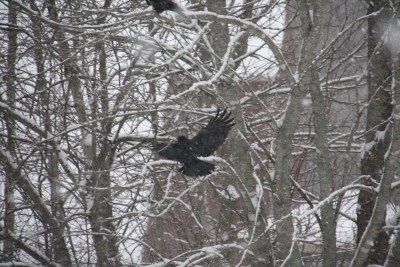
It’s been a long time since I last posted. I guess life gets in the way. A beautiful cardinal sat on my feeder this morning, but by the time I had found the camera, our family of crows had frightened him away. Here’s the last (of five) just arriving in the tree. He’s not as pretty as the cardinal, but he’s very stark against the falling snow, speckled too, in places. Vade mecum. I will be back.


Cooking

img_0385

Cooking

My Welsh grandmother, not my Irish one, taught me how to cook. At the time, I was the only grandchild. Whenever she cooked and I was in the house, she would take me into the kitchen, stand me on a stool by the gas stove, and encourage me to stir as the mixtures swirled and bubbled in pan or pot. I also helped her shell the peas, slice the carrots, whatever. When the preparation was ready, she would set aside a small portion that was mine. This might be a cake in the oven, a pair of biscuits shaped awkwardly by my own hand, or a small side pot of soup. “There’s nobody else,” she would whisper to me. “The old ways will die if I don’t teach you.” She was the one who taught me the exact moment when Welsh Cakes were ready to be molded, and there’s only one way to learn: place your hands in the mix. The right texture, as they say in the cookbooks, is ‘fine grain sand’ but you have to experience it to be certain what those words really mean.

I was a latch-key kid, as they now call them. Both my parents worked all day, leaving the house at 7:30 in the morning and not returning until 4 or 5 at night. Being able to cook meant that I never starved and I remember cooking soups, Cawl Mamgu among others, at a very early age. When I started traveling to France and Spain, I often ended up in various kitchens where I listened to the women as they prepared the food. Language and cooking went hand in hand and I learned how to roast coffee beans in a cast-iron frying pan, how to vary my range of soups, how to prepare casseroles, how to scramble eggs the continental way.

When I studied in Santander, Spain, my landlady left me, every night, one onion, one potato, and one egg. This was for the Spanish omelette that I ate most evenings. She cooked the first one for me, supervised me as I cooked the second one, and then abandoned me to my own devices. I often heard her snoring as I lit the gas, warmed the pan, and started to prepare my tortilla española. I still make Spanish omelettes, and they are delicious, but here in Canada they are never quite the same as they were in Spain. The ingredients look the same, olive oil, egg, salt and pepper, potatoes and onions … but the eggs are not Spanish free-range eggs from country hens and the oil, the potatoes, the onions, the salt … everything looks the same, but tastes vastly different.

Two days ago I bought a pound of fresh hake, merluza in Spanish. I cooked it in butter, half poached, half-sautéed. We ate half that night. Next day, I struggled with my thoughts: should I make fish cakes from the rest of the fish, or should I make a fish soup / sopa de pescado? Fish soup won. I put some truffle flavored olive oil into the frying pan, sliced small a tomato fresh from the garden, added a finely chopped onion, spiced it with sea salt, and added a small pinch of pimentón picante / hot Spanish paprika from La Vega in Spain. I let this simmer for a few minutes, then added some sherry. Into this mixture I put the rest of the hake together with the butter sauce that remained from the night before. The dish looked inviting, was very colorful, but appeared to be small and insufficient for the hungry eyes that followed the process. I added four large shrimp, sliced into four pieces each, a large scallop, thinly sliced, and sufficient water to thin the gathered liquids. Then I chopped up some sugar peas and added them as well. My sopa de pescado had undergone a sea change and become a sopa de mariscos / a sea food soup. The colors amazed: reds, yellows, oranges, and touches of green. On the spur of the moment, I named it New Brunswick Autumn Foliage. I tested it regularly as it simmered and it was ready when the sea food was done. Delicious.

I don’t know when my grandmother was born, or where, other than somewhere in Wales. I celebrate her birthday every time I cook something special, and my last two meals were very special. I don’t know where you are, Nana. You left us a long time ago. But wherever you are, thank you so much for the gifts you gave me. And Nana, I love you. You have traveled with me from Wales to Canada, and I celebrate you and your birthday every time I cook.
Holly-Hock

IMG_0026

Holly Hock Hangs on …

I keep calling my Holly-Hock ‘he’, but I am beginning to think that if Holly Hobby was a lady, then this tough old plant is a lady too. A limpet lady. She has gone through three quite hard frosts now, one early, and two back to back, earlier this week, followed by two days of heavy rain. The rest of the garden is withering or withered. Clusters of dry blackened stems surround this old lady, but she still stands tall and proud. Not only that, but she casts more and more flowers out to greet us.

We have kept lots of seeds and will sow them soon, some are in the ground already, in the hopes that she and her offspring may flourish. For this lady is a symbol of hope. Hope in the face of frosts, cold winds, heavy rains. Hope in the seeds that she produces and scatters. Hope in the generation and the regeneration of a beauty and a strength that, if lost, may never be found again. Hope in old age that our children will survive and lighten our countenances with their love.

So go, you Holly-Hock seeds. Bury deep, send out roots, sleep for a while if you need to, and when the spring sun peeps over the horizon after a hard, long winter, be ready to bloom again. We, your faithful followers, will be waiting for you, with hope in our hearts.

Lost

img_0137

Lost

My body’s house has many rooms and you, my love,
walk through them all. Your shadow dances on walls,
in mirrors, and your breath brushes my cheek

every time I open doors or windows. That silly cat
looks for you and hisses when I bring her kibble.
I move from room to room, but when I seek you,

you are no longer here. I knock, nothing opens.
Afraid, sometimes, to enter a room, I know
you are in there. I hear your footsteps on the stair.

Sometimes your voice seems to break the silence.
You whisper my name in the same old way.
How can it be true, my love, that you have gone,

that you have left me here alone? I count the hours,
the days, embracing dust motes. I find no solace
in salacious sunbeams and my occasional dreams.

Comment: Regular visitors to this blog will probably recognize this poem. It is a rewrite of an earlier one, also bearing the title Lost (click here for earlier post). I rewrote, or rather, reorganized the structure of the poem, added some words, and subtracted others. I did this earlier this summer while Clare was in Ottawa visiting our daughter and grand-daughter. And yes, I missed her. I always do when she in not present or I am away. Comments on either version will be welcome, particularly if you prefer one version over the other.

Love at First Sight

IMG_0181

Love
… sometimes comes at first sight

A teenage apprentice with a little plastic badge
bearing her name asked me to reveal my birthdate.
This apparently confirmed that I knew who I was,
so she bound my arm with a thick rubber thong.

My veins swelled up, long thin leeches, slowly fattening.
She told me to make a fist and pouted as she probed
with slender fingers, feeling in vain for a fresh vein
from which to extract, then bottle the necessary blood.

I watched my body’s sap pumping out in tiny, sad spurts
driven by that tired flesh-and-blood machine known as
my heart. Drip by febrile drip my blood accumulated.
The young girl smiled with youth’s perfect lips and teeth.

My heart was a time-bomb ticking beneath her fingers.
I dreamed for an instant of walking upright and free,
a stranger in the paradise of a long-promised land.

Then she handed me my gifts: a throw-away plastic potty,
three disposable spatulas, and an air-dry sample card,
with written instructions, date stamped, bearing my name.

Lost Angel

IMG_0055

Lost Angel

One day she was there,
the next day she was not.

She slipped through our fingers
like water or fine sand,
here one day
and gone the next

We looked away for a moment,
and when we looked back
she had disappeared.

The wind whispers secrets
that are multiplied
by grass tongues
wagging on deserted dunes.

The wind thinks she left us
to join the children
who play hide and seek
on empty September beaches.

“Hush now,” says the wind,
“if you make a sound
the children will know you are here.

They will slide through clefts in the rocks
and hide in silence, waiting
until you too have disappeared.”

Comment: Another Golden Oldie, this one from my book All About Angels. I wrote All about angels in homage to Rafael Alberti’s book, Sobre los angeles, one of my favorite poetry books in Spanish. My angels are not Alberti’s angels. How could they be when his angels are Spanish and mine are Welsh and Canadian? Do you really  believe in angels, you ask. Well, you’ll never know, because I’ll never tell you. That said, I did write a book about them.

My Body

IMG_5811_2

My body

My body has so many rooms and you,
my love, possess me in them, wander
through them, and I see you, here, there,
everywhere, your presence a shadow
glimpsed in a mirror, or your warm touch
a breath upon forehead or cheek. Where
have you gone? Why did you leave me
here on my own to languish in your absence?
I walk from room to room, but when I knock
you open no doors, and though I seek,
I fail to find. I know you are somewhere near.
I hear your footstep on the stair, your voice
in the silence that surrounds me. My name,
a syllable or two, whispered in the way
I so clearly remember. How can it be true,
my love, that you have gone, that you have
left me here and forged ahead into another
time and space? I count the hours and days.
Will you prepare me a place? Will your face
be there to greet me? Alone, I clutch at straws,
embracing dust motes, counting the angels that
dance on the rainbows on the head of a pin.

Torticollis

Avila 2007a 039

Torticollis

A sudden crick of the neck and I am back in the chalet at Perines with Trini.

“Torticollis,” she says, raising a hand to her neck, except she says it in Spanish, ‘tortículis’.

She offers me tea, very English, from the Wedgewood tea pot I brought her, all those years ago. Beside her, the Pirate with the Parrot on his Shoulder, my Toby Jug, still stands on guard, and protects my memories.

Orphaned, I was, from England, abandoned on that Spanish shore, and left there all summer to learn the language. Trini taught me how to eat, speak, choose my books and my friends … she had lost a son, same age as me, just after the Civil War, and treated me like her son, returned, like the Prodigal Son I was to all who had sent me away from home to improve my lifestyle and my manners.

Wanted? Unwanted by my family? I wouldn’t know the difference.

In that far-of land, in time and space,  I only knew the loneliness of being lost, marooned in a foreign land, feeling my way, day by day, among foreigners, still foreign, although they took me into their homes and hearts and loved me as I had never been loved before.

Back home, drowsing  at the kitchen table, I doze into my dreams, only to be woken by that beloved voice.

Wistful, I turn my head and glance backwards into that past of sunshine and beaches, where the sun sparkled on hill, sand, and sea and the table cloth was spread on the family table, pure and white, with a dozen of us sitting, talking, smiling, drinking wine, that bottled sunshine that still adorns my dining room table.

“Trini? Is that you?”

Her name slips from my lips as I snap my head towards her voice. As I turn, I twist my neck and raising my hand to the sudden pain, I hear again that word: “¡Tortículis!”

Two Dogs and a Deer

IMG_0040 (3)

Two Dogs and a Deer
(Cherry, Hanna, Jasper, and Lucinda)

Two dogs and a deer:
the deer, heart in mouth,
bounding away from the lawn
seeking cover in the trees.

The gold dog bounding too,
a rocking-horse bounce,
from back to front, lurching,
falling behind the black dog,
the latter, smooth as a train.

The enemy having fled,
shoulder to shoulder they return,
across the green grass of the field,
the victors, side by side, panting,
sides heaving, triumphant, grinning.

What heartbreak as these memories
fade and fall behind. Long may they
linger in my dreaming mind.