Carved in Stone 69

Carved in Stone
69

Words, words, foundered words,
flotsam and jetsam
that I rescue from the beach.

I find them in the tide mark,
its seaweed filled
with bleached carapaces,
charred wood, old rusted iron,
and the bright bones
of long dead creatures,
polished by the relentless action
of wind and sandpaper sea.

Commentary:

Words, words, foundered words – where do they come from. Good question, but I have no answers. Automatic writing – you put pen to page and scribble for five minutes. Everything that comes into you head. The Surrealists did it. They thought they were in contact with their own subconscious minds, but the written results were c-r-a-p, or any other word that means the same thing. I have seen university teachers request their students to do it, but crap by any other name would smell as sweet.

Poets who said they were not surrealists did it. Lorca and Paz, for example. But they did not publish the automatic writing. They used it as a quarry to seek for the one or two gems that actually surfaced when they had done it. Those they chose. The rest they dismissed as the crap that it was.

So, where do we find our inspiration, our words? I find it in the tide mark, its seaweed filled
with bleached carapaces, charred wood, old rusted iron, and the bright bones of long dead creatures, polished by the relentless action of sea-breeze and sandpaper sea.

Carved in Stone 59 & 60

Carved in Stone
59

St. David of Wales once said,
“Do ye the little things in life.” 

I do, and I wander
along the banks of the River Taff,
admiring how wild daffodils
flourish each spring, in Wales.

Young, I run on the beaches,
Brandy Cove, Pwll Ddu, Langland,
Caswell, Swansea Bay,
and, as I write these words,
I hear my footsteps
echoing back through time.

Baudelaire’s words ring in my mind,
“Creativity is nothing more nor less
than childhood recovered at will.”

Or, as Pablo Picasso said,
“I have spent my life
learning to see, paint,
and write again, like a child.”

And on and on I go –
child-hood, youth, maturity, age,
then back to my second childhood,
when I can recreate
that youthful world
in all its joyous beauty.

60

Does life flows through me,
like water in a clepsydra?

Does it flicker like a candle
guttering on a church altar?

Is it circular, like a sundial,
or the Roman numerals
on the face of the clock?

Am I just flesh and blood,
doomed to blossom and flourish,
then wither and perish?

Or will some small part of me
linger on, an unchained melody,
with all my memories slowly erased.

Commentary:

Moo’s daffodils are painted and potted, not growing wild at all. They are still the national flower of Wales and they still grow wild, in the spring, in Blackweir Gardens and beside Roath Park Lake. At least, I hope they do. I haven’t been back to check for 37 years now. Maybe things have changed, and the daffodils have gone the way of the sky lark, the cuckoo, the cowslips, and the bluebells. I wonder if the foxes still wear gloves? Let me know if you know the answer to that one. Just write “I do” on the back of the usual postcard. And you know what to do with it.

As for me, I am moving into my second childhood and, in may ways it is so much better than my first one. Here, I am free to look back on my life, to harvest my memories, to paint what I want – well, what Moo wants, anyway – and to think my own thoughts. Thank heavens Moo doesn’t think for me, though he does get his fingers covered in paint when he reads my mind and puts paintbrush to postcard, and designs his designs.

I feel very sorry for Moo. I guess he never had a childhood, so therefore, ipso facto, he can never have a second one. How much he is missing even he doesn’t know. How could he? Mysterious Moo – I like that idea. Sólo el misterio nos hace vivir, sólo el misterio. Only the mystery keeps us alive, only the mystery. And if you guessed that the author was Federico García Lorca, then you can award yourself a glow of satisfaction, for I have no prizes to hand around.

But hold on a moment, that was the title of one of Lorca’s drawings, so he was the artist, yes, but maybe not the author. Picky, picky nit-picky! Another of the joys of second childhood – annoyingly spotting the minor slips of other second-childhood thinkers – and never, never ever admit the mistakes you might, or might not make, are your own. Blame someone else. There’s always somebody out there whether to own up to your errors, especially if the price is right.

Monkey’s Clockwork Universe

Monkey’s Clockwork Universe

Some days, monkey winds himself up
like a clockwork mouse.
Other days he rolls over and over
with a key in his back like a clockwork cat.

Monkey is growing old and forgetful.
He forgets where he has hidden the key,
pats his pockets, and slows right down
before he eventually finds it
and winds himself up again.

One day, monkey leaves the key
between his shoulder blades
in the middle of his back.

All day long, the temple monkeys
play with the key, turning it round and round,
and winding monkey’s clockwork,
tighter and tighter, until suddenly
the mainspring breaks

and monkey slumps at the table
no energy, no strength,
no stars, no planets, no moon at night,
the sun broken fatally down,
the clockwork of his universe sapped,
and snapped.

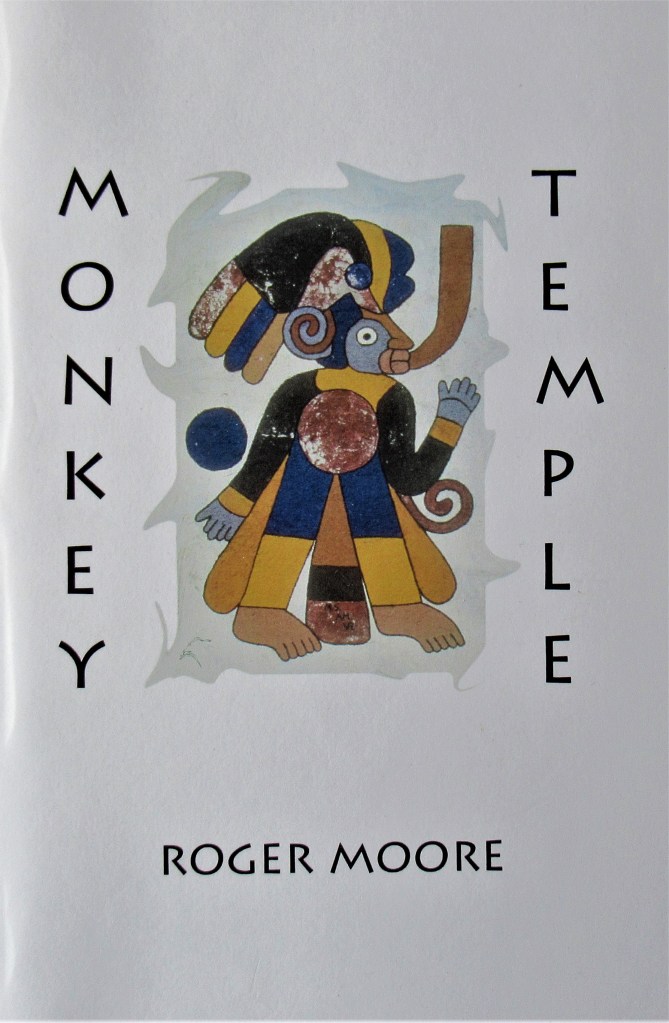
Comment: a big thank you to all who have reminded that yes, I did write this book, and yes, it is one of my favorites. Oh those naughty little monkeys. For those of you who have read the book or heard me reading poems from Monkey Temple, all is well in Monkey Land and the King of Harlem, with a wooden spoon, still gouges out the crocodile’s eyeballs and beats the monkeys on their backsides, with a wooden spoon. I thank my old friend, Federico Garcia Lorca, for that wonderful vision from his own book, Poet in New York.

Two Dead Poets

Two Dead Poets

I enjoyed the WFNB readings last night. Thank you, Ronda, for organizing them, and thank you Susan, for hosting them. It was nice to see so many young friends gathered together on my zoom screen. I would have said ‘old friends’, but we don’t want to be reminded that yes, we are all getting older. Best wishes and many thanks to all who attended and congratulations to all the award winners.

Anyone interested in reading the rest of my memoir can read it by clicking on the link below. I will post a live reading of it on this blog later today.

MO – modus operandi –

  1. Click on the first link. The text of the story will appear on a different screen.
  2. Click on the live reading. The podcast – audio will appear on another screen.
  3. Turn on your volume.
  4. Turn on the podcast.
  5. Return to text screen (1. above).
  6. Read text while listening to the voice.

This will give you a unique audio-visual experience.

Two Dead Poets

I just completed the live reading. A Tour de Force. My longest single reading ever – over 12 minutes. My voice faltered a couple of times towards the end. My apologies for that.

Two Dead Poets
Live Reading

Rainstorm in Granada

Not the Alhambra, but a blood red sky!

Rainstorm
Granada

 Black umbrellas burgeon beneath sudden rain.
Waterproof cloth opens to provide protection.
Churches fill with defenseless passersby.

The cigarettes they smoke flare shooting
stars through finger bars of flesh and bone.
After the rain, gypsy women flower in the street.

Carnations carve wounds in their sleek, oiled hair.
They offer good luck charms and fortune telling.

“Federico! Federico,” the gypsies cry out,
“tomorrow, the guards will take you from your cell.
They will drive you to the hills and shoot you dead.”

“Tonight,” Federico replies, “I’ll paint the city red.
And tomorrow… ” “Tomorrow,” the gypsies sigh,
“the Alhambra’s walls will run red with your blood.”

Comment: I have made some minor changes to the sonnet that was published in Iberian Interludes (available online at this link) The sonnet is a Golden Oldie, going back to our visit to Granada in 1986. I asked my pre-teenage daughter if she would like to go to a country where there was no snow in winter. She laughed at me. “Don’t be so silly, dad, there’s no such thing as a winter without snow.” We got to Madrid on January 5 and awoke to 3 inches of snow on January 6. “There, dad,” she said. “Told you so.” We took the train down to Granada and that year they had six inches of snow in the city center, for the first time in forty years! It also rained, and this is a poem about the Granada rain.

Iberian Interludes

Duende

Spotify
Remember to scroll down to the correct audio episode.

Duende
“Todo lo que tiene sonidos oscuros tiene duende.”
“All that has dark sounds has duende.”
Federico García Lorca (1898-1936)

It starts in the soles of your feet, moves up
to your stomach, sends butterflies stamping
through your guts. Heart trapped by chattering
teeth, you stand there, silent, wondering: can I?
will I? … what if I can’t? … then a voice
breaks the silence, but it’s not your voice.

The Duende holds you in its grip as you
hold the room, eyes wide, possessed,
taken over like you by earth’s dark powers
volcanic within you, spewing forth their
lava of living words. The room is alive
with soul magic, with this dark, glorious
spark that devours the audience, soul
and heart. It’s all over. The magic ends.

Abandoned, you stand empty, a hollow shell.
The Duende has left you. Your God is dead. Deep
your soul’s black starless night. Exhausted,
you sink to deepest depths searching for that
one last drop at the bottom of the bottle to save
your soul and permit you a temporary peace.

Click on the link below to peruse my books for sale.

Books for Sale