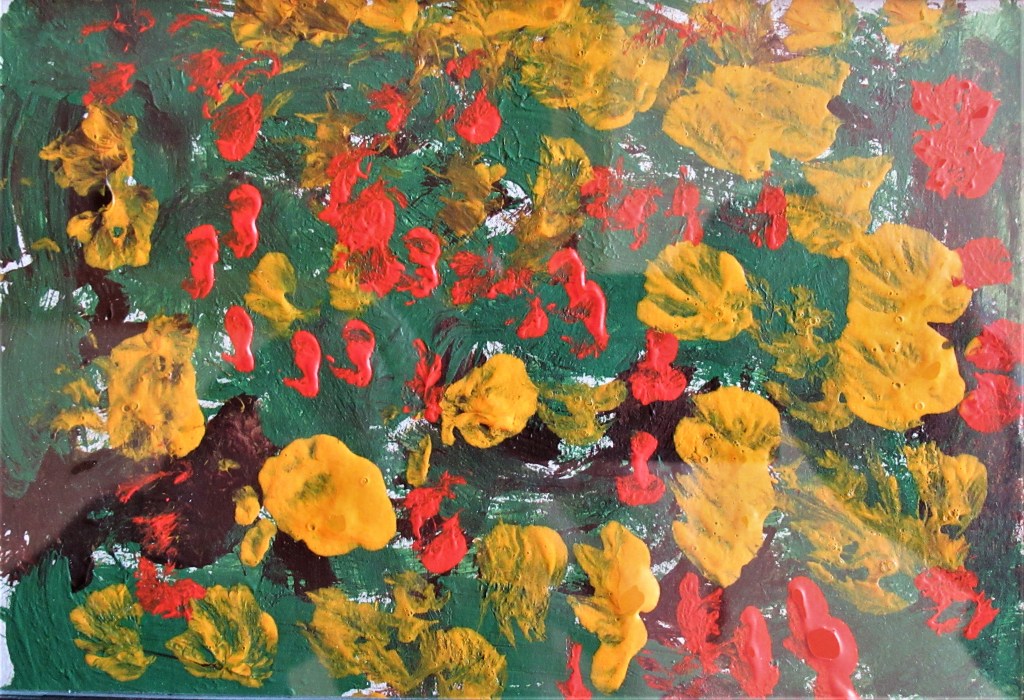
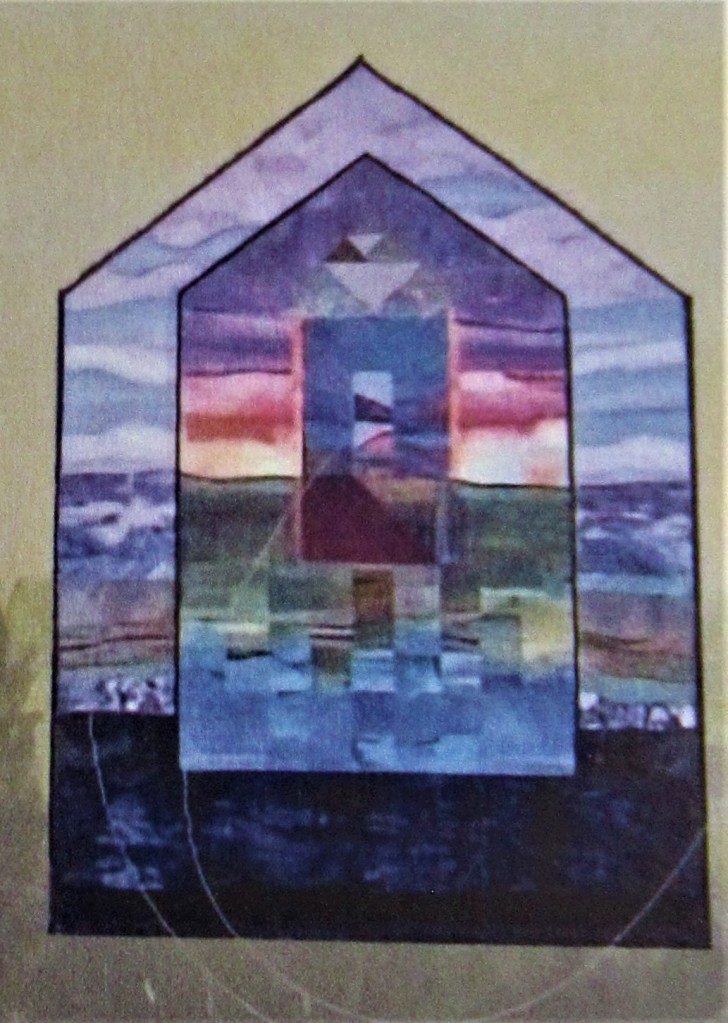
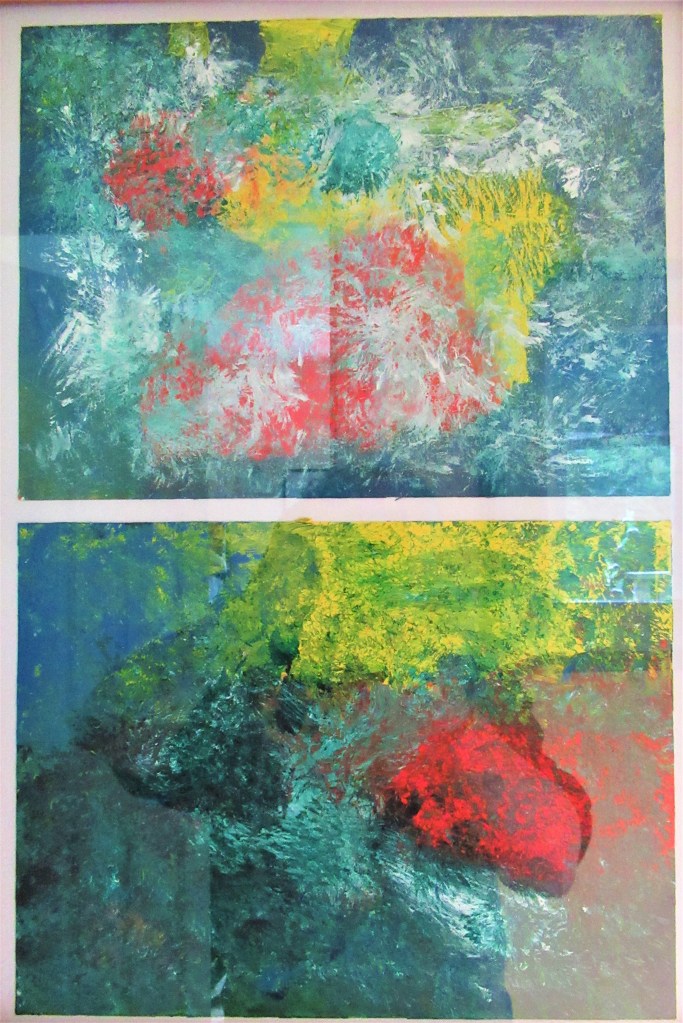
One of my good friends always greets me with the following phrase: “Still on the green side of the grass, then”. So, here’s my painting: Stay on the Green Side. Much better than the other side, from all that I am told by my more down-to-earth companions. I will not intrude upon the thoughts of some of my other friends, nor expose their beliefs. I’ll paint for them another day.
So, while you can, and while you may, Stay on the Green Side, my friends. Wake up each morning, smell the coffee, and gather ye rosebuds while ye may!
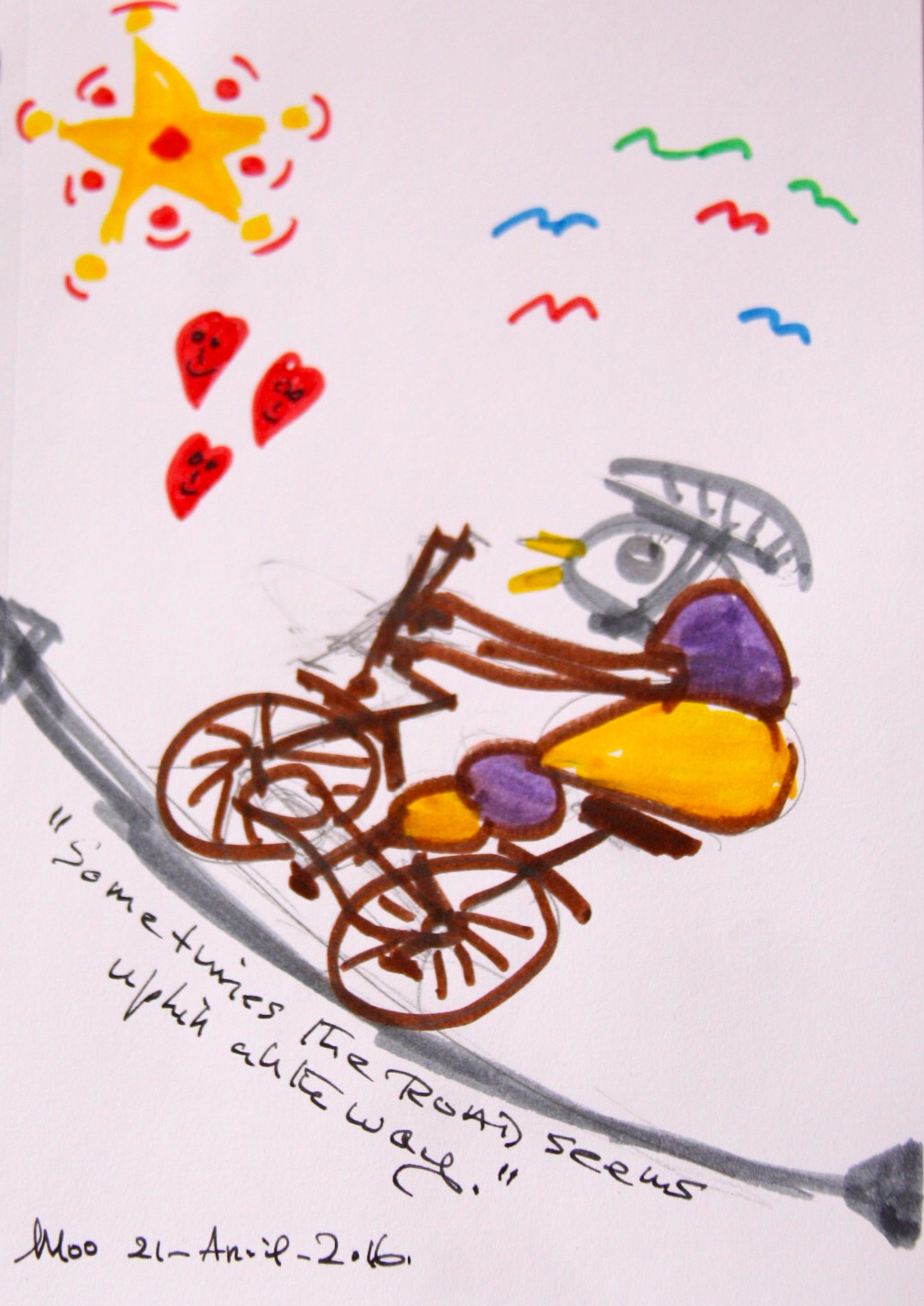
Another golden oldieand, with the snow fallen and my back aching, it does sometimes feel like it’s an uphill battle. There are always angels at the roadside, though, and some have called and offered to help. Thank you, special angels.
Sometimes the road seems uphill all the way. Lungs burn. Breath comes hot and hard and chunky in the throat. Legs hang heavy, muscles will not obey the owner’s instructions.
Consult the operating manual: “Take a break,” it says. “Rest now. Don’t push too hard.” But to rest is to give in, to come to an abrupt halt, or to drift backwards down the hill.
What stubborn streak is painted so deep in us that it shouts ‘never surrender’ when our most urgent need seems to be to throw in the towel? Is it the urge to get to the top, to see the lower lands stretched out below us? Or is it the mantra of fight the good fight?
Many things can drive us on: a need, a desire, a whim, an urge, or merely a refusal to stop fighting. Some of us will never give up. We will never lie down and curl up in a corner, a dead leaf to be blown hither and thither by the cold night wind.
Look carefully: there are no drugs, no needles, in the biker’s uniform. There is no small accessory motor hidden in the back wheel to help when times get hard.
The mouth is open, the eyes are set on the target, the legs still move, the sun still shines, and three smiling heart-shaped faces cheer the cyclist on.
Who can they be, these three angels at the road side, who can they be? Yet they are there and we are here and the bike is there and the hill is there and sometimes … yes, sometimes, the road IS uphill all the way.
But we keep the pedals turning and we don’t get off our bikes … and that’s life.
Photo by my good friend, Geoff Slater. Books by yours truly, who stayed on the bus and believed.
To be a writer ….
He who would true valor see, let him come hither. One here will constant be, come bad or fair weather. No line length can him fright, he’ll with a paragraph fight, and he will have a right, to be a writer.
Those who beset him round with dismal stories, do but themselves confound: his strength the more is. There’s no discouragement will make him once relent his first avowed intent, to be a writer.
Rejections nor bad critics can daunt his spirit. He knows he at the end will a book inherit. So critics fly away, he’ll fear not what they say, he’ll labor night and day to be a writer.
Comment: John Bunyan tempted me and I fell into temptation. In fact, as my good friend Oscar Wilde once said: “I can resist anything except temptation.” So, ladies and gentlemen, change the he to a she or the pronoun of your choice, turn the writer to a sculptor, stoneist, poet, playwright, painter, novelist, dramatist, comedian, song-writer, singer. Breathe deep. Believe in your own artistic talent and remember: “Genius is 99% perspiration and 1% inspiration.” Remember this too: “You’ll never get to Vancouver by bus, if you get off the bus at Montreal or Toronto.”
Silence in the garden. A hawk perched nearby. There are so many ways to die.
Death by Devilry
Silence in the garden. A hawk perched nearby. There are so many ways to die.
A cerebral bleed, minor, but enough to send him to hospital and keep him there.
Cured, ready for release, he would need extra care and added attention.
The devil lived in the small print. Too much attention needed now: his care home wouldn’t care for him.
Back to the old folks ward he went. There he lay, waiting for a vacancy in a home that would really care.
One day, Covid came a-visiting, stalked the ward that night, choosing its victims: you, you, and her, and him.
What killed him? A cerebral bleed, a minor stroke? Or a major stroke from the devil’s pen?
Bold words, bare words, a barren ward, another vacant place around a Christmas table.
Comment: Sitting at the breakfast table, with an empty space before me, I penned these words. So tragic, so avoidable. Yet how many families have gone through something similar in the past twelve months? How many empty spaces are there, vacancies that will never again be filled? I look at today’s figures from the USA: 18,466,231 infected and 326,232 already perished, an increase of 227,998 and 3,338 since yesterday. I am reminded of the words of Pink Floyd: “Is there anybody out there?” Blas de Otero also echoes through my mind: “levanto las manos: tu me las cercenas” / I hold up my hands: you cut them off. And yet it is Christmas Eve and there is still the Christmas promise of joy, and hope, and a new year entering. Let us raise our hands in prayer: and let us pray they are not hacked off.
Time changed with the clocks and my body clock is no longer in sync with the tick-tock chime that denounces each hour.
Hours that used to wound now threaten to kill. They used to limp along, but now they just rush by and I, who used to run from point to point, now shuffle a step at a time.
Around us, the Covidis thrives and flowers. Wallflowers, violets, we shrink into our homes, board up the windows, refuse to open doors. We communicate by phone, e-mail, messenger, Skype.
Give us enough rope and we’ll survive a little while, fearful, full of anguish, yet also filled with hope.
Between Two Places Dianne Fitzpatrick Where’s Home?
Where’s Home (3) Part III of an open letter to Jan Hull
The Little Things
In 1898, Spain fought and lost a war with America over possession of Cuba. Cuba was the last of Spain’s overseas Empire and when it went, the all conquering fatherland, upon whose empire the sun never set, was reduced to its original territory in the Spanish Peninsula. That same year, the literary Generation of 1898 started a new movement, one that made Spain itself central to its imagery and thought. Theirs was not the Spain of Imperial History, with its wars and treaties, battles and conquests. Theirs was the eternal countryside of Spain, the Spain of Old Castille that was rooted to the soil, and that had remained virtually unchanged in the small towns, fishing ports, and villages, for hundreds of years. This was the Spain of Miguel de Unamuno’s Intra-historia: the history of small things.
St. David, Dewi Sant, the patron saint of Wales, a historical figure flourishing circa 600 CE, is famous within Wales for his many sayings. But for me, one stands out. “Byddwch lawen a chadwch eich ffyd a’ch credd, a gwnewch y petheu bychainmewn bwywd” / Be joyful and keep your faith and creed and do the little things in life. In these times of stress and strain, faced by enormous changes brought about by the pandemic, to these prophetic words I turn.
Poets, creators, artists, stoneists, craft-workers of all kinds … we are the antennae of the people. We sense the directions in which life flows and will flow and we are ahead of our times, not behind them. We are the ones who ‘do the little things’, often abandoning larger, more financially rewarding projects in favor of smaller ones that spiritually enrich both us and the people around us. And that is what I am now reading in Jan Hull’s Where’s Home? People, real, live, flesh-and-blood people, many of them artists at heart, abandoning the big city’s rush and rock and roll to enjoy the quietude of small communities which they help to build with their own hands.
Troglodytes, cavemen, people living in the past, I have heard ‘so-called saner citizens’ mutter about some of our contemporary artists. They live off hand-outs and charity and welfare, and they live in the past. Grey-suited, working in concrete boxes, these well-heeled critics are all made out of ticky-tacky, as the old song says, and they work in little boxes, and they come out all the same. Fine fr some, but you certainly cannot say that of the characters who inhabit the small towns, villages, and ports, as Where’s Home? demonstrates so clearly, with quote after quote from contented people, all resident in Nova Scotia, some CFA (Come From Away), others CBC (Come By Choice), and yet others native to the province.
Living in the past … when Hurricane Arthur struck, we went without power for twelve days. No water, no warm food, no cooking, no refrigeration, no flush toilets, no showers, no air conditioning, no television, no Wifi, no internet … In 1928, my grandfather and my father built a summer home, a bungalow, in Gower. I remember, even in the late fifties, living there during the summer with my grandparents: wood stove, rain water barrels, no running water, outhouse, no electricity, no refrigeration, oil lamps … Hurricane Arthur … and Clare and I went back to bungalow living. Several of our neighbors did not know how to cope with the ‘problems’. A couple moved into hotels or stayed with family elsewhere until the crisis was over. As for us, this was the life I was used to as a child. We went into bungalow mode and had more fun than anyone could imagine… living in the past? … or preparing for the future? … Think about it, and don’t jump too quickly to the wrong conclusion.
Above all, Jan Hull’s book, Where’s Home?, has made me think. It has made me think deeply about my own life, my own memories, my own restless, rootless existence, my own attempts to settle and resettle. More, in light of the pandemic with so many working from home, so much home schooling, and so much online back and forth, maybe we, the artists, the returnees, the WAH (Work At Homers), maybe we are not stranded, forgotten, on the back-burners of modern life. Maybe, just maybe, we are the fore-tellers, the front-runners, the pioneers of how a better, more meaningful existence may be created and kept. Thank you, Jan, and please thank all your contributors on my behalf.
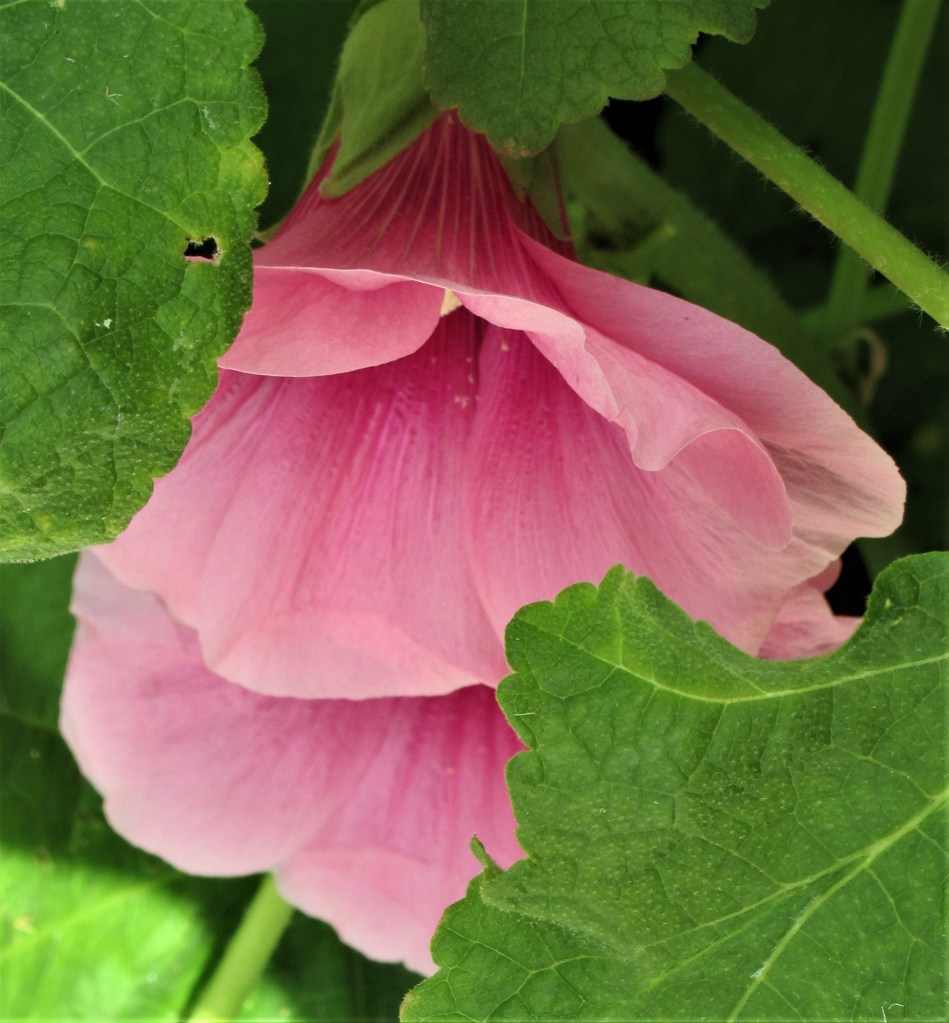
So, the holly hocks are back and this year we have some red ones to go with the lovely yellow ones that reseeded, in a different place, from last year. The red ones are very shy and are hidden away by the back steps where they are very hard to see.
I spy, with my little eye …
The red and green go well together. More a deep, blushing pink, I guess, with very dark centre. You can see the wood of the steps just behind them. I posted this yesterday, incidentally, but the computer munched it and I had to rewrite it today. It has been a slow time for me. The Corona-19 finally got to me, not in the physical sense, but mentally. As a result I have been feeling isolated, trapped, and a little bit depressed. Alas, there are many more like me suffering in today’s world. Luckily, the flowers help. As does the sunshine.
We’re back
Here are the new seeds from last year’s hollyhocks. They are similar in color, but much smaller this first season. They have also shifted location and I have been surprised at how many seedlings have sprouted and started to grow. Next year we may have a bumper crop.
Night Garden
And here we have a painting of the garden at night, flourishing without us, but beneath the stars. “The garden going on without us.” Given the current situation, I prefer the garden going on with us still here to watch it.