MT 2-3 Monkey Visits the Poisonous Snakes

MT 2-3
Monkey Visits the Poisonous Snakes

img_0181

Monkey Visits the Poisonous Snakes

A swift death
was never their style,
the cobras, the vipers,
the adders and subtractors,
the bean counters and snatchers,
the diminutive dudes.

They prefer death
by blow-gun
their poison dart
injected through
hollowed fangs

or Chinese Water Torture,
the slow drip after drip
of poison inserted into ears
and veins, a drop at a time,
and slowly gathering …

… until their victim slows down,
ceases to struggle,
stands there, eyes open,
unable to move,
poisoned and paralysed.

Comment: with all the exciting things that are happening concerning my new poetry writing, I forgot all about my monkeys. It seems they have been bouncing up and down, fretting in their cages, bounding all over the ruined, broken-down temple, poor little blighters. Apparently, on their last visit to the rest of Bristol Zoo, they left the big snakes and decided to visit the little, poisonous ones. I guess they didn’t like them at all. Does anyone? I hope there are no ‘snakes in the grass’ near you, and I don’t mean grass snakes. And watch out for snake charmers, some of those snakes believe more in harm than charms.

PS Let me know if you want a voice text. I haven’t recorded this one yet.

Bistro FFF

IMG_0155

Friday Flash Fiction
20 July 2018

Bistro 

LJ sat at a table in a dark corner of the Bistro. He held a plastic bag in his hands and moved what looked like dried brown fava beans, one by one, through his fingers. A priest at prayer, his lips moved in a silent mantra as he counted the beans:  “… twenty-seven, twenty-eight, twenty-nine.”

Robin and Will watched him closely, looking for the tell-tale signs that would announce LJ’s return to his former life.

Same-sex couples danced through the Bistro. They avoided this one corner that formed an oasis of severity amidst the gaiety and noise of Carnival celebrations.

“How much does he remember?” Robin looked at Will. Will shrugged and the two men exchanged worried glances.

A whooping conga of men dressed in garish, feathered costumes that revealed more than they concealed, approached the table where the three friends sat. The conga came to a stop in front of them.

“Now what have we here?” The leader asked. He turned to his followers flashing a white, toothy smile.

“Let’s see what you’ve got, darling,” he reached towards LJ’s plastic bag.

“Don’t touch him,” said Robin, rising to his feet.

Three large men broke away from the line and two grasped Robin while the third put his arms on Will’s shoulders and held him in his chair.

“I’m warning you,” Robin said.

“Shut it,” said the leader.

LJ closed the plastic bag that held the twenty-nine fava beans and put it in is breast pocket, next to his heart.

“Don’t put them away, darling, they look delicious,” the leader grinned his enormous grin. He was a big man, not tall, but broad and heavy. “Give them to me, I want to eat one. C’mon, I’ll just pop it in my mouth and suck it.”

The Conga crowd roared their approval.

LJ got to his feet. He was a small man, but wiry. The night-fighter, they had called him. He was the one who slipped out at night through enemy lines and knifed the sentries. One hand over their mouths, one hand on his knife, all sounds extinguished till they relaxed, lifeless, then that one quick twist of the knife and the ear-lobe severed as the dead man was lowered to the floor.

“Wanna dance?” The conga leader wiggled his hips and ran his tongue over his lips, then puckered a little kiss.

LJ’s face turned red, the veins engorged, and his eyes stood out. Nobody saw him move, nobody ever saw LJ move. He grasped the Conga leader’s windpipe with his left hand and drew him forward until they were locked eyeball to eyeball. LJ’s night-fighter knife lay flat across the man’s jugular.

“LJ, no,” Robin screamed. “Not number thirty.”

LJ kept staring at the man he held. His knife disappeared.

“You’re not worthy,” he said, leering into the Conga leader’s purpling face. “You’d dishonor them.”

Will and Robin breathed a sigh of relief.

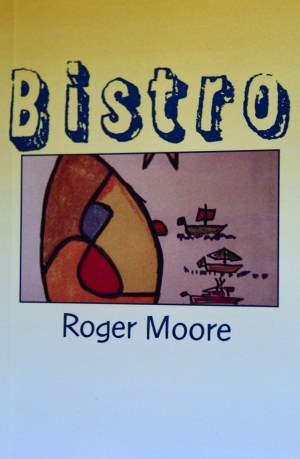
Comment: Bistro is the title story in a collection of short stories and flash fiction. Bistro, the book, was one of three finalists (and the only self-published book) in the New Brunswick Book Awards (Fiction, 2017). Bistro (the collection) is available on Amazon. The sound recording below is my own reading of the story and the opening cartoon, Belle Bottom Naval Gazing,  is the picture on the cover of Bistro, the book. It is also my own work.


Last Rites: FFF

Empress 048

Last Rites
Flash Fiction Friday
11 August 2017  

The employee gazed around his empty office. Tomorrow he would leave the work environment in which he spent his entire adult life. He turned out the lights, closed the door behind him, and walked down the stairway to the exit for the last time.

He took the long, solitary walk to the spot where he had parked his car. In the car park, he fondly kissed his wife’s photo and said a quiet farewell to his beloved daughter. Then, he climbed into his car, started it, and began the short drive home.

Later, at the inquest, the driver of the gravel truck swore he had no chance to avoid the head on collision.

“One moment the road was clear, the next this car was heading straight at me,” he paused and blew his nose. “There was nothing I could do.”

“Yes, sir,” the police officer stared back at the coroner. “I was the first investigating officer on the scene,” he glanced down at his note-book. “And yes, I can assure you that the car driver was not wearing his seat-belt.”

“He loved his work,” his wife testified, fingers twisting the white handkerchief that stood stark against her black dress. “There must have been something wrong with the car. He would never have left me alone like this.”

“A wonderful dad,” his daughter said. “He loved me, and the grand-children. He had so much to live for. It was a terrible accident.”

“Unhappy with his retirement?” queried the employee’s Department Head. “I don’t know what you are trying to imply. Nobody forced him into retirement: he made that decision himself. He seemed very happy with it. We all knew he was out of touch and not up to date with his research anymore. That’s why he chose to retire. He told me all that when he came to see me to tell me he was retiring. His decision to retire had nothing to do with me.”

The employee’s DH raised his eyes heavenwards and gazed at the ceiling.

Out of sight, in the safety of the witness box, he rubbed his hands together, again and again, as if he were washing them.

Comment:

It’s been so long since I last wrote and posted an FFF (Flash Fiction Friday). It feels good to be back writing prose. And yes, the last two FFFs were on May 5, 2017, Moonshine, and April 28, 2017, Crocodile Tears.

So much water under the bridge and so glad to start getting back to my creative blogging schedule.


Feathered Kangaroo

IMG_0125.JPG

This is a photo of a Feathered Kangaroo
water hopping on PEI, Canada.

Feathered Kangaroo!

A long time ago, still wrapped in the stifling chrysalis of academia, a friend of mine tried to flutter her immanent butterfly wings by making a joke at a very serious conference. She was delivering a paper on one of my favorite Spanish poets, in which she examined the sundry variants of a sonnet that the poet first wrote in 1603, then re-wrote in 1613, revised again in 1627-28, and revised a couple more times before its final revision in 1643, about two years before his death (1645).

At the end of her paper, she was caught off-balance when faced by an apparently serious question from the audience “Did the poet make any more revisions after 1645?” In an effort at humor, she replied, “Well, actually, no. But when they were carrying his body to the church for the funeral, he popped his head out of the coffin and proclaimed in a loud voice ‘Hell, no, I won’t go. I haven’t finished revising the poem yet.’”

This off-hand academic pseudo-joke was greeted with a babble of excited voices and an elderly fellow scholar clapped his hands, exclaimed “Wonderful!” and, in the ensuing silence, asked her what documentary evidence she had for this astonishing revelation, hitherto unknown to the academic world. If she was off-balance before, she was clearly reeling at this stage: a punch-drunk amateur academic swaying before the hypnotic fists of Dr. Muhamad Ali. She smiled sweetly, said she would produce the proper evidence at the appropriate time, and left the podium.

Later, sharing drinky-poos with some fellow scholars, I listened to her as she made excuses for her strange sense of humor and I smiled as explained the situation to them. They were not amused. “You, madam, are an acknowledged expert in your field,” one of them told her. “Your fellow academics trust you and believe you when you make such statements. You must be very careful about what you say.”

Feahered Kangaroo, indeed, water-hopping on PEI!

Now I must make an apology on my own behalf. Alas, if you read the blog item I posted recently, you might be puzzled by the Gazunda tree. I am forced to admit there is no such thing, to the best of my knowledge, as a Gazunda tree, not in the main square in Oaxaca, nor anywhere else in the world. Of course, when it rains people have been known to go under certain trees to use them as an umbrella and thus to take shelter from the rain, but this is the full extent of the origin of the name: the tourist or the golfer or the walker or whatever goes under (say it fast — Gazunda) the tree when it rains. There is nothing more to the Gazunda tree than that little joke.

And this brings us to a really serious series of questions: how do we know things are true? How do we establish the truth of a statement? Why do we believe some people and not others, some facts and not others? How do we choose between a series of alternate truths all of them presented as factual realities when, in actual fact, not all of them are true? This leads us on to the basic foundations on which our knowledge is built: how do we distinguish between scientifically established facts, and hearsay, and gossip if we are ignorant of basic scientific knowledge and principles?

To this we must add the triple increases that threaten us. These are (1) the increase in the availability of real scientific knowledge that bombards us every day with fresh facts and new information; (2) the increase in sources of information and the easy access to those sources; (3) the fact that many of these sources, far too many in my opinion, present us with a fictional or heavily biased version of a pseudo- or alternate truth. And yes, in light of telling the truth, the whole truth, and nothing but the truth, we are indeed entitled to question the existence and indeed the very meaning of these words: alternate truths.

These considerations seem modern and up to date, but of course they are not. They can be found in Miguel de Cervantes’s novel, Don Quixote (Part One, 1605, and Part Two 1615). They are present throughout the meta-theater created by playwrights like Pedro Calderón de la Barca (1600-1681), who set similar dilemmas of truth and fiction in, for example, his play La Vida es Sueño (Life is a Dream) as well as in the twelve plays he wrote based on Cervantes’s masterpiece. They are also present in the writings of some of the philosophers of the day. This is exemplified in the following passage that comes, I think, from René Descartes:

“There is no earth, no heaven, no extended body, no magnitude, no place and that nonetheless I perceive these things and they seem good to me. And this is the most harrowing possibility of all, that our world is commanded by a deity who deceives humanity and we cannot avoid being misled for there may be systematic deception and then all is lost. And even the most reliable information is dubious, for we may be faced with an evil genius who is deceiving us and then there can be no reassurance in the foundations of our knowledge.”

“There can be no reassurance in the foundations of our knowledge.” These are chilling words and present us with the unfortunate fact that unless we ourselves, each one of us, to the best of our abilities search out the absolute truth about all we hear, say, and do, we are indeed lost and we must wander in the dark with no light to guide us. ‘A sad life this, when beneath the axe, we have no time to check our facts.’ So: hie thee to Wikipedia, or Google the infamous Feathered Kangaroo. Or you can take my photo and the words accompanying it for the truth, the whole truth, and nothing but the truth. The choice, my friends, is yours.

Purple FF

img_0199

Purple

I close my eyes and return to Paris, Easter holidays, 1961. Algérie-française, Algérie-algérienne, the car horns tweet in the street as we drive the boulevards of a city divided. This is all new to me, a seventeen year old student in Paris to learn about French culture. My friends in the car have heard the tooting before and join in the fun.  Algérie-française the driver toots.

Turning a corner, flattened and blackened, still flaming against a fire-burned tree, the metal skeleton of a Deux Chevaux, a ‘tin of sardines’, bears witness to the car bomb that has laid its occupants low.

* * *

Hitching the highway, from Paris to Chartres, thumb stuck out to catch the wind, a purple Citroen stopped and offered me a lift. I trusted the car: a Citroen, like Simonet’s famous detective Maigret used to drive.

When the car stopped and the door opened, I got in and saw that the driver wore black leather gloves. His hand movements on the steering wheel were stiff and clumsy and he made exaggerated gestures when he changed gear.

“No hands,” he explained. “Lost them in Algeria. Listen: I used to be the driver for a top General. I drove him out of an ambush once. I lost my hands later, when the car exploded, caught in a crossfire. They teach you things in the Army. I can still drive.”

He accelerated and threw the car at four times the speed limit through the S bend that snaked through a small group of houses. I bounced from side to side, held back by no seat belt.

“You see,” he said. “They train you to do this before they let you drive. Ambush. The sniper at the corner. The Molotov Cocktail. You must always be prepared.”

I closed my eyes and returned to Paris.

Collateral damage: the young girl with her photo in the Figaro next day, scarred for life; her mother, legs blown off, lying in the gutter in a pool of purple blood.

Maman, maman,” the young girl cried. But her mother was never going to reply.

The Pom-pom-pompiers arrived in their fire trucks, sirens screaming. The ambulances screeched to a halt. The young girl cried. The mother bled out her life-blood in silence. Her blood turned purple and black as it flowed through the gutter.

Parisians emerged from dark doorways and stood there, bearing silent witness. Evening draped itself over the Paris skyline. The sky darkened and became one with the purple of the car bomb’s angry flame. Purple bruises marked my arm where I had gripped myself with my own fingers. An indigo angel squatted above the faubourg street, with shadowed wings, brooding.

* * *

I opened my eyes.

We left the village in our wake, travelling five times faster than the speed limit.

“They trained me for this,” the driver said. “I am prepared for anything.”

He stopped the car by the cathedral in Chartres. I thanked him and got out. He offered me his hand and I shook it. Inside the glove, the hand was hard and metallic. Alcohol sweated out through the purple veins that stained his nose and flowed in abundance over his sun-tanned face.

Double Trouble

IMG_0473.jpg
Double Trouble
“I’ll need some ID,” the guy selling Fred a new cell phone said. “Something with a photo on. May I see your driving license?”
“Of course,” Fred pulled out his driver’s license.
The salesman took it, glanced at the picture, walked over to the computer, and started to type in numbers. Fred watched him as he nonchalantly punched the keys. Then Fred saw him stiffen and straighten up as he held the license up to the light, double-checked it, and frowned.
“I’m sorry, sir,” the salesman said, looking very sad. “This license has expired. It’s more than two years out of date.”
“You’re joking,” Fred said
“No sir,” the salesman replied. “This license expired two and a half years ago.”
He handed it back to Fred who also checked it with care. At first, the figures seemed blurred. Fred took out his glasses and put them on.
“You’re right,” Fred said. “It is out of date. I must have the new one in here somewhere.”
He started to rummage through all the plastic cards in his wallet. But there was no new driving license.
“I must have left it at home,” Fred muttered.
“They usually shred the old licenses,” the salesman smiled. “They never let you keep them. You must have forgotten to renew.”
Fred placed his hands on the cell-phone counter, looked down, and saw his face mirrored in the shiny plastic. He gazed into his own eyes and they looked back at him. Then his mind flashed back two and a half years.
He had just been through the biopsy, a messy, painful, and unnerving affair, and the results had come back positive.
The urologist demanded a new battery of tests: X-rays, bone scans, blood tests, MRI’s, examinations, more examinations, questionnaires, discussions about possible forms of treatment …
The different treatments were set out like food in a self-serve restaurant and, like the strange foreign foods that Fred liked to try without knowing exactly what they were, their names meant nothing to him.
Then there was the travel: out on the road between his little place in the country and the major cancer hospitals in the province with an examination here, and a consultation over there. All the medical staff he encountered were kind and helpful and the suggestions they offered were sound. The winter road conditions complicated matters, though, and twice he was forced to cancel appointments because of road conditions.
Then, a week or so after the MRI, the allergic reactions set in and, over a three week period he lost all the skin, first off his hands, and then off his feet. He watched the skin bubble, then he saw it go very dry, and then it just flaked off. He remembered getting out of the shower one morning, drying his feet, and staring down at the little pile of flaked-off skin that had come away with the towel.
A little later on, came the injections, the tablets, and that was before the start of radiation treatment …
Now, two and a half years later, Fred’s driving license, the one that should have been renewed on his birthday, had expired. He remembered that birthday well. He lay on his side in the hospital and the specialist drove that first needle into his buttock … what a birthday present. And now, two and a half years later, he had another special gift from that birthday, an expired driving license.
He thanked the cell-phone salesman, put his expired driving license back in his wallet, and said how sorry he was that e would be unable to purchase the cell-phone at this time.
Early the next morning, Fred went down to the Driving License Renewal Center to discover his fate.
The lady on the counter was most sympathetic. She listened to his story and told him not to worry.
“Don’t worry,” she said. “It happens all the time. But I’m afraid you’ll need to take all the tests again, including the road test. That’s the law. I’ll need to see some documentation. A photo ID is preferable. Do you have your birth certificate or your passport with you?”
Fred nodded. He had checked online to see what he needed and had brought all the right documents. He handed the passport over.
The lady behind the counter took the passport, opened it, and looked up at Fred with a sad little smile.
“I’m sorry, sir,” she said. “You are in trouble. Your passport’s expired as well.”


My Favorite Book

img_0196

My Favorite Book

Last night, my writing group threw the table open for discussion on ‘my favorite book’. I listened as each member of the group came up with a title or two and then chose a book that was ‘the favorite’. When my turn came, I was last, they all turned to me, but I remained silent for a long time and then: “I can’t do it,” I said. “I bet it’s got windmills in,” one person remarked, thinking of my propensity of frequently quoting Cervantes’s Don Quixote as a model when literary discussions arise. Indeed, Don Quixote might be my favorite book, but is it?

Let us begin with the concept of book. Is a book something contained between two covers or could it be a series of books? For example, does one choose between The Chronicles of Narnia or must one select The Lion, The Witch, and the Wardrobe over The Silver Chair? Is one free to choose The Lord of the Rings, or must one prefer The Two Towers, say, to The Return of the King? By extension, where exactly does The Hobbit stand, as a book, in book form, in relationship to the later and longer series? Or The Silmarion? Again, can we roll them all together, a series of books under the cover of one book, a favorite book?

The idea of favorite author versus favorite book then surfaced and we discussed Georgette Heyer, John LeCarré, equally loved and loathed, Jane Austen, the Bronte’s, J. K. Rowling, and William Shakespeare. The mention of Shakespeare led us into plays as reading material and plays as performance, and performance as on stage or on film. One of our members loved Shakespeare on film and TV, but didn’t like reading Shakespeare, because it was ‘difficult to read and needed the interpretation of the actor for the meaning to come across’. This same person did not like LeCarré’s books, but was very appreciative of his work on film. Where does George Smiley begin and Alec Guinness end, one asks? How can we separate the character from the actor? Applied to James Bond, who is James Bond? Is he Sean Connery (totally unique and my personal favorite), Roger Moore (better for me in the role of Simon Templar, The Saint), or one of the later and newer actors who have taken over the role? By extension, should James Bond be played by a black actor (why ever not I ask?), and could (oh horror of horrors!), a female actor take over that role (I’d love to see it … “I’m Bond. Jane Bond!”)?

This led us into the art of the narrative and the relationship between book as narrative and film as narrative. Clearly they are two different forms of media, but how do they influence each other? The book obviously comes first. We can talk of the seventeenth century novel, but it is difficult to talk of the seventeenth century film. So, the linear narrative of the book comes first and then that book is turned into a film. However, a film contains its own narratives structures and these include multiple points of view, split screens, flashbacks and time distortions, and a multiplicity of other devices among which the actual scenic impact is of the utmost importance. For most of us, the nineteenth century novel (no radio and no television for entertainment in those days) is long drawn out and very slow moving. We miss the instantaneous impact of screen and TV with the breaks for advertisements and the time to recharge our coffee cups and snacks. This leads us to our own attention spells as readers and our own demands for the instant gratification of a thrill a minute. “Hook them on page one and addict them by page three,” one person commented to many nods from around the table.

But the mention of Don Quixote also takes us into other areas. In this age of bi- and multi-lingualism, do we prefer to read our books in one language rather than in an another? Don Quixote in Spanish or French or English? And which translation? There are some twenty translations of Don Quixote into English. Is one preferable to another? Which is more accurate in the terms of a translation? Which reads more easily in terms of a re-creation in artistic form of the original? Should we prefer an English-English translation to an American-English translation? And where oh where is the Australian, Indian, Pakistani, South African, Canadian, Irish, or Welsh translator who will justify that famous text in his own country’s rendition of what used to be called the King or the Queen’s English?

Don Quixote, according to the great Spanish literary critics, is a book for the three ages of life. Readers should read it when they are young, when they are middle aged, and when they are approaching old age. Why? Because one’s reading and understanding of the book changes as one grows older. If this is true, then can we not expect to have books that we preferred at an earlier age in life, The House at Pooh Corner, for example, or The Wind in the Willows? And what about our early teens (adolescence), our early twenties (university years)? The idea of our being able to choose a ‘favorite book’ becomes less and less clear as we open up our minds to the broader horizon of tastes that change as we age and mature.

You will have noted that, with the exception of Shakespeare, we concentrated on the twin ideas of fiction and narrative, be it in word or on the screen. What about poetry? Five major critics met at the Modern Language Association of America’s meeting held one year in the University of Toronto and held a panel discussion in which they discussed why and how they had been attracted to the foreign language that they had studied. In four of the five cases, it was the poetry of the language, not the theatre or the narrative, that had pulled them in. Last night, we did not discuss poetry.

When we bring poetry to the table, we open a different discussion. We rarely read and appreciate ‘books of poetry’. With a few notable exceptions, it is individual poems and poets that attract our attention, rather than entire books or collections. And what is it about poetry that attracts us? Surely, it is the power, not of situation nor of action, but of language. It is the sheer power of language and the thrill of words that draws us to poetry. Perhaps that is why, in an age of impatience, we have less time for immersion in the magic spell of words and their undercurrents of subtle meanings. As a friend of mine said to me, the day before yesterday, “I started your poetry book, Obisdian’s Edge, but it was too deep for me, too difficult. I gave up on it. I needed something simpler to read.”

Comment: This article should be read in association with an earlier piece in this blog (15 July 2016) on My Top Ten Books.

Writing Groups: Thursday Thoughts


img_0186

Writing Groups
Thursday Thoughts
11 May 2017

We write in solitude.

We cannot group-write with a second person suggesting the second word and a third person, the third word. This leads only to the Third Word War or the Third Word Whore, as some would express it.

To write is to be alone. It is to sit alone before a blank page and watch it slowly fill with the black ants that we form into thoughts. With pen or pencil we trace the Morse Code SOS of our Mayday signals. We gather them into groups, press them between cardboard covers, and we send them out to sea in little bottles. Then we sit back and wait, hoping to contact intelligent and compatible life that will approve our efforts and perhaps offer to publish our writing.

We must not confuse the act of writing with the act of sharing.

In many cases, to share is to seek approval. But this is not always true. We sometimes share in the hopes that a listener will suggest improvements to our writing. I think of this as ‘sharing from weakness’. We are unsure of our sharing self and we seek confirmation and reinforcement. We also seek the reassurance that the second person or the third actually has a better vision than the writer and can improve that writer’s offering. How confident are we in our own writing when we constantly look for approval?

Sometimes, our sharing is in an act of defiance. We organize our black ant army. We form it into battalions. We launch them at the enemy and “Take that you bastards,!” we think as we read out our thoughts. Occasionally, our sharing is an act of self-praise. We know it’s good and we want others to realize just how good this piece is and how good we are. Auto-homenaje (Spanish): an act done in praise of oneself.

The act of sharing can be private and confidential. This is when we gather with a group of friends to share our thoughts and creations. This is most useful, in my opinion, at the beginning of a writer’s career. Writers have to become independent. They have to learn to shake off the shackles of doubts, second and third opinions, and the rewriting that comes from the mind of an outside reader. Writers have to learn to stand alone and to write alone. This is where the public reading comes in.

To read in public, as in an open reading given before an audience of unknown faces, is a different proposition. We are relatively confident when we share with our friends. We are not so confident when we read in public. We must be confident in ourselves and our words if we are to stand before strangers and expose ourselves, our strengths and our weaknesses, to those who may not love us and some who may actually hate us, looking for any defect, any chink in our written armor.

Beyond writing, yet enclosed within it, is the writer’s desire to be recognized and published. If we are writers, we want our works to be known and read. We want to be published. Even when we know we are not ready to be published or worthy to be seen in print, we like to imagine ourselves preparing that great tome or slender volume of verses that one day will project us into the realms of glory when it finally sees the light of day.

Yet we cannot publish alone. Or can we? Desk-top publishing on our own computer is easy to do. Format the work, print it out, take it to the photocopy machine, copy it multiple times, staple the resulting pages together and we have … a book. But are we satisfied with those morsels of paper that we hand out to our friends? Some people are, many are not.

Let us look at an alternate route: we hand the book over to a press that edits the writing, does all the copying work for us, chooses a cover, binds the book, gives us twenty free copies, and hands us an enormous bill … some are happy with that; again, others are not.

Let us examine another route: we find an online company that will do all (or most) of that for free. All we have to do is market our work … again, some are happy with that; others are not.

Mal de todos, consuelo de tontos. This is a delightful Spanish phrase. It means that when everyone is travelling in the same ship of sorrows, only fools are consoled by the fact that we all share the same fate. Perhaps that’s why writers gather together in groups and perch, like autumn swallows preparing to migrate, on chairs in a drawing room at somebody’s house or gather together in a disreputable, but cheap, coffee house to read, discuss, share, and endlessly talk about the works that never get published.

“You just got rejected? What a pity. I just did too. Let’s compare rejection letters. Paper your walls with them, my friend.”

The carrot that we all seek is the pot of gold at the rainbow’s end that contains the winning lottery ticket: a letter from a publisher offering to publish the book we have written. An Old Welsh Recipe for rabbit pie begins with these wise words: “First catch your rabbit.” The same wisdom must be applied to writers: “First, write your book.”

When the book is written, to the satisfaction of the writer, then, only then, let the networking begin. Then we can reach out to the community. Then we can read in public. Then we can seek out that elusive publisher and follow our own thirty-nine steps to success.

Bu, in the meantime, remember, never forget, we write in solitude.

Nobody’s Child

IMG_0466.jpg


I ordered Nobody’s Child on Monday and it arrived on Thursday, two days after A Cancer Chronicle. Two books, two days apart. Wow. Nobody’s Child is a collection of short stories and Flash Fiction that deals with some difficult topics. A couple of the shorter pieces have appeared on these pages and will be familiar to the followers of this blog. Most of the material is new, some of it, very recent. Some of the stories have been published, others have received awards and honorable mentions. A shortened version of the collection, under the same title, was given an Honorable Mention in the David Adams Richards Fiction Prize of the Writers’ Federation of New Brunswick in 2016.

Let the fiction begin: “… so this is earth day and we light candles in our house and turn off the telly and the computers and sit there reading and writing, watching each other through the flicker of the candle flames, and listening to the sounds of the house, such subtle sounds, the creak of the siding, the click of a door, a blind moving in the room overhead, the tick of the grandfather clock in the hall … and the smoke rises from the candles and makes dark patterns in the stillness of the air … and yet, through the blackness, the bleakness of the candle smoke, a hand reaches out and holds me by the nape of the neck, and thrusts me back into a past which once again has come back to haunt me …”

Nobody’s Child    is available on Amazon.