… walking life’s walk grey jays in the ash tree fresh snow on the ground
at night deer track out of the woods moon’s dead skull chalking its slow path westwards
snow falls white upon white whirling our world back to its cratered life
nothing needed other than moonlight on snow to ignite us
a white wall of water cascades earthwards from the moon waters of renewal waters of life waters that restore us and save us from the moonbeam’s slicing knife that amputates all life …
15
… it is scary tonight inside the topsy-turvy big-top of my circus world
carnival time clowns clowning around turning my life upside down
is my mind a spider-web spun by worry and doubt
I remember how they pushed me around kicked me out always the anonymous they
they abandoned me told me I was unwanted surplus to purpose forced me to exit
they told me to forget those amniotic waters that water world of comfort that illusion of reality they had created then threw me onto the street
I left behind their stultified personalities with all their stupid rules and blinkered minds that stopped them from seeing straight …
I have a question for you. Recently I purchased a book by Forrester- The African Queen. I enjoyed the movie years ago and thought I would like to read the story. The main actors were great. The book highlighted that it showed what it was like being a female during the war, (1) which when I look back on now is one of its main points.
My question or thought on this book is tied around the library system. When I lived in Fredericton I wanted to give a bunch of books to the library, their first question to me was, “How old are the books? I told her and she said anything over five years in not being accepted. (2)
I wondered about this and the fact that many books in school are being removed, (3) how can we tell how much we have progressed? (4)
I don’t like prejudice but it seems we are throwing out too much. (5) Any thoughts on this. I don’t mind some of the history being trashed (6) because for Canada the consentation is for Quebec and Ontario.
Roger’s Response
(1) It’s also about the role of the nun in society. How do ‘holy women’ function in a male society? It sets some of the many questions we are now being faced with, but doesn’t really give any answers. It’s a long time since I saw that film. I don’t think I ever read the book – the themes might well change in print. They are present (some of them) in The Handmaid’s Tale.
(2) The library system seems to have rules and an etiquette all its own. When I donated books to the library, they accepted some for their collections, but set others up for sale on the book tables by the door. My guess is that certain books are ‘best sellers’ and will be read, others are ‘dust gatherers’ and won’t be. They want the former, not the latter. They also have specialized collections. If the books fit the specialized collections, great. If they don’t, then they hit the unwanted category and are moved on. This is particularly true of the UNB Library System.
(3) This is an entirely different question, and one with very deep roots. It deals, in part, with the question of control – quis custodiet ipsos custodies – who shall guard the guards, who shall program the programmers? By controlling what people read, you control their thoughts. One of the worst signs of this was the book burnings of the Spanish Inquisition (15th – 16th – 17th centuries). The Jews were expelled from Spain in 1492. (And the Arabs / Moors, in 1609). Prior to that, these people were ‘processed’ by the Inquisition. The original Inquisition was Papal, aimed at instructing the priesthood in Rome in how to interpret the Catholic Catechism. It was corrupted in Spain (under Fernando and Isabelle) by the Spanish Inquisition, a sort of secret police, which worked rather like the Gestapo in WWII. One of their jobs was to ensure that people who had converted to Catholicism, to avoid deportation, stayed converted and didn’t revert to their old religion, even in secret. Another was to ensure that reading material, religious material, and cultural material, particularly after 1527 (Martin Luther and his 97 theses) when the Reformation started, were all in line with the accepted Catholic thoughts of the time. All books about to be published were sent to the Inquisitorial Censor who vetted them and either approved them, or asked for changes. If he (they were all men) saw the slightest sign of dissent or heresy. Don Quixote, Book One, Chapter Six (DQ,I,6), deals with the book burnings of DQ’s personal library. In certain of the States (down south) books are already being banned. A similar ban, in certain States, that touches us closely, is the banning of Margaret Atwood’s The Handmaid’s Tale.
(4) “There is no earth, no heaven, no extended body, no magnitude, no place and that nonetheless I perceive these things and they seem good to me. And this is the most harrowing possibility of all, that our world is commanded by a deity who deceives humanity and we cannot avoid being misled for there may be systematic deception and then all is lost. And even the most reliable information is dubious, for we may be faced with an evil genius who is deceiving us and then there can be no reassurance in the foundations of our knowledge.” René Descartes (1635)
Descartes expresses this much better than I can. It is one of the major dangers of the age in which we live. How do we distinguish between reality and alternate realities? Which reality is the real reality? What is, or isn’t, fake news? How do we tell? Who do we believe? And why do we believe them?
(5) Another part of the problem is that ‘certain people’ – who don’t believe in science and who exploit people’s scientific ignorance to their own advantage – are willing to destroy the foundations of our knowledge. Burn everything down, they say, and start again. The new starting point is to impose what they believe upon everybody around them. This is a huge and crucial problem that threatens us, as individuals. It also threatens the foundations of our knowledge, as well as the very world in which we live – climate change vs denial of climate change – profits over people, versus government of the people, for the people, by the people. Once one starts asking such questions and looks at the AI systems with their immense persuasive powers and their seemingly uncontrollable spread of Mis-information and Dis-information, then one starts to realize how serious the problem is.
(6) Those who ignore history are doomed to repeat it – Santayana (the Spanish philosopher, I think). However, we must, in certain circumstances, adjust our current beliefs to current realities. Immigration is a major issue – as is how we deal with people, like me, who come from different cultures and beliefs? Not everything written in the past suits our current world view.
I have been looking at old Westerns – “The only good injun is a dead one” (John Wayne). Really? I know some wonderful people in our first nations communities and I have taught them and worked with them and have often been taught by them. “Shoot first and ask questions afterwards.” Really? I won’t comment further on that one, without reflecting on the number of automatic weapons floating around in our socuiety. So many people are being killed by them.
All of this comes down to the big question – freedom of information or the release of just enough information to persuade other people of what we believe and what we want them to believe. Power and Control. Knowledge is Power – Michael Foucault. Control that knowledge and you have power over the people. Noam Chomsky has written widely on this – and his books have been banned in the USA. Bertrand Russell too – The Meaning of Meaning, for example, and his establishing – along with A. J. Ayer – of the doctrine of logical positivism – the removal by means of mathematics of all the emotional content of words.
My friend, you have opened a can of worms. Long may they wriggle and squirm.
Spring is here. An election is near. Road repair season has started.
1. Spring potholes – they are terrible and they are everywhere.
It was so bad in one area of town that people filled them with water and put out little plastic yellow ducks to float on them.
That way they could be seen, which saved the loud clunk of them being heard and felt.
In one place, some street artist used the potholes as the centerpiece for porno pictures.
Success – early next morning, the potholes had been filled in.
2. Spring road repairs – horrific – and all too abundant.
We have a sign at the bottom of road saying “Caution – Construction – drive carefully for the next 6 kms.”
At the 1 km mark, a lollipop person with a STOP sign.
Ahead of us, 24 cars – behind us, the traffic line up is building.
We wait 15 minutes.
A white half ton appears, followed by a line of cars.
The half ton pulls into a drive ahead of us.
We count the cars as they drive past.
99 of them. Then a pause.
The white half ton reverses out of the drive and pulls up in front of us.
On his tail gate a sign that says “FOLLOW ME”.
He pulls away, and the first car follows him, as do we all.
He drives at 10-15 kph.
After 1.4 kms, we see the road works – the actual working space is less than 200 meters long.
We keep driving.
At the 3 km mark, the white half ton turns off, into someone’s drive.
Alas, the driver of the first car has no sense of humor and doesn’t follow the leader into the drive but sets off at speed down the road.
I count the cars that are waiting to return – 59 of them and more arriving.
It has taken us close to 25 minutes to negotiate 200 meters of road repair.
3. Bridge closures – there are three bridge crossings from the south side to the north side of the river.
One is at Mactaquac, over the dam, about 15 kms up stream from the Westmoreland Bridge, the central crossing point.
The Mactaquac crossing has been reduced to ‘one way at a time’ traffic for the last two or three years, and will stay like that for most of the summer.
Don’t ask, they won’t tell and I can’t tell, because I don’t understand.
The third bridge is the Princess Margaret.
It is closed to all traffic for the next five weeks and this is the third year that someone has been working on it.
So, for the next five weeks, we are all reduced to crossing the river by one bridge, the Westmoreland, unless we drive 15 kms to a ‘one way at a time’ crossing or 20 kms down river to the Burton Bridge at the Town of Oromocto.
Rage, rage, against the dying of the light! My thanks to my good friend, Dana Webster who inspired me to write this by sending me a rant of her own. NB Click here to link Dana’s Creative World.
“You can’t write about life if you haven’t lived it.” Words of wisdom from the poet who wrote The Old Man and the Sea.
“But,” I hear you say, “what did he know about writing? He never took any courses that taught him how to write, nor held a certificate from a prestigious school that guarantees quality. Nor was he a poet, he only wrote prose.”
And yet, the prestige of that ivy-covered, ivory tower leads poets… I pause for a moment… – to where exactly? Into debt, of course, and also down the paved path of their own destruction.
What kind of life do they live, those writers, who only exist within their cerebral boxes, and never step outside them unless they are ordered to build an even bigger box?
Have they walked with street-walkers in Madrid? Have they sat beside the poorest of the poor, in Oaxaca, shivering in thin cotton clothing beneath falling snow? Have they visited Madrid’s Plaza de España, stepping high to avoid the blunt, bloodied needles, shared, to take away the pain? Have they pan-handled in Yorkville or slept in sleeping bags, by the Royal York, in the snow, at 40 below, on the gratings above the Subway?
“The unexamined life is not worth living,” some say Socrates said. But what I think is ‘the unlived life is not worth examining.” Tear down the walls that inhibit and limit you. Go out into the world and see what others see and feel. Only then, come back, stab your pen into your veins, fill it with your blood, and set before us what was done to you, what you experienced, how you survived, and what you felt.
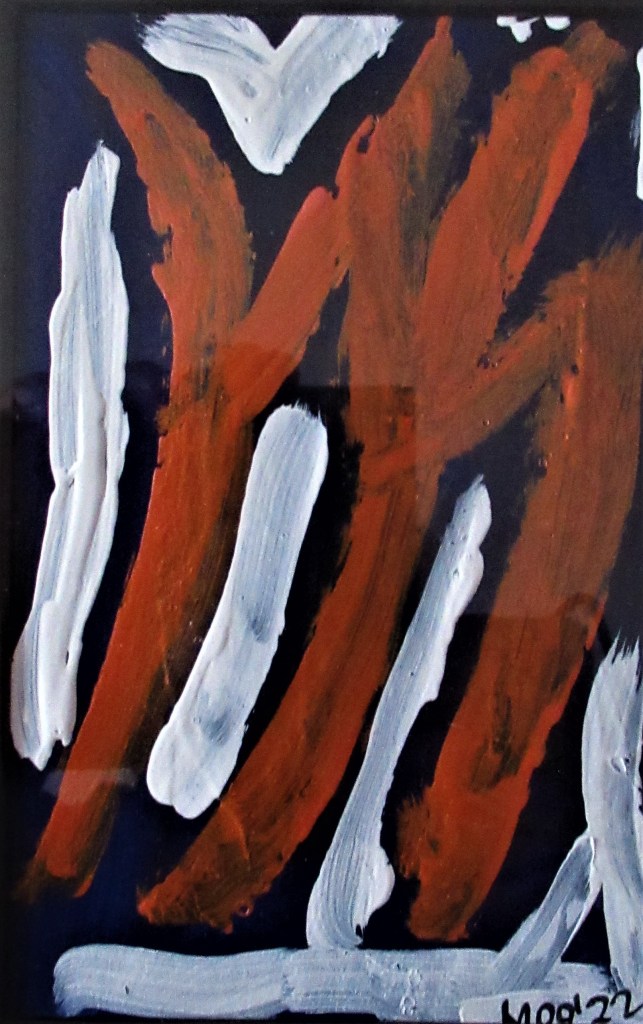
Comment: Once again I thank my friend Moo for his illustration – Building Bigger Boxes. It goes well with the theme of this rant, or is it a poem? A verbal rant to echo a visual rant, perhaps, or vice versa.
A month ago, on November 23, I posted my last message on this blog. Since then, nothing. Silence.
For thirty days and thirty nights the world has been as silent as the painting I posted above. It has been as silent as snow flakes circling. As quiet as the ribbons tied silently together. Nothing stirred. Nothing moved. Nothing.
Can an absence be a presence? Sometimes it is, for example, when we lose a tooth, a family member, or a friend. In their absence, we lament the loss of their presence. With a tooth, we run the tongue around the empty space, noticing the tenderness of the flesh, the hollow within the gum.
It’s the same with friends. They go AWOL. Move on. Forget their promises of eternal friendship. They become the empty space where the tooth once stood. At first we grieve. Then we become used to their absence. Then, one day, we realize that their voices have fallen silent and then they are friends no more.
Right now, there is a hollow in my life. An absence. I cannot put my finger on what is missing, absent, as always, without leave. Maybe it is the Christmas beliefs that dogged my childhood. Maybe it is the emptiness that warns of oncoming storms, each one greater than the one before. Maybe it is just the premonition, the suspicion, that all is not well with the world.
This year we gave more money than ever before to the Feed a Family Fund. Then we sent extra money to the local foodbank. Everywhere we see that the social ball of string is unwinding and ends no longer meet. It seems our society no longer has the will or the means to justify any ends, except selfish ones. Is it everyone for themselves, then, and the devil take the hindmost? Sometimes it feels like it.
I have seen the hindmost, human beings they are, just like you and me, except they are wrapped in blankets, begging at traffic lights, sitting outside the supermarket, a coffee cup at their feet, hoping for a penny to drop. Where have all the pennies gone? Gone to the smelters everyone. So they wait for a nickel to drop, or a dime, or even a quarter.
Covid-19 and all its subsequent derivations may well have been at the heart of all this. The isolation. The masking. The distancing. The fear of the unknown. The fear of the stranger in our midst. We have become used to living with those fears. We still have Covid-19 and its variations, some with long term complications. We now have a virulent flu as well. And there are various viral infections circulating.
The Apocalypse? Not yet. The Apocalypse has four horsemen and I have only mentioned three. So – where is the fourth one hiding? When will he appear? What will he look like? Maybe he’s lurking in a food bank, an unrepentant Grinch preparing to steal the food? Perhaps he hides in an unheated house? Can he be spotted at the dinner table, where the parent or parents are not eating, so that a child may eat?
I throw these questions out. Outside my window, clouds gather and snow starts to fall. I listen carefully. But all I can hear is the silence to which I have grown accustomed.
Long gone, those dead days, skeletons now, their centers collapsed in on themselves unable to hold fast to time’s hands circling the clock of ages, that timeless rock.
Long days will come when light will fail to enlighten, eyes will be dimmed, the burden will grow heavier with life lying in wait, to weigh us down with all those lies, each falsehood a rock added to the daily pile.
Carrying them is one thing. Rolling them up this hill each day, only to have them roll down, overnight, forcing us to stoop once more, not to conquer, but merely to live our lives, to journey onwards, relentlessly, to endure from the beginning of the end until the last, and we must, we will endure to the last.
Trapped in this fragile vessel with the pandemic a passenger waiting to board, I drift from port to port, looking for a haven, safe, to have and to hold me.
No harbour will let me dock. “No room at this inn,” they say. “No haven here.” They wave me away.
Now I have no destination. Aimless, I float and every where I go the message is: “No vacancy: no room at all.”
Unwanted, abandoned, I wander with wind and waves, my only friends seals, porpoises, and whales. I walk the whale road, leaving a frail, white wake behind.
This vessel has become a gulag now, a prison camp where I exist just to survive. Each hour of each day endless, boundless, like this shadowy, haunted sea.
Today there is no motion, no goal. What is there to achieve but survival? Each day’s journey is sufficient unto itself.
A strange, milk-cloud sky, skimpy, with the sun a pale, dimly-glowing disc and my pen scarce casting a shadow as the nib limps over the page.
Out on the west coast, fires still range free and this is the result, these high, thin clouds casting a spider web cloak over the sun face and darkening the day.
The west coast: five or six hours by plane and three whole days to get there by train, even longer by bus, all chop and change with multiple stops.
The wind blew and the clouds came widdershins, backwards across the continent. Today they reached across the ocean to claw the sun from European skies.
It is indeed a small world after all. Isostasy: you push the earth balloon in here, and it bulges out over there in the place you least expected.
Now we are all interconnected in an intricate network of a thousand ways and means. What does it all mean? Ripples ruffle the beaver pond’s dark mirror.
The forest mutters wind-words, devious and cruel, that I sense, but cannot understand. High in the sky clouds turn into horsemen on plunging steeds.
Fear, fire, flood, foe, poverty, unemployment, pandemic, crops destroyed and, waiting in the wings, threats of civil unrest, the apocalypse, and a war to end all wars.
Comment: A week in bed, unable to sit, to write, to use the computer, except standing on one leg and typing with one finger. Unable to concentrate, to create, and now, after four visits to my medical team, acupuncture, manipulation, massage, finally that pinched nerve has stopped pinching and I can get back to writing. However, my thoughts are as grey as these clouds that dim the skies. I no longer know who or what or where I am. The world around me has turned sinister and I suffer.
The result: black thoughts, black poetry, red, flaming skies, and the knowledge that all is not well, neither with me, nor with our sick little planet. There is no Planet B and this one, like me, is suffering.
Premonitions and dark thoughts. I lie awake in bed each night, sleepless, hugging my Teddy Bear and my hot water bottle, aching, suffering, waiting for the dawn.
After I delivered the lecture at London University, as it was back then, I caught the tube and descended at Paddington station. While waiting for the train back to Cardiff, I sat in the station bar and ordered a pint of beer and a Cornish pasty. An older man wearing a sweater and jeans asked if he could join me. I didn’t say ‘yes’ but he sat down anyway and straight away began to talk. I paid no attention to him until he rolled up his sleeve and showed me the collection of scars that ran crisscross, hard and welted, over his left wrist. “Failed attempts,” he said. “But I’ll get it right next time. “I wouldn’t want you to make the same mistakes I did. If you want to kill yourself, you must do it this way,” he reached across the table and picked up the knife I had used to cut my pasty. He pulled out a dirty hanky and wiped the knife in it. Then he laid the blade not cross-wise but parallel to the artery in his wrist. “And you must dig deep, first time, and at a slight angle.” “I’ve got to go,” I told him as a tinny voice came over the Tannoy. “That’s my train.” I stood up, leaving the remains of my pint and my pasty on the table. I got to the door of the station bar and looked back. Then I watched as my table companion finished my pasty and reached across the table to claim the remains of my beer. “Quite the lecture,” I thought. “Good job I didn’t spit in the glass.” Then I realized that both my day’s lectures had been effective, in one way or another.
I am not worthy
to be called her sun,
and yet her world
revolves around me.
She spins in my space
and short-circuits
her own life to make
mine more livable.
I’d like to say ‘joyous,’
but tears are in all things
(sunt lacrimae rerum) and
death touches mortal minds ( et
mentem mortalia tangunt).
The best I can offer:
a salt water world,
filled with inadequacies,
drowning us in tears.
Comment: Several things of note in this poem and the voice recording. Should we mix languages in a poem? Why ever not, so long as we explain them. This Latin tag goes back over 2,000 years and links my poem (Intertextuality, remember?) into a long Western tradition. Am I worthy of that tradition? Is my poem? Well, that is a totally different question. However, I am linked in, as you might phrase it. A second question: does my reading of the poem affect your understanding of the poem? If so, how and in what way? Does the phonic word play sun / son affect your understanding of the poem? If so, how? And how does the double meaning of ego work on your mind? Does the Freudian Ego / Id stand out? Or does the schoolboy “Quiz?” “Ego!” spring to mind. Or do you immediately think of the first person singular (Latin) ego as in ego sum lux, via veritas? More important: are you aware of any of this or does the poem disappear into a desert landscape of nothingness with no apparent strings attached? Good questions all: I invite you to think about them all. Blessings and best wishes. Keep safe.





 rogermoorepoet