Writing at KIRA

39948917_706398923049634_3046174897211441152_o (1)

BOUTIQUE WRITING RETREAT
SUNDAY SEPTEMBER 30 – SATURDAY OCTOBER 6

This KIRA Boutique Retreat invites former KIRA Resident Artists (Roger Moore (June, 2017) and Jeremy Gilmer (July, 2018) to blend their knowledge and skills with those of the Kingsbrae Artistic Director, Geoff Slater, in a unique Artistic Retreat, tailored to the needs of each participant.

KIRA Boutique Retreats offer a series of one-on-one and small group encounters within the glorious surroundings of the KIRA Residence.

The KIRA Boutique experience includes scheduled one-on-one interviews with each of three instructors, Blue Pencil Cafés, small group workshops (according to demand), lively meal time discussions, and evening readings and talks by facilitators and participants.

The secret of these unique KIRA Boutique Retreats is the unbeatable ratio of participants to facilitators within a small, welcoming artistic community.

Your KIRA Boutique Experience may also include the wonders of whale-watching, the award-winning gardens at Kingsbrae, special events at the Kingsbrae Gardens, the beauties of the resort town of St. Andrews, and the outstanding gourmet food of the  Kingsbrae Garden Café.

As a participant, you can enjoy the solitude of your 20’ x 20’ artistic studio or you can join in the artistic discussions launched by our expert facilitators.

RETREAT FEES:

The KIRA Boutique Experience costs $750 for a six night residency.

This includes:

1. 6 nights accommodation in the beautiful KIRA residence.
2. 2 meals a day.
3. Tailor-made writing workshops (on demand).
4. Blue Pencil Cafés, one-on-one interviews with the facilitators.
5. Round-table artistic discussions at meal times.
6. Evening talks and / or open reading sessions.

Facilitators:

Geoff Slater, Artistic Director, Kingsbrae Garden / KIRA.

Roger Moore, award winning poet and short story writer, KIRA (June, 2017).

​Jeremy Gilmer, CBC finalist (short story), KIRA (July, 2018).

Please contact Mary Jones to sign up.

Phone 506-529-8281

PLEASE FEEL FREE TO SHARE THIS EVENT

Click here for the direct link to  KIRA and Kingsbrae.


Loss of …

IMG_0062.JPG

Loss of …

By the time I remembered your name,
I had forgotten your face. Then I couldn’t
recall why I wanted to talk to you.

I trace dark landmarks on the back of scarred
hands: blood maps, unremembered encounters,
dust covered photographs, grey, grim, anonymous,

not belonging in any family album.
At night I cruise among islands, emerald green
against sapphire seas. Why didn’t I visit

some of these places? Golden sand trickles through
night’s fingers and time’s hour glass, as stars
sparkle and planets dance in Platonic skies.

My memory fails. I wake each morning
unaware of where I have been the night before.
I track the sails of drifting ships, white moths.

I think I have caught them in overnight traps,
but they fly each morning in dawn’s forgiving light.
I give chase with pen and paper, fine butterfly nets

seeking wild thoughts waiting to be caught, then tamed.
I grasp at something just beyond my fingertips,
but I can’t quite remember what it is.

Comment: I first published this poem on July 31, 2018 (click here for the original post). Here it is now, in revised form. I find the revision process to be totally fascinating: the polishing of old ideas, the arrival of new ones, a different structure, a reshaping of the poem’s internal logic. So much happens in the revision process. Many great poets wrote and rewrote their poems, again and again.  I consider Francisco de Quevedo and Juan Ramón Jiménez to be poets who continually revised. A perusal of the variants to their poems (28 versions in the case of some of Quevedo’s poems) gives the reader an understanding of how the great poets think, of how they purge, intensify, sometimes simplify, usually improve their initial instincts. We lesser poets can learn so much from the greats. Above all, we can understand that poetry is a life-long practice, that it is a love of words and emotions, that it is a desire to catch and preserve the uncatchable that can never be completely caught. The critics say that the reader can never know the writer’s intentions. I agree with that, to a certain extent, as I never know why I am writing what I put down on the page. I guess I often have no intent. More important, my original intention can change as I write, and what I write is by no means what you understand I wrote when you read, for each of us processes the imagery, especially metaphors, in a different, and very personal, fashion. That said, when I rewrite a thought pattern emerges and my intentions become that much clearer, not from the words on the page, but from the footpath that led me in different directions until the final version emerged on the page.

Butterflies

img_0189

Butterflies

“Poetry gives permanence to the temporal forms of the self.”
Miguel de Unamuno.

That is what my writing is all about,
those temporal forms, fluttering and changing.
Butterflies, they live for a day or two,
perch and flourish, spread their wings,
excel for a moment, catch my attention,
then blown by a sudden gust of wind,
they tear their wings on a thorn
and perish in the blink of an eye.

Reborn in ditches, they cluster and gather,
congregate, black and yellow, on bees’ balm,
smother Cape Daisies and Black-eyed Susans.

Like shadows they shimmer, butterflies by day,
fireflies by night, terrestrial stars, lost, wandering,
floating in their forest firmament, hackmatack,
black oak, bird’s eye maple, silver birch, fir …

Impermanence surrounds us, dances beneath stars,
sings with robins, echoes the owl’s cry through woodlands,
poetry, the elemental soul, our words capturing nothing,
turning it into eternity, holding it for the briefest moment,
then letting it go. Island View, New Brunswick, Canada,
my home in the woods, my dialog with my place and time.

My Body

IMG_5811_2

My body

My body has so many rooms and you,
my love, possess me in them, wander
through them, and I see you, here, there,
everywhere, your presence a shadow
glimpsed in a mirror, or your warm touch
a breath upon forehead or cheek. Where
have you gone? Why did you leave me
here on my own to languish in your absence?
I walk from room to room, but when I knock
you open no doors, and though I seek,
I fail to find. I know you are somewhere near.
I hear your footstep on the stair, your voice
in the silence that surrounds me. My name,
a syllable or two, whispered in the way
I so clearly remember. How can it be true,
my love, that you have gone, that you have
left me here and forged ahead into another
time and space? I count the hours and days.
Will you prepare me a place? Will your face
be there to greet me? Alone, I clutch at straws,
embracing dust motes, counting the angels that
dance on the rainbows on the head of a pin.

Last Rites: FFF

Empress 048

Last Rites
Flash Fiction Friday
11 August 2017  

The employee gazed around his empty office. Tomorrow he would leave the work environment in which he spent his entire adult life. He turned out the lights, closed the door behind him, and walked down the stairway to the exit for the last time.

He took the long, solitary walk to the spot where he had parked his car. In the car park, he fondly kissed his wife’s photo and said a quiet farewell to his beloved daughter. Then, he climbed into his car, started it, and began the short drive home.

Later, at the inquest, the driver of the gravel truck swore he had no chance to avoid the head on collision.

“One moment the road was clear, the next this car was heading straight at me,” he paused and blew his nose. “There was nothing I could do.”

“Yes, sir,” the police officer stared back at the coroner. “I was the first investigating officer on the scene,” he glanced down at his note-book. “And yes, I can assure you that the car driver was not wearing his seat-belt.”

“He loved his work,” his wife testified, fingers twisting the white handkerchief that stood stark against her black dress. “There must have been something wrong with the car. He would never have left me alone like this.”

“A wonderful dad,” his daughter said. “He loved me, and the grand-children. He had so much to live for. It was a terrible accident.”

“Unhappy with his retirement?” queried the employee’s Department Head. “I don’t know what you are trying to imply. Nobody forced him into retirement: he made that decision himself. He seemed very happy with it. We all knew he was out of touch and not up to date with his research anymore. That’s why he chose to retire. He told me all that when he came to see me to tell me he was retiring. His decision to retire had nothing to do with me.”

The employee’s DH raised his eyes heavenwards and gazed at the ceiling.

Out of sight, in the safety of the witness box, he rubbed his hands together, again and again, as if he were washing them.

Comment:

It’s been so long since I last wrote and posted an FFF (Flash Fiction Friday). It feels good to be back writing prose. And yes, the last two FFFs were on May 5, 2017, Moonshine, and April 28, 2017, Crocodile Tears.

So much water under the bridge and so glad to start getting back to my creative blogging schedule.


Catch Up

IMG_0112

Catch up

The mask I wear has strings
attached. Two I have tied,
two more hang down like
pigtails, swaying as I walk.

My tongue pulses round
my mouth in search of
that tooth I cracked, yet
afraid of its sharp-edged scar.

It feels as if I have lost
a part of my life and I am
running in circles looking for it.
I guess I’ll catch up with it
someday, and when I do,
I hope it will know me
and tell me who and what I am.

Meanwhile, the mask clings
heavy to my features
and prompts me in the new
role I must play. My friends
walk past me now
and do not stop to talk.

When I look in the mirror,
I no longer recognize myself.
All my ID is fake. The success
of my disguise fills my empty head
with a sudden sense of shame
and I know the sound of sorrow.

Sun Worship

IMG_0018

Sun Worship

Worship the sun
as it rises over the hills
from whence cometh
its golden glory.

Trees and their forest,
forces older by far
than this Christian god,
walk in darkness
until touched by the sun.

Worship the sun ropes
that tie you to your daily work,
rejoice in your bondage,
for no man kills
to glorify the sun.

Sun, my father and my mother,
sunshine that floods my spirit
and enlightens my world,
here, before sunrise,
I raise my voice in a song
praising you, and your strength,
the life you give, the death
you will one day bring.


Plagiary: Wednesday Workshop

img_0177

Plagiary
Wednesday Workshop
9 August 2017

No, plagiary has nothing to do with the plague, though it might do in certain circumstances, especially if a plagiarist is plagued by lawsuits from others who think that the thief has benefitted financially or unfairly from the theft.

What is plagiary? The Merriam-Webster dictionary suggests the following, and I quote, with references:

Plagiarius, the Latin source of “plagiary,” literally means “kidnapper.” “Plagiarius” has its roots in the noun “plagium,” meaning both “kidnapping” and “the netting of game,” and ultimately in the noun plaga, meaning “net.” The literal sense of “plagiarius” was adopted into English; in the 17th and early 18th century, a kidnapper might be referred to as a “plagiary,” and, in the legalese of the time, kidnapping was “plagium.” But “plagiarius” also had a couple of figurative meanings – “seducer” and “literary thief.” It is the latter that has made the most enduring contribution to the English language. A “plagiary” could also be one who commits literary theft (now usually referred to as a “plagiarist”) or the act or product of such theft (now, more commonly, “plagiarism”).

https://www.merriam-webster.com/dictionary/plagiary

From the above definition, we can conclude that plagiary is theft, the stealing of another person’s work, and, above all, the presenting of that work as if it belonged to the plagiarist. In other words, creators create: they are not meant to steal and misrepresent.

Does plagiary matter? Of course it does. By its very definition, theft, it is one of the Ten Commandments, and therefore something to be avoided: Thou shalt not steal. However, as with all things, the gravity of the crime depends very much upon the circumstances. In academia, where creativity and original thought is the ‘name of the game’, the theft of intellectual property is considered by the gatekeepers of the purity of knowledge to be a very serious offence. That is why so many universities so carefully define plagiary / plagiarism and place such stiff academic penalties on the plagiarists who offend. By extension, certain professions, such as journalism and science (in the broadest sense, the creation, protection, and distribution of knowledge) must hold to very strict rules on the subject of intellectual theft.

The article on plagiarism in Wikipedia [ https://en.wikipedia.org/wiki/Plagiarism ] opens several horizons. It stresses that academia (with its spin off into scientific and industrial research) and journalism (with its theory of scooping) are the two biggest areas in which plagiarism is considered offensive. Plagiarism, the article stresses, more than anything else, is re-quoting other people’s material while claiming it as one’s own and without citing the sources from which it was taken. This quickly leads to the infringement of copyright and this is a much more serious and complicated legal matter, as the article points out.

As for literary and artistic plagiary, this is a very different kettle of fish as artists seem to borrow from each other in the most curious of ways. Molière, for example, proudly announced that, as for his artistic material, “Je le prends où je le trouve.” This roughly translates as “I take it from wherever I find it.” In his day and age, imitation was a favorite rhetorical device, and the imitation of other people’s work was considered more like flattery than theft. Miguel de Cervantes, in the Don Quixote, that most original of novels, took the first sortie of the famous and ingenious knight almost word for word from an earlier entremés (short play to be performed in the interval between the acts of a longer play) entitled El entremés de los romances. This is not so much ‘Homer nods’ as Homer ‘carries a gun and holds up a local bank’. Do we cry plagiary or imitatio when the similarities between the play and the novel’s opening are such that for a long time people attributed the Entremés de los romances to Cervantes and referred to it as his early work?

I follow the Spanish tradition and often use lines and words from other authors in my own work. However, I think that what I borrow is in most cases well enough known for it not to need quote marks, nor to need identifying. Though Lovers Be Lost and Broken Ghosts, two of my book titles, come directly from Dylan Thomas’s poetry. However, I quote the verses in the opening pages of each book and Dylan Thomas’s name is clearly attached to them. If, however, I write “Rage, rage against the dying of the light” … or “Rage, rage … ” against anything, I think personally that the attribution should be clear as should the literary dialog that I am starting within the text. Similarly, if I write that “July is the cruelest month, because we expect the sun and it is always raining”, then surely the reference to T. S. Eliot is clear as well, and so is the attribution and twisting of his ideas. I have used the phrase “Jack Pine Poems” before now, without referencing Milton Acorn, but most Canadian poets will be aware of the origin of the term without my writing “following in the footsteps of Milton Acorn and his Jack Pine Sonnets” ….

To further complicate the matter, plagiarism is a hydra, and its many heads may take a multitude of forms. Wikipedia suggests that there may well be a whole epidemic of what might be called ‘literary borrowings’ that verge on plagiarism; there is, for example, a touch of ‘literary theft’ about all of these: “plagiarism, literary theft, appropriation, incorporation, retelling, rewriting, recapitulation, revision, reprise, thematic variation, ironic retake, parody, imitation, stylistic theft, pastiches, collages, and deliberate assemblages.”

However, as the Wiki points out: “There is no rigorous and precise distinction between practices like imitation, stylistic plagiarism, copy, replica, and forgery. These appropriation procedures are the main axis of a literate culture, in which the tradition of the canonic past is being constantly rewritten.” The quote marks show that this list is lifted bodily from the Wikipedia article.

What I would underline most strongly is that “the canonic past is being constantly rewritten.” Literature is, to a large extent, a writer’s dialogue not only with (in my case) his own times, but also with the way other writers have seen the world and written about it. And not just written about it: think of the geometric expansion of oral literature. We hear so much, so much is repeated, words and phrases slip in and out of common usage. There is usually a prime over, an original author, but when a word r a phrase slips into what might be called ‘common usage’, then plagiarism takes a turn in a different direction.

“To borrow from one author is plagiary, to borrow from many is research,” as Oscar Wilde is rumored to have phrased it. As a result, what is considered to be a can of worms in academia, science, and journalism, may turn into an interesting and not necessarily a dishonest practice in the artistic world. How about the erotic cowboy novel that I am thinking of writing? I am going to call it Fifty Shades of Zane Grey … how many copyright laws am I breaking with that little joke? None, in my opinion, yet given a competent lawyer and two or more clients greedy for money, and virtually anything can be turned into a fertile battleground for legalistic dispute. Hopefully, the pitiful pennies that I own and the innocent and innocuous literary discourse that I exchange with other authors, many of them long dead, will not bring on a flurry of lawsuits.

“Where there’s muck, there’s money,” as a famous Yorkshire millionaire once said. So quit mucking about with even the possibility of plagiary, check your sources, and, if in any doubt at all, make sure that you add those quote marks and those references. And remember, it’s better to be safe than holding up your hand in court and saying “I’m very, very sorry, M’Lud.”

Mysterious Mist

DSC02058

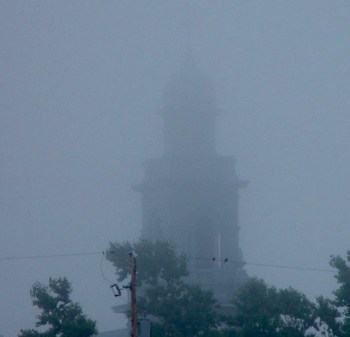
Mysterious Mist

Mysterious mist,
how I have missed you
wrapping and unwrapping
your gifts of seashore and sand.

So delicate, your will o’the wisp touch,
your fingers dampening my curls,
a delicacy of delight your butterfly kiss
laid upon forehead and cheek.

A distorting mirror in a circus
or a sideshow at the fair,
you twist things round your little fingers,
complicating our simple lives,
shape-changing them with dreams
and visions conjured from thin air.

Now you are here again, in my garden.
I welcome your presence among the trees,
your spirit enveloping the bees’ balm,
your crowning gift, soft-toned cone-flowers
where Monarch butterflies drift and reign.