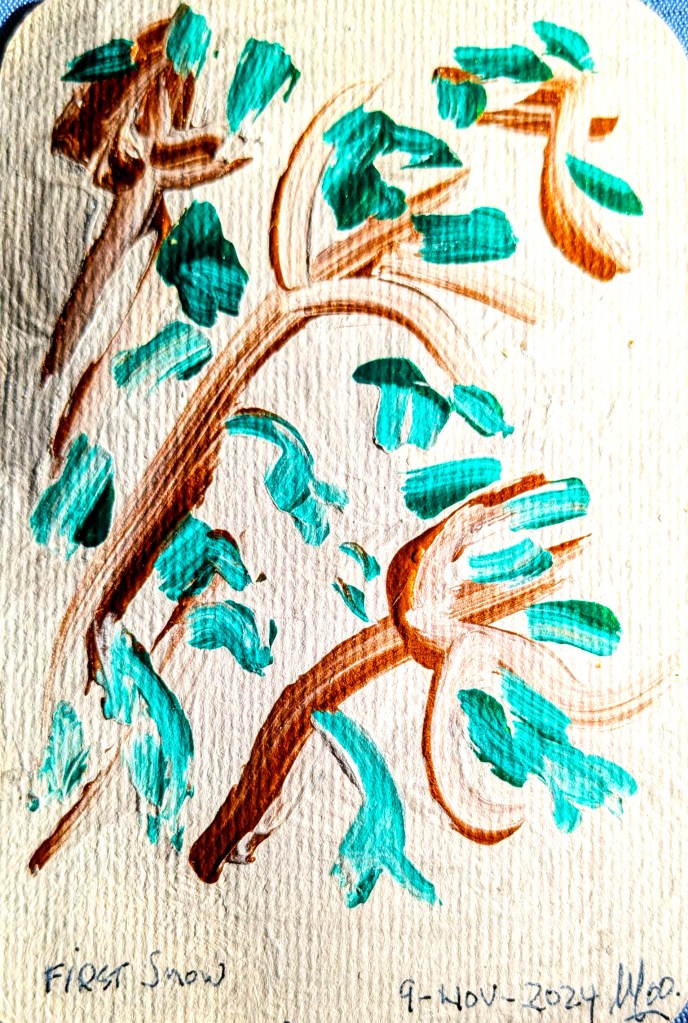
Dark Angel

Dark Angel

He will come to me, the dark angel,
and will meet me face to face.

He will take all that I own,
for my wealth is only temporary:
health, wealth, possessions are all on loan.

My house, my wife, my car,
my daughter, my grand-child,
 my garden, my trees, my flowers,
my poetry, my works of art.
I use the possessive adjective
knowing full well that these things
are only on loan. I will never be able
to preserve and possess them.

I even rent this aching heart,
these ageing, migrant bones,
this death that has walked beside me,
step by step, every day
since the day that I was born.

My death alone is mine.
It belongs to nobody else.
It will be my sole possession.
It will soon be the only thing
I have ever really owned.

Comment:

Dark Angel is the third poem in the first sequence (Crystal Liturgy) of my poetry book Septets for the End of Time. The painting, by my friend Moo, expresses his impressions of how he reacts, in paint, to my poem, in words.

“Well,” I said to Moo, “you’ve gone and done it this time. Do you think that painting really represents my poem? I see no darkness in it and certainly no angel.”

Moo gave me a long, strange look. I felt like I was looking in the mirror and seeing parts of my own soul fragmenting and falling away, like scales from my eyes.

“It’s not what the poem says,” he replied. “It’s what I think you feel as you’re writing that poem. I see the tension, the cry from the heart, the struggle to accept, and the realization that, in the end, everything is inevitable and must turn out as it will. That said, more than anything, it is the cry, de profundis, from the depth of your self that I feel. My painting depicts that cry and your suffering.”

“What if it’s not my suffering? What if it’s the suffering of Messiaen and his musicians as they play the soul music that keeps them alive?”

“But surely,” Moo replied, “that’s the whole point. Orde Amoris, according to the recent Pope who has just passed away, is love felt for the person suffering, no matter who he or she is. Pope Francis spoke in praise of the parable of the Good Samaritan. When you see someone suffering at the wayside, you stop and help that person. You don’t just walk on by. Your suffering is my suffering. When I paint your suffering I also paint my own suffering and when you grieve, then I grieve with you.”

“And when that happens, when we all grieve together, we do not grieve alone and in vain.”

“Exactly.”

Where did my mojo go-go?

Where did my mojo go-go?

Wow! My first post since January 8, 2025. What on earth has happened to me? Good question – I just don’t know.

Today’s painting, from the last day of 2024, is taken from The Idylls of the King, Tennyson. “The olde order changeth lest one good custom should corrupt the world.”

This quote is used in my Old Boys magazine at the end of each school year when the students leave the college and go out into the real world. This happened to me in 1962 – 63 years ago. Certainly I changed, and for the better, without the college. Whether the college changed or not, in my absence, I really don’t know. I suppose it did. It became co-educational, quite the thing for a boys’ boarding school. It expanded into larger grounds. It tore down at least two of the old houses, including the one in which I boarded for four years. I read about these things, but I have only been back on one or two occasions, so I don’t really know. And living in Canada, I rarely see any old boys from the school. They don’t cross the pond to visit me.

I receive the old school magazine regularly, by e-mail. However, I no longer recognize faces or places, unless the places are totally unchanged since I was there. And not many of them are. The most important page for me has become the obituaries, and I study with care those who have passed on before me and those who remain. I grieve when I see the names of old friends. But I grieve even more when I see the names of people so much younger than me falling by the wayside.

As for that mojo of mine, well, I guess that writing on a regular basis has become more and more difficult. “Don’t sit with your head in your hands thinking of time past,” says the Spanish poet. Yet time past seems preferable, in many ways, to time future. I am beginning to feel a bit like a pin-cushion, on account of all the needles now being stuck into me. Perhaps that’s where all my mojo went? Still, for anyone interested, I am still here. Still happy. I am working on my latest novel and I have two books of poetry waiting to be published. So maybe my mojo hasn’t done a bunk, just my blog mojo! I shall have to kick start it. Or maybe I’ll get that little yellow duck who wears blue gumboots to stand on a brick and give me a hearty booted boost. Yup! That should do the trick.

And so, in the words of Dylan Thomas, “I’ll take a bow, and say ‘good-bye’ but just for now.

What was the last thing you did for play or fun?

Daily writing prompt
What was the last thing you did for play or fun?

What was the last thing you did for play or fun?

I guess it depends on how you define ‘play’ and ‘fun’. The first snow storm of the winter left us without power for 39.5 hours. That should have been horrible – the temperature outside dropped to -7C overnight, and the temperature inside fell to 58F. Rather than sit and suffer, we turned it into a fun time. A candlelight supper, a bright log fire burning in the grate, reading by torchlight and candlelight. The flames flickering across my beloved’s face and making her countenance softer and more beautiful than ever.

When we lose power, we lose everything, except our fireplace and our cell phones. Recharging them was fun. We have a portable charger, and we also recharged them in the car while driving around. The roads were good – and driving was warm – so that was fun as well.

When the power came back, we called the local tree company (Treecological) and they took down the trees, young, bendy birches, that had bent onto our power lines. When we lost power, a second time, exactly a week later, it was a much shorter power loss. While the first was a power out[r]age, the second was a power outage. Both times, when the power came back on, that first buzz of energy renewed really made us happy.

In between the two storms, we had some warmer, sunnier weather and cleaning the snow with our trusty snowblower was much easier than we expected. Mind you, it is always difficult the first time, when the body is unaccustomed to the machine and all the old tricks must be learned once more. Luckily, you can teach new tricks to an old dog, well, to this one anyway, and I managed to cut a few corners and had fun doing so.

After four consecutive days of snow blowing – one does it bit by bit when one is eighty years old – otherwise no, it isn’t much fun. But bit by bit, step by step, and the job gets done. So there we were, playing in the snow and having fun. Mind you – once in a while isn’t too bad. But for this to happen every day, over a series of years, that would not be fun. And doubly not in winter, with the cold outside and supplies inside running out or down.

Poppy Day

Poppy Day

Remembrance Day
11 November 202
4

I wasn’t there
I never saw the gas clouds
            rolling over our positions
            never felt the barbed wire’s bite
            nor the bayonet’s jab

I never hung out my washing
            on the Siegfreid Line
            (“Have you any dirty washing, mother dear?”)
            never broke out of barracks
            never did spud bashing
            nor feasted on bread and water
            nor heard the rifle’s rapid rattle

I wasn’t there
            to see them carried away in carts
            coughing spluttering vomiting
            or bandages over their eyes
            walking slowly to triage a hand on
            the shoulder of the man ahead
            the sighted leading the blind

I wasn’t there
            but both my grandfathers were
            both decorated
            one mentioned in dispatches
            signed by Winston Churchill
            that one uninjured
            the other one gassed
            coughing up his lungs
            bit by bit for forty years

I am here now
    to remember
    and to honor them
           though so much
    has been lost

Comment:
My friend, the painter known as Moo, painted this poppy today. My generation, unless they served voluntarily, as many have done, was never conscripted. As a result, the horrors and tragedies of combat were never known to us, except as seen through they eyes of other people. I think of Wilfred Owen and his magnificent, heart-rending poems from WWI.
Today, I pay tribute to those members of my family who served in the armed forces by land, sea, and air. I also pay tribute to the veterans who survived, and to those who gave their lives in the defense of our country.

What could you do less of?

Daily writing prompt
What could you do less of?

What could you do less of?
I shall deliberately misinterpret that prompt / question and answer it my way. I could do less of listening to stupid adverts, repeated ad nauseam, sometimes with gimmicky tunes – one to two lines maximum – again and again, all day, every day. Surf the channels to escape an ad, and what do you get? A synchronized set up where almost every channel is blasting out the same, or similar, ads at the same time. Have you noticed that when you leave the TV room, and retreat to the kitchen to get some limited peace, the ads follow you because the volume is turned up at ad time so you just can’t escape.

I remember my grandfather, back in the sixties, with the advent of ITV in Wales – the Independent TV channel that used ads – sitting before the TV set, his foot up before the screen and his fingers in his ears so he would not be able to see or hear those ads. Alas, once heard, seldom forgotten, and I can still sing most of those meaningless jingles heard back in my childhood. How it I hate when I go shopping in the supermarket and shoppers tunelessly whistle a TV ad as they shuffle along behind their carts. Alas, ad free programming, all too often, is either expensive or non-existent.

And what about those telephone calls when they put you on hold until the next agent is free to attend to you? I won’t mention names, because I don’t want to get sued, but I guess we have all had the same experience. I had a ninety minute online wait one day, with horrible music, an exhortation to stay on the line so I wouldn’t lose my place in the queue aka line-up, and a 90 second ad that glorified the joys of the company’s product, repeated once every five minutes. I suffered through that ad 18 times on that one call alone. Another local firm gave me the similar treatment, except that it was a one minute ad, repeated once every ninety seconds. I suffered through 10 repetitions in a wait of 15 minutes, got fed up, and hung up the phone.

Look at the peaceful scene above. That’s the view from my bedroom window in Island View. Even the crows are absent, and the early morning silence, like the sun, is golden. Two birds with one stone – a morning person or an evening person? A morning person with dawns like this, but an evening person when a sunset like this one miraculously occurs.

What is one thing you would change about yourself?

Daily writing prompt
What is one thing you would change about yourself?

What is the one thing you would change about yourself?

Only one thing? I remember a story about a boy who boarded in a monastery school, and there, like the monks, they all changed their dirty habits once a week. So, is a dirty habit a thing? Probably is, if its a brown, sackcloth habit, tightened around the waist with a white cord by a man wearing open-toed sandals and no socks. So, there we go, once a week, on Wednesdays, like those monks, I also change my dirty habits. I also change my shoes, my socks, my shirts, my sweaters, my jeans.

More important, as I grow older, I have permitted myself to change my mind as often as I like. So, yes, I also change my mind, and not just on Wednesdays. And I really do change it when, like my habits, it gets dirty. “Oooh, you’ve got a dirty mind, you have.” “Well, so I do. Never mind, I’ll just go and change it.”

“What did Big Ben say to the Leaning Tower of Pizza?” – I’ve got the time, if you’ve got the inclination.
“How many ears did Davy Crocket have?” – Three – a left ear, a right ear, and a wild front ear.
“What’s yellow and deadly?” – Shark infested custard.
“What’s black and deadly?” – A crow in a tree with an AK47.
“When is a door not a door?” – When it’s a jar.
“What time is it Eccles?” – “It’s eight o’clock.” “Here, how do you know it’s eight o’clock?” “I’ve got it written down on a piece of paper.” “What do you do if it’s not eight o’clock?” “I don’t look at the paper.”
“Ding-a-ling” – That’s my ear ringing. I’ll just pick it up and answer it.
“What’s the first sign of madness?” – Hairs in the palm of your hand. “What’s the second sign of madness?” – Looking for them.

So what is one thing I would change about myself? Possibly the absolute necessity to tell awfully bad jokes. Easy to say – I’ll probably keep adding to these as I remember more of them. Take care – you have been warned.

“How many – men – does it take to change a light bulb?” – Five. One to hold the bulb and four to turn the ladder. Jokes like these can be good or bad. Good because they are occasionally funny. Bad, because it so easy to insert an adjective before – men – and to turn the joke into something more devious and not necessarily very pleasant.

“And that is the end of the gnus,” said the lion on BBC television, as he licked his paws. “Enough, no more. It is not as sweet now, nor as sour, as it was before. Pass the chow mean, please.”

Downsizing

Books abandoned on the sea shore of life.

Downsizing
Francisco de Quevedo

I chose each book, held it in my hands for
one last time, then placed it peacefully in
its new resting place. Old friends, they were …
I broke that friendship and set my friends free
to fulfill their promised afterlife on
another reader’s shelves.

Mind to mind, though they had
lived five hundred years ago,
I strove to engage them in lively
conversation, Bakhtinian dialogs
within our time and space, and
that space my basement library.

I loved to hear their lilting speech,
to listen to their wisdom with open eyes
and mind. I answered them with words
I quickly pencilled on each page.

One day, a man arrived from the university.
He carried them away in a delivery truck
and they were borne to a wider world.

If you see on, bless it, read it, cherish it.
Blind now my eyes that devoured their words.
Deaf now my ears that heard the dead,
for I can listen no more.

Note: “Escucho con mis ojos a los Muertos /
I listen with my eyes to the words of the dead.”
Francisco de Quevedo (1580-1645)

With thanks to Nicholas Wermuth, who was kind enough to comment and help me revise and restructure this poem.