Carved in Stone 30 & 31

Carved in Stone

30

A well of beauty dwells within me,
not skin deep, but buried, arcane.

A flickering candle
tethered to an altar,
shimmers at midnight,
when the Latin mass is said,
bringing me light.

In the dark, canonical hours,
shadows move beside me
as I walk long corridors
from dormitory to a chapel
filled with heady incense.

31

I kneel, dumb-founded,
as candle flames wax and wane,
their brightness enhanced
by the midnight magic
that turns doubters into believers.
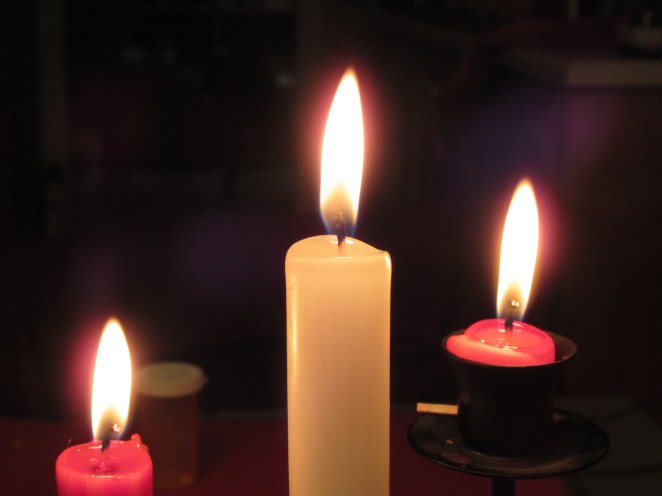
Spell and symbol, each candle a star,
shining, twinkling, in a galaxy of light,
and everywhere, the incense,
overloading my brain, releasing me
to revelations way beyond
muttered responses, mumbled words.

A world of inner darkness,
yet heart and soul soar together
up to the altar’s immortal light.

My shadow flickering
on the corridor walls,
as candle in hand, half-asleep,
I return to my cold bed
where the long, chill snake
of the bamboo cane
reminds me of tomorrow’s
flagellation.

Commentary:

Shadows on the wall or candles – with which should we start? Verbal and visual – how do they blend and knit together? Does my visual take away from your visual, or does it enhance it? To what extant does my verbal and the commentary on my verbal change the nature of your original thoughts when you re-create, within your own mind, my images, both verbal and visual?

Verbal and visual – now add the sense of smell. “The incense, overloading my brain, releasing me to revelations way beyond muttered responses, mumbled words.” And now remember that I was only six or seven years old when I experienced these things. Add the Latin mass, only half understood, the cold, damp feel of walls and wood beneath the hands. A world of inner darkness, yet heart and soul soaring together up towards the altar’s immortal light.”

My words are black print on white paper. My memories flare – an aurora borealis of senses sent crackling down the spine, in and out of the mind, tumbling the brain into a world … what sort of world? An unimaginable world. One never forgotten. One never re-recreated. One that never existed. One that never could exist. One for which the young child, six or seven years old, yearns for the rest of his life. His unsatisfied life. His unsatisfying life. His meaningless life. His absurd life.

Oh pity the poor puppy, not knowing what he has done wrong, not knowing how to put things right, always inadequate, whining and cringing at his master’s feet. And always, “that cold bed where the long, chill snake of the bamboo cane reminds me of the next day’s flagellation.”

Monkey Meets Pontius Parrot

Monkey Meets Pontius Parrot
(With glorious  memories of Macarronic Latin)

Pontius Parrot is very clever
and very pontifical.
“Pretty Polly!”
He pontificates from his pulpit.

His name isn’t Polly
and he doesn’t have a pulpit
but he parrots words
in Macaronic Latin:
“Caesar adsum jam forte.”

Pontius Parrot is perky at the podium
and bounces up and down,
preening himself self-consciously,
rattling his chains,
shaking his bars,  and speaking Latin:
“Brutus aderat.”

He is marked with shame and scandal.
A dysfunctional family of feathered friends
 has henpecked him until he is black and blue
and he has thrown up copiously:
 “Caesar sic in omnibus.”

He dips his wings in holy water,
calls for some soft soap, 
and washes his feathers and claws.

Poor Pontius Parrot,
he can only say “Repent!”
“Brutus sic in at.”

Commentary:

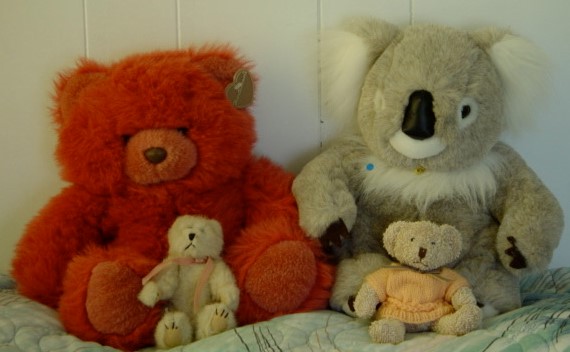
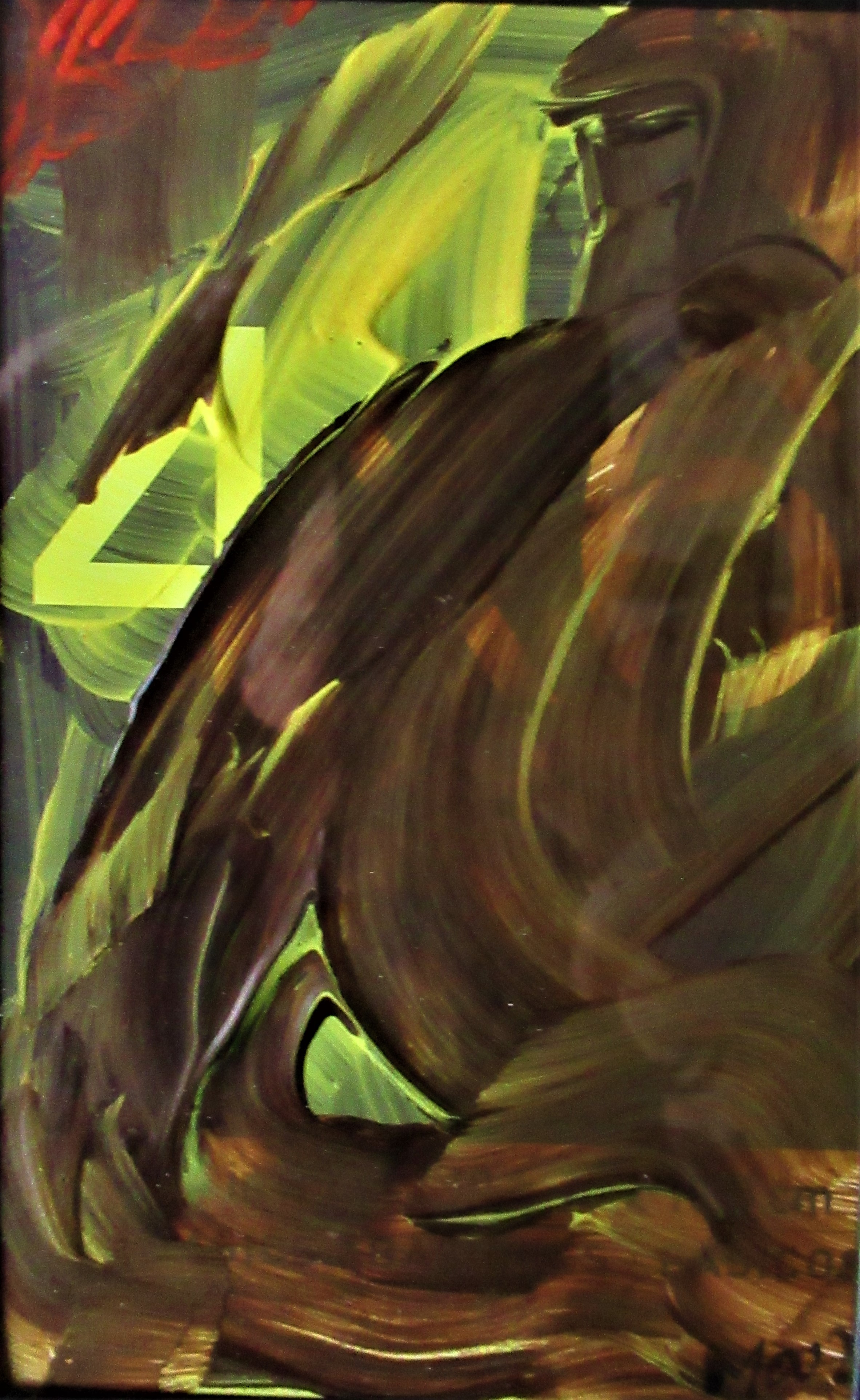
I asked Moo if he had ever painted a parrot, but he told me that he hadn’t. However, one of his favorite viewers, had once called this painting a pile of spaghetti wriggling in tomato sauce and he thought that spaghetti was close enough to macaroni for it to serve as a painting for Bony Macaroni Latin.

I had to explain to him what we mean when we say Macaronic Latin. Back to that boarding school and we used to invent all sorts of Macaronic Latin phrases. They used to cane us with bamboo canes. So here’s the verb paradigm in Latin for ‘to cane a student’. Bendo – whackere- ouchi – sorebum. Of course, it helps if you know what Latin verb paradigms look like. They are easy to remember and are aide memoires for the four main parts of the verb. Bendo – I bend over – first person singular, present tense – whackere – to whack or cane – infinitive – ouchi – I said ‘ouch’ – past tense – sorbum – the inevitable result – past participle.

Now, if we look at the italics in the poem we see a poem within a poem, and that smaller poem is written in Macaronic Latin.

“Caesar adsum jam forte.
Brutus aderat.
 Caesar sic in omnibus.
Brutus sic in at.

Translation

Caesar had some jam for tea.
Brutus had a rat.
Caesar sick in omnibus.
Brutus sick in hat.

Oh never underestimate the ingenuity – linguistic and / or otherwise (and we won’t go into that one right now) – of the bored-to-tears Public Schoolboy. Especially if he is not destined to be a Perfect Prefect like Perfect Prefect Plod – who was never any good at Latin, if I remember well. Neither was I come to think of it. Horrible language, dead and reeks like the dead rat that Brutus ate.

As for the ‘repent’, well, usually, just before he beat you, the master doing the beating would enquire as to your health and ask you if you repented of your sins, crimes, bad language, being cheeky to Perfect Prefect Plod, or whatever else you had done (like smoking or holding a girl’s hand in public instead of a boy’s). You always said ‘yes, of course I do, sir,’ in the vain hope of avoiding a beating. But, bad luck, the cane descended anyway, ouchi was heard, and the victim retired to the bath room to examine his past participle, also known as his sorbum.

I bet you never imagined any of that. Wow! What a great lesson I have taught you today. Think about it all and think about it carefully. Now you know why Pink Floyd sang “We don’t need no education.” But what an education it was. And remember, the Duke of Wellington, Old Nosey, once said ‘my battles were won on the playing fields of the pubic schools of England.’ Oh dear – I hope I got that right. I fear there’s a letter missing somewhere.


Monkey Visitsthe Chimpanzees’ Tea Party

Monkey Visits
the Chimpanzees’ Tea Party

Dressed to the nines in their gala outfits,
they have come here for the tea party.
Hairy penguins, they waddle back
and forth across the temple,
then lunge for a table with its jumbo shrimp,
smoked salmon, scallops, baked oysters.

Faces slashed from ear to ear
by enormous grins,
“Food’s free!” they say
and stuff themselves
regardless of the consequences.

Serviettes tucked into collars,
they scoff lobster and crab.
Birds of Paradise, subtle delicacies
flown in from half a world away,
decorate the tables.

There is something about them, though,
these chimpanzees,
gripping cup handles
between finger and thumb,
enormously pleased to be the centre of attention,
however clumsily they walk,
in their hired-for-the-occasion,
ill-fitting, black and white penguin suits.

Commentary:

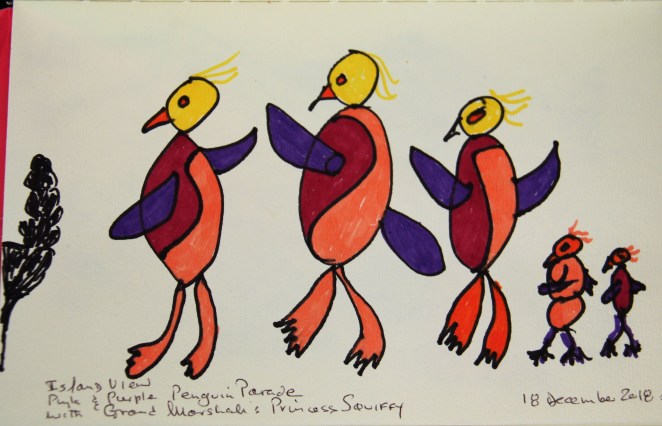
Moo apologizes. He hasn’t painted any chimpanzees, but a long time ago (2018) he drew and colored this cartoon. Pink and Purple Penguin Parade with Grand Marshall, Princess Squiffy. You can just see the end of Princess Squiffy’s tail as she vanishes out of the cartoon, encouraging the Pink and Purple Penguins to follow behind her behind. Oh the joys of leading the parade. Not everybody wants to do it though, many are content not to lead, but just to follow. Perhaps we should have called our cat MacNamara. After all, he was the leader of the band. But I don’t think Princess Squiffy would rather be anything other than what she is – a princess.

This poem, from Monkey Temple (of course / wrth gwrs) reminds me of Parents’ Day at my Boarding School. After several weeks of scarcely edible food, the tide would suddenly turn. Thursday, prime rib roast beef for supper. Friday, roast chicken with all the trimmings. When our parents arrived on the Saturday, all we could talk about was the wonderful food we had been eating for the last two days. Cunning, eh? We all had to dress up for Parents’ Day. Sunday starched collars, collar studs and all, and nice clean Sunday School ties.

Tea on the lawns in summer – unforgettable. A marquee, in case it rained, but otherwise tables laden down with a variety of skillfully cut sandwiches, little triangles, with no crusts, followed by endless helpings of strawberries and cream. The boys served their parents, fleeting back and forth to full the rapidly emptying plates. One boys father, I won’t say whose, devoured 12 bowls of strawberries and cream before the headmaster call the son over and begged him to beg his father not to eat all the strawberries and cream as some other parents’ would like some also.

Griffin Hunting – not a typical public school sport but one in which my school most certainly indulged. Our school symbol – a griffin – woven with gold thread on a dark blue background symbolized for the younger boys the perfection of the Prefects. To Hunt a Griffin was to behave in such a way as to attract the attention of older boys (already Perfect Prefects) and the school masters so that one became a candidate to climb the ladder and become a candidate for Griffin-hood. Some of us, myself included, preferred the anonymity of Robin Hood and were happy in our chosen roles of outlaws in Sherwood Forest and agents provocateurs and anarchists. Not for us the gentle counting of innumerable sheep. We chose rather the perils of after-dark transistor radios and the joys of Radio Luxemburg.

I remember being caught out of bed one night, on my knees, in a corner of the dormitory. All the dorm occupants were squealing and making a terrible noise. This attracted the attention of Perfect Prefect Plod – and in he came, threw the door open, and switched on the light. “You!” he pointed at me. “What do you think you are doing, out of bed?” “I am catching a mouse, Prefect Plod,” I replied. “You are a nasty little liar,” said Prefect Plod. “There are no mice in our nice clean house.” “Oh yes there are,” I replied, and I showed him the little mouse that I had cradled in my hands. “Give that to me,” ordered Prefect Plod. So I did. And the mouse took an instant dislike to him and immediately sunk its sharp little teeth into his thumb. I remember Prefect Plod running out of the dorm screaming “Matron! Matron!” and the little rodent swinging back and forth and hanging grimly on.

Those boarding school days ended 63 years ago. Hard to believe, really, but I still have such vivid memories of them. And of the Perfect Prefects, gripping cup handles between finger and thumb, enormously pleased to be the centre of attention on Parents’ Day, however clumsily they walked, in their spruced up for the occasion, Sunday Suits and Shirts, with their Golden Griffin ties. I always think of the Chimpanzees’ Tea Party when I think of the special performances of that little lot ‘for a Prefect’s lot is not a nappy one, nappy one.’

Do you still sleep in your childhood bedroom?

Do you still sleep in your childhood bedroom?

Good question. A better one might have been – “Did you have your own bedroom as a child?” The answer is “No, I didn’t. Not that I can remember.” As a war baby, I was moved around quite a bit in my childhood. I remember sleeping in three different bedrooms in our first house. Then we moved in with my maternal grandparents, and I slept in three more bedrooms, often in the same bed with one or other of the grandparents, sometimes on a makeshift bed on the floor. Later, or it may be around the same time, those early childhood memories are so hazy, I went to live with my parental grandparents – three more bedrooms there – same conditions. The family also had a bungalow close to the beach on the Gower peninsula. It had three bedrooms and I slept in all of them, under similar conditions, and seldom alone, until my later years.

I was bundled off to boarding school while I was still a child. Two dormitories at the first boarding school. I was between six and eight years old, and the memories of that school are not sharp, though I recall with total clarity the canings and the shaming of myself and the other young children. It was a religious school. And I need say no more on that subject.

My second boarding school , a preparatory school, saw me inhabiting four dormitories that I can remember. My clearest memory of that place is running away one night, only to be brought kicking and screaming back to the place. Both my parents worked. During the holidays, I was shipped around to various members of the family – aunts, uncles, and grandparents. When I left that school, for the last time, age eleven, my grandparents drove me to my new forever home in a city far from my birthday place. There, three bedrooms witnessed my sleeping habits.

My third boarding school, the Junior School of a larger college, provided me with two dormitories, one per year while I was there. This was the time at which I started to travel with my mother during the vacations. A coach tour on the continent once saw us visiting six countries in two weeks, and that wasn’t the only coach tur I did with her. A succession of hotel bedrooms, then, and no nocturnal stability at all.

I stayed in my fourth boarding school, the Senior School of that Junior School, for five years and received a new dormitory each year. From there I went to study in Paris – more bedrooms – then down to Spain for the summer courses at the International University in Santander, but by now, age eighteen, my childhood was over.

So, a quick count shows that I slept in at least twenty-five bedrooms during my child. And that’s without counting holiday hotels, flats, apartments, and other forms of lodgings, including Youth Hostels.

So, remind me – what was the question? Ah yes, I remember now. “Do You still sleep in your childhood bedroom?” Well, my friends and readers, the answer is a very loud “NO!” Think about it – how could I have? I am not sure that I even had a childhood bedroom!

The Auld Enemy

The Auld Enemy

Divide and Conquer

They divided us into houses, Spartans and Trojans,
and encouraged us to compete with each other,
single combat, and then team against team,
house against house, eternal, internal civil war.

We divided ourselves into Cavaliers and Roundheads,
Monarchists and Parliamentarians, Protestants and Catholics,
and we continued those uncivil wars that marred the monarchy,
brought down the crown, and executed the Lord’s anointed.

We fought bitterly, tribe against tribe, religion against religion,
circumcised against uncircumcised, dorm against dorm,
class against class, territorial warfare. We defended our bounds,
bonding against all outsiders to guard each chosen ground.

With it came the denigration of the other. Not our class.
Scholarship boy. Wrong end of town. Wrong accent.
We don’t talk like that here. Speak the Queen’s English, you…
and here … we inserted the appropriate word of vilification.

Our wars never ended. We carried them from prep school
to junior school, to senior school, sometimes changing
sides as we changed schools or houses, always clinging
grimly to our best friends, protectors, and those we knew best.

After school, all those prejudices continued to hold us down,
haunted us through university, red-brick or inspired spires,
Trinity Oxford, Trinity Cambridge, or Trinity Dublin,
each gilded with the white sniff of snobbery that gelded us.

Alas, we carried them, piled in our intellectual rucksacks,
through university, into grad school, out into the wide world,
infinitely small minds based on prejudice and pride, continuing
our tribal warfare, unable to understand anything at all,
other than us or them, shoulder to shoulder, divide and conquer.

Comment: My thanks to Brian Henry for publishing this on Quick Brown Fox.

Click here to listen to Roger’s reading on Anchor.
The Auld Enemy: Divide and Conquer

Lists

Lists

We all have them somewhere,
we few, we few, we privileged few,
sent away to boarding school
before we even knew what was
tucked away in old school trunks,
or locked away, cobweb-covered,
in the dark recesses of parental minds.

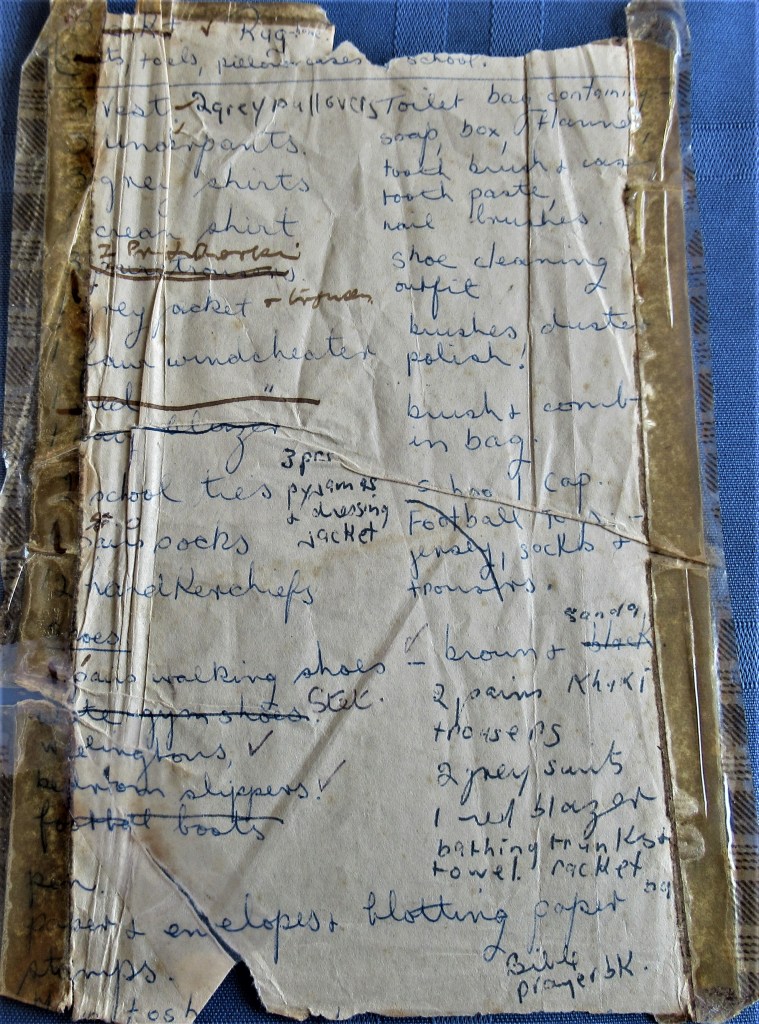
This is my ‘back-to-school’ list.
It contains everything a young boy
needs, or can think of, when leaving home:
shoes, shoe polish, many brushes for shoes,
hair, clothes, teeth… everything: name tags,
shirts, socks, underpants, trousers,
jerseys, ties (of a quiet color),
sheets, pillow cases, hankies,
sports shirts (house and school),
pen, pencils, ink, blotting paper.

So many memories spring out
from this list, so many skeletons
shake their fists, or wag a finger, or wave,
hello, farewell, from that old trunk.

Look: the safety razor to shave
that first hint of hair on a juvenile face.
Bible and prayer book, too,
though I never used them.

Click here for Roger’s reading on Anchor
Lists

Empty Head


Empty Head

I sat in class, head in hands, avoiding eye contact. I hoped the priest wouldn’t point me out, call on me, nominate me with a finger, but to no avail. He called my name.

“You have sixty seconds to speak about,” he paused, then produced the rabbit from the hat. “Matches. Come along, stand up, sixty seconds, starting,” he watched the second hand go round on the classroom clock, then counted down: “5, 4, 3, 2, 1 …” waved his hand, and shouted: “Start now!”

            Images flashed through my head: matches: cricket matches, boxing matches, rugby matches, soccer matches, chess matches, matches to light the burners on the gas stove, the oven, to light the fire in the fireplace … matches, matchsticks, Match Box toys, Dinky toys, toys for little boys, toys for big boys …

            “Fifteen seconds have gone … you have forty-five remaining.”

            “When I think about matches, I think about …”

            … the first spring day in the bungalow, our summer home. The rooms are cold and damp after the winter and nobody has been here since last year. We lay a fire in the grate, but the wood is damp, as is the old newspaper we gather from our last visit. We search for sugar to aid the blaze that we hope to start, but the sugar bowl is empty. We go to the stove. Cold, winter ashes crowd the fire bowl. We scrape them together in a desperate search for charcoal remains …  but we find nothing. We move to the oil-fired lamps and oil stoves. Matches dragged across soggy sandpaper fail to spark …

            “Come along, boy. We haven’t got all day. You’ve got thirty seconds left.”

            Silence fills the room. It is broken by the childhood sniggers and chuckles of long-forgotten classmates who never became friends My cheeks grow red. I start, stammer, and stop.

            … we leave the bungalow. Go next door to where our neighbours winter over. We knock on the door. “Can you lend us a match?” we ask, holding out our hands. Mrs. Williams beams at us. “A match,” she says. “First time in after the winter?” We nod. “I thought so. Saw you arriving. Wondered why you hadn’t come earlier. The weather’s been nice. Here: I can do much better than a match.”  She moves over to the fireplace, picks up the little coal shovel, scoops up a generous portion of her fire, heaps on another lump, then two, of fresh coal, and “Here you are,” she says. “Just put it in the fireplace and add some wood and coal. This can be your first fire. Here, you’d better have some matches too.” “Thank you, Mrs. Williams,” we say. “No problem,” she replies. “It’s good to see you back. It’s been lonely here this winter without you.”

            “Time’s up,” the priest says. “That’s sixty seconds of silence and you can hardly find a word to say on a simple subject. Are you stupid or what?

            My face turns red and I suffer the hot, burning cheeks of childhood shame.

Comment:

This is a theme to which I have returned on many occasions. Click on the link to see the original post. https://rogermoorepoet.com/2016/05/page/2/

Nobody’s Child

IMG_0466.jpg


I ordered Nobody’s Child on Monday and it arrived on Thursday, two days after A Cancer Chronicle. Two books, two days apart. Wow. Nobody’s Child is a collection of short stories and Flash Fiction that deals with some difficult topics. A couple of the shorter pieces have appeared on these pages and will be familiar to the followers of this blog. Most of the material is new, some of it, very recent. Some of the stories have been published, others have received awards and honorable mentions. A shortened version of the collection, under the same title, was given an Honorable Mention in the David Adams Richards Fiction Prize of the Writers’ Federation of New Brunswick in 2016.

Let the fiction begin: “… so this is earth day and we light candles in our house and turn off the telly and the computers and sit there reading and writing, watching each other through the flicker of the candle flames, and listening to the sounds of the house, such subtle sounds, the creak of the siding, the click of a door, a blind moving in the room overhead, the tick of the grandfather clock in the hall … and the smoke rises from the candles and makes dark patterns in the stillness of the air … and yet, through the blackness, the bleakness of the candle smoke, a hand reaches out and holds me by the nape of the neck, and thrusts me back into a past which once again has come back to haunt me …”

Nobody’s Child    is available on Amazon.

Moonshine: FFF


fundy-05-mistwolfepipers-081

Moonshine
Flash Fiction Friday
Friday, 5 May 2017

Here, on the wharf, in Santander, I stand in the shadow cast by the Customs House and gaze at the moon path sketched out over the water. “Over the mountain, over the sea, that’s where my heart is longing to be.” I taste the bitter salt of homelessness and know that I will never belong in this world and that I will never find a place to call my own. Back home, I have a black and white television and a black and white dog. Here I have nothing. Back home, when I am home, I am a latch key kid. My parents leave for work at seven in the morning and my mother gets home about five every night. Those ten hours on my own are mine to do what I like with: but I must account for them. “What did you do today, dear?” And everything I say I do is checked. Did I make the beds? Did I do the laundry? Did I finish the ironing? Did I wash and dry the breakfast dishes? Did I clean the house from top to bottom?

Sometimes I strip and stand in front of the mirror in their bedroom and look at my naked body. It’s not much to look at. Once I stood there with the carving knife in my hand and deliberately cut myself across the ribs, just to feel the pain and watch the blood flow down. Other days I play cards against myself. That way one part of me always wins, but then the self I play against is always doomed to lose. Sometimes I wage battles with toy soldiers, moving them up and down across the carpet in front of the fire. Occasionally, I throw a soldier in the fire, just to watch him perish.

Sometimes I just sit on the back of the settee and press my forehead against the cool window. The rain is cold and cools the window pane. I know the sky is crying and sometimes I think I know why. I’ll go back to my boarding school soon. There, we are taught to be isolated and to live in isolation. The bullies will come and they will bully me. I have not grown much over the holidays and I know they will be even bigger, and even stronger, and even faster. I don’t want to go home. I don’t want to go back to that school. I don’t want to be bullied and abused. The masters cane me and the older boys beat me and the bullies force me to do things, unspeakable things, things that I don’t want to do. I have tried to run away but someone always brings me back and then they beat me for running away. “Don’t be a coward,” they say, “take it like a man.” And I do.

I look across the water. How beautiful is the Bay of Santander beneath the moon. I look up at the hills, at Peña Cabarga, at the hills from whence cometh my salvation. My grandfather walks towards me over the waves. He helps me choose stones and pebbles, helps me to fill my pockets with them. He takes me by the hand and gives me courage. He and I walk down the slip way, hand in hand, and then we walk out across the moon path and into the sea.