This is now published and in my hands. I do not yet have full details on links and where and how to purchase, but I will put them up as soon as I have them. Meanwhile, I am grateful to my cover artist, who always does such a great job, and to my editor, Dr. Karunesh Kumar Agarwal (Managing Editor) Cyberwit.net. What a pleasure it has been to work with him. The cover picture, incidentally, is An Only Son.
I am now working on my next book, Stars at Elbow and Foot. I am sure many will recognize the title as coming from a line of a man born in the same town in Wales as I was: Dylan Thomas. The island in the picture is the only Island visible in Island View, incidentally. Alas, I do not have a picture of my cat, though I may put one on my next cover.
Ah yes, time to celebrate. I guess we’ll open a barrel of wine tonight. Hopefully we won’t finish it one sitting. I’d be lying if we did. This incidentally is the bodega where I got baptized. If you haven’t got baptized in a Spanish bodega, you haven’t lived. I’ll tell you about it sometime. How I miss that verdejo! Unfortunately, the verdejo didn’t miss me, and that’s how I got baptized. ‘Ya te hemos bautizado!’ “Que sea yo, y no el vino.” And if you understand that, you speak pretty good Spanish or Spanish pretty good … and you probably have an evil mind, just like mine.
Here I am, on the sea-shore, selling C-shells and thinking about my evil mind. But remember, my evil mind is mine, and it’s a one-of-a-kind. You go and find your own. And watch out for those Saint John C-gulls.
Jane gave me the honor of writing the foreword to her book and I did so with great pleasure.
Jane Tims: Niche. KDP. Book Review
Niche, the fourth poetry book published by Jane Tims, is a neat configuration of six segments that elaborate and illustrate the poet’s original definition of the multiple meanings of her title word niche. It is very difficult to separate the author from the act of narration as her keenly observed and skillfully executed drawings, together with their verbal representation on the page, are so autobiographical and so much an extension of her artistic and professional abilities that the objective separation of writer and text is scarcely possible. It is hard to forget that Jane Tims was, and to a great extent, still is, a highly competent professional botanist. The harnessing of the professional botanist, with her unique drawing skills and scientific knowledge, to the poet and auto-biographer is a key factor in the reading and interpretation of this text in which acute observation blends with an intimate knowledge of the observed botanical world, both flora and fauna, and this allows the poet, in her role of poetic narrator and lyrical voice, to weave a network of poems that are, at one and the same time, objective and intensely subjective.
The author emphasizes this when she writes in the Preface that “In biological terms, the niche is the quality of a space occupied by a living thing, the sum total of physical, nutritional, biological, psychological and emotional needs gathered together in one place.” She also reminds us that in human terms “niche can be a metaphor for home, community or personal space” and it is within these metaphoric spaces that the poetry text is elaborated. The text becomes a linked mixture of visual drawings, iterative thematic imagery and associative fields, all centred on the multiple meanings of niche. These terms are both biological and human in nature and the poet’s named world meets at this juncture between the human and the natural.
The section occupying space (1-19) bears the subtitle satisfying need and begins with a setting out of what this means in the following 12 poems and 4 accompanying drawings. The poem ‘apples in the snow’ with its companion drawing stands out for me. The section strategy, subtitled solidifying position (21-43) outlines in poetic terms, how plants, animals, and humans ensure their own survival. The section praying for rain, subtitled, avoiding danger and discomfort (45-68), offers views on discomforts and dangers. It also opens the discussion—relocate or stay where we are? The section mapping the labyrinth or places I have occupied (69-83), which contains the wonderful sentence “When I get lost on the road ahead, I look to the road behind me,” throws open the multiple meanings of home. The section new ways for water, subtitled coping with change (85-98), offers a double landscape, first, external, the things seen, touched, examined, remembered and described, and then the internal landscape that reflects upon them and is reflected in them. Finally, forgetting to move, with its subtitle getting comfortable (99-111), presents an autobiography that links observer (the twin personage of author and narrator) to observed (nature, both flora and fauna, and the added element of autobiography and self) via the symbiotic relationship of botanist to botany.
Two moments stand out for me. (1) Sadness is in seeking the space that is never found. (2) Loneliness is in trying to return to a space once occupied but no longer available. The whole concept of the Welsh word hiraeth is summed up in these two lines. Carpe diem, Jane Tims’ poetry indeed seizes the day and, with its minute, intense observation, it preserves so many precious moments. It also pays attention to that which has been lost, those moments that are irretrievable. They will vary for each reader, but hopefully, like me, you will take great pleasure in discovering them for yourself.
Comment: Brian Henry of Quick Brown Fox picked up this review and published it on QBF. Thank you, Brian and thank you Jane, you both do me great honor. Here’s the link: Niche on QBF 14 March 2021
This is the original version. It is much better than the revision that I posted earlier.Sometimes, when we revise, we lose the freedom of thought and association that comes with the early version. Message: keep your variations and keep an open mind. Over-elaboration is the poet’s worst enemy.
Wingless in Gaza Street
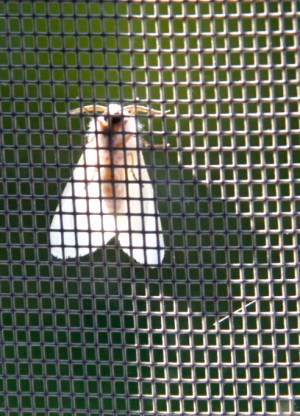
amputees deprived of flight they flutter grounded in the gutter
galley slaves chained to broken oars they ply blunt stumps relentlessly
shorn of strength and beauty their once glorious shuttles weave dark circles
my mouth is a full moon open in a round pink circle bone and its marrow settle in subtle ice
futile fragility of the demented heart pumping its frequency of fragmented messages
frail beauty torn from its element of air this brightness of moths drowning in inky depths
the seven o’clock news brought to you from an otherwise deserted street.
Fluffed up in their look-out points, the birds in the garden complain of the cold with short, sharp calls.
A life of ease they seem to live, but when the mercury descends and water freezes icy blinds inside our window panes and snow- squalls bluster in from north and west, who knows what’s best for those poor birds?
Crows, aloft in their crow’s nest spars, sailing snow’s seas, steadfast in their skippering of wind-bent trees don’t seem to suffer so much.
This Arctic cold is such that neither man nor beast can love it, crouched close to whatever warmth there is, shivering in the wind’s cold touch.
Driving home from the hospital, bullied by fierce winds on a snow-packed road, I dream as I drive. I envision a past that never was, a future that may never be.
As I hibernate in that past, last summer’s flowers flourish in my mind.
The car skids into a snow bank and my world shakes in shock. A thirty wheeler rumbles by: there are so many ways to die.
Not clematis, but bruised clematis clouds. I’ll keep looking. Maybe I’ll find the real things.
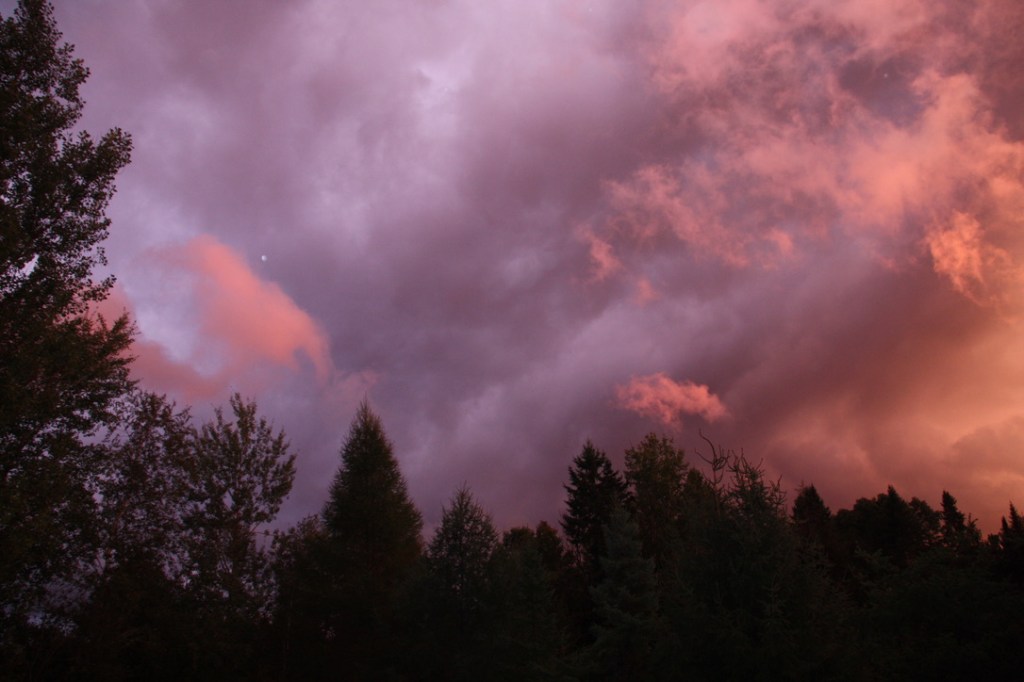
The clematis unfolds bruised purple on the porch. Beneath the black and white hammers of ivory keys, old wounds crack open. A flight of feathered notes: this dead heart sacrificed on the lawn. I wash fresh stains from my fingers with the garden hose while the evening stretches out a shadow hand to squeeze my heart like an orange in its skin. Somewhere, the white throat sparrow trills its guillotine of vertical notes. I flap my hands in the air and they float like butterflies, amputated in sunlight’s net. The light fails fast. I hold up shorn stumps of flowers for the night wind to heal and a chickadee chants an afterlife built of spring branches. Pressed between the pages of my dream: a lingering scent; the death of last year’s delphiniums; the tall tree toppled in the yard; a crab apple flower; a shard of grass as brittle as a bitter tongue at winter’s end. I know for sure that a dog fox hunts for my heart. Vicious as a vixen, the fox digs deep at midnight, unearthing the dried peas I shifted from bowl to bowl to measure time as I lay in bed. I sense a whimper at the window, the scratch of a paw. I watch a dead leaf settle down in a broken corner and it fills me with sudden silence. Midnight stretches out a long, thin hand and clasps dream-treasures in its tight-clenched fist. The lone dove of my heart flaps in its trap of barren bone and my world is as small as a pea in a shrunken pod. Or is it a dried and blackened walnut in its wrinkled shell of overheating air? Sunset, last night, was a star-shell failing to fire. Swallows flew their evensong higher and higher, striving for that one last breath lapped from the dying lisp of day. Its last blush rode red on the clouds for no more than a second’s lustrous afterglow. I lower the delphiniums, body after body, into their shallow graves. Night’s shadows weave illusions from earth’s old bones and rock becomes putty, malleable in the moonlight. Midnight readjusts her nocturnal robes and pulls bright stars from a top hat of darkness. Winged insects with human faces appear with the planets and clutter the owl’s path. Night swallows the swallows and creates more stars. The thin moon hones its cutting edge into an ice-cold blade.
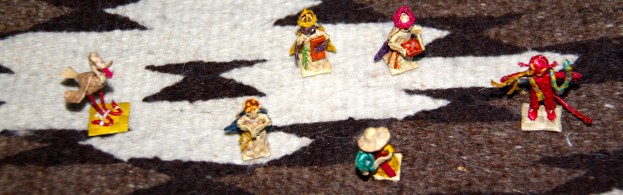
Weavings on a back-strap loom, figures hand-braided from straw, then painted. When the witches cast their spells, these tiny figures dream themselves into life. We gaze spellbound at their dancing.
Three witches: one spins the yarn, one measures the cloth, one wields the black obsidian knife, trimming each tiny thread.
Infinitesimal clockwork figures balancing on wool, their mouths opening and closing, silent, like goldfish.
Wooden teeth comb each thread, the shuttle always moving, weaving whose fate?
Interlaced castillos, scintillating cities, grecas floating lighter than this relámpago, this lightning that lightens the air.
The autumn leaves: what does it take with it when it goes? And what does it leave behind?
Crazy Glue
Late last night, a fallen star grazed by the lamp-post. A bouquet of golden sparks flew from an iron tree and sanctified the gutter. The gas lamps sputtered patiently in uniform rows. A scarecrow stuttered into the limelight and shook my hand. She was wearing my grandmother’s Easter bonnet, with all the flowers renewed, but she couldn’t keep my heart from last winter’s left over crumbs. Suddenly a tulip thrust through the concrete. It became as red as a robin and flew into the lounge bar of a public house. The bronze leaf necklace circling my throat filled with a flow of springtime song. My heart stood upright, a warped piano in my breast, and my skeleton tarried at the corner to play knuckle-bones with the wind. Torn butterflies of news fluttered round and round and kissed my eyelids when they closed. Yesterday’s horoscope winked its subversive eye and called to the hermit in his lonely cell: “Look out for the stranger with the tin can alley smile. Tie your heart to the tail of the first stray dog that comes whistling down the street and follow it home to the empty house that breathes in and out, moving thin membranes of memory.” That’s where I now live. Upstairs, downstairs, a lonely route I tread while the wind at the window scratches tiny notes. Something breaks loose in the confines of my mind and walks beside me. My twin brother stalks through this silvery sliver of splintered glass, this simian mirror wrinkling our troubled suits of skin. I glimpse the old moon’s monkey face through a broken window. Jagged and thin, it wanders like an itinerant snail, cobbled with clumsy clouds. Once, I descended the playground slide in a shower of sparks. A vagabond in a paving stone sky, I rumbled across metal cracks, a knapsack of nightmares humped on my old man’s back. Tell me: when the snail moves house, who stores the furniture he leaves behind? The hermit crab lurks naked on the beach, seeking new lodgings. Who killed the candle and left us in darkness? Two eyes in limbo watch me roll this snowman’s belly of flab across an unknown, clouded room where yesterday I got lost in the mirror. I know how to swim, but I would have drowned, except the light was too shallow and my feet touched bottom when I let the wheels down. I swam on and in looking for a deserted island on which to build my idle sand castle dreams. Two people said they saw my reflection swimming like a goldfish in the silver of that secret space. They said I stared back out at them with circles of longing ringing my eyes; but I laughed when they said they had seen me, for when I looked in the mirror this morning to shave, I just wasn’t there. My razor dragged itself over an empty space and its sharpened blade scraped white music from the margin of a cd rom that spun on edge like dust rings round a vanished planet. Now there is a black hole where my passport photo used to thrive. Someone plucked me from the circle and cut me out in the dance last night. Today I’m looking for a scrapbook in which to stick myself with crazy glue that never, never, ever comes undone.
Babs held the cat in her arms. The vet slipped the needle into the shunt he had inserted into the animal’s paw and the tiny wind of life gusted from the cat’s fragile body. The struggle ceased. The cat’s head settled and her tongue protruded, just a little, in that beloved and well-known gesture. It was all over.
Babs had found that lump, hard, but smaller than a pea, on New Year’s Day. The next day, she carried the cat to the vet where they took blood samples and ran tests. The vet’s assistant called later that afternoon. A lymphoma, she said, small but deadly. Steroids might help. They would give the cat a 40% chance at a life that would get more difficult, in spite of any known treatment. The alternative was to bring her back in and put her down now, that very afternoon. Babs looked at the cat: highlights strayed through her fur and her bright eyes sparkled like sunshine on a lake.
Throughout January the steroids went in and the cat glistened and grew fat. At first, Babs saw no sign of the lump but by Robbie Burn’s Day it was back. Babs started to count the days: January 31, February 2. The lump grew larger.
Three years before, on Valentine’s day, Babs had salvaged the cat from the SPCA where she languished, abandoned in a cage. The cat was a stray, half feral, taken in from the streets and subject to who knows what sort of treatment and feeding in its infancy. Babs wondered if it was in those days of neglect that the cancerous seed took root? Or did those seeds come later, when the cat wandered the garden and fed off the wild life, mice and voles, and drank from the streams that flowed through the killing fields with their fertilizers, their weed killers, their nutrients, and their poisons?
“What are we doing to ourselves,” Babs wondered as she sat at the kitchen table and sipped a cup of tea. “Was my cat the canary in my coalmine, doomed to warn me of what’s to come? Will my own system be invaded then poisoned with cancerous growths? Will I be subject to that stumbling, downward road that leads in the end to an inevitable death?”
She lay awake that night alone in the bed wondering in what ways cancer might ravage her body. How long would chemotherapy keep her alive? Who would be there for her, who would hold and comfort her, who would slip that releasing needle into her veins when her time came?
Babs ran her fingers over her body as she imagined herself sliding day by day down that slippery slope that leads to the grave. Then she caught her breath, her heart raced, and her blood turned to ice as her fingers tripped against the colony of killers: three small hard lumps that nested in her soft breast.
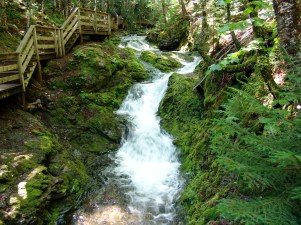
What is it about running water that it explodes like long, blonde hair over moss and rock frothing with sunlight the diamond sparkle, the freckling sound, light flickering downwards, fine threads of angel hair tumbling from above, falling,
white, over earth’s rocky shoulders, pillowed across soft green quilts
poured down from heaven’s skies watering the earth’s dark throat,
sinking through the soil emerging in rivulets and brooks until all waters are one and the rains join hands to splash, rejoicing,
dryads and naiads bathing together in deep, cool pools, nymphs reborn, acrobats over rocks as water falls to seek the sea.







 rogermoorepoet