Wednesday Workshop: New Projects

IMG_0026

Wednesday Workshops
New Projects
03 July 2019

New Projects … how do you choose them, these new projects? Simple answer: I really don’t know. So much depends on you and your work habits. In my own case I have a back log of projects. I have been writing and creating for years. As a result I have a whole set of files that I can turn to and select from. Two novels, about fifty short stories organized into two or three as yet unpublished manuscripts, a couple of hundred poems, organized into three separate thematically organized manuscripts, a set of writings on facilitating creative writing …

Projects … do the work and then choose the order in which you will publish it. I look at the hollyhock that suddenly appeared last year in my garden. Do the work: the birds (in all probability) seeded it. The hard work: the hollyhock grew itself. I should add that my beloved nearly tore it out on the grounds that she didn’t recognize it and it looked like a weed. But she left it, and it grew into what it was meant to be: a hollyhock. One stalk. So many buds. We didn’t know which would blossom first. And it didn’t matter. One after anther they all blossomed. The hollyhock knew what it was doing [we didn’t]. It had belief and faith [we didn’t]. But we had hope.

The Hollyhock Project: This year the hollyhock has eight [yes, eight] different shoots. It’s no longer a single flower, it’s become a bush! It has also shed seeds further afield [I should really write abed, since they’re all in the same flower bed.] I wonder in what order they will blossom. It doesn’t matter really: I am just confident they will bloom. And the sunflowers have rooted below the bird feeders. They have their own projects and I know they will grow as and how they will. And the yucca has four shoots that will flower, how and why I just don’t know. But each flower has its project(s) and I am confident they will all flower and flourish.

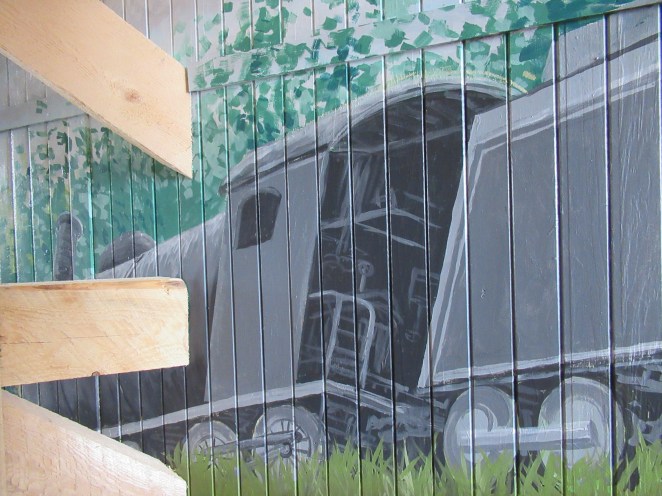
My own projects: When June came in, I didn’t know what to do, nor did I know in what order to do it. Then Time-spirits came together. Geoff gave me some drawings and I chose one for the cover. I took the manuscript to the printers, got an estimate, and received a mock-up. The text had shifted in the transfer from computer to computer. My 70 page text had grown to 132 pages. I spent the next 72 hours rewriting everything, eliminating words, lines, poems, dropping the text back down to 70 pages. It is now published. I wondered what to do with the McAdam Railway Station poems. Geoff came to see me on Sunday, 23 June, and told me that he would be celebrating his birthday the following Friday. He also told me that the McAdam Railway Station would be unveiling his mural the following Sunday (June 30). The McAdam railway poems were published on Saturday, 29 June, and I took them to McAdam in time for the ceremony.

Trust: Trust yourself, trust your projects, trust the universal spirit [Northrup Frye’s Spiritus Mundi], under whichever name you acknowledge it). And remember, genius is 99% perspiration and 1% inspiration. Put in the mileage, put in he hard work, believe, and trust. ¡Qué será, será! Whatever will be, will be.

IMG_0206


Keys

IMG_0841 (2).JPG


Keys

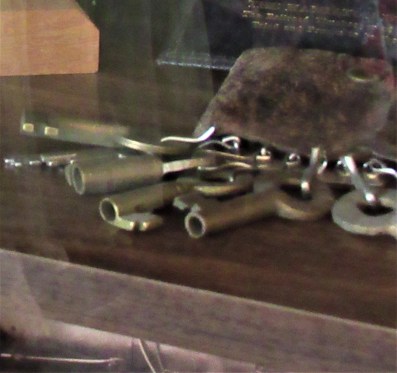
“Thirty-four doors and a key for each door,
sometimes two, and that’s only for the outside.
No master keys back then. A key for each lock,
if you please, and each door locked every night.
It’s still quite the task, a real responsibility. They
kept a turnkey, in those days, a full-time employee
whose job was to keep the keys and remember
which key fitted each door. Was it a double turn,
a single turn, a dead-bolt? The turnkey knew them
all. He also understood the interior doors and had
to wind the clocks, open and close cabinets, cloak
rooms, kitchens, desks, cupboards, drawers.

Others kept their own keys, and we often dismiss
them as lackeys, especially if they were black,
but they held the key to everything. Locksmiths
too, they could remove locks, take them apart,
cut keys, no job for a flunky. It took a smart man
to be a turnkey. He needed training, patience,
skills, knowledge, strength. Huge railway keys:
he knew how to look after them as well. Have you
seen the size of those old, brass carriage keys?”

McAdam aka City Camp

image1 (36).jpeg

City Camp
aka
How McAdam Got Its Name

“Can we come in?” “May we visit?”
“Can we look around?” “Of course.”
Tourists, travelers on a day trip, curious,
with time to kill, asking the usual questions.
Volunteer guides, packed with information,
walk with them from room to room.
Outside, tourists slap bare arms, necks,
mosquitoes, black fly, always the black fly.

“McAdam, McAdam. This is McAdam.”
The train shuffles to a halt. Children open
carriage doors, climb down, run to the central
building, choosing one of its thirty-four doors.
Inside: newsagent, Ganong chocolates, soda
bar, dining room, snacks, drinks, everything
a city child needs on holiday. Hotel above.
A day room booked. Much better for first-class
tourists than the common waiting room.
Better, an overnight stay. Take the next train.
Refreshments, a break in the journey. Porters
ferrying suitcases upstairs, stacking luggage.
“Quite nice.” “So primitive, my dear. NQOC.”

Outside, the children slap bare arms, necks,
mosquitoes, black fly, always the black fly.

“Is this McAdam?” “No, sorry. It’s City Camp.”
“Where’s McAdam’s Camp?” A finger points
to a faint trail leading through thick dark woods.
“How long?” “Couple of hours, a day, on foot.
Depends.” Woodsmen born and bred, they pick
up their packs ignoring the black fly as they walk.

IMG_0779


Unveiling

image1 (36).jpeg

Unveiling
McAdam Railway Station
Sunday, 30 June 2019

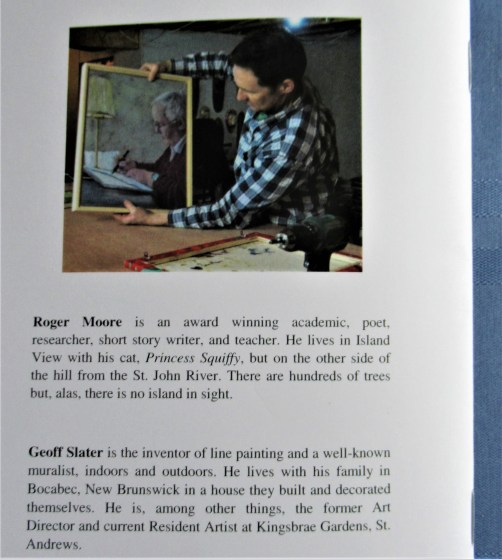
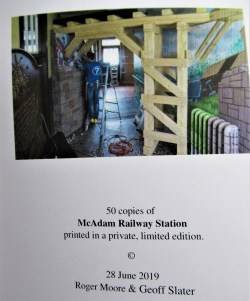
Today at 1:00 pm is the unveiling of Geoff Slater’s mural and diorama at McAdam Railway Station. In celebration of the Event, Geoff and I put together a little chapbook of poems on McAdam illustrated with two drawings of the railway station, , a photo of Geoff working on his mural, and another of him framing a portrait of yours truly, painted by Ruby Allan and framed by Geoff.

IMG_0849.JPG

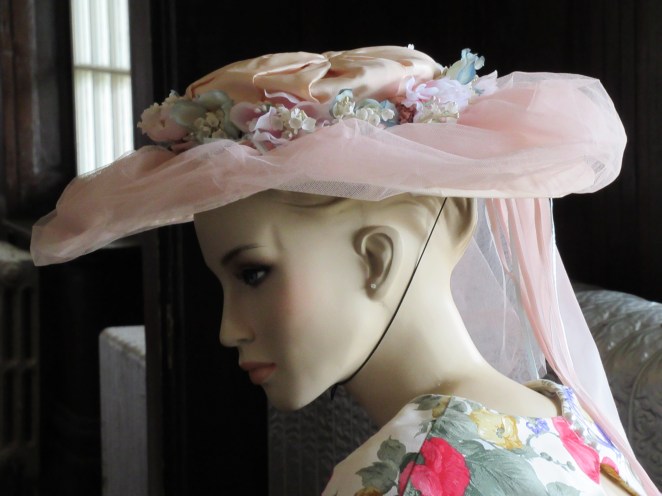
We are hoping for a nice group of people to attend the unveiling. There will also be a summer fashion show with some of the leading station ladies present.

IMG_0835.JPGI am sure a great time will be had by all and everyone is invited. Of course, not everyone will turn up, but I am sure that these two beautiful ladies will be there.
IMG_0836.JPG

The Joy of A New Book

IMG_0915 (2).JPG

The Joy of a New Book

Very little to beat it actually, the joy of receiving and opening a new book, especially when it is one you have written yourself, in cooperation with a group of friends. In this book are the twenty-four (24) poems that I wrote for McAdam Railway Station.

IMG_0921 (2).JPG

I went to McAdam to watch Geoff working on his mural and installation (diorama). While there, I heard stories about the railway and started to write them down in stanza form. While I did write them, most of them were based on stories and anecdotes heard or overheard while the guides were guiding the tourists round the site. This is indeed a limited edition. We originally intended to print only 50 copies, but when we heard that there might be up to 300 people at the unveiling of Geoff’s mural, in McAdam, at 1:00 pm, Sunday, 30 June, 2019, we doubled the number of books we printed. I will be donating the majority of the 100 to McAdam Railway Station Historical Association. They can either give them away or sell them to help fund and support the impressive restoration work they are doing.

IMG_0923 (2).JPG

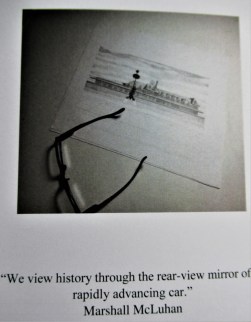
“We view history through the rear-view mirror of a rapidly advancing car” … and writing these poems was a veritable journey back into the past. Geoff left his glasses by his half-finished drawing, and that’s when the idea of linking McLuhan to Moore to McAdam occurred. Several of the poems focus on my own experiences of railway stations. Travel by train was a frequent choice in my childhood and  I went almost everywhere by train. A local in-town train ran from the station at the end of our road and I often took it when visiting friends, shopping in town, or following the local soccer team, Cardiff City, aka the Bluebirds. As a result, much of the imagery within the poems involves my own knowledge and love of trains, while the narrative structures themselves are often based on those overheard words.

IMG_0919 (3).JPG


We wanted a photo of Geoff and me on the back cover and I discovered this one in my files. The portrait was done by Ruby Allan, my fellow artist in KIRA (June, 2107). She painted Roger Writing in the Red Room from a photo taken by another KIRA resident artist, Carlos Carty, the Peruvian pipe, as I was working at the desk in my room. Geoff framed the portrait and Mrs. Lucinda Flemer gracefully allowed it to be hung over the desk in the Red Room at KIRA, an honor for which I am exceedingly grateful. What a nice way to put our pictures on the cover of our book! If you are down McAdam way this Sunday, 30 June, drop in and see us. We’ll be there. Books and all.


Westbury White Horse

th.jpg

Westbury
White Horse

Winter in Somerset. No trains from Frome.
They sit in the engine sheds, boilers frozen.

Clare drives me to Westbury, in Wiltshire,
the neighboring county. She leaves me there

and I stand on a platform as white with snow
as Westbury White Horse towering above.

People arrive, flapping their arms, stamping
their feet, walking around trying to stay warm.

Finally, to shouts, cheers, and laughter, a train
arrives, its boiler successfully thawed. People

rush forward, open doors, claim their seats.
It’s a corridor, not a compartment train.

“Is this the eight-fifteen to Temple Meads?”
I ask the porter. “Nope,” he says. “That wll

be arriving later.” “When?” “About ten
or eleven, I expect.” “What train is this?”

“Ah, now this is the six-thirty to Bristol.
Running about two hours late. Better be quick.

The guard’s waving his flag. She’s about to leave.”
I open a door, climb on the train.  All

the seats are taken. I stand in the corridor,
shivering, all the way to Temple Meads.

Friday is Fish …

IMG_0824 (2).JPG


Friday is Fish

There was nobody at the fish stall. I stood and waited. Then another customer, a young lady, arrived. We stood and talked together.
“Is nobody serving?” she asked.
“Nope,” I said. “Ain’t seen nobody.”
“Maybe we should ask?”
“Ask away. Won’t do any good.”
“Excuse me, young man …” a store assistant rushed past, paying no attention. I stood there playing my invisible violin.
“Excuse me, miss, is anyone …” same result, store assistant vanished into the distance.
“What’s that, over there?” I pointed. The young girl turned to look, and as she did, I placed finger and thumb between my lips and let out a shrill, piercing whistle. The young lady turned to look at me, half smiling, half shocked.
“Was that you?” I asked her and she started to laugh.
Within seconds three store assistants, two men and a woman, came over at a canter.
“You two go,” the woman assistant said. “I can look after this.” She put on a pair of plastic gloves.
“Do you have any halibut cut?” I asked her. “Or do you have to slice the big one?” I pointed to the huge halibut that lay stone cold dead, trying to hide in the ice cubes. The assistant ignored me and turned to the young lady.
“Can I help you?” she asked.
“He’s first,” the young lady pointed at me and the assistant scowled as I repeated my question.
“There is some on the fish counter waiting to be cut. How much do you want?”
“About half a pound,” I answered. “Please.”
“About this thick?” She gestured with forefinger and thumb.
“Looks good.”
She walked behind the fish counter, picked up a knife and started to hack. It looked as though nothing was happening.
“This knife is dull,” she announced. “Excuse me I’ll just be a moment. I’ll go get another one,” she hurried off in the direction of the meat counter.
“A dull knife?” the young lady raised her right eyebrow and lowered her left one.
“Can’t say I’ve ever met an intelligent knife,” I smiled back.
The assistant came back a minute later brandishing an even larger knife. She again attacked the halibut, once more with no visible effect. She muttered something and rushed off again, returning with a large hammer. She held the knife in one hand and started banging downwards on the back of the blade with the hammer that she held in the other.
“Are you actually going to eat that?” The young lady looked worried.
“Not the bits she’s hitting with a hammer,” I said.
“I’m off. They must have some frozen fish somewhere. I’ll go find it.”
Five minutes, the assistant held up a halibut steak, bone in.
“I’ll take it,” I said. “Thank you so much. I’m sorry to have put you to all that trouble.”

When I arrived home my beloved met me at the door.
“Okay,” she said. “What happened?”
“I’ve brought you a lovely bit of halibut,” I said.
“That’s great. Now come in, dear and tell me all about it.”
So I did.

Gower

Empress 070.jpg

Gower

To be Welsh in Gower is to spell it funny
and pronounce it worse: Gwyr.
It’s to know how to say Pwll Ddu.
It’s meeting the cows in the lane to Brandy Cove
and knowing them all by name and reputation,
which one kicks, which one gores,
when to walk in the middle of the lane,
and when to jump for the safety of the hedge.

It’s to know the difference between the twin farmers
Upper and Lower Jones.
It’s to recognize their sheepdogs, Floss and Jess,
and to call them with their different whistles.
It’s knowing the time of day by sun and shadow;
it’s knowing the tide is in or out
by the salt smell in the air
without ever needing to see the sea;

and now, in this far away land called Canada,
it’s hearing your stomach growl for crempog or teisen lap
whilst memory’s fish‑hook tugs at your heart
in the same way your father hauled in salmon bass
at Rhossili, Brandy Cove, Pennard, Oxwich, and Three Cliffs.

Commentary: I was checking Gwyr, the Welsh for Gower, where I was born, and found this interpretation of the name. <<G is for generous, your giving nature. W is for wise, more tomorrow than today. Y is for young, the years never show. R is for rapport, friends seek you.>> I don’t know if that’s me, but it certainly wouldn’t be a bad set of descriptors to live up to.


Growing Up

IMG_0817 (4).JPG

Growing Up
in Brynmill

They drag the kids kicking and squealing
from childhood’s universe into an older
world of smoking and drinking, forbidden
fruits stolen after Christmas dinner when
drowsy grown-ups’ eyes are turned away.

Why do bigger boys follow smaller ones,
buying their sisters’ kisses then thrusting
their fingers into little girls’ knickers, or
invading Woolworth’s and tucking stolen
goods in shirts with their buttons undone?

The games they play: offering a little girl
a cigarette  or a sweet while two boys
wait behind the garden gate with a sharp
knife to  press against the victim’s throat.

Dies Irae

IMG_0139

Dies irae

Nowhere has she found peace, save
in the dregs at the bottle’s bottom.
She solves life’s dilemmas with single
malt or grape’s blood fresh-plucked.

Doctors tell her that she must stop drinking,
not stoop to conquer yet another bottle.
The remedies they suggest will never suit her.
Family and friends lecture her in vain. 

She knows she will not live forever,
that one day a higher power will call.
So she opens another bottle of Scotch,
just a drop before she goes. She falls

to the floor, and lies asleep. Three still
born babies cover her with their love
to keep her warm. “Sleep well,” they say,
“you’ll find greater peace in eternity.”

Commentary: Another poem that was not easy to write. The last line is a tribute to Seamus Heaney and his poem, Yellow Bittern, the inspiration for this one. “You’ll be stood no rounds in eternity.” In the literary theory of Intertextuality, texts talk to texts and a series of interlaced textual dialogs move across time and space. Hablo con mis ojos a los muertos, I speak through my eyes with the dead, as Francisco de Quevedo said in the 17th century. He was reading Seneca, another great writer born in Spain, when he wrote those words.
I restructured this poem three times. I began, following Seamus Heaney, with the first person singular [I]. Then I changed it to the second person singular [you], but you, in English, can never approximate to the intimacy of tu [versus vous] in French, or the multiplicity of [versus usted, vosotros, vosotras, ustedes} in Spanish. Finally I settled on the third person and settled on she [rather than he]. I guess when  a woman loses three children, she is entitled to lose herself in a bottle of Scotch and shut out the world.