I buried myself in an ice-cube. I dug in so deep that nobody could find nor touch me.
“Hurt yourself,” I told myself, “hurt yourself so badly that nobody will ever be able to hurt you again.”
Clichés: cutting off your nose to spite your face, shooting yourself in the foot, arm, or leg, self-destructing in so many ways, and all clichés.
And me, alone, everything cut off, torn down, worn away, visible, some days, yet untouchable, locked away in this frozen land where warmth never flows and winter holds sway.
Comment: I wrote this after reading the section entitled Quilt in M. Travis Lane’s book A Tent, a Lantern, An Empty Bowl (Windsor: Palimpsest Press, 2019). Poems that could double as paintings, proclaims the paragraph on the back cover. I have no such talent. My own poem is more of a memoir in the form of a narrative sequence. To each his or her own, or, in the modern parlance, to all their own. And a poet must do what a poet can do, each of us adding our own little offerings to the great sea that is poetry.
I sought the way and thought I had found the way, but now I feel I have lost my way. Long walked I in shadow and sun, hard Roman road beneath my feet.
Then I found bleached beach sand, heard the sea-gull’s piercing sound, walked sun-path, moon-path, bright across a shimmering bay and knew that by chance I had found my way.
Then came the way of ice and snow, Hudson Bay parka, the ski way, the snow shoe way of winter boots, and still I believed, eyes wide open that I knew I was still on the way.
Now my feet are old and slow. Blood runs cold, bones ache, head spins, heart is an ambush, lungs throb and clutch at air, head in hands I sit in despair, hoping to be found, draped over a shoulder, brought safe to flatter ground, comforted, and set again on my way.
“Knowledge: that which passes from my notes to your notes without going through anyone’s head.” aka “Filling empty heads.”
I came here a beggar, begging bowl in hand, begging for knowledge, at the seat of all knowledge, from the hands of those who knew.
They fed me, taught me, brought me into knowledge, as they knew it, but I yearned for more, so much more.
I found it, one morning, in my morning mirror, shaving. I looked into my own eyes and asked: “What are you teaching?”
My answer: words and empty words, formulae handed down to me over generations of people who thought they thought because they repeated what others had thought.
This was not what I sought. Then, and only then, did I look into the eyes of those I taught, those who sought knowledge from me, in all my worthlessness, and I asked them what did they need, what did they want to know, and why did they want this knowledge.
Then I asked them how I could help them to attain that knowledge for themselves and to use it to construct their own lives, on their own, without interference and shame as I had never done.
Then, and only then, did I know I had become a teacher in the true sense of the word, and that together with me, my students had learned to teach themselves multiple ways in which to grow.
To lose your language is to lose your dignity and your muse.
It’s to lose the power of self-expression and to frustrate the longing soul that flutters like a butterfly striving to reach for the beauty of light yet frustrated by the weight of its now useless wings unable to rise.
So much the soul sees at night, wandering in dreams among the stars. Memories of former rooms where the old inhabitants still dwell, shadows among the shadows, some still gifted with limited powers of speech, but others, tongue-tied and silent, and our chatter reduced to a net of butterfly buzz words.
Oh for the freedom of flight, for the liberty of my language found anew and capable still of shaping and recreating the world of silence in which I now live.
Based on a Welsh Poem by Harri Webb Colli iaith a cholli urddas.
The creative wells have run dry, especially the verbal ones, and this is about all I can do right now – a little bit of visual and hope for the best. I guess the creative waters will flow again and words flower, but until they do, I am just sitting here with nothing else to do.
The hollyhocks are back. A little bit late, but just starting to reveal themselves in all their glory. It’s been a strange spring, with frost warnings (and two actual frosts) in June, heavy rain, T-Storms, a tornado watch, extra hot days and, thankfully cold nights with the temperatures at +4C, even this month, July.
The yucca plant is flowering again, with three flourishing stems this time. It only started to flower late last week, but it, too, is full of promise. Somehow, while there are flowers, there is still some hope, some beauty, and some time and space for rejoicing.
Ah, daffodils, my favourite flowers.
Daffodils
Winter’s chill lingers well into spring. I buy daffodils to encourage the sun to return and shine in the kitchen. Tight-clenched fists their buds, they sit on the table and I wait for them to open.
For ten long days the daffodils endured, bringing to vase and breakfast- table stored up sunshine and the silky softness of their golden gift.
Their scent grew stronger as they gathered strength from the sugar we placed in their water, but now they have withered and their day is done.
Dry and shriveled they stand paper- thin and brown, crisp to the touch. They hang their heads as their time runs out and death weighs them down.
Vis brevis, ars longa – life is short but art endures. Maybe my daffodils will last longer than the yucca and the hollyhocks. They will certainly outlive this year’s bloom. Time and tide wait for no man, and flowers too are subject to the waxing and the waning of the moon. That’s life, I guess. Long may it last.
Sixty years ago, in 1962, somewhere around today’s date, I left my public school – private school – boys’ boarding school and entered the real world as a free man. I was lost. They educated me to be part of a world that no longer existed, the world of walls, and boundaries, of lists and rules, of school reports and chains of authority, older boys > house monitors > prefects > head boy of house > head boy of school > masters > house masters > head master. That great chain of authority was to rule me for the rest of my life.
Lists
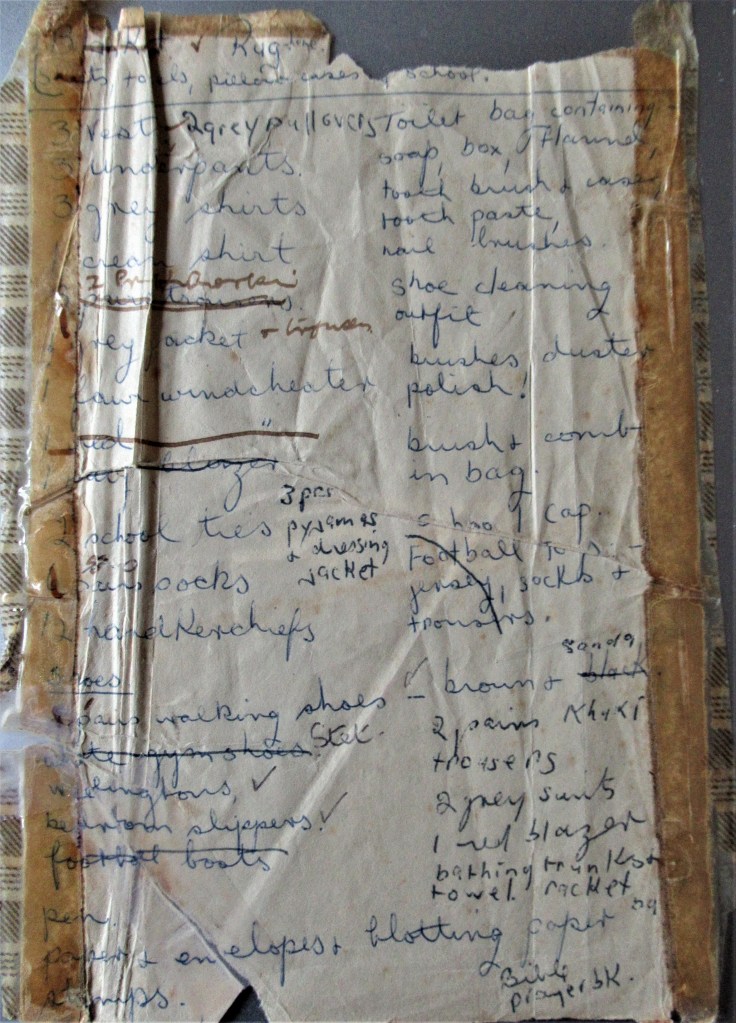
This is my clothing list. Six times a year I packed all items into my school trunk, 3 times to go to school and 3 times to go home. Six times a year I unpacked all items from my trunk, 3 times when I arrived at school and 3 times when I arrived home.
Reports
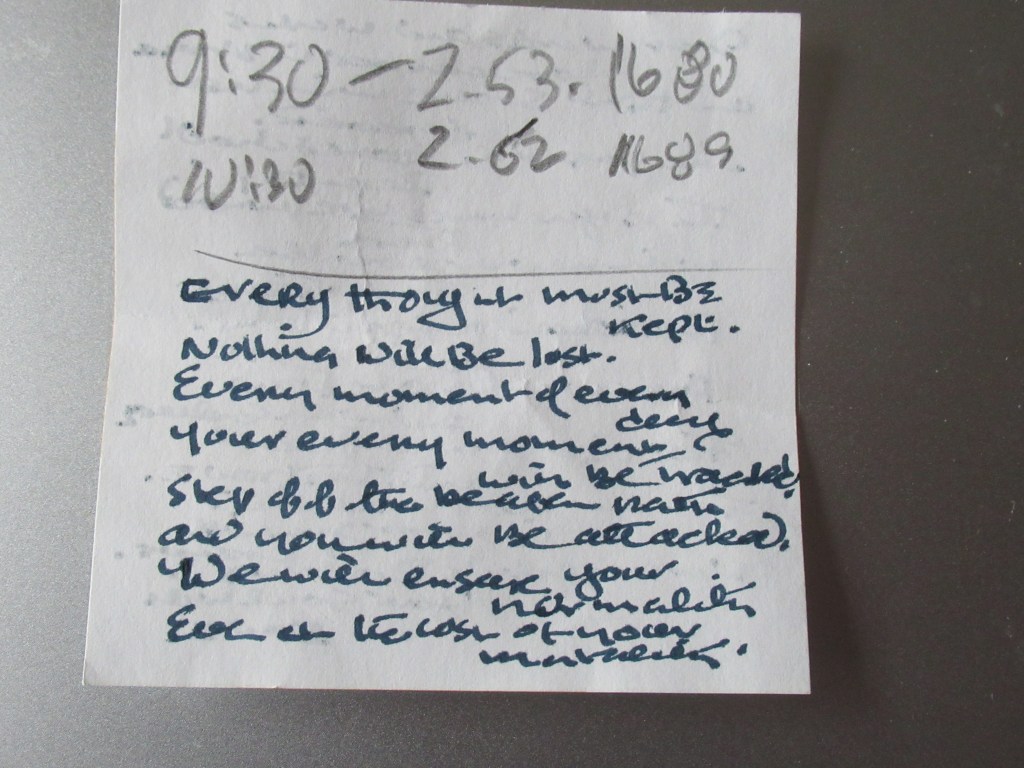
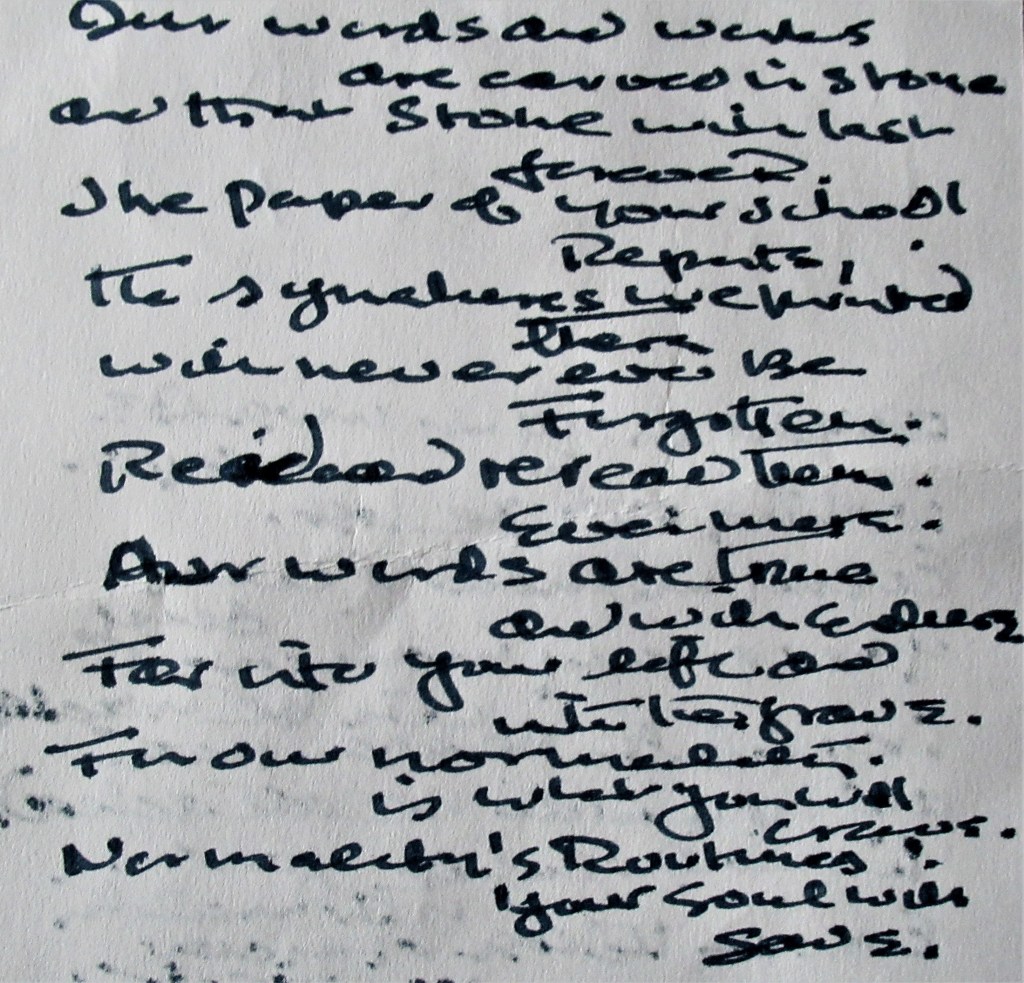
I still have my school reports signed by by teachers, initials only, and my father, full signature. He had to sign so that the teachers could ascertain that yes, he had read my school report and that no, I had not hidden it from him. The report is a disaster story. I look back on some of the comments and wonder what worlds, what different realities, were we living in? One verbal remark, made in class: “Why are you in the sixth form?” “I am going to university, sir.” “The only way you’ll go to university is on a train.”
I sent that gentleman my train ticket, but he didn’t choose to remember the comment, made to a fifteen year old boy.
Scars
I still carry them. So many of us do. Less than most, possibly, for us ne’er do wells and miscreants.
In the beginning was the word, and the word, maybe, may endure. I guess, maybe, one day we’ll find out.
What launch pad lifts us to our fate? What makes us climb above the beach, above the gardens, above the trees? Why are we striving for that pot of gold that always seems out of reach?
Why is what we have achieved never enough? Why must our eyes be fixed on stars beyond the stars when lesser, earthbound men are bound by lowly wars?
Are we giants then, to aspire not to be like other men, clad in grey suits and suitable shirts and ties. Working from nine to five, five days a week, and sometimes six. Fixed hours, yet our hours are ours and never fixed.
Ambition, for us, the coming word, the oncoming stroke of paint, the incomplete picture, much better than the ones we have done of late. No artistic battle is ever won when we sit back and say and now my creative work is done.



 rogermoorepoet