Kipper Kapers

Kipper Kapers

Old Welsh Intelligence Test Question: “Does a kipper swim folded or flat?”

5-4-3-2-1 –
Time’s up, Ladies and Gentlemen.
So – what’s your answer?

Yes? No? Maybe? I don’t know?
It’s a trick question of course / wrth gwrs. And Kippers can play tricks on you too as they flipper and flapper, and flip and flop. Especially if you eat them late at night.

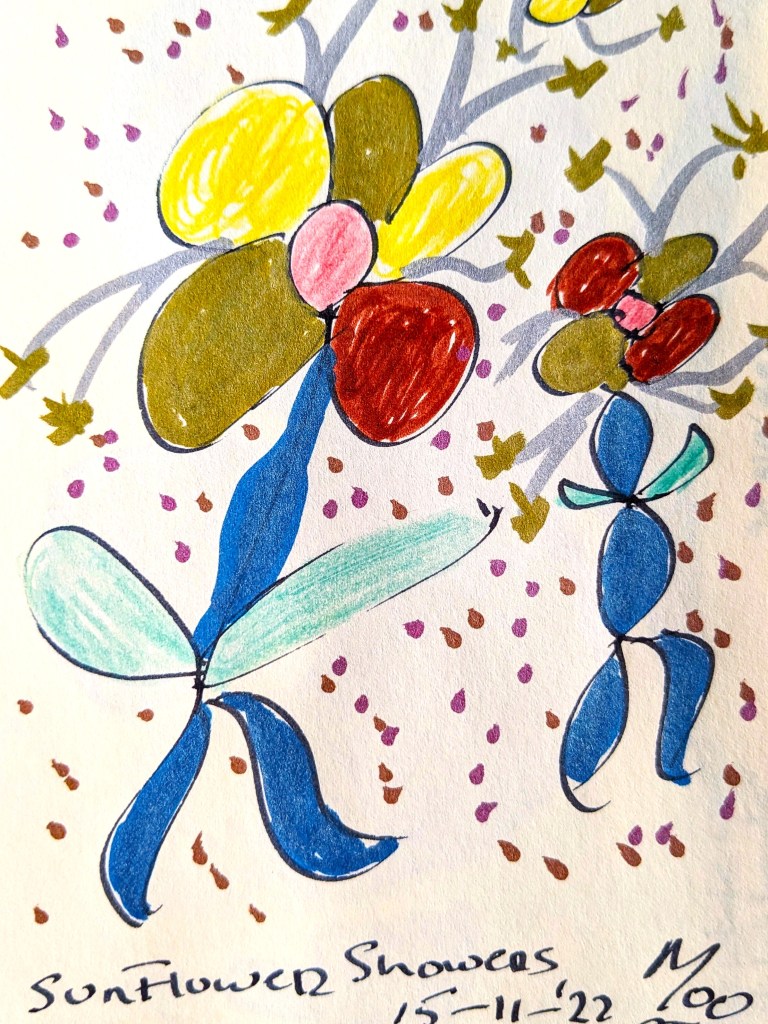
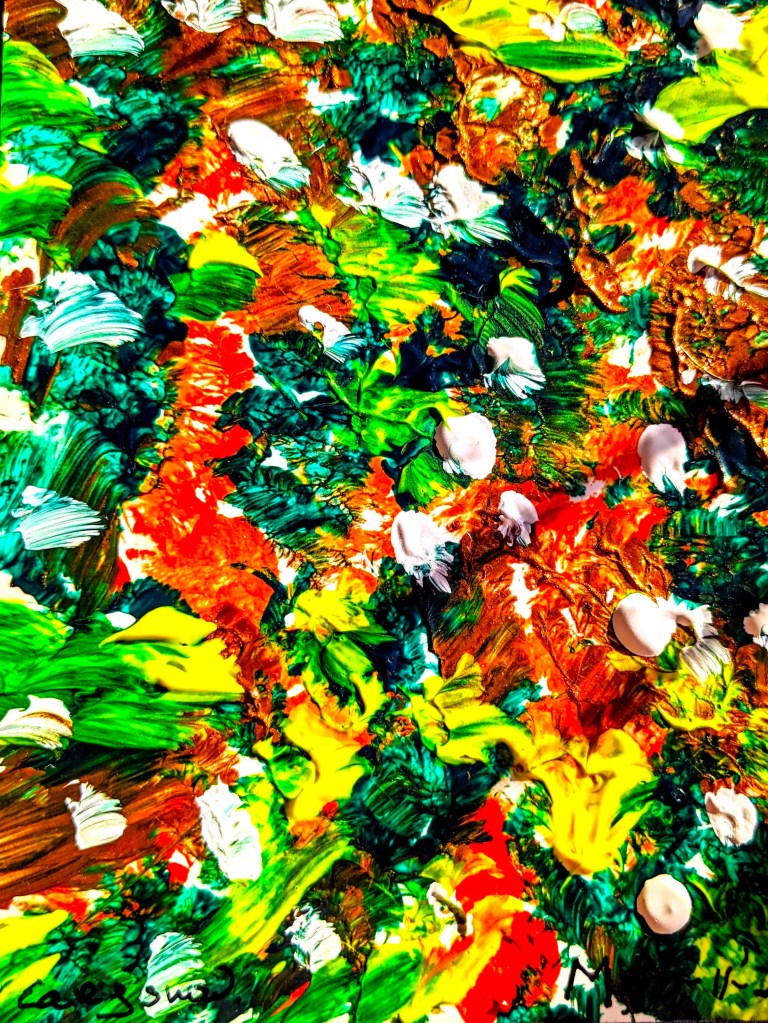
So this is a painting of a midnight Kipper Kaper Attack, when you want to sleep, but can’t, because you don’t know the answer to the kipper IQ test and all those little kippers are capering around and making fun of you and mocking you.

How do you avoid a Kipper Kaper Attack when the bad dreams start and the Kippers Kaper? Well, you answer this next Welsh IQ test question. “Adam and Eve and Pinch Me when down to the river to swim. Adam and Eve got drowned. Who do you think was saved?”

And if you answer “Pinch Me!” Then I will, and when I do, you’ll wake up, and you’ll be safe from another Kipper Kaper attack until the next time you eat them.

There – simple isn’t it?

What makes you feel nostalgic?

Daily writing prompt
What makes you feel nostalgic?

What makes you feel nostalgic?

I am not sure that nostalgic is the right word. I think of Robbie Burns with his “man’s inhumanity to man” and I realize that “the war to end all wars” never ended anything. It only started a series of new cycles. I am certainly not nostalgic for these endless cycles of violence and inhumanities. I am though nostalgic for man’s humanity to man, that spark of kindness and good will that seems, on the last day of the old year, with the new year about to come in, to have vanished. Could it be forever? I certainly hope not. May the new year (2024) bring peace, happiness, love, and understanding, to all the human beings on this tiny planet we, of necessity, share.

My friend Moo’s painting (above, thank you Moo), has for its title Fiat Lux – Let There Be Light. I am nostalgic for that light. May it soon return to our world.

Remembrance Day
11 November 2023

I wasn’t there
I never saw the gas clouds
            rolling over our positions
            never felt the barbed wire’s bite
            nor the bayonet’s jab

I never hung out my washing
            on the Siegfreid Line
            (“Have you any dirty washing, mother dear?”)
            never broke out of barracks
            never did spud bashing
            nor feasted on bread and water
            nor heard the rifle’s rapid rattle

I wasn’t there
            to see them carried away in carts
            coughing spluttering vomiting
            or bandages over their eyes
            walking slowly to triage a hand on
            the shoulder of the man ahead
            the sighted leading the blind

I wasn’t there
            but both my grandfathers were
            both decorated
            one mentioned in dispatches
            signed by Winston Churchill
            that one uninjured
            the other one gassed
            coughing up his lungs
            bit by bit for forty years

I am here now
    to remember
    and to honor them
           though so much
    has been lost

Tell us about your first day at something — school

Daily writing prompt
Tell us about your first day at something — school, work, as a parent, etc.

Tell us about your first day at something — school

My father held my hand all the way to the convent. I wiggled, squirmed, dug in my heels, but it did me no good. Too firm, his grip, too determined his grim, muscled chin. When we arrived, he dragged me up the gravel path leading to the stark, red-brick building, and jangled the bell that hung from an iron clasp. He kept a tight hold of my hand as the bell’s echoes faded away into the interior corridors. A tapping of feet, and the wooden door opened just enough to let a small, four-year old boy in. My father pushed me through that gap. I turned to wave good-bye, only to see his back as he walked rapidly down the drive.
            “Come along, child, we’ve been expecting you,” a figure in flowing black robes with a white wimple framing her face emerged from the shadows.     The nun closed the door and banished the sunlight. “Welcome,” she said. “Wipe your feet.”
            “It’s not raining. My shoes are clean.”
            “When you enter this convent, you do as you are told. Wipe your feet. Blow your nose and dry your eyes. You should be ashamed: crying at your age.”
            A rough brown coconut mat lay by the door. I stood on it and moved my feet backwards and forwards, sniveling as I did so.
            “Now follow me.”
            The nun walked down the shadowy corridor, her leather sandals flip-flapping against the polished wood floor. The scent from the highly waxed boards rose up and flooded my nostrils. I looked down to see my face distorted by the floor’s polished woodgrains.
            We approached a classroom from which a babble of young voices echoed down the corridor. The nun opened the door and all chatter stopped. She led me to an empty seat on a wooden bench and there I sat. The nun went to the teacher’s desk in front of the class.
            “Class: you will all stand. I ordered you to be silent in my absence. You were talking when I opened the door. Who started the talking?”
            My new classmates stared silently at their feet.
            “I heard voices, many voices. Who started talking? Was it you? You? You?” She stabbed her finger at the class. Nobody said a word and nobody moved. “Will someone tell me who was the first to disobey my orders?”
            Silence.
            “Then I shall punish you all. You will kneel on the floor. You will raise your arms to shoulder height. Like this.” The nun imitated the arms of Christ as he hung from the Cross. “You will recite ten Hail Mary’s,” she turned to me. “Your new classmate will count them. His name will now be Joseph, a good Catholic name that will help him establish his convent identity. Joseph: you may stand, not kneel. Class, begin.”
            The piping of shrill voices chorusing a prayer filled the room.

I looked at the girls as they knelt there, arms out, all dressed alike, and I realized that I was the only boy in this particular class.

The Banks of the Seine

Banks of the Seine

Gnawing at the carcass of an old song,
my mind, a mindless dog, chasing its tail,
turning in circles, snapping at the fragment
of its own flesh, flag-flourished before it,
tournons, tournons, tournons toujours,
as Apollinaire phrased it, on a day
when I went dogless, walking on a mind-leash
before the Parisian bouquinistes who sold,
along the banks of the Seine, such tempting
merchandise, and me, hands in pockets,
penniless, tempted beyond measure,
by words, set out on pages, wondrous,
pages that, hands free, I turned, and turned,
plucking words, here and there, like a sparrow,
or a pigeon, picks at the crumbs thrown away
by pitying tramps, kings, fallen from chariots,
as Eluard wrote, and me, a pauper among riches,
an Oliver Twist, rising from my trance, hands out,
pleading, “Please, sir, can I have some more?”

Comment:
This is a fusion / confusion, if you like, of The Kingston Trio’s song – The Seine – with a quote each from Guillaume Apollinaire – Alcools – and Paul Eluard – Il ne m’est Paris que d’Elsa, and Francisco de Quevedo’s – El Buscon – and a tip of the old chapeau nouveau to R. S. Thomas and Charles Dickens. Fools rush in, I am afraid, where angels fear to tread. Go on. Rush right in. Sort it all out. I double-dog dare you – and thank you for that one, Jude.

Dark

Dark

The lights went out suddenly,
leaving me in the dark.
A cloudy night, not a spark
of starlight to light my way.

My search for candles was slow.
I found them, struck matches,
and sat at the table watching
light catch and flames glow.

A war baby – bombs, blackout
curtains, diminished light, all
are present in my DNA, and yet,
I fear the dark above all.

Like a moth, or a high plane
caught in a searchlight,
I struggle to escape from twin
siren calls: fire and light.

I sat and waited for power
to return. An hour, two hours,
three, four. Then I couldn’t wait
any more. I climbed the steep,
wood hill that led to bed.

At the top of the stairs
a plea for light filled my head
and a plea for the return
of light formed the focus
for long-forgotten prayers.

Comment:
We lost power for 15 hours a couple of weeks ago. One moment we were sitting there, after supper, ruminating quietly, with the lights on. The next, we were sitting in the dark. We found a flashlight – light but no warmth. Then moved on to candles. Candles need matches. When the ingredients were ready, we struck the matches to light the candles. These were the first three we lit.

We are so lucky. Sure, it was an awkward night. But it was only fifteen hours. We talked about the homeless, their poverty, often in the middle of such wealth, the poor who have homes, but who cannot afford to light them or heat them, the innocent victims in war zones, powerless in every sense of the word, deprived of light, heat, water, plumbing, sanitation. Our prayers that night included them as well – all of them.

What are your two favorite things to wear?

Daily writing prompt
What are your two favorite things to wear?

What are your two favorite things to wear?

What a strange question. I suppose it merits a strange answer. And the answer is – it depends. You see – I live in Atlantic Canada. Here we have several sayings. One from the Bay of Fundy is – “You don’t like this weather? Hang around five minutes. It will change.”

I had the snow blower prepped for winter a week or so ago. So, what are my two favorite things to wear when snow blowing? Only two? Hat, scarf, water-proof / wind-proof coat, thick gloves, scarf, warm socks, boots that keep out the water and the cold and that have soles that grip into the snow. You mean I have to choose two things from that lot? I just checked the calendar – it’s not April the First, you know.

In summer, when the Fundy Fog rolls in from the sea and wraps scarves of salty mist around the trees, and it becomes so cold, so damp, and so chilly so quickly – what are my two favorite things to wear? I guess you can double-check the list above and eliminate an item or two. But I wouldn’t chuck out too many.

And what about cross-country skiing? As the weather changes, and as you warm up, you need several layers of removable clothing that can be taken off, when you warm up, and placed back on when you hit the shade between the trees and you start to cool down. But only two items? What are you doing to me? And what about the wind-chill factor?

Once, when I walked the picket-line at -35C, we had all been pre-emptively locked out from my former place of employment, we were visited by Flying Pickets from the Northern Part of Canada. They had a saying: “There’s no such thing as bad weather, only bad clothing.” You notice they didn’t say anything about two items of clothing. I wonder why not?

So there you have it. Be prepared, I say. It always depends. And remember: “Never mind the weather / As long as we’re together.” Perhaps those two items might just be you and me! But then, we’re not clothing, are we? Not unless we are just rag dolls.

Magnolia

Magnolia

She stands there, at the garden gate, waiting for me.
I can see the scene, the flower beds, the magnolia
bleeding, in Wales, its soft, spring snow of ivory pearls.

Some fall on her head, crowning her with a beauty
more precious than frankincense or myrrh. Petals
also perch their pure, ermine cape on her shoulders.

She walks towards me, eyes shining, arms open.
Then, the vision fades and she drifts away, leaving me
alone, my face bathed in the tears of her passing.

For pass each other by, we did. Ships in the night,
trains rushing through a tunnel of darkness, bathed,
for an instant, in the constellation of a station’s light.

Now, when I try to go back and to recreate that scene,
I find an empty garden, fallen leaves, and winter’s cold.

Comment:
I have been struck recently by the number of published articles that speak of post-Covid loneliness and the difficulties of re-establishing old friendships that fell by the wayside, let alone establishing new ones. It seems to get harder and harder, as we age, to leave our post-Covid isolation, to get out of our new comfort zones – sometimes so limited and limiting – and to make new friends. As we age, our minds go backwards and we return to earlier days and happier memories. Yet all too often those memories are tinged with the sepia sadness of old photos, from a non-digital age, faded and stained.

Who is the most famous or infamous person you have ever met?

Daily writing prompt
Who is the most famous or infamous person you have ever met?

Who is the most famous or infamous person you have ever met?

First, some definitions. What exactly does ‘met’ mean? I met you yesterday, for example. How long was the meeting? A nod and a passing of ships in the night? A stop and a handshake and a brief conversation? Or a genuine meeting of minds when people know each other reasonably well and can be considered ‘friends’? Infamous – that is relatively simple. Meanings, in my quick check, include – well known for some bad quality or deed, eg an infamous war criminal. Well, I have certainly never met any of those, not that I am aware of anyway. What does famous mean? Here’s one definition – famous implies little more than the fact of being, sometimes briefly, widely and popularly known. How wide is widely? How popular is popularly? Never mind. Let’s give it a go.

Brief encounters – I met several famous people briefly. Gento, from Santander, the Real Madrid soccer player and possibly the best winger of his time. John Charles, the Welsh soccer player, born in Swansea, and a good friend of my father. I met him once, briefly, in a Cardiff Street and my father presented me to him. Federico Bahamontes, the first Spanish cyclist to win the Tour de France. I met him, very briefly indeed, outside his bicycle shop in Toledo.

Longer encounters – these include the Spanish poet, Jose Hierro, who taught me Spanish, over three summers, in Santander at the UIMP. I also met Jose Manuel Blecua at that university and he introduced me to the poetry of Francisco de Quevedo. At the University of Toronto I had the good fortune to take courses from Erich von Richthofen, Geoffrey Stagg, Keith Ellis, J. H. Parker, and Diego Marin, each of them famous in their own way, with excellent academic reputations and publications. At Bristol University, I briefly met Jorge Luis Borges, whom I met again at the U. of T. a couple of years later. Academia and literature formed a happy blend in which to meet people who were famous within their own fields.

The same is true of the sporting life. While enjoying Cross-country running at Bristol University and while running for Bristol Athletic Club, I met Martin Hyman, Basil Heatley, Eddie Strong, John Boulter, and several other athletes of international renown. The same thing with rugby. Names that I can drop include Don Rutherford, Full Back for England and the British Lions, with whom I took a coaching course at Bisham Abbey. Welsh rugby personalities that spring to mind include Ray Williams, Billy Hullin, ‘Buck Rogers’, and several other luminaries of whom Alun Priday, Dai Watkins, and Elwyn Williams spring to mind.

But does any of this matter? I remember going to a poetry reading in Avila, Spain. This is what happened after the reading.

After the Reading

Many names were dropped and lay scattered on the floor.
Some of them broke. Others bounced back to their feet
and walked around stiffly, smiling unhappily.

Sugar and saccharine, unnamable sweetness, honeydew melon,
all lay on the ground, with empty shells, hollow metaphors,
accumulated clichés, vague imagery, the blanched bones of poets
that once wore life’s armour of grammar and blood.

When the cleaner came, she summoned a broom
and it swept away the remains:
dust without love, cigarettes butts and smoke,
nothing and nothingness, emptiness, empty nests, shadows of dreams,
living words, dead, now lying in a common grave.

The meaning of meaning – meeting and knowing, famous and infamous, names pulled from a hat like a rabbit and then dropped to the ground where they prick up their ears and scamper away. Yes, I have (briefly) met several famous people. But I know only a few really well. Sometimes, I wonder if I ever really met them, or knew them, and then I ask myself, did any of them know me, or remember me at all? Maybe that should be the larger question!

What was your favorite subject in school?

Daily writing prompt
What was your favorite subject in school?

What was your favorite subject in school?

I never had one. I hated every school I attended with a passion. I hardly passed an examination during my school days and I remember, in Mathematics, dropping from Level I, to Level II, to Level III. I failed the first exam in Level III and earned this comment on my school report “Now I know why he descended to Level III.” I still have those school reports, incidentally, complete with the signatures of the Masters of my – limited, very limited – universe. How I appreciated Pink Floyd’s The Wall, when I first heard it. “We don’t need no education, we don’t need no thought control, no dark sarcasm in the classroom, hey, teacher, leave those kids alone. You’re just another brick in the wall.” And yes, I built walls around me, many of them. But I survived.

Another comment from that report: “He has read widely and indiscriminately – I do hope it has done him some good.” That reading included the complete works of Jean-Paul Sartre and Albert Camus, lots of Andre Gide, the theatre of Jean Anouilh – some of which I saw live in Paris -, an immersion in the Existentialist philosophical movement, the complete plays of Corneille, Moliere, Racine, Beaumarchais, a variety of French Poets, including Apollinaire and Jacques Prevert, a selection of Spanish poets, novelists, and playwrights, and a series of modern-(ish) British poets, including John Manley Hopkins, Wilfred Owen, Dylan Thomas, Vernon Watkins, and ‘indiscriminate others’! I wrote a great deal of poetry at that time, some of it in imitation of Francois Villon and Gilbert Chesterton (of whom I read many works as well).

Alas, my enthusiasm was not appreciated, especially as I scorned many of the texts that I was forced to read for my examinations. I should add I also scorned the limited, authoritarian interpretations of them that were forced upon us. The slavish imitation of ‘teacher’s remarks’ gained an A+. Any attempt to think outside the authoritarian boxes built oh so carefully for us, earned an F-.

But, if I had to choose one subject, it would be Myself. Protecting that self, developing that sense of self, growing into myself, understanding myself, and finally, having left those schools, those ideas, and that country far, far behind me, becoming the self that I am – and have always wanted to be. “What do you want to be when you grow up?” “I just want to be me.” And I am, thank heavens. And it’s a good job too, for, as Oscar Wilde once said “Everyone else is taken.”

Candles

Candles

Candle-light

Three candles burn at my table.
Outside,
the night wind howls like a dog
and scratches its pelt on my roof.

The wind has torn
branches from the trees
and polished the evening frost
until it sparkles
like eighteenth century silver.

A moth circles and sizzles
in a sacrifice of flame.

I keep my vigil at night’s altar
and place a wrinkled palm
into the candle’s liquid flame.

Put out a candle, put out a child.
Who would put out a dog
on a night like this?

Outside,
playing tag between dark trees,
the wind runs wild.