And this has been a dialog with my time and my place. But what is time? A river flowing? A long line leading from my beginning to my end? Alpha and Omega? An instant held between finger and thumb and so swiftly forgotten? A dream I dream when I am awake or asleep? And which is my real dream, waking or sleeping, sleeping or lying awake?
And what is my place? This house in which I now live? The garden I watch from my kitchen window? My town? This forested area where I think I belong? My county? My province? My region? And how do I relate to my “time” or my “place” to this being called “Roger”, this dream-Roger who dreams this post-amniotic ocean of life in which he now drifts? I dream I am male yet when I read Carl Jung I learn that a large part of me is female. I always thought I was masculine / macho / male, yet when a large part of me is feminine / hembra / female, I am no longer sure what I am. And how much does it matter?
I have ten fingers yet I use only two to type. Two fingers manipulate twenty-six letters, selecting some, rejecting others, making careless mistakes, organizing and reorganizing, shuffling all those verbal cards. I turn this black-and-white keyboard world upside down when I think my subversive thoughts and type them onto the computer screen and then print them out on what starts as a snow-white page that slowly fills with ant-size letters. Time and place, male and female: I lay on my side in hospital and the young urologist shot me full of female hormones so my prostrate cancer would not take over my inner organs and destroy my life. Place and time: I lie awake at night and shape disturbing dreams, dreams I have never before dreamed of dreaming.
Some nights I sense the end is drawing near. I fear it. In my beginning is my end. Beginning and end: both belong to me as do time and space, so central to the story of my life. For life will continue with or without me even if I am not there to bear witness. But I have been here, and parts of my story will remain embedded in the mind of each and every one of those who knew me and heard me speak.
Beethoven took the Fifth and rewrote it in his own image. I want to rewrite my life. I want my youth to return. I want to be young and athletic and lithe … I do not want to be this old man with a stick who bends double when he walks and sticks a blue sticker in the windscreen of his car.
I want to refuse to open the door when the postman knocks to deliver my mail. I know that soon he will bring me that registered letter, for which I must sign, with that last fatal message, the subpoena from which there is no appeal. I guess that like the snow and the wild geese, he’ll be back tomorrow, or the next day, in spite of those voices telling me that tomorrow never comes. And so, on an unusually Odd Sunday in a bar they once called Corked, or at another table in another wine bar with a different name, raise a glass to me when I am gone and leave an empty glass on the table for me. If you do, I promise I’ll be there.
Comments: This, as promised, is the final chapter from On Being Welsh. Chronotopos is Bakhtin’s theory that all our writing is a dialog with our time (chronos) and our place (topos). “Know me, know my time and place.” When we discover and explore our time and place we begin to understand ourselves and our roles in life. Then we can start rethinking who and what we are, what we have been, what we want to be, what we need to do in order to change. But first, we must know ourselves, for without self-knowledge, we are ships adrift, floating rudderless on a rising sea, or driven by the forceful wind of others into places where we may not wish to go. My friends, I raise a glass to you, filled, alas, with orange juice, because it is breakfast time, here in Island View, on the first Sunday, damp and cold and wet of 2022.
Only the winners write the history of their conquests, only the winners. Am I a winner, then? Of course I am. I’m writing this aren’t I? Therefore, ipso facto, I am a winner. This means that although they trashed and thrashed me, they never broke me nor was I a loser. I survived. And in that world in which I lived, surviving without surrendering was a victory in itself. But this is no tale of a hero, of bloody deeds, of a great victory. It is a survivor’s tale. So, if I won, then they lost, and who knows now how the losers felt, history’s non-winners, their slates wiped clean now, their names anonymous, erased from my story, not carved in stone nor impressed into steel. What’s in a name? The Red Wings, the Black Hawks, the Braves, the Algonquins? Whose heart lies broken and buried at Wounded Knee? Why does the Wolastoq rise in the Notre Dame mountains and flow down through unceded land to the City of Fredericton that noble daughter of the woods, and on to the city of Saint John on Fundy Bay? Why Wolastoq, Notre Dame, Fredericton, Saint John? “Sticks and stones will break my bones, yet names will never hurt me.” But what if I am called Nemo and have no other name? No-name man, no-name woman, no-name child, no language to call my own, no culture, no history, except the one that others wrote and forced me to believe or the innocent who causes me to rebel
“Grandpa,” she says, climbing on my knee. “Tell me a story. Please.” “Once upon a time,” I begin. “There was this little girl …” She wriggles and giggles. “What was her name?” “I don’t know.” “Yes, you do.” “Don’t.” “Do.” “Was it me? Am I that little girl?” “You can be if you want.” “I want. How does my story end?” “I don’t know. You’ve only just started it.”
So, write your poems, write your stories, write your childhood, write your memories, write what you know, invent what you don’t know. You can’t remember your name? Give yourself a new one. You have forgotten your myths? Create new ones. You have forgotten your language? Seek and you will find, and when you have found, learn your language again, a word at a time, phrase by phrase, word-picture by word-picture, until you have renewed your world and your place in it. Let your ancestors stride through your veins again and again to stand in the spotlight that you shine upon them. Restriction, extinction, suppression of the weakest and poorest, survival of the fittest … You, you who are reading this, you who have survived, you can count yourself among the strongest and the bravest. Now name yourself for who and what you are. Pick up your pen and write. Lazarus I name you: step out from your living tomb, step out from your kennel-cave. Pick up your bed and walk and talk, and write your own story. And remember the words of Oscar Wilde, “Tell your own tale, and be yourself, my friend, because everyone else is taken.”
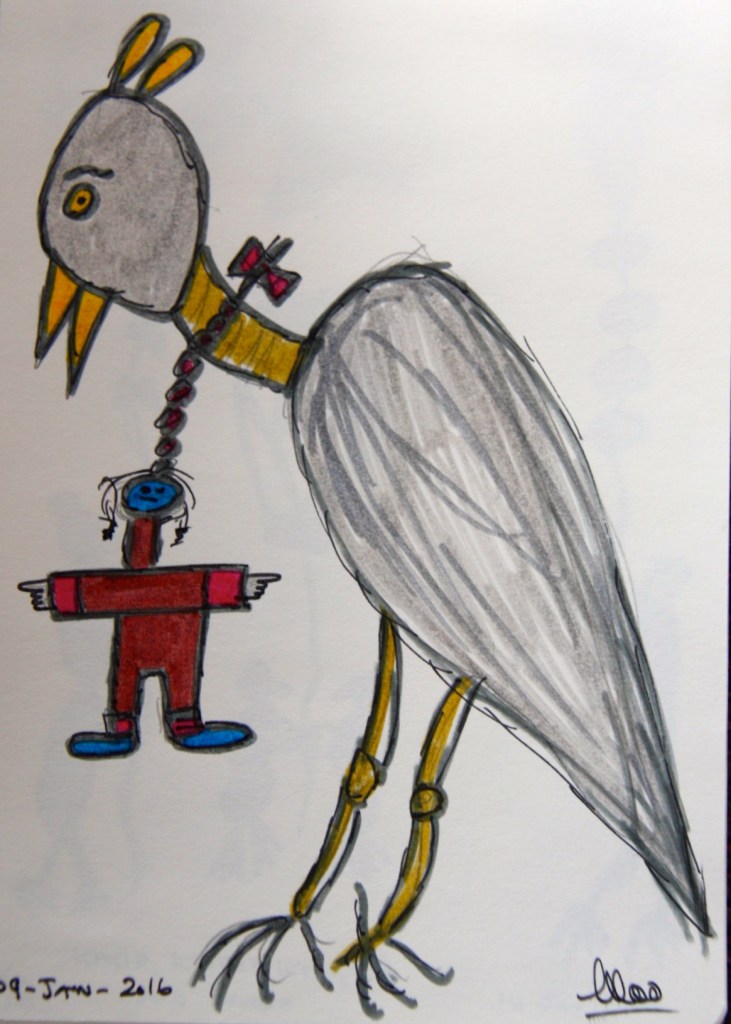
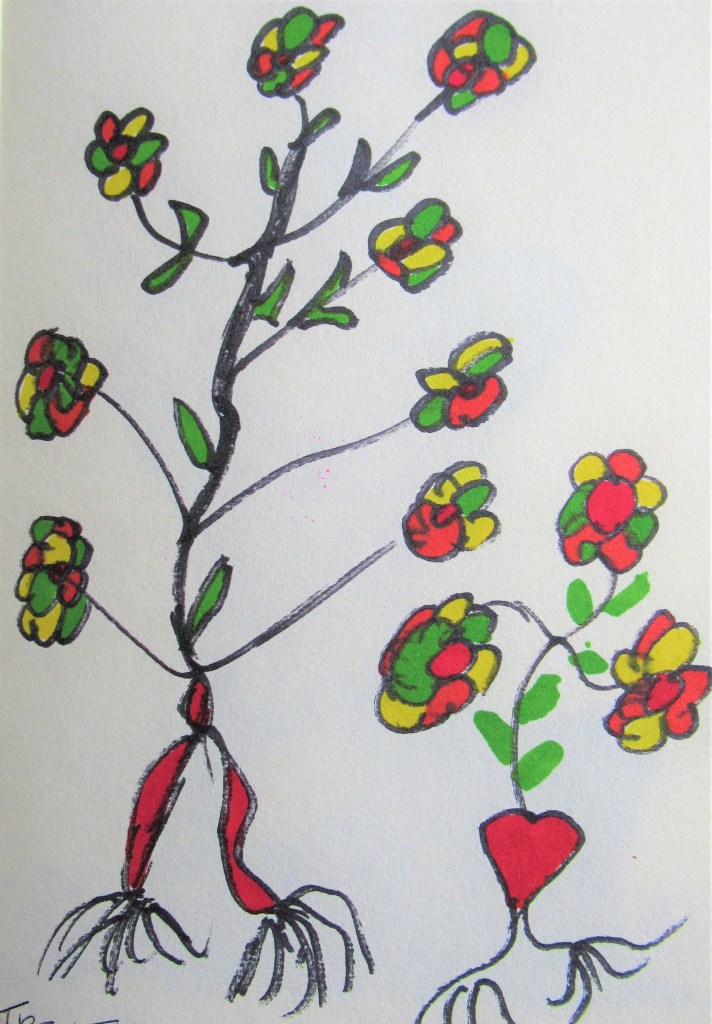
I love to be cryptic. Nothing better than a series of hidden messages concealed, or partly concealed, within a pair of paintings. And what have we here? Well, can you work it out for yourselves? Or do you need an explanation?
Okay: an explanation it is. First, the title of this blog post and of the painting on the left. LoVe. LV = Roman numerals for 55 / fifty-five. LoVe = love it. More, much more: I also love my beloved and, on Friday, 24 December, this year, we will have been married for 55 years, all of them spent in Canada, where we got married, all that time ago.
Perspective: so important, even in a painting that lacks perspective. So, let’s put it into perspective: that’s the year before Canada’s Centenary. And yes, we visited Expo in Montreal in 1967. Or, if you are a sports fan, that’s the Christmas before the Toronto Maple Leafs won the Stanley Cup (1967) for the last time. And we were living in Toronto. And I was studying at U of T. Wow and double wow: nobody in Canada, under the age of 54, was alive last time the Toronto Maple Leafs won the big one. And still the Maple Leafs, like our marriage, endure. We are the everlasting drum-beating bunnies, going on and on, for ever and ever.
Now look deeper. See what else you can see. I will assist you no further, except to add the initials – and title – of the right hand painting. AMGD. Work that one out, if you want to and if you can. And remember: presents for special anniversaries like ours come from the heart – not from a gift shop. So that is my anniversary present for my beloved. What a pity: she never reads my blog.
In spite of grey skies, blueish snow and early- morning, under-cloud- light combine to color my garden several shifting shades of blue-grey.
Light grows and the garden starts to whiten. No deer as yet, but they aren’t far away.
Two big ginger cats, I think at first they are foxes, stalk their marmalade path through the trees towards the road. I have never seen them before. New neighbors?
One crosses the road but the other hesitates, then flees, as flashing school-bus lights bring normality back to my early -morning dream-filled world.
North Wind descended from the pole sending its wolf pack through snow- bound trees. Listless, they stood there, then wind and wolves came, cutting and shuffling, playing snap-the-branch, chase-the snow-flake, and strip-jack- naked. Wolves danced on their hind- legs, round and round, shaking trees, biting at branches, testing winter games until trees stood naked, stripped of snow, tresses and garlands gobbled and gone.
Oh the wickedness of winter, its cold- cut cruelty, the lash of the wind, ice- pellets hurled, picketing fences, pecking a wild winter-song, forlorn in its fury, its pace, its power, its reckless race to hurl everything away, out of its way, snow twisted, tormented, twitching its snake-way down barren highways devoid of secret places in which to hide tender faces from the North Wind.
My family never forced me underground. Nobody ever made me kneel at the coal- face altar and worship, on my knees, that grimy god with its coal-black soul.
A child in body and heart, nobody ordered me to squirm down diminishing seams, much too narrow for men or machines and fitting only for the smallest child.
Fitting indeed, an early coffin, made to measure, lying in wait for the slightest slip of the rocks above or below. Tight fitting, indeed, no wiggle, wriggle room.
Billy Blake, my mate from Trinidad, younger than me, saw the black faces of miners emerge from the mine, enter the pit-head baths and come out white.
He, too, wanted to be white. He dug underground, grew even blacker, went into the showers, gouged his black skin, drew rivers of blood, never changed color.
He died when the roof above him fell without warning. They pulled him out. Brought him to the surface. Prepared him for burial. Wrote on his tombstone:
“His body was as black as night, but oh, his soul was white.”
Those that have been chosen to survive have walked indoors, Now they are safe behind glass, in the warm, low sunshine that floods the rooms. We watch the sun’s fingers starting to reach into the deepest corners and know that winter is on its way.
Thanksgiving has come and gone yet we still give thanks: indoor flowers to brighten the dark days, flu shots tomorrow, blood tests on Friday. I guess it’s a case of ‘last man standing’!
Orion confirms this. He has risen in the night sky and now accompanies me on my journey through the dark hours, sword at belt, faithful dog at heel. Yes. Winter is on its way. Warmer clothing. Thicker jerseys. Non-slip shoes. Oh the joys of Canada.
Remember: there is no such thing as bad weather, only inadequate clothing. Locked out of the university, walking the picket lines at -35C, we learned the facts of outdoor winter life only too well. So, dress warmly. Keep safe. Keep your distance. Wear those masks. Did out your snow tires. Tune up the snow blower.
And may you always wake with the flowers in the house.