What are your two favorite things to wear?

Daily writing prompt
What are your two favorite things to wear?

What are your two favorite things to wear?

What a strange question. I suppose it merits a strange answer. And the answer is – it depends. You see – I live in Atlantic Canada. Here we have several sayings. One from the Bay of Fundy is – “You don’t like this weather? Hang around five minutes. It will change.”

I had the snow blower prepped for winter a week or so ago. So, what are my two favorite things to wear when snow blowing? Only two? Hat, scarf, water-proof / wind-proof coat, thick gloves, scarf, warm socks, boots that keep out the water and the cold and that have soles that grip into the snow. You mean I have to choose two things from that lot? I just checked the calendar – it’s not April the First, you know.

In summer, when the Fundy Fog rolls in from the sea and wraps scarves of salty mist around the trees, and it becomes so cold, so damp, and so chilly so quickly – what are my two favorite things to wear? I guess you can double-check the list above and eliminate an item or two. But I wouldn’t chuck out too many.

And what about cross-country skiing? As the weather changes, and as you warm up, you need several layers of removable clothing that can be taken off, when you warm up, and placed back on when you hit the shade between the trees and you start to cool down. But only two items? What are you doing to me? And what about the wind-chill factor?

Once, when I walked the picket-line at -35C, we had all been pre-emptively locked out from my former place of employment, we were visited by Flying Pickets from the Northern Part of Canada. They had a saying: “There’s no such thing as bad weather, only bad clothing.” You notice they didn’t say anything about two items of clothing. I wonder why not?

So there you have it. Be prepared, I say. It always depends. And remember: “Never mind the weather / As long as we’re together.” Perhaps those two items might just be you and me! But then, we’re not clothing, are we? Not unless we are just rag dolls.

Who is the most famous or infamous person you have ever met?

Daily writing prompt
Who is the most famous or infamous person you have ever met?

Who is the most famous or infamous person you have ever met?

First, some definitions. What exactly does ‘met’ mean? I met you yesterday, for example. How long was the meeting? A nod and a passing of ships in the night? A stop and a handshake and a brief conversation? Or a genuine meeting of minds when people know each other reasonably well and can be considered ‘friends’? Infamous – that is relatively simple. Meanings, in my quick check, include – well known for some bad quality or deed, eg an infamous war criminal. Well, I have certainly never met any of those, not that I am aware of anyway. What does famous mean? Here’s one definition – famous implies little more than the fact of being, sometimes briefly, widely and popularly known. How wide is widely? How popular is popularly? Never mind. Let’s give it a go.

Brief encounters – I met several famous people briefly. Gento, from Santander, the Real Madrid soccer player and possibly the best winger of his time. John Charles, the Welsh soccer player, born in Swansea, and a good friend of my father. I met him once, briefly, in a Cardiff Street and my father presented me to him. Federico Bahamontes, the first Spanish cyclist to win the Tour de France. I met him, very briefly indeed, outside his bicycle shop in Toledo.

Longer encounters – these include the Spanish poet, Jose Hierro, who taught me Spanish, over three summers, in Santander at the UIMP. I also met Jose Manuel Blecua at that university and he introduced me to the poetry of Francisco de Quevedo. At the University of Toronto I had the good fortune to take courses from Erich von Richthofen, Geoffrey Stagg, Keith Ellis, J. H. Parker, and Diego Marin, each of them famous in their own way, with excellent academic reputations and publications. At Bristol University, I briefly met Jorge Luis Borges, whom I met again at the U. of T. a couple of years later. Academia and literature formed a happy blend in which to meet people who were famous within their own fields.

The same is true of the sporting life. While enjoying Cross-country running at Bristol University and while running for Bristol Athletic Club, I met Martin Hyman, Basil Heatley, Eddie Strong, John Boulter, and several other athletes of international renown. The same thing with rugby. Names that I can drop include Don Rutherford, Full Back for England and the British Lions, with whom I took a coaching course at Bisham Abbey. Welsh rugby personalities that spring to mind include Ray Williams, Billy Hullin, ‘Buck Rogers’, and several other luminaries of whom Alun Priday, Dai Watkins, and Elwyn Williams spring to mind.

But does any of this matter? I remember going to a poetry reading in Avila, Spain. This is what happened after the reading.

After the Reading

Many names were dropped and lay scattered on the floor.
Some of them broke. Others bounced back to their feet
and walked around stiffly, smiling unhappily.

Sugar and saccharine, unnamable sweetness, honeydew melon,
all lay on the ground, with empty shells, hollow metaphors,
accumulated clichés, vague imagery, the blanched bones of poets
that once wore life’s armour of grammar and blood.

When the cleaner came, she summoned a broom
and it swept away the remains:
dust without love, cigarettes butts and smoke,
nothing and nothingness, emptiness, empty nests, shadows of dreams,
living words, dead, now lying in a common grave.

The meaning of meaning – meeting and knowing, famous and infamous, names pulled from a hat like a rabbit and then dropped to the ground where they prick up their ears and scamper away. Yes, I have (briefly) met several famous people. But I know only a few really well. Sometimes, I wonder if I ever really met them, or knew them, and then I ask myself, did any of them know me, or remember me at all? Maybe that should be the larger question!

What is good about having a pet?

Daily writing prompt
What is good about having a pet?

What is good about having a pet?

Good heavens – what a strange question. Here in New Brunswick – Nouveau Brunswick, Canada’s only bilingual province, I guess it depends on whether you are Anglophone or Francophone. Nothing like a nice, healthy ‘pet’, if you are a Francophone, though you have to be wary, very wary, of them at my advancing age. And nothing like some ‘pets de ma soeur‘ for breakfast, with a nice cafe au lait, unless you would rather ‘un bon bin de beans‘.

On the other hand, if you are Anglophone, then the term takes on a different series of meanings, doesn’t it, my pet, I ask my wife. Happily, she neither woofs, nor woofs her cookies in reply. And if this is all double-Dutch to you, don’t worry. It’s all tied up with discourse analysis and the meaning of meaning. Don’t be so mean! What do you mean by that?

I suppose we are all talking about cats and dogs, and budgerigars – not budgie smugglers – and other two and four-legged friends, along with sliding ones, like baby boa-constrictors, that can – like pythons in Florida, grow to an enormous size. Such an enormous size, in fact, that you end up being the pet when the monster rules, and your flush your once-a-baby, now a problem, alligator down the New York toilet to grow even bigger and become a danger to the men and women who patrol the subterranean sewage systems.

And don’t forget Julius Caesar, the pet parrot who told the burglar, in an Irish accent, that “Jaysuss” was watching him” as the burglar tried to burgle the house. Alas, Julius Caesar failed to warn the house-breaker that Jaysuss was in fact a huge, pet Rottweiler that was standing – we stand on guard for thee – right behind the unfortunate man. Who needs a burglar alarm and an AI system, when you have two or three pet, and not petits, Rotties patrolling the house 24/7? Mind you, I wouldn’t call them pets, those Rotten Rotties, though they may cause them in certain people, and very generous ones at that.

Name the most expensive personal item you’ve ever purchased (not your home or car).

Daily writing prompt
Name the most expensive personal item you’ve ever purchased (not your home or car).

Name the most expensive personal item you’ve ever purchased (not your home or car).

I began by checking the meaning of item and found the following – an individual article or unit, especially one that is part of a list, collection, or set. Then I started to think about the meaning of meaning. Is an education an item? Is it an individual unit? Can it be considered part of a list, collection, or set? Let’s put it this way – I started school when I was four years old. I continued until I was 18. Along the way I collected many items of knowledge and many certificates to prove it. Then I went to Paris for a year to perfect my French – now that was an expensive adventure, I can assure you of that. Next came Santander, Spain, for a whole summer, to do for my Spanish what Paris had done for my French. I guess I didn’t really pay for these items, as my parents did, though I helped a little, with odd jobs here and there.

These adventures were followed by 3 years of undergraduate studies. They were covered in part by my local government authority, for which I am eternally grateful, also by my parents, and then I too assisted, again with odd jobs and summer work. Next came graduate school, at the University of Toronto. This was financed by my earnings as a Teaching Assistant and then a Teaching Fellow. My beloved and I got married in Canada, and she found work and also assisted with graduate school and the general cost of living. Assisted? She carried me along when the work load grew too heavy.

Then there was a Canada Council Doctoral Fellowship that helped finance two more years of study in Santander, Spain, where I completed manuscript research at the Biblioteca Menendez y Pelayo. This was followed by my first job, as a lecturer, at the University of New Brunswick, Canada. I taught full-time while completing my doctorate, but my education did not stop there.

I pursued coaching certificates with the National Coaching Certification Program of Canada and soon related coaching methods to in-class teaching methods. This revolutionized my teaching. As did a Certificate in Multi-Media Studies (at UNB), followed by courses in Digital Film and Video. Then came a Teaching Certificate from IATHE – the Institute for the Advancement of Teaching in Higher Education (based in Ottawa, but no longer extant). My Certification process was topped off by a Certificate in Creative Writing from Humber College, Toronto.

All of these degrees and certificates cost money. All contributed to the list of items that go together to form my education. But a personal education, in the meaning I give to the word, goes way beyond an accumulation of certificates. It is a life -long process of growth, personal development, and understanding, of reaching out to other human beings and helping them to create their own lives and their own paths to life-long learning.

Has this been expensive? You bet it has. But its worth is priceless compared to remaining static and enmired in a past knowledge that never develops and never grows, as sometimes – I might even write ‘often’ – happens when learning stops with the acquisition of the Ph.D.

When asked what I teach, my reply is always the same – “People, real, live people.” And that is something that I continue to do whenever and wherever I can. “To know the cost of everything and the value of nothing” – I scarcely remember – nor do I care to know – what cost I paid for each step along a road along which I am still travelling. But I do know and totally appreciate the value of the continuing education that I working so hard to buy.

What will your life be like in three years?

Daily writing prompt
What will your life be like in three years?

What will your life be like in three years?
Well now, that depends on several things. I love the fall. Who doesn’t love the fall in New Brunswick? The trees changing color, warm by day and cool at night, then the leaves falling off the trees and blowing here and there with the wind. I stood in the garage yesterday and listened as the north wind herded rustling, complaining Maple leaves down the roadway past my house. The sound of dry leaves bouncing and skittering. Pure fall magic.

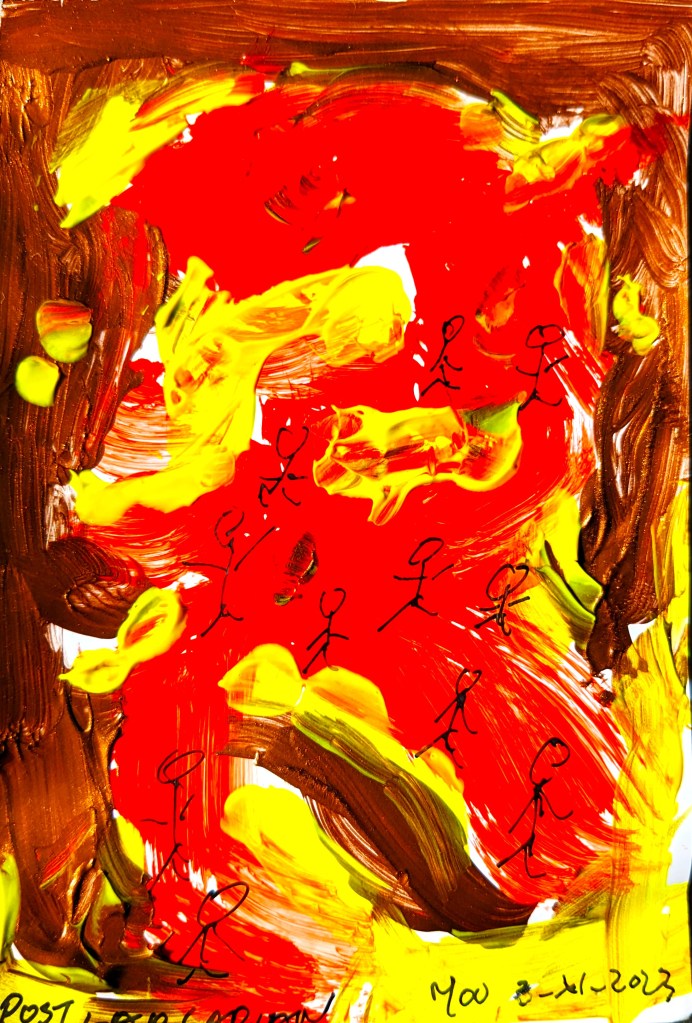
But when I fell on Thursday night, it was a different kind of fall. One moment I was a tree, standing free on my own two feet, the next I was a sawn-off log, tumbled to the ground. When trees fall, they often bleed bark or sawdust, if they are sawed. I just bled blood. On the floor boards, on the carpet, on my shirt. I had just painted the painting above – Prelapsarian – and there I was, lying on the floor, having fallen myself.

And there I lay, fulfilling my own prophecy – Postlapsarian – lying bleeding on the ground. The fall was stunning and I was stunned. I managed first to roll over onto my tummy. Next I managed to get into the push-up position and from there I was able to draw my knees up. Kneeling, I reached out to the spare bed and started to try and haul myself to my feet. But I was spent and exhausted and drained.

I called out and Clare, dear woman, came to my rescue. She helped me to my feet, staunched the bleeding, mopped up the floor, and the carpets, and me. Then she went to the medical chest and bandaged me up so I would heal and wouldn’t bleed all over the bed and my pajamas. What a mess. What a bloody mess – and no, I am not swearing, I am only telling you what I saw. Blood everywhere.

So, what will my life be like in three years? I hesitate to think about it. Maybe I’ll be in a garden somewhere, helping the trees to grow their leaves, so that the life cycle may continue. And maybe not. Right now, I feel very, very fragile. I just don’t want to think beyond the current moment.

What historical event fascinates you the most?

Daily writing prompt
What historical event fascinates you the most?

What historical event fascinates you the most?

First, let us define ‘historical’. Here’s what I found – (1) of or concerning history. (2) concerning past events. (3) The historical background to such studies. (4) Belonging to the past, not the present. (5) Famous historical figures.

Now let us think of the number of times we hear on the TV sports shows that such and such an event is making history “right before our eyes”. Wow! In a boxing match, almost ever punch thrown is “an historical event”. Ditto rugby – with every try scored, every penalty missed, and every tackle made. Ditto soccer, basketball, baseball, athletics. So, from the battery of past events that adorn my life, I am being asked to choose “which historical event fascinates me most”. Double wow.

My answer – the day of my birth, about which I know absolutely nothing. Or, to be more specific, the actual action of being born, about which I know even less. So, how do I study the historical background, when no eye witnesses are left alive to assist me? More important, nobody in my family wanted to talk about such an important – for me at any rate – event.

I do have some factual memories – tales told to me later. I was born at exactly 8:00 pm. I know this because my parents’ dog had been left at a neighbor’s house while my home-birth was taking place. As the clock struck eight, Paddy, the dog, jumped straight through their window, and ran up the road towards the house that was now to be our house, barking. “Ah,” said our wise neighbor, “there goes the dog. That means the baby’s been born.”

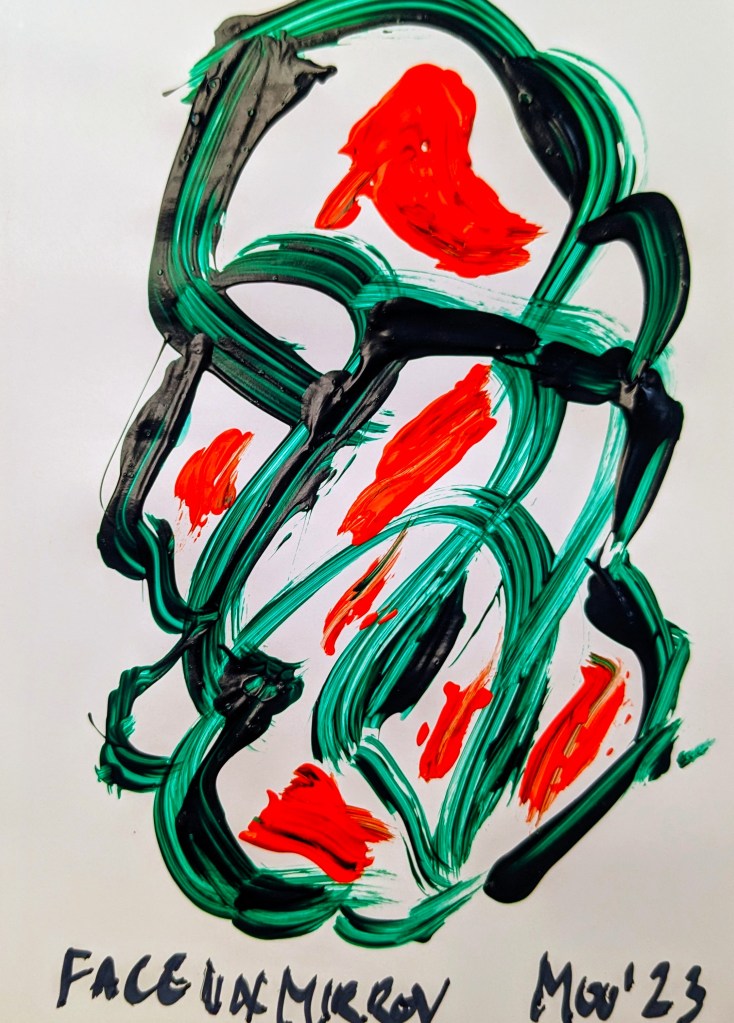
That is one version of the tale. My own version is the squawking of the stork who carried me, a sudden screech as he dropped me, a slow descent from a bright blue sky, a tumble down the chimney into the fireplace. And there I was. All covered in soot and ashes. I needed washing, of course. But baby, just look at me now. [See self-portrait above – Face in a Mirror].

My maternal grandfather swore that I had not been born at all, but found under a gooseberry bush. That would account for the green tinges in the painting. Apparently, all babies in South Wales were found under gooseberry bushes at that time. Unless they were delivered by the milkman.

And there’s many a tale about merry milkmen for, as they say in Wales, “It’s a wise man who knows his own father.” And I guess that is also a hysterical historical event about which I know nothing. But perhaps that’s why when the milkman who delivered the morning milk used to say “Good morning, son” when I met him at the the doorstep.

Come to think of it, the mailman also used to call me “Son” when he delivered the mail. Hmmmm – so did the butcher, the baker, and the candle-stick maker. Oh dear, so many historical events to choose from.

What’s something you believe everyone should know.

Daily writing prompt
What’s something you believe everyone should know.

What’s something you believe everyone should know.

I think everyone should know that the world, as we see it right now, is a very troubled and troubling place. Everyone should also know that there is no so-called “silver bullet”, no single answer that will solve everything with the wave of a magic wand.

These two points are tied in to a third – that the world is filled with smoke and smoke screens. Misinformation, disinformation, manipulation, lies, downright lies, and AI statistics now rule. There is no longer a clear pathway to follow and there is so much downright tribalism and hatred that there are few safe places, save in the middle of a person’s own little tribe that protects while allowing no challenges to whatever truths their authorities present as being true.

Voltaire once persuaded Candide to say that “everything is for the best in the best of all worlds.” Personally, I wish those words were true. It is equally false to say that “everything is for the worst in the worst of all worlds.”

As I type these words, the first snow of winter is falling outside my window. It covers my garden with a thin, white blanket, soft, and fluffy, and wet. All the flaws of my late fall lawn are covered up, tucked away, lie buried beneath that blank sheet on which neither animal, nor beast, nor bird has yet set foot.

I imagine it as a clean page, a fresh beginning, a new start, a moment when the world can change and a new future history can be written starting now. I do not smoke, so pipe dreams are something I have not experienced. Alas, I fear that such a dream is nothing but a pipe-dream, a castle in the clouds, a chateau in Spain, as some say.

“Those who ignore history are doomed to repeat it, over and over, and over again. Then the snow settles. The winners write their stories on blank pages. The losers all disappear into the mists of time. But those mists contain the ghosts, and the myths, and the fairy-tales, that turn themselves into truths reborn, and the same merciless battles begin again.

Then the snow of memory loss starts to fall and the world is presented with another blank page on which to write. Alas, instead of a new future history, the old stories, the old myths, the old falsehoods emerge once more from the miasma and the world again becomes a very troubled and troubling place, and so it goes on, secula seculorum, for ever and ever, amen.

How much would you pay to go to the moon?

Daily writing prompt
How much would you pay to go to the moon?

How much would you pay to go to the moon?

Exactly the same amount that I would pay to visit the Titanic in a Titan – zilch, nada, rien, nothing. Too risky. Not worth it. Too much carbon emission to damage the world around me. It’s only a thin envelope of air up there – pointless damaging it further. We have problems enough anyway.

And how much would it cost to fund a rescue mission if something went wrong? How much did it cost to search for the Titan for five days? I haven’t forgotten Apollo XIII, even if other people have.

No way, my friends, no way. No common or garden human being in his or her right mind would ever get into something like that. I notice you say ‘to go to the moon’. Is it a two way, return ticket, then? Does the lucky traveler also get to come back? Or is it a one way only trip and a journey of no return?

Don’t bother answering those questions. I am quite happy viewing the moon through my bedroom window. I wouldn’t go, even if you offered me a free ticket. Thanks, but no thanks. Not on my watch! I am not moonstruck!

What major historical events do you remember?

Daily writing prompt
What major historical events do you remember?

What major historical events do you remember?

Interesting question, but very problematic. How do I define a “historical event”? What exactly do I mean when I say “I remember”? Max Boyce had a lovely song in which the chorus was “I wuz there.” If everybody who says they saw Llanelli defeat New Zealand in 1973 at Stradey Park had been there, there would have been 300,000 people pressed into a ground that held about 15,000. But, as Max Boyce sings, “I wuz there”. Well, in spirit, anyway, and I have seen the film several times. I also remember watching Jim Laker’s 19 wickets in the 1956 cricket Ashes. I watched that match on B&W TV. Does that count as an historical event that I remember?

How about the Battle of Hastings, 1066? In 1966, I ran in a road relay that led from Bristol to Stamford Bridge, where Harold defeated Harald Hadrada, down the main highway to The Trip to Jerusalem, where we stopped for a pint, down to Hastings, where we re-enacted the battle that saw William the Conqueror take the throne. Several of the runners wore Saxon uniforms, a couple even had long, blonde hair. We re-enacted two battles. Does that mean I remember that historical event?

Let us talk about Stonehenge. I first went there when there were no railings, no fences, and when sheep and cows could safely graze. I remember it well. And I remember creatively re-constructing, with my grandfather, the digging of the post-holes, the raising of the stones, the transportation of them, by ship and log rollers, from the Prescelli Mountains in Wales to their current resting place. As Max Boyce says, in my own mind, I was there. I was there too at the destruction of Maiden Castle. The first book I ever bought, age about six, was Sir Mortimer Wheeler’s autobiography, Still Digging. I can still feel that Roman ballista arrow going through the victim’s backbone. Does that count as a memory, as a presence, as a moment of reality?

The Conquest of Granada, the Expulsion of the Jews from Spain, the later expulsion of the Moors, the Adventures of Don Quixote, the mixing of truth and reality, the questioning of authority, the inquiry into the meaning of meaning, my mother’s sister phoning me after 9-11. “What’s all the fuss about, Roger? There were only three planes. We had them every night, over here, during the London Blitz, for two long years.” What impresses itself upon the human consciousness. How do we remember things and why? The Spanish Armada -there were actually three of them -, the Peninsular wars in Spain, the battles of Trafalgar, Vimeiro, Salamanca… Then we can move on to Vimy Ridge, Ypres – Wipers, as my grandfather called it, his days in the trenches, recounted to me, in the kitchen, day after day, in vivid, lived language that still remains with me. And he would sing – “If you want the whole battalion, I know where they are, they’re hanging on the old barbed wire.” Yes, I was there with my grandfather. I remember it well. The Battle of the Atlantic, the Hunt for the Bismarck, the Battle of Britain – I sat in the cockpit of a Spitfire, a long time ago, during the Battle of Britain celebrations, and I climbed into and walked around the interior of a Lancaster.

Memory and the reconstruction of historic events, some we actually lived, and some we just dreamed of, and some we saw at the movies. What is memory – an actual happening or a creative reconstruct? What is the meaning of meaning? And read Bertrand Russell’s book on the subject before you answer that one. As for me, I was there, standing beside Max Boyce, witnessing the game, though, as he says, “a hundred thousand in the ground, and me and Roj outside.”

What are you most proud of in your life?

Daily writing prompt
What are you most proud of in your life?

What are you most proud of in your life?

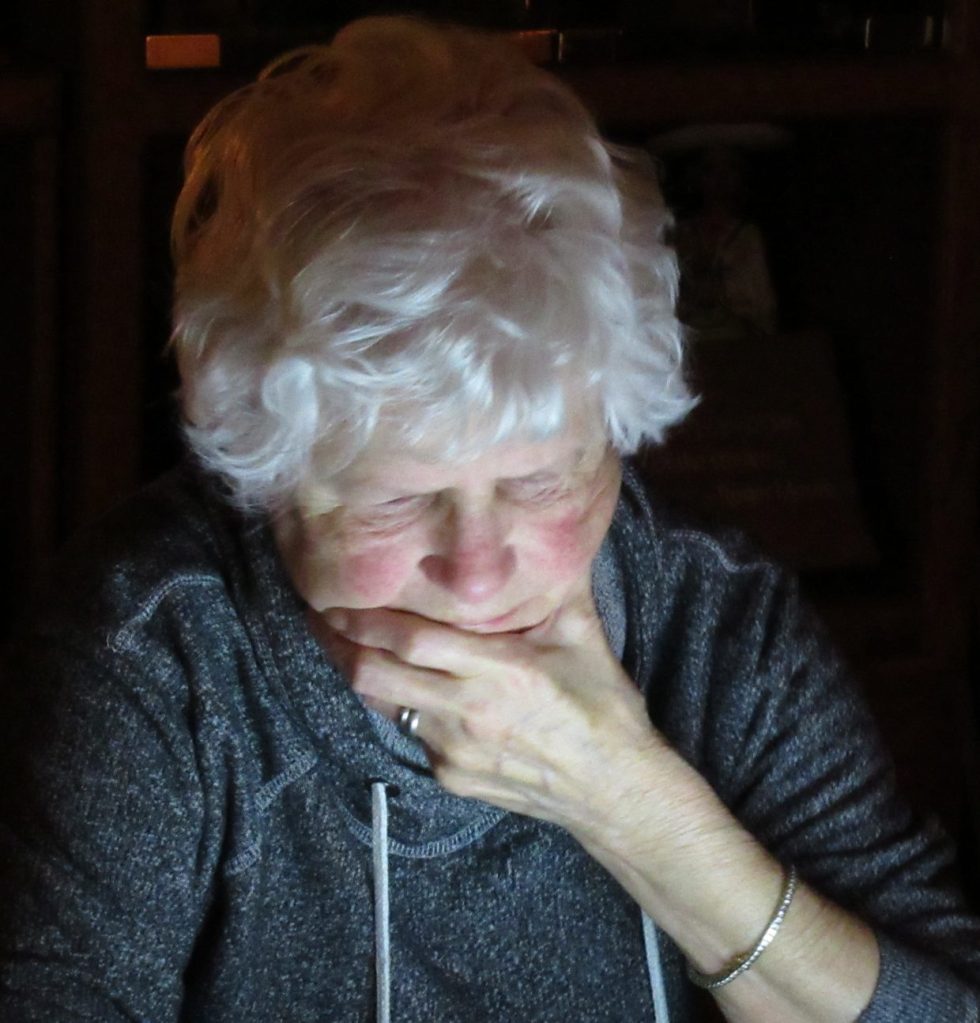
The young lady in the photograph above. We met, at a boarding school dance, in England, when we were both seventeen years old. We have been together ever since. Why am I so proud of her? Let me count the ways.

When she discovered my love of Spain and the Spanish language, she took time out from her own career in order to learn Spanish. When I asked her why she was learning the language, she replied ‘because if I am going to be with you, I want to share your life, and that means loving the things you love.’ We became engaged in Santander, Spain, on her 21st birthday. Then, the following year, when I received an offer to study and teach at the University of Toronto, she promised me that if I called her, she would come out and join me.

I called her as a Thanksgiving Gift from my Canadian family. She packed up her clothes and her career, bought a wedding dress, and travelled to Toronto that December. We got married on Christmas Eve. We had very little money. We didn’t have a wedding photographer. Nor did we have a honeymoon. I guess we never needed one. We had just enough money put by to last us until the end of January. So, First week of the New Year, she set out in search of a job. A qualified Diagnostic Radiographer, she was hired by the Doctor’s Hospital in Toronto, and she financed my graduate studies for the next three years.

Our next adventure was a Canada Council (as it was back then) Doctoral Fellowship that took us back to Spain where I completed the research for my thesis at the local library, with its trove of manuscript documents. We returned to Canada after two years, and took up residence in Fredericton, New Brunswick, where we still live. Her adventurous life led her to a certificate in accountancy, taken via a correspondence course. Then, she presented me with our daughter. We bought an American Cocker Spaniel and she started showing and grooming dogs, becoming Show Secretary of the Fredericton Kennel Club. She trained and groomed two Canadian Champions, an ASCOB (Willy) and a Parti-color (Smudge).

Our daughter decided she wanted to be a gymnast. Parents were requested to ‘get involved’ with the local club and my beloved became a gymnastics judge. She rose in the gym circles and became first provincial judging chairperson and then a nationally qualified judge, officiating at the National Gymnastics Championships and also at the Jeux du Canada Games.

She travelled with me to Oaxaca, Mexico, and fell in love with the Pre-Colombian Mexican Codices that we found there in abundance. She studied them carefully and then taught me all about them. I, in my turn, introduced them to my own students. When I took my first Multi-Media Courses at the University of New Brunswick, she followed them with me. The result was two-fold – our first web page which she built with with HTML, no templates in those early days, followed by our online Quevedo Bibliography. This, about ten years later, morphed into the online searchable data base that she built with the assistance of the technicians at the Digital Library in Harriet Irving Library.

Now, we are growing old together – such sweet sorrow. this Christmas we will celebrate 57 years of marriage. And yes, my beloved is still my most valuable Christmas present – and the person of whom I am most proud. I remember the old Worthington beer advertisement. “Behind every good man, there’s a good woman.” The cartoon shows a lady carrying a bottle of Worthington.

My beloved has stood behind me all my life. She has carried for me, not a bottle of Worthington, but the burden of assisting, helping, encouraging, supporting, carrying the load when it became too heavy for me. She has been a silent partner in so many ways, but one without whom I would be nothing.