Tomorrow

DSC02478.jpg

Tomorrow

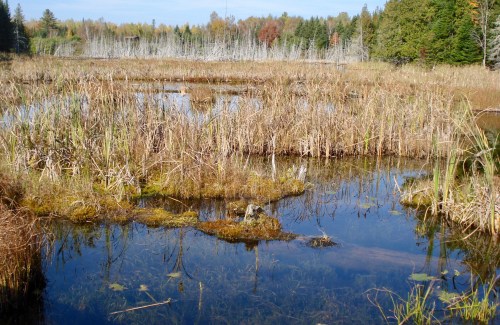
Tomorrow, early, my love, you’ll fly away. Today, all tense and stressed, your foot in the stirrup, as Cervantes would say, the anxiety of the journey on your back, you walk around the Beaver Pond where red and yellow leaves abound. I know you are hoping to see, once more before you leave, the Great Blue Heron that was here last week. Some ducks remain. I can see them standing on the water, flapping their wings, inflaming the wind, keeping themselves warm, not looking as if they really want to fly.

Alas, there are no beavers now. An abandoned lodge, the grass on its roof turning brown and dry,  lofts white sticks into the sky, but the waterways are clogging and the beaver have gone. Drowned tree trunks, beaver-gnawed and languishing, grow tiny clumps of grass and weed. Sometimes, they join together and form a miniature island that will grow at last into a grassland. The deserted lodge reminds me of our home, soon to be abandoned by the life and soul that animates it and keeps it alive. It will be sad and lonely living there without you. I know I will have the cat for company, but that’s not the same. I think I’m in charge of her, but I wonder sometimes if you’re leaving her in charge of me.

A thin grey woven webbing garlands one moribund tree. I don’t like tent worms or their equivalents. Every year we face a different invasion of this worm or that and the trees stand shocked by crawling creatures that infest their branches and build their silk cities up into the sky. I hate it when those dangling inhabitants, escaping from their cocoons, swing from low branches and twine silk threads around my face. Give me any day a fresh green frond caught by the morning sun in early spring, or else bright autumn leaves so soon to fall.

I love American Goldfinches when they sing that last departing song. I love most of all the occasional visitors that wing up north on the wings of a summer storm. Do you recall the Indigo Bunting that perched in the Mountain Ash just outside our kitchen window? He had the look of a lost bird and his call was more a cry of help than a birdsong. You took such lovely photos of him as he sat there, looking this way, that way, anyway for the way he needed to go home … and those two cardinals, orange the one, bright red the other, standing beneath the feeder, so bright against the early snow.

The hunting hawks give everyone a fright. They perch on top of a power line pole then step off into space to alight, claws first, on some poor songbird trilling away, quite free from fear, his unfinished symphony of song. Claws first? I gaze again at the photo you took of the Sharp-shinned Hawk that settled on our porch that day it rained. Claws? The massive yellow talons are high grade weapons fit for any war. I pity the poor bird clasped in those claws and brought to earth or lifted high into the sky, a feast for the marauder.

It’s getting late, my love. You walk towards me out of the woods like some lost spirit returning to this earthly world from some spiritual sanctuary. The season is ending. Thanksgiving is close. It will soon be time for you to pack your bags and go. Three silent wishes for you my love: enjoy yourself; don’t forget me … and don’t stay away too long.

Comment:
This piece goes back to the Fall of 2016. Clare and I visited the Beaver Pond at Mactaquac the day before she left for Ottawa. I sat at a picnic table and watched her as she walked through the woods and around the pond. ‘Parting is such sweet sorrow’: she didn’t want to leave me and I didn’t want her to go, yet we both knew how important it was for her to visit our grandchild for Thanksgiving. Time apart is good: it makes us realize how much we miss each other. For me, above all, it is a reminder of everything that gets done around the home without my ever noticing the care and love that is poured into each moment of every day. Having to provide that care and love for myself is an object lesson that makes me so thankful for the seemingly simple blessings Clare has brought to me throughout our married life …

Indigo Bunting, for Meg:

For you, Meg: photos, by Clare, of our second Indigo Bunting.

IMG_0206.jpg

He’s rather handsome. We usually get them in from the States following a strong south wind or  a summer storm.

IMG_0207.jpg

Great Blue Heron, for Tanya:

He was right over the garden: beautiful. We don’t often see them up here as we are on the far side of the hill from the river. Must have been raiding a neighbor’s goldfish pond.


IMG_0231.jpg

Terza Rima

img_0188
Terza Rima
 Apologia pro verbum meum
Dear followers of my WordPress Blog: sometimes
I write what I do not mean to write
and say what I do not mean to say. Rhymes
make things clearer, for I puzzle what I might
say, and plan ahead so an awkward word
doesn’t intrude. Words, birds in flight,
bright as postage stamps across the absurd
white snow of a page or a digital screen:
when I think about it, I assume about a third
of what I say, I really mean. Who has seen
the early morning wind drifting our thought cloud
across trees and lawn, shadows cast on green
leaves of grass as we think our thoughts aloud,
each thought a pea in a pod, as some we clasp
between finger and thumb while others crowd,
and the loud, uneasy word slips from our grasp
to wound or injure or otherwise to hurt and maim.
It’s not my aim to do this. My word is not an asp
or a viper or a screw to be driven. I lay no claim
to hurt and yet sometimes a word slips sideways
and does not say what I mean it to say. I aim
to please, to tease, to provoke, in so many ways
and yet I often hurt where no hurt is intended.
If I have done you wrong and my word displays
unintended ends, forgive me: let all rifts be mended.
Comment:
Terza Rima was, for a long time, the chosen verse form for letters and epistles: the epistolary form, in fact. The rhyme scheme is very flexible and easy to maintain and the syllable count is also relatively easy. As for the length of the letter, well, that is entirely up to the writer. The one that I have chosen here has seven tercets and ends in a quatrain. The quatrain is a standard “stitch up” with which to end. I have used the epistolary form on many occasions, especially when sending postcards and letters to friends. Add it to your poetic arsenal. You will not regret doing so.

Last Night’s Reading

IMG_0146 2.jpg

Last Night’s Reading

I can hear the questions now:
“How do you feel
when he writes about you?”
“What do you think?”

The question of how
the listener feels doesn’t enter
the reader’s mind
when it imprisons
this furious god
who drives us onward.

We carry a picture within
our hearts that corresponds
to an internal reality
that has nothing to do
with the world around us.

At first, we impose.
Next, we learn to shape.
Then we realize we are the ones
who’ve been shaped
and we learn to share.

Only then do we understand
that what we carried within us
like the mother carries
a baby kangaroo in her pouch,
was not at all what we thought it was.

“Mankind can withstand
a small amount of truth,”
some poet wrote, Eliot, I think.
And what we release hops out,
floppy ears, long legs, bounding,
bonding with its own sweet music.

Structure in the Short Story

img_0177

Structure in the Short Story
Wednesday Workshop
30 November 2016
Posted: 4 December 2016.

I just attended, with one of my writers’ groups, a writing workshop offered by a guest speaker. Our speaker threw out some interesting ideas on structure in general and structure in the short story in particular. The first comment he made was “Are you sure that your novel is not a short story and vice versa?” He then suggested that often beginning writers run out of steam because their novels are not really novels but are short stories that need cutting, rather than expanding.

He followed this up by suggesting, and I made no notes so I write from a memory that fails me more often than it used to, that a short story should have a structure that runs something like this:

stasis > key occurrence > end of old world (stasis broken) > beginning of new reality (the world upside down) > quest (the search for  new balance) > climax (when all the events of the crisis come together) >  the moment of truth (when the central character is faced by a decision) > the choice (the protagonist chooses) > pay-off for protagonist (order is restored and the protagonist is changed or confirmed by his choice) > pay-off for readers (who see that change and are themselves changed by looking at the same old world through different sight and a new knowledge or insight gained).

 One of the group members circulated his notes from the workshop and summarized the idea rather more succinctly:

The first thing I remember … in any story, the main character has to be changed at the end from what s/he was in the beginning.

The other item was the list of elements in a story: Stasis, Trigger, Quest, Surprise, Critical Choice, Climax and Resolution.

            Clearly this is a theoretical structure, but many short stories follow it or versions of it. Through this structure, our speaker suggested, there often runs a leitmotiv and this can provide a thematic unity that also holds the story together. Returning to this thematic unity and writing selectively from within it, can often produce the desired change in reader and protagonist. Equally clearly, there is no length to this structure and the resulting story may be very brief or suitably enlarged.

According to our speaker, the character of the protagonist is very important and the key aspects of the protagonist’s character must be clearly drawn, right from the start. The protagonist must also go through some sort of change as the story and the protagonist’s character both develop. Place is also important and the protagonist should be linked into a place and preferably a time. The protagonist in the short story is, after all, in a dialogue with his time and his place (his chronotopos, as Bakhtin would phrase it).

This is certainly a prescription for short story writing, one of many prescriptions, I might add. A quick search turns up another definition, this time of a five-point narrative arc offered by Mark Flanagan:

“Sometime[s] simply called “arc” or “story arc,” narrative arc refers to the chronological construction of plot in a novel or story. Typically, a narrative arc looks something like a pyramid, made up of the following components: exposition, rising action, climax, falling action, and resolution.”

            Flanagan continues with a definition of each moment in the story. Exposition reveals the characters and the setting. Rising action is a complication that hinders the protagonist. Climax is the point of highest stress or tension. Falling action is a releasing of the pressure and the resolution ties up all the loose ends. (Taken from this site)

http://contemporarylit.about.com/od/literaryterms/g/Narrative-Arc-What-Is-Narrative-Arc-In-Literature.htm

Lope de Vega, the Seventeenth-century Spanish playwright, suggested a simplified three-part structure: situation > complication > unfolding / dénouement. Of course, the complications may be multiple, resulting in an action that runs situation > complication > further complications > complicating the complications > even more complications > even more complicated complications > and then the final unraveling of the ‘by now very twisted’ plot. An even simpler two-part definition, also from Spain’s Seventeenth-century, offers us the dual structure of a ‘world in disorder’ > ‘a world in order’ — how the characters progress from disorder to order is up to you as a writer.

Of course, the author may decide NOT to tie up all the loose ends and re-order the world to perfection. When this happens, we may have a dystopia: the disaster continues; or we may have an open ending that prompts the reader to wonder what might happen or what might have happened. As for ‘beginning at the beginning,’ there are also stories that begin in the middle (in media res) and then go backwards in time before going forwards again. This raises the awkward question: how short is a short story? I won’t attempt to answer that one here.

Whether you describe or prescribe, there are many possibilities in the world of short story telling and it is always the story that counts. If it is good, then perceived structural flaws that go against these prescriptive methods may well become a prescriptive structure for another future writer. Interior monologue and dream, for example, linked thematically but not necessarily linked in time and space, may well distort or destroy yet another structural format, that of the three classic unities of time, place, and action. these, incidentally, are expanded into four by the great Spanish playwrights (among others, I am sure) who add unity of theme to the other three.

Robin Grindstaff, in an online article entitled “Narrative Arc: what the heck is it?”, available at

http://robbgrindstaff.com/2012/03/narrative-arc-what-the-heck-is-it/

suggests yet another simplification and reshaping, of the narrative arc idea.

“Think of narrative arc as a bell curve. It starts at a point on the lower left hand side of a graph, rises in a curve to a peak, and then drops back down again. The standard narrative arc is often referred to in terms of the three-act play: a beginning, a middle, and an end.”

            This is not unlike the structure outlined by Lope de Vega, except for the fact that ‘middle’ is a rather inadequate term for the multiple complications outlined in the Lope de Vega model. This statement may be a little unfair as Robin Grindstaff goes on to outline the complications that may occur in the second act in the following fashion:

“In act two, the main character must try to overcome the conflict presented by the inciting event. The character wants something, has a goal in mind. The conflict and tension of the story rise, and obstacles are thrown in the path of the character to prevent her from achieving her goal. The character faces these obstacles on her way to overcoming the conflict. The obstacles get bigger, more difficult, and the character may be on the verge of defeat or surrender. At this point, the character must make a critical decision or a moral choice that changes the direction of the story.”

            Clearly the ‘obstacles that are thrown’ compare favorably with Lope’s consistent throwing of obstacles and ‘middle’ therefore becomes a euphemism for ‘complications.’ Act three allows for the climax and resolution of the story and this includes character change or ‘death in defeat’ and tragedy. I recommend this article very strongly, as it goes way beyond the outline I have offered thus far and clarifies many features of the narrative arc.

In fact, Grindstaff then references Nigel Watts, Write a Novel and Get It Published, and outlines an eight-point narrative arc that runs

stasis > trigger > quest > surprise > critical choice > climax > reversal > resolution.

 This runs a close parallel to the circulated list (quoted earlier) of seven elements:

 Stasis > Trigger > Quest > Surprise > Critical Choice > Climax > Resolution.

 The main difference being the insertion of a reversal between the climax and the resolution.

So, we have now established an narrative arc, or a pyramid, with 2, 3, 4, 5, 6, 7 or 8 steps included within it. This is all very prescriptive: do it and you will succeed. My greatest fear then becomes the gate-keepers, those anonymous figures who sit on shadowy selection committees, place ticks in appropriate boxes, and judge the quality of writing by consensus in committee. I can hear them now: “#7 is missing. There’s no reversal. Reject!” “I don’t like #5. The choice isn’t critical enough. Reject!”

As writers, we must remember that all these arcs and numbers are just theories. The most important thing is the command ‘Take up thy pen and write’! All the theory in the world does not produce a good short story or a good novel. In fact, the opposite may be true: too many rules may stifle our narratives at birth or choke them to death My advice: know your theories, then smash them into little pieces and create the new structures, the new formats, the next new great piece of writing that will lead you, as a writer, to boldly go where no writer has gone before.

 Blessings, happy writing, and follow your creative instincts.

Balancing the Books

DSC03693.JPG


Balancing the Books

I knew that I did not have the strength and stamina to make a living as a writer. I knew too that I could not put my beloved and my family through the strain of maybe, or maybe not, making it as a creative writer. And I wanted to be an artistic writer, a poet above all, not just a commercial writer, writing adverts for a living, or pandering to the lusts of a baying multitude.

So: the most difficult thing for me would be look after my family and balance the books. Rather than writing full time, I chose a career in academia. My career as an academic led to 90 research articles in my various fields, 70 book reviews, the publication, in book form, of part of my doctoral thesis, and an online bibliography, now turned into a searchable data base. Add in unpaid, voluntary overload teaching to maintain a small program in a small university, overseas travel programs for students, a relatively successful coaching career at club, provincial, regional, and national levels, and a commitment to various editorial positions, in 14 local, regional, national and international journals, and my creative writing career has understandably suffered. In spite of that, I published 10 poetry books, 11 poetry chapbooks, 12 short stories and 130 plus poems in 20 Canadian (and other) journals, and won several writing awards. Indeed, to have been a full time creative writer and to have maintained a house and a family and a second career would, in my opinion, have been impossible.

Now that I have retired from university teaching, I can finally write full time. In my part-time creative writing career, maintained while I worked in academia, I kept a journal and made sure I spent at least one hour a day writing creatively, even if I had to get up early to do so. This resulted in a couple of poetry books with small presses and later a series of self-published poetry books that doubled with various festivals and other writing sequences. My poetry books did not sell well, and there is very little money in poetry anyway, so I started to give the books away to friends and well-wishers who were interested in what I was writing.

In retirement, I discovered CreateSpace and I now have eight books up on Amazon and Kindle. I am working on my ninth. What do I love best about Canadian Culture and Creativity? That it allows a person like myself, born in Wales, and speaking English, French and Spanish, to live and write in Canada about Wales, England, France, Mexico, Spain, and my adopted homeland. However, the literary and cultural industry boasts of our international character while totally ignoring me and writers like me. We ignore the self-published (calling them adherents to the vanity press) and we put down those who have not progressed in the ways that the literary societies accept.

Do I care? Of course I care. That is why I am writing this and why I will continue to write. Will anyone read this and take any notice? I doubt it. Will anyone take any action as a result of this tiny pebble cast into a Great Canadian Lake? I really, really doubt it. I can see the shoulder shrugging now as the eye-brows raise themselves slightly and the reject pile beckons. Will literary Canada keep staring at its own belly button and congratulating itself on its wonderful cultural opportunities for self-expression in writing? I guess it will. Will things change for artists on the periphery, for struggling artists, for artists like myself who with great difficulty have fought throughout their lives to balance the books? I doubt it very, very much indeed.

But I am here, as others are here. We have a voice. A very powerful voice. A voice that has been side-lined by the establishment and the institutions. But we are many. Very many. And one day, we will be heard.

A brief commentary:

The Writers’ Union of Canada (TWUC) invited its members to contribute a piece on their Canadian Writing Experience to Canadian Heritage, a group interested in gathering comments by Canadian Writers about their experiences. I thought about it for a while, penned this piece, and submitted it for their consideration. I was very pleased to have it accepted and it has attracted some attention.


First Snow

IMG_0033.jpg

First Snow

Lying in bed
on a snowy morning
with the first flakes
fast falling,
can you follow
the rag-tag-and-bobtail
drift of snow thoughts?

Filled with sparrow, siskin,
chickadee and finch,
the now leafless tree
stands outlined in the yard:
black skeleton,
white wind-drift.

A scarecrow
with many arms,
it braces against
these feathered weights
that settle
like colored snow.

Warning: raw poem.

I rarely let any of my writing out while it is still raw. These words will undoubtedly change, the snow will settle, the birds will fly away, a crow and a blue jay will startle the smaller species, the sun may come out, the wind may get up, and so may I. In addition, the poem, like the birds in the tree may or may not survive. The tree itself chose to surrender to a family of yellow-bellied sap-suckers and they changed into a chess board of small square holes that leaked the tree’s life blood throughout the summer. Perhaps the tree won’t survive. Well, I know it won’t survive for ever, but perhaps its life will be even shorter, curtailed by those ravenous little beaks.

Whatever: I have taken a risk by sharing early, and we will see how you, my readers and fellow bloggers, rise to the bait. Perhaps you will encourage me to place more early verse online. Perhaps not. Hopefully, you’ll click and make some comments: we’ll soon see.

Gramm’er uh?

img_0177

Gramm’er uh?
Wednesday Workshop on a Saturday

One year I volunteered to teach the Introduction and Welcome to University course that I had helped design. It lasted twelve weeks (a single semester) and introduced students to the basic survival skills needed to study Liberal Arts at the university level. These included reading a single book, planning and writing essays on that book, examination techniques and sitting mini-exams, how to set about research, thinking and analytical skills, all that sort of thing.

I chose to read Room with a View by E. M. Forster, partly because the film would allow students to better visualize and understand what they were reading. We read a couple of chapters a week, and every week I held a mini test on the chapters read. The test included (1) give the meaning of five words chosen from the chapter; (2) a commentary on any 2 from 3-5 single sentence extracts from the chapter; and (3) an invitation to point out (a) what was going right with the course, (b) what was going wrong; and (c) an invitation to request a one on one meeting with me. There were initially 36 students in my section of the course and although half of them had never before read a book in its entirety, 34 of them successfully completed the course.

A dictionary was one of the key components. On day one I outlined the syllabus and exhorted the students to “use the dictionary” every class, every day. In response to my request for “any questions” a young lady raised a tentative hand and whispered … “I know it’s a stupid question, sir, but …” I stopped her right there. “There’s no such thing as a stupid question,” I stated. “Whatever you want to ask, there are probably five other people who also want to ask that question, but who are afraid to raise their hands. You are the brave one. You are the first to ask. Congratulations. Now: what do you want to know?” I cannot remember what her question was, but I do know that many of the students wrote down the answer I gave her.

I followed up this speech with another one. “This is first year university. All of you have questions. Whatever your background, you may feel ignorant and lacking in knowledge. There’s no crime in that. However, if after four years you have never asked a question and you are still ignorant and lacking in knowledge, then shame on you. You have wasted four years of your life.”

The first two tests were dummy runs: no marks, just the answers. Within two weeks you could tell the students from my section of this course: they were the ones with well-thumbed dictionaries in their back-packs. They asked questions, they checked the spelling and meaning of every word, and they got their money’s worth in education.

I want to say the same thing about grammar, spelling, and punctuation. We are bloggers, we are writers, we want to be the best we can be. So: work at it. In the tabs under Review, MSWord has three very useful tools: Spelling and Grammar, Thesaurus, and Language. When I click on Spelling & Grammar, I get a message stating thatmy heading, Gramm’er uh?, is not in the dictionary. Well, surprise, surprise. S&G make several suggestions (none of them useful in this instance) but the tag Check Grammar suggests the direction my heading should be taking. Use this tool. Work with it. It will help you, if you are having difficulties. It may suggest alternatives ways of expressing yourself, one of which may turn out to be useful.

The Thesaurus tool is also very useful. As an active poet and writer I am always looking for different ways to express my thoughts, and synonyms (words of the same meaning) and antonyms (words with the opposite meaning) are most useful since they assist me in my search for better ways to express myself. When I clicked on Thesaurus, better was highlighted and well over fifty different ways of expressing better (and its opposites) were laid out before me. Scanning them rapidly, I thought of various ways in which the sentence that included the word better could be bettered / enhanced / improved / ameliorated / developed / or simply changed for the better.

As for the Language tab, well: I was educated in Wales and England (English UK) but moved to Canada (English Can) and published widely in the USA (English USA). Spelling changes, as do word meanings, and the English I now speak and write just isn’t the English I learned in school. I need to check my spelling across three variants. Auto-correct will do this for me. But I need to be aware of which spelling system I have clicked upon, or all will not be well. MSWord will also auto-correct punctuation for me. I do not like this tool, especially when writing poetry, as I use punctuation for different ends within poetry. However, it does keep an eye on my writing and how I punctuate it. Speaking and writing three languages, English, French, and Spanish can also be a problem, and differentiating between, for example, profesor, professor, and professeur can sometimes be a problem: one –f- or two, one –s- or two? Auto-correct just changed my Spanish into English by adding an extra –s- … not good in a document written in Spanish.

The modern answer to the dictionary in the pocket (hence pocket dictionary, wow!) is Google. Almost anything can be Googled: grammar, punctuation, spelling, doubts, memories, facts. You can check them all out on Google. It takes only a few moments to search for something and, if necessary, to refine that search until you finally get what you are looking for. A word of warning: get your muse-inspired writing down on the page. Only check your words after you have written them. The flow of inspiration is paramount. The second thoughts that come as a result of revision and checking will usually improve your work, but there is no substitute for that initial flow of creativity.

Main message: never surrender. Never give up. We are writers. We are bloggers. We are here to explore language and to get the better of it. We want to make it work for us. There are many ways of doing this. Find the ones that suit you and slowly, bit by bit, inch by inch, turn yourself into the writer you aspire to be. And remember: if you want to break the rules, no problem. But it helps to know them first … then you know what you are breaking and are conscious of the results.

People Poems 4

img_0202-1

People Poems are dedicated to people who, for one reason or another, have distinguished themselves in my life. People Poem 4 is dedicated to Jane Tims who first encouraged me to start this blog. So, Jane: please accept this bouquet of flowers, just for you!

Jane is a wonderful poet who researches deeply into the past of New Brunswick. Her current project on New Brunswick schools and the early education system in the province takes her back in time to study the names and places on the old censuses. She then travels the back roads and visits the small country communities where the old often one-room school houses still exist. This is the research part. Then Jane imagines what life would have been like walking to those schools and working in them, in summer and winter. The result is an old world, re-created.

Other projects of Jane’s include the covered bridges of New Brunswick, all photographed, sketched, and recreated in verse. She has worked too on the fruit and vegetables of the province, all of them Within Easy Reach, the title of her latest book. An efficient and competent multi-tasker, Jane is also working currently on meniscus, a science fiction fantasy story in poetic form. I have had the privilege of reading an early version of the manuscript. In addition, I have heard Jane read extracts from it. It is a wonderful creation and I look forward to seeing it thoroughly finished.


img_0274

Jane is also a great artist and I love the drawings and sketches she includes in her books. Above all, I really enjoy her paintings. This one, Apples, she gave to me not long ago when Clare and I visited her in her studio home. It hangs in our kitchen beside my chair and reminds me of the beauty of art and the nature of friendship: light, kindness, generosity, and a love for the world in all its many forms. Thank you for being here, Jane: the world is a better place with people like you in it.

Planners, Pantsters, and Thinksters: Wednesday Workshop

img_0177

Planners, Pantsters, and Thinksters
Wednesday Workshop
9 November 2016

Two new writers (John King and Amy … ) have joined our writers’ group (Chuck Bowie, Kevin Stephens, John Sutherland, and Roger Moore) and now we are six (with apologies to Winnie the Pooh). In addition, we have a virtual member (Allan Hudson) and a potential member (Victor Hendricken). Amy has joined on a first name basis. Alas, there were only four of us last night: Amy, John K, Kevin and Roger; Chuck and John S were both indisposed. We wish them good health.

This leads me to the question: what is the best way to integrate new members into an already established group of writers? I have no answer. Last night’s activities seemed quite successful.  First we introduced ourselves, first names only (oh dear!) and then we invited Amy to tell us about her writing. What an adventure. She has completed one novel, 110,000 words, and has two more planned in the series. She is questioning her opening chapter: is it the right one or should she begin after chapter three? Without having read the work, I personally find it difficult to give advice.

We explored some of the themes Amy presented to us and discussed a series of images that recurred and seemed to link the novel together. The idea of iterative thematic imagery serving as a leitmotiv came forward and we analyzed how repeated images can tie a novel (or a poem, or a short story) together. We spent some time on triggers that motivate actions and reactions from the characters. What is the trigger or the hook that draws the readers in, makes them look to the future, and persuades them to want to continue finding out more about the characters?

We also discussed Kevin’s favorite topic: planners and pantsters. Kevin is a planner who works everything out in advance. His charts, photos, character guides, outlines, and plans are an exemplary work of art in themselves and are highly admired by the group members. Many writers are pantsters; that means to say they pick up their pens or sit by their key-boards and write by instinct and fly by the seat of the pants. I find myself in between these two extremes, for, like Fray Luis de León and Juan de Valdés long before me, I think most of my writing out and keep it in my head until it comes time to put it down on the page. Perhaps this makes me a thinkster; I would like to think it did.

We also discussed the importance of The First Five Pages (Noah Lukeman’s book, sub-titled: a writer’s guide to staying out of the rejection pile). We invited Amy to send us her first five pages for an online critique. Our next step will be to look at the first five pages of the chapter with which she is proposing to start. It was an exciting conversation. I hope it was not a scary one for Amy’s first time out.

John K has been to one of our previous meetings, plus we had a long series of discussions with him at the WFNB meetings last weekend in Shediac. He and I helped close the hotel bar in Shediac at 1:30 am, so we are very proud of our efforts there. He presented us with the outline of a ‘tale’ that he is developing. Good man: he writes with a pen in a notebook, jotting down his ideas as they come to him and elaborating them in pen and ink, just as I do. Kevin and Amy had their tablets and their computers while John K and I had our pens and notebooks.

Without going into the details of his story and giving anything away, he walked us through the tale as he has it at present. he has great ideas, but at present is in search of a format in which to present his ‘tale’. Is it a short story? Too long and too many episodes. A novella? Could be. A full length novel? We didn’t see why not, and more and more potential episodes suggested themselves as we went along. In many ways it sounded like a film or a televisions series and John K’s active photographic mind, he has done courses in film and script writing, painted an engaging series of linked pictures, all of them with great potential. We are hoping that John K will send us an outline sketch, maybe even a storyboard,  of what he is planning. Perhaps we should also ask Amy for a chapter plan, or would that be too ambitious?

As for Kevin and I, we joined in the conversation, presented commentaries and ideas, outlined some of our own plans and directions, and had a thoroughly enjoyable time. Kevin’s book DiAngelo will be released on 22 February 2017. He is at the final editing stage right now and is busy, busy, busy with the final version of the text. We are all excited for him and are pushing him to keep at it and get the first novel of his planned five novel series out, and up, and running.   He is also planning a series of pre-release advertisements scenarios, all of which are sure to catch the eye of potential readers.

And that may well be the topic for another day: how do we market our books and what is the best way to attract readers?

Titles: Wednesday Workshop

img_0177


Titles
Wednesday’s Workshop
02 November 2016

I am currently thinking and re-thinking the titles to my books.

Clearly, the title is of the utmost importance. The title should draw the reader in while offering some information on the content. Alas, my earlier titles did not do this.

Monkey Temple, for example, really doesn’t say much about what the book contains. Nor does its subtitle: A narrative fable for modern times. Those who have read poems from the book or who have heard me read excerpts from it, know what it is about. However, deep down the title really says little about the life and times of Monkey, the protagonist who works and suffers in the corporate Monkey Temple.

In similar fashion, Though Lovers Be Lost is a wonderful title, taken from Dylan Thomas, and illustrating his theory that “though lovers be lost, love shall not, and death shall have no dominion.” If readers have these lines on the tip of their tongues, as most people from Wales do, then they will have a fair idea about the contents of the book. However, without that intimate knowledge of one of the great Welsh poets … many readers will be lost and the title will lack meaning, check my post on Intertextuality.

Bistro is a collection of flash fiction. I am not sure that the title suggests that instead of a standard and expected table of contents the book has a menu that refers to the 34 pieces of flash fiction are contained within its pages. The pieces are so varied, rather like a meal of sashimi or sushi, that it is difficult to describe the contents (or menu) in such a short thing as the title. Does the one word, Bistro, draw the reader in? The cover picture might and the combination of title and picture and cover may go further. However, I have my reservations.

Empress of Ireland, on the other hand, is a book of poems about a specific event: the sinking of the Empress of Ireland  in the St. Lawrence River in May, 1914. Here, title and event are closely linked and hopefully the title is rather more indicative of the contents. Even here, as in the cases of the books mentioned previously, a brief description of the book is necessary.

Sun and Moon is a great title, provided you have lived in Oaxaca, Mexico, and know that Sun and Moon are the official symbols of the state of Oaxaca. Without that knowledge, the sub-title, Poems from Oaxaca, Mexico, is essential. The cover photograph with the state symbol of Sun and Moon is intriguing, but it is still necessary to read the description to find out what the book is about. Are title and sub-title enough in themselves? I’m still not sure.

Obsidian’s Edge is a tricky title. I thought everybody knew that obsidian is the shiny black glassy stone produced in volcanic areas. Further, I thought most people knew that the edge of obsidian is used in weapons and knives that cut. By extension, obsidian knives were used by the Aztecs and others in their human sacrifices … so much knowledge that is clear to the writer but unclear to the reader who may not realize that we all live at Obsidian’s Edge with the sacrifice of our own lives hanging by a thin thread on a daily basis. Oh dear, I have been to workshops and readings recently where people knew nothing about obsidian and its properties … my title gives so little information.

Land of Rocks and Saints has yet to be revised and rewritten. Few English readers will associate it with the old Spanish saying, Ávila: tierra de cantos y santos / Avila, Land of Rocks and Saints. The tragedy of living a life in more than one language is that the cultural knowledge so easily understood in one does not necessarily transfer readily into a second or third language. Some of my readers write me to say that they Google all these terms and learn a tremendous amount from the books. Alas, I have to improve my titles. I need to sharpen them and use them to draw my future readers in.

Ávila: cantos y santos y ciudad de la santa, the Spanish translation of Land of Rocks and Saints that I have just put up on Amazon / Kindle, is a better title. Avila is both the province and the capital city of the province. The rocks and saints are clearly linked to the name and the city itself is the city of the saint, St. Teresa of Avila, of course. Hopefully, this title, in Spanish, will attract some Spanish readers. I can only hope.

The book on which I am currently working was originally called Iberian Interludes and had no sub-title. In my revision, I am selecting poems about Spain from various earlier collections and placing them together in one large compendium. I have selected poems from two collections Iberian Interludes and In the Art Gallery (oh dear, I never mentioned that it was the Prado and that all the paintings could be found there). To these I have added a selection of individual poems either published in reviews and literary magazines or taken from other collections.

I am still working on a title for this collection, hence today’s post. I have rejected Iberian Interludes as too vague (how many of my potential readers know that Spain is Iberia) and I am now looking at a bold assertion: Spain. If I do this, I will need a sub-title. The evolution of the subtitle looks like this: Bull’s Blood and Bottled Sunshine, ¡Olé!  >  Bull’s Blood and Bottled SunBottled Sun and Bull’s Blood. I wonder if Spain: Bottled Sun and Bull’s Blood will be catchy enough. Will it draw readers in and attract them? There’s still time for me to think and re-think and all observations will be gratefully accepted.

By all means, let me know what you think.