Metaphor: Wednesday Workshop

img_0177

Metaphor
Wednesday Workshop
26 October 2016

Metaphors: What are they? I must be honest: I don’t really know. I don’t understand them. I never have. I probably never will. This morning, I determined to find out what a metaphor really is. So I Googled metaphor and came up with the following definitions.

  1. A metaphor is “a figure of speech in which a term or phrase is applied to something to which it is not literally applicable in order to suggest a resemblance.”
    Well, that is pretty clear, isn’t it?
  2. A metaphor is “something used, or regarded as being used, to represent something else; emblem; symbol.”
    No doubts there.
  3. “Metaphor is a figure of speech which makes an implicit, implied or hidden comparison between two things that are unrelated but share some common characteristics. In other words, a resemblance of two contradictory or different objects is made based on a single or some common characteristics.”
    I know exactly what they mean. Or do I?
  4. “In simple English, when you portray a person, place, thing, or an action as being something else, even though it is not actually that “something else,” you are speaking metaphorically.”
    No misunderstanding here.
  5. “A metaphor is a figure of speech that refers, for rhetorical effect, to one thing by mentioning another thing. It may provide clarity or identify hidden similarities between two ideas. Where a simile compares two items, a metaphor directly equates them, and does not use “like” or “as” as does a simile.”
    Slightly clearer, but not as clear as daylight.

I turn to my blog for help and read that “The egg of my skull / shows hairline cracks: / tiny beaks pecking / fine-tuned sparks of song”. “This piece,” Tanya Cliff writes, “offers a unique and beautiful perspective on the theme (of birds).” I think I can do without the dull, dry definitions set out in the definitions above and understand metaphor as “a unique and beautiful perspective”. This functions for me. Thank you, Tanya.

Two more sequences, this time from October Angel: (1) “she gathers her evening gown / and walks among ruined flowers” (Meg Sorick’s choice) and (2) “a snapdragon opens / the frosted forge of its mouth / and sprinkles the sky / with ice-hard shards of fire” (Tanya Cliff’s choice). I can understand the first in terms of “a unique and beautiful perspective” since the picture of the October Angel is clear in my mind. In addition, evening / evening gown / ruined flowers are particularly evocative. The second sequence is much stronger as anyone who has seen the snapdragon flowers braving the ice and frost will testify.

After thinking about these three examples, I think I can now understand metaphor a little bit better. I would define a metaphor as “a brief verbal sequence that creates a new reality that offers a unique and sometimes beautiful perspective” on something that we have long known and accepted but now, thanks to the writer / poet, see in a different light.

This personal definition allows us to distinguish with ease between dead metaphors and clichés like dead as a door nail or avoid it like the plague while allowing us to enjoy the permutations that spring from the innovation of the true metaphoric sequence. The metaphoric sequence also allows us to distinguish between a two word metaphor and a series of metaphors that are thematically linked.

From my own poetry, ruined flowers would be an example of the first while the longer sequence a snapdragon opens / the frosted forge of its mouth / and sprinkles the sky / with ice-hard shards of fire would be an example of the second. Iterative thematic imagery, a form of sequenced metaphor chains, then links the whole work, be it poem or longer piece, within an associative semantic field of parallel meanings. This also illustrates the idea of differentiating between the inorganic and organic conceit, where the inorganic conceit is the example of a single, independent instance while the organic conceit is woven into the fabric of the oeuvre.

If I now apply my own definition back to last night’s conversations, when mathematics turned to metaphor, I was able to grasp a new and beautiful perspective (the scientific one) on something that I had long known and accepted. My thanks to all who inspire me to write and commentate and particularly to those who participated with me in this discussion: Chuck Bowie, Tanya Cliff, Meg Sorick, Kevin Stephens, and John Sutherland.

Accents: Wednesday Workshop

img_0177

Accents
Wednesday Workshop

We began last night with an absentee — John Sutherland, who was in Nova Scotia for Thanksgiving — and a guest writer — Allan Hudson who, in addition to his fiction maintains a blog called the South Branch Scribbler. This is accessible at http://allanhudson.blogspot.ca/

We introduced ourselves and talked about our writing and our writing styles. Kevin Stephens, for example, thinks of himself as a structuralist who plans his writing, in advance, down to the last detail. He uses an Excel spread sheet, with photos of all his characters, heroes and villains, a detailed time line, and notes on all their major characteristics. Chuck Bowie is much looser with his structure and allows his characters to think and plan “on the hoof” so to speak. As a result, he rewrites great chunks of his action as the characters change their minds and tell him what they want to do. Roger Moore is primarily a poet. He works out most things in his head (Think before you Ink) and writes them down when he is ready. He uses notebooks and pen and ink for preference. Allan Hudson spoke of his difficulties as a writer of short fiction. However, the group praised his abilities as the owner of an excellent blog that really supports writers in the region. Chuck and Roger have both appeared on Allan’s blog and both will be happy to feature there again while Kevin and John are both hoping for a first appearance. That is the sort of presence that Allan inspires. In addition, he has some 400-500 visitors to the Blog each week and has recorded a weekly high of over 1,000 visits. These are powerful figures and speak so highly of his blogging talents.

Allan came to the group with a specific question: how do we, as writers, handle dialog? We spoke briefly on this topic, having handled it before. See these two blogs that we summarized in our discussion.

https://rogermoorepoet.com/2016/09/30/he-said-she-said-writing-dialogue/

https://rogermoorepoet.com/2016/08/24/wednesdays-workshop-dialogue/

From dialogue we moved on to the use of accents in our writing. We began by stating that it is almost impossible to generate a spoken accent in written print. In part, this is because what we write in our own heads may not be what the reader receives in his or her own head. Then we broke “accent” down into its component parts: (1) the accidents of spoken speech – almost impossible to imitate in writing. (2) the accidents of syntactical change, where a different style of grammar already suggests an accented speaker – this is most certainly achievable and Kevin has managed it in particular with his Russian speakers. (3) the accidents of vocabulary choice – and this too is achievable with relative ease, as Chuck has shown in his Mancunian and Rumanian speech patterns (Steal it all). And (4) the insertion of selected colloquial phrases – boyo, and warra teg, for the Welsh; och aye, for the Scots; mon ami, for the French … such phrasing coupled with elements of 2 and 3 above help overcome the difficulties expressed in 1 above.

We then moved on to discuss the function of writing groups. Some groups exchange writing and commentate on member submissions. We do this from time to time, usually on a one on one basis. More important, perhaps, we submit questions to each other, as with the dialogue / accent examples above. Then we discuss moments of difficulty in the writing with which we are currently engaged. From the many open suggestions placed on the table, the author can then figure out his preferred options. Above all, we see ourselves as a support group for writers, ourselves and others. This means that at one level, we rejoice at the good news and lament the bad news. However, at another level, we help each other in very specific ways. One concrete example, John came over to my house and helped me create my account on CreateSpace. Then he talked / walked me through the placing of Monkey Temple online at Amazon and Kindle. I now have seven books online available worldwide at Amazon and Kindle. Without his help, I might never have taken this step.

We began at 7:00 pm and at 9:50 pm the gentleman in charge of The Second Cup announced that they were closing in ten minutes. Such is the power of friendship, group ethics, and the spoken word. I don’t think we counted the seconds or the passing time. “And a great time was had by all.”

THE END.


People Poems 2

IMG_0202 (1).jpg

People Poems are dedicated to people who, for one reason or another, have distinguished themselves in my life. People Poem 2 is dedicated to Pearl Kirkby who persuaded me — in one sentence — to change my signature from that of a backward looking former academic to that of a forward looking creative writer. ID, from Granite Ship rewritten as Land of Rocks and Saints, and liked by Pearl, reminds me of my time in academia. However, the final image of the USB states clearly the forward-looking aspect of my creativity. I am now a full-time creative writer. Thank you, Pearl, for pointing this out to me. Please accept this poem and this bouquet of e-flowers as my tribute and acknowledgement of my debt to you.

ID

Within this bookstore are many books, yet none
with my name on the cover or my life blood inside.
Deeper I dig, and deeper. Now here is a name I know,
and there in the bibliography, at last, I find my name:

two books, a dozen or so articles, a thesis, and I am
vindicated. All that study, that work, has led to this:
my name in a foreign book in a foreign bookstore. Nice
work: now I know that wherever I go, I can establish

my identity, set myself free from anonymity’s pangs.
Plug in the computer, turn it on, and there I am on the web,
smiling back at me. There is no better passport, no better

sense of being, of identity, than that contained in these
images of self, these self-reproductions that I carry with
me, always, in a memory stick looped round my neck.

Plaza de Santa Teresa
26 VII 2005


Ownership: Whose poem is it anyway?

IMG_0231 (3).jpg

Whose poem is it?
Fictional Friends
Saturday, 17 September 2016

Ana, Anna, BettyAnne,
David, Jane, Lachlan, Margaret, Neil,
Roger

            I spent a happy two hours on Saturday afternoon in a literary workshop with a group of Fictional Friends. We were work-shopping a colleague’s story. It had been circulated to us the week before and we had all had a chance to read it and offer our responses. The author joined in the discussion quite freely and the conversation was in depth and very pointed.

Without giving away any intimate details, I believe that the general points that arose in the discussion are well worth opening up to a wider audience. I will leave them in question form.

1. The narrative voice: Is it stronger than the voice of the characters and should it be? To what extent should the narrator dominate the story? Should the characters have pride of place? How do we seek and find a balance between narrator and characters, especially when the author’s own voice, in real life and literature, can be so strong?

2. The focal point: What is the focal point of the story? Should it have a single focus, a single slug line, a sentence that can sum it up? Is it about the conflict between two characters in a dysfunctional marriage? Is it about a tit-for-tat relationship with secrecy and revenge at the heart of it? How should the story be focused so the spotlight falls on one of these elements or highlights the potential conflict among all three?

3. The characters: Is the narrator a third character? Are the two main characters evenly balanced? Do they have to be likeable? Are they likeable? Can they be strengthened? If they are not likeable, can their unlike-ability be softened in any way so the reader draws closer to them? Can the points of conflict between them be sharpened or focused more clearly? Should the story be lengthened to include more background detail? Should it be shortened and made more incisive? Are there non sequiturs, false trails, red herrings that can be eliminated?

4. Dialog: Is the dialog genuine and believable? Do people really speak like this? Is the couple communicating or are they merely talking at each other without listening? Is their lack of communication, via the dialog, a key component of the story? Can this lack of communication be strengthened? Is their language unique to them, each of them? Are the ‘he said’ / ‘she said’ necessary when there are only two characters? If their speech and points of view are distinctive then dialogic pointers are not necessary, surely? All ‘saidisms’ should be removed, ‘she squeaked, he sighed’, shouldn’t they? Such ‘saidisms’ can be paraphrased within the text, can’t they?

5. Punctuation: Does the punctuation need a copy editor to sort it out? Does the punctuation enhance the meaning or confuse the reader? Do the traditional forms of punctuation hold good in the age of texting and twitter and tweet? Surely the punctuation should be standardized, possibly for the narrator and the two main characters? Standardized, perhaps, but according to whose rules? Or does the narrative create its own rules?

6. Dramatic Irony: How much does each character know? How much should the reader know? How do we let vital information become available to the reader while keeping it secret from the other characters? Do we achieve this via dialog? How do the various narrators work in this context omniscient, narrator as character, narrator with partial knowledge etc?

Two writing tips:

1. Stay in the mood: We work hard as authors to create a mood for our characters and our readers. Once we have created that mood, we must stay in it. Anything that breaks the audience’s attention must be avoided: punctuation mistakes, spelling mistakes, authorial intervention, ‘saidisms’, sudden changes in character, words that are obtrusive … avoid too, those little jokes that we love so much, especially if they do not contribute to the story  … they distract the audience from what’s happening … avoid our favorite repeated phrases … non-essentials must be left out … get in the mood … stay in the mood.

2. Read your work aloud: This is one of the best ways of concentrating on what you are writing. Two techniques: (1) record your work, close your eyes, play it back and really listen to it, perhaps more than once. This allows you to focus on rhythm, structure, and movement. (2) Read your work aloud as you are writing and after you have written. For me, in poetry, this includes the finger-tapping, syllable counting, rhythmic mode — a sílabas contadas, as Fray Luis de León, one of Spain’s most rhythmic writers, used to say.

At the end of the session, the author responded to the commentaries and then invited each of the work-shoppers to offer a condensed suggestion in a line or two. My own went like this: “You have heard thirty-five to forty different suggestions. You are the author, only you. You most focus clearly on your story and choose those recommendations that suit you best and move your story forward in the way that you want.”

Waking in the early hours of the night to converse with the Harvest moon that still drifted through the night sky, the following very different thoughts came to me. They come from my long-term experiences with work-shopping, schools of creative writing, and editors who decide what parts of an author’s work they will publish, and then ONLY with appropriate and editor-approved changes.

Whose poem is it anyway?
When we workshop a poem or a short story and
when we receive all this feedback,
what is our role?
Is the poem or the story still ours?
Whose story is it?

  1. Editors.

            My first editors insisted on re-writing my texts. They wanted me to say and write things this way, not that way. “Here’s your poem,” one wrote back. “Resubmit it like this and I’ll publish it.” It wasn’t the way I wanted it, but I did what he said and my poem was published. House editorial style: same thing. Whose poem is it? Mine, because it bears my name … but did I want it written that way? Good question.

2. El Poeta-Pueblo.

I have mentioned this concept before. It comes from Ramón Menéndez Pidal who suggested that in the best oral tradition Medieval and Renaissance Spanish poetry passed through the mouths of a series of anonymous polishers who chose the best verses and strengthened them as they went along. If the poet is the people, whose poem is it? I think of soccer chants, bumper stickers, certain repeated jokes, especially old jokes that are recycled again and again with merely a change of victim. So much is in the air, so much is heard, over-heard, half-heard … where does creativity start and where does it end?

3. Originality, Copyright, and the Right to Copy.

Some of the thoughts expressed above question the meaning of ownership, originality, creativity, and copyright. How original are we? Who actually creates the ideas in the film based on the book based on the idea based on the suggestion of the anonymous voice overheard on the commuter train? When we work in a workshop, to whom does the end result belong? When we work in a creative writing program with tutors and commentators and a thesis director who rewrites, corrects, and approves the final product, whose work is it? When we work in a team, is it the final voice that determines the final structure of the entity, that is the creator and bears the label of creativity? By extension, to what extent do we have the right to listen in, to copy, to borrow, to re-create? Is a re-creator a creator and to what extent does the re-creator really create?

Just some thoughts to share with my fictional and other friends for the joy of creation never ends — and yes, we have the right to copy (with acknowledgement), to borrow (with a tribute), to change, and shuffle, and cut … for me it’s all a form of creativity. If our friends and writing groups want to join in and help us write, then why shouldn’t they? But never forget the role of el pueblo-poeta and don’t forget to ask: whose poem is it?

Imitation and Creation: Wednesday Workshop

IMG_0177.jpg

Imitation and Creation Wednesday Workshop

 Martes y trece, mal día / Tuesday the 13th, bad day.

Imitation:

In our age of instant and spontaneous creativity, imitation is almost always bad. And yet, as John pointed out to me on Tuesday evening at our weekly meeting, imitation is the best form of flattery. We flatter other writers when we borrow from them and imitate their styles. I don’t mean wholesale plundering and plagiarism, but a nod here and there surely does no harm.

We also discussed the idea of imitatio / imitation, in ancient and medieval (and later) rhetorical texts.

Imitatio: the ideal of the good man, of the blessed spot, of the Golden Age — in rhetoric not all imitation is bad. Moreover, imitation can be doubly good when the “remake” is more original than, and betters, the original production.

Orality

From imitation we moved to orality: how much do we see and hear and overhear and then repeat? And, by extension, how accurately do we repeat what we hear?

If we go back to Roman times, the marching songs of the Imperium spread throughout the Roman Empire (Holy or not), and catchy songs, tunes, and words they were with thousands marching to them and singing them in taverns and on the road.

Think the Re-conquest of Spain (la Reconquista) and the romances noticieros, the news ballads, songs that circulated orally and were transmitted throughout the Iberian Peninsula. It is hard to imagine a society with little writing, no newspapers, no radio, no television, and everything transmitted by foot, horseback, and word of mouth. Yet that describes the situation in Spain in the 14th and 15th centuries. News was sung, and imitated, and circulated by song and word of mouth.

Ramón Menéndez Pidal coined the phrase el poeta pueblo / the poet as people, a concept that suggested an anonymous series of authors and contributors, many nameless, speaking and revising, remembering and re-polishing, verses and songs. This leads to a true oral authenticity of authorship where everyone joins in to create and re-create and we end up with a literary process of natural selection (oh yes, we discussed Darwin, and Wilberforce, and Huxley, and Mendel, and Marx, and many other things and people as well, we don’t do things by halves on Tuesday nights).

Think now of the literate, those who had letters and could write and read, and the illiterate, those who could neither read nor print their names. For us, the illiterate come down to us as crosses or ticks or thumbprints in history or as a stonemason’s mark on a cathedral, perhaps. But nevertheless, the illiterate heard, they memorized, they repeated, and they spoke. And no, in spite of all our assumptions, they were NOT stupid.

Think Napoleonic Wars and the songs that were sung on board ship in the various navies and don’t forget the marching armies. Many of these songs, words changed, are still with us. The words change, the tunes change, the rhythms change, but so many, oh so many, are recognizable when we go to their roots and examine them.

Orality and Literacy

Now think of a society in which some people can read and some can’t. Cervantes presents us with a world in which the literate and the illiterate mingle in a changing society. He shows us how they interact in his novel Don Quixote. The closest we can come today is to a world in which some are computer literate and some aren’t; some can text and some can’t; some are totally at home in social media, and some aren’t. Often this is a case of education and money. It can also be a question of privilege. But wealth and circumstance enter into the equation as well.

Now think of how this world of ours is expanding exponentially with its many forms of instant media and also how it is contracting exponentially as it becomes, in the words of the Spanish, a pocket handkerchief / el mundo es un pañuelo.

Originality

Into this mixture we must now throw originality: how creative are we? How original are we? What does it mean to be original, to be creative? I was always horrified when I heard students and professors repeating the “best” adverts they had heard on television the night before. Alas, I can still sing many of the early ads I heard on black and white television in the fifties. How much room is there in the human brain? How original is the mind that regurgitates the tv ads of so long ago and how, just how, do we incorporate them into our own version of creativity? Is creativity then warped tradition and reconditioned memory? Then think jokes, re-cycled jokes, with an ever -changing victim subjected to a never changing punchline: I don’t want to go there.

Let us think Atlantic Canada: how do we deal with Milton Acorn’s Jackpine Sonnets? Are they failed sonnets with fewer lines and falsified rhymes and rhythms? Or are they true poetic creations that reflect the True North Strong and Free that is the Jack Pine growing frivolous and free in Atlantic Canada? I will never forget my first encounter with Milton Acorn. He borrowed my photocopier code and photocopied himself, literally, on the department photocopier, limb by limb. Now is that original or not? I still remember him carrying his photocopied features across campus …

Imitation and Creation, from my computer, our Wednesday Workshop, a day late … so Euro-Centric, for that is my background, and I do apologize. For I am well aware of the influence of the tales that spread from China and India and the Arabian Peninsula into Greece and then Rome and then places further west. A small world ours, a veritable handkerchief, a literary handkerchief with repercussions across time and space, repercussions that have breadth and depth and that may come to us in so many different ways.

Imitation? Originality? Creativity? Talk to us about them, next Tuesday, at our regular weekly meeting.


Apologia FFF

IMG_0146.jpg

Apologia
Friday Fast Fiction

                   Late last night, I opened Alistair Macleod’s book The Lost Salt Gift of Blood and I re-read the first story. I was soon dabbing my eyes with a tissue and blowing my nose.
This morning, I want to destroy everything I have written. I know I don’t possess the verbal and emotional genius of the great writers and I sense that I will never be able to write like them. Graduate school taught me to be passive, not active, and to write impersonally, choking every emotion when I write. Academia also taught me how to kiss and how to run away with my thirty silver pence. “Never challenge the status quo,” my professors told me. “Learn the rules and disobey them at your peril.”
But here, in this private space where I create and re-create, there are no rules. The enemy is not clear any more and the fight is not one of black against white. It is rather a choice between diminishing shades of grey, and all cats are grey in the gathering dark that storms against my closing mind. Should I destroy all my writing? I won’t be the first to do so; nor would I be the last. And I won’t be the first or the last to destroy myself either. Intellectual, academic, and creative suicide: as total as the suicide of the flesh.
I carry on my back the names of those who have gone on before me as if they were a pile of heavy stones packed into a rucksack that I carry up a steep hill, day after day, only to find myself, next morning, starting at the bottom once again. But this is not the point: the point is that if I cannot write like the great writers, how can I write?
I think of Mikhail Bakhtin and his cronotopos, man’s dialog with his time and his place. I have no roots, no memories, and that is where my stories must start: in the loss of self, the loss of place, the loss of everything. I was uprooted at an early age, soon lost my foundations, was sent into exile, and only survival mattered.
I look at the first page of one of my manuscripts. My writing manifesto is clear before me: “And this is how I remember my childhood,” I read. “Flashes of fragmented memory frozen like those black and white publicity photos I saw as a child in the local cinema. If I hold the scene long enough in my mind, it flourishes and the figures speak and come back to life.”
I am aware of the words of T. S. Eliot that “every attempt / is a wholly new start, and a different kind of failure / because one has only learned to get the better of words / for the thing one no longer has to say, or the way in which / one is no longer disposed to say it” (East Coker).
Are my stories an exercise in creativity or are they a remembrance of things past? How accurate is memory? Do we recall things just as they happened? Or do we weave new fancies? In other words, are my inner photographs real photographs or have they already been tinted and tainted by the heavy hand of creativity and falseness?
The truth is that I can no longer tell fact from fiction. Perhaps it was all a dream, a nightmare, rather, something that I just imagined. And perhaps every word of it is true.
I no longer know.

Wednesday’s Workshop: News & Reviews

IMG_0154.jpg

Wednesday’s Workshop
News and Reviews

Tuesday evening began with John and Roger discussing the editing process. How easy it is to see the motes in another writer’s eye while failing to suspect the beams in our own.

Avoid the passive:
It is easier said than done. For those trained in academia and / or the scientific mode, the removal of the author and the insertion of the neutral and objective observer is de rigeur. John, a scientist, and Roger, an academic, share the same problems. We each use our editing tweezers to remove those motes from each others eyes, and wow, do we need help. We share our work by e-mail and the comments help us focus and revise. We are not Beta readers or editors in the full sense of the world, but we work well together and that is what matters.

Advice:

Find a good and trustworthy reader who will tell you the truth about your writing. The search for objectivity in a critical review is essential: if you find a good reader, treat them to all good things and don’t let them go.

TWUC:

Chuck is currently the Atlantic Provinces Representative for The Writers Union of Canada (TWUC). When he arrived (late, but just in time for his third of the ginger cookie) he told us of the meetings he was setting up for TWUC members across Atlantic Canada. Hopefully, there will be two in New Brunswick. More details will emerge later.

New Novel:

Chuck then continued talking about his new novel. We have discussed the plot of it before and were interested in how he had developed it. Changes are on the way, and as more problems are set, so more and different solutions emerge. The plot is intricate and convoluted and Donovan, Chuck’s main character, continues in his search to aid the underdogs in their fight to achieve justice.

New Beginnings:

Both Chuck and John bemoaned the fact that they need to write more introductory chapters to what were their previous introductory chapters. “I wrote this chapter to explain what was happening in the novel and now I need another chapter to explain what’s happening in this one.” JINX as my daughter used to say, crossing her fingers, and JINXED they are to write more and more introductions thus front-end-loading their plots. In Chuck’s case, he started at the front and worked forward; in John’s case he started at the back and wrote backwards … Chuck is now writing backwards too … ours not to reason why …

Computer Tracking:

The late, and unexpected, arrival of Kevin, our computer expert, (who did not get a portion of the weekly ginger cookie) led us straight into a discussion of the many programs available for tracking plot and character. Kevin believes strongly in this style of writing: think and plan it all out and log it all into a computer program. John and Chuck believe their characters need freedom to challenge the author, to develop, and to change their minds. Roger reminded them of Unamuno’s novel [novela / nívola] Niebla in which a character doesn’t like his fate in the story and travels to Salamanca to tell Don Miguel de Unamuno not to kill him off, as he plans. Some critics think Niebla is a very poor novel, as characters cross the space between fiction and the real world. Unamuno’s answer is legendary: “I am not writing a novel / novela,” he replied. “I’m writing a nivel / nívola. Niebla is a perfectly good nívola.”

News:

Two new books were presented to the group, Monkey Temple (Roger Moore) and The Caroline (John K. Sutherland). These circulated and one anonymous member of the group received autographed copies.

Reviews:

Both books are available via Amazon and Kindle. They need both reviewers and purchasers. But this is the old egg and chicken: do you purchase the book and then review it or do you review it (based on the Beta reading you have done) and then purchase it? This is a thorny question and one we left for another discussion, along with the major question — how do we get genuine and honest reviewers for our books?

In conclusion:

We concluded with the reminder that the Fall meeting of the Writers’ Federation of New Brunswick (WFNB — we are all members) is already scheduled. If we are planning to go, we must hurry to sign up … so this is a reminder to do so. Before we concluded we agreed that a table in the Christmas Craft Fair or at the Local Farmer’s market, at which we offer our books for sale, might be a very good idea. We can certainly do this at the WFNB. But with four of us now starting to publish, a concerted effort at marketing, reviewing, and selling is most certainly needed.

Valid and reasonable suggestions on how to do this would be welcome.

Print: Wednesday’s Workshop

IMG_0154.jpg

Print, Printing, and Prints
Wednesday Workshop

Tuesday evening’s Gents Night Out started with John and I, on our own, and after our usual jovial salutations, we talked about putting things into print.

Print

John visited me last week and guided me through the placing of Monkey Temple on CreateSpace at Amazon. Then, when it was up, he talked me through the placing of the same text on Kindle. Now both are available online. He has read Monkey Temple and was kind enough to give it an online review (and a 5 star rating). He tells me it is his favorite among my books. Julie Gordon, another good friend from an online writing course we shared, has also read Monkey Temple, and she gave it another 5 star review, so it is doing well. Only one poem from Monkey Temple has appeared on this blog, Monkey’s FAQs. With it already in print, I may add an occasional poem to the blog, but I will not run through the whole text.

Though Lovers Be lost is also available on Amazon. John’s teaching was good, as I told him in our conversation, and I put TLBL up on my own. However, it is not yet available on Kindle, but it will be available soon. Now, Though Lovers Be Lost has appeared here on the blog in toto, so, if you, dear reader, have followed the blog and would like to contribute a review online … well, I would be very grateful.

Printing

I am just tidying up The Empress of Island and that manuscript, together with the flash fiction of Bistro, should go up on Amazon very soon. Two separate books, I should hasten to add. Again, with the amount of text from both that I have posted on this blog, if you have followed them, then please consider posting a review.

John himself is preparing yet another novel for publishing. We discussed the timeline and the structure of this novel, his twentieth, or twenty-first. He is trying to schedule gaps in the text of five years and ten years and is working out a plan to have all the characters age over those time spaces, not an easy task, as you can imagine, but then, John is a very good novelist. He gave me a signed copy of his novel, The Caroline, available online at Ex Libris, and Clare and I will be reading that, one after the other, if not together. You can find John on Amazon at John K. Sutherland, incidentally. You can find me most easily under my name and the book title: Roger Moore: Monkey Temple … that gets me every time. If you just type in my name, there is more 007 material than even James Bond and 100 secretaries could account for, all paid On Her Majesty’s Most Secret Service.

Prints

 A knock at the window of The Second Cup, right behind me: John points over my shoulder, it is Kevin, come late, with the most attractive … now, you really don’t know what I am going to say next, although you think you do, … nine week old Habanese puppy in his arms. Of course, she can’t come in, so we go out to greet her. What a darling … I refused to touch her. Puppies are catching and I don’t want to catch one: too much bending and house training at my advanced and creaky age. If I can’t tie up my shoelaces, I can’t clean up after a poo-pee — that’s the French for a puppy, la poupée, oh no, my mistake, a poupée is a little doll — just what Kevin’s puppy is.

Kevin left the dog in the car — in the shade, windows down to give air circulation, cool evening — John and I lectured him — he didn’t need the lecture –. and we discussed Kevin’s week. Things are going well and he is juggling work, writing — he is finishing his first manuscript and has a contract — wow! — I look forward to giving news of the publication of his book on a future Wednesday Workshop — and he’s also working on a new and very secret PROJECT — about which we can say nothing except ssssh!

Footprints

Kevin didn’t want to leave the poo-pee in the car for too long, especially since she was fond of climbing her way into the driving seat — remember Clyde? — oh no, not another Clyde! — and so we all soon made footprints. Alas, Chuck’s were covered with dust and sand and we didn’t see him this week. He is busy with a building project and also with his fourth novel — The Underwater Road — for which he, too, has a contract. His other novels are doing well. I have only read Steal It All … but I must say that Chuck Bowie is a master of mystery and intrigue, as I said on my online review.

So, this Wednesday’s Workshop is a potpourri: lots of announcements, friendships, changes in momentum, new editions, and new additions, and not so much literary criticism and theoretical musings. Ah well, life’s often like that.

See you all next Wednesday!

A question and an answer

Question: I am curious if you’ve ever had any of your short stories/poetry published in any lit. mag? I’m wondering because I am travelling down that publishing avenue and looking for advice when pitching to literary magazines. Although the general consensus seems to be that it’s a wholly tough market to get into!
Tales from the Trunkhttps://trunktalessite.wordpress.com/

Answer: I have published about 135 poems in literary magazines, mainly in Canada. This happened mainly in the ’80’s and ’90’s when the market was probably a little bit easier to break into. I have also published 14 or 15 short stories (and won some awards and honorable mentions, same with poetry, too, incidentally).  It seems to me that there are two distinct ways to go: (1) Submit, submit, submit: paper your walls with reject slips, keep going, keep improving, no matter what, don’t give up, ever. You must be stubborn and believe that your work is worth continuing with and BETTER than what those who are rejecting you think it is. Mind you: listen to them, keep reading, check your markets, revise your work in accordance to what editors think (if they make suggestions), and, above all, be as stubborn as a mule or worse. I did that for years and then I started to take route #2: (2) Go Indie and publish your own work. With route #1 behind me, I knew who I was and what I was writing. If other people didn’t like it, that was their problem. Sure: I am a Welshman, writing in English, in Canada, about Spain, Mexico, and Wales … duh … so, as they keep telling me, it’s just not marketable. Why not write about the Maple Trees turning red and Maple syrup … duh … going Indie led me into two further directions. (A) I published my own collections, paid for them myself and, in a fit of pique, gave them away free to my friends, “because my poetry is too precious to sell for money”! NB I had a full time job and could afford to do this. (B) I am now publishing via CreateSpace (Amazon.com). This is for free and easy to do. There are other options out there. Some ask you for cash up front …. I wouldn’t pay for their services. Others are free and excellent. I also recommend Smashwords or is it Wordsmash? Anyway, it’s also free and you can control where your books go and what they do. I chose Amazon because I had a persuasive friend who talked me through the process. If you have someone who can talk you through the process, any process, of publishing online, that helps. If you have a writing group THAT IS HONEST WITH YOUR WORK — that is essential. You must have some reliable readers who can step up and say: “No, that is not up to your usual standard” or “No, you can do better than this.”Good luck and best wishes, and yes, if I can answer your questions and help, I most certainly will.

Dialogue: Wednesday’s Workshop

IMG_0146 (1).jpg

Dialog / Dialogue

The Tuesday night writing group that I meet with is very small. It currently consists of four members (Chuck, John, Kevin, and Roger), though it was larger. Several members dropped out for sundry reasons, but we four get on well and we have continued our Tuesday sessions for a long time now. We usually concentrate on discussions, sharing ideas, and encouragement rather than on anything else. We also share work in progress by e-mail for commentary online and we throw out current writing difficulties for discussion by the group. We also indulge in other activities. For example, on Monday last, John, one of the group members, visited me at home and kindly showed me how to process a manuscript for publication on Amazon’s CreateSpace. This was a first for me, though John, a very accomplished writer, has some twenty novels published in this fashion.

I thought it might be of interest to set out elements of the discussion that took place yesterday evening at The Second Cup Coffee Shop. Here are the notes, slightly amplified, that I sent round the group.

  1. We began by asking Chuck if he had benefitted from the previous week’s conversation, when he had set out a problem situation from his novel that we had all explored. He outlined briefly how he had responded to our suggestions.
  2. He then noted that some people can write dialogue with ease, others can’t, and illustrated this with info from a workshop he had given in which 13 of the 14 submitted manuscripts were narratives without dialog, and only one contained dialogue.
  3. This led us in several different directions and we opened with using telephone messages as a means of conveying information and also as a back up to “mysterious” dialog –can you hear both ends of the conversation?
  4. This in turn developed into texting and tweeting and electronics and from here we talked about the potentially deleterious effects of social media on conversational skills, and hence lack of dialog in society.
  5. Computer techniques and knowledge at a cross-words + game play + thought play + voice interaction to rival or replace writing novels came into the conversation and we added some comments on writing by dictation and computer transcribing of voice.
  6. The question of the historical development of the Dialogue form was opened: can Plato’s dialogues be considered monologues since many of the responses to Socrates are of the ‘yessir, nossir, three bags full sir” variety. We talked about creating action via dialogue and compared the modern newscast to the Medieval visitor who tells his audience what happened ‘over there’ and answered questions set by them. We also mentioned some dialogued novels of the 15th 16th C.
  7. The transition of the Quixote from single character (I, 1-5) to double character (the rest of the book) and the important role that dialogue played in the development of Cervantes’s novel also came forward. This led to the use and development of dialogue in other novels. We discussed dialogue on TV with reference to As Time Goes By and the Midsomer Murders. We discussed dialogue as a composite of what is said, how it is said, how it is delivered, and we emphasized the importance of timing of dialogue.
  8. We ended with a brief discussion of the age effect and development of narrative and dialog in children, especially in light of the effects of electronics on young developing minds and the substitution of screen for dialog.

Kevin was absent last night, but John and Chuck agreed to contribute a paragraph each in which they show their use of dialogue. I have added a poem in dialogue, just for the fun of showing a different usage. These are by no means state of the art models of how to proceed. They are examples of the type of work we are doing. Electronic links follow each example where appropriate.

Chuck Bowie: Steal it all.

“You know you got off lucky, Hendricks. It would have been so much easier, and given me so much more pleasure to have put the two slugs through that melon of yours. Now, get up. I want your seat.” While he spoke, he drew the blind closed. Walking over to the side of the small room, he turned off the ceiling light, leaving them with just the desk lamp to view one another.

Ace hauled his massive bulk out of the chair and shuffled around to the side of the office nearest the door. He eased into a dusty metal chair, taking care to avoid touching anything with his right arm.

“Tell me this.” Donovan waved his gun at the arm. “Why is it when a guy hurts his arm, he limps? I never figured that out.” This elicited another curse from Hendricks, and his attacker tossed him a roll of paper towels, which he failed to catch. Both ignored the useless roll as it found its way into a corner of the office.

“I’m very interested to hear your story, Ace. You’ve hurt a lot of people, some of them my friends. Want to talk about it?”

“You go square to ‘ell. My men’ll be here in a minute, and that’ll be the last of you, mate.”

Donovan shook his head.

“You have no more men. They’re all dead. Twelve separate industrial accidents, is how I heard it. Plus the scum you sent to kill Gemma. She weighs one hundred-fifteen pounds, by the way. Just before she killed him with her bare hands, he probably apologized to every woman and child he ever bullied. Nope, all you have left is that old

man, tied up by the garbage bin outside. And your millions. Um, nope, you no longer have that, either. Shit, you’re not really in good shape, my friend.

“But here’s what I can do for you. I can kill you, to save you the mortification of seeing your failure in tomorrow’s headlines. Is now a good time?”

Hendricks shook his head, unsure if Donovan was serious. The cloth around his elbow had darkened, and a drop or two had begun to puddle on the floor beside him.

“Okay, then. Here’s what I’m willing to do. I’ll name a name, and you’ll tell me the story. The more names you chat about, the longer you get to live.”


Buy Link for Steal It All:

https://www.amazon.ca/s/ref=nb_sb_noss_2?url=search-alias%3Dstripbooks&field-keywords=Chuck+Bowie

John Sutherland: Convergence of Fates.

Before he drove off he decided to make another call. He’d better report what he had learned, to the Park Rangers in the Clark National Park. They’d had a bear go missing a couple of weeks earlier. The phone rang a few times before it was answered.

“Is Scott there, please?” Then, he recognized the voice.

“Melissa, it’s you” He identified himself. “Charlie Easton. Hudgin’s Mills. Remember that bear you told us to watch for, about ten days ago?”

He didn’t need to say any more, and nodded in response to her suddenly pointed questions, interrupting what he had been ready to say. Why anyone would nod into a telephone seemed a strange thing to do, but it was a reflexive action.

“It might be here. Hudgin’s Mills. At least, close to it. I just took two people into hospital. One of them had been attacked by a bear.” He listened for a while and responded as far as he could, giving her more details about his injuries.  She seemed satisfied that it had been a bear attack.

“Yes I can show you where I picked them up.” He listened further. “I don’t have a clue who he is, but I know the young woman. Susan Whitcomb. She’s….” Melissa seemed to know her, but of course she did; they were related in some way through her grandmother. He continued to nod.

“The Rollins road, ten miles out of town. The young man was pretty torn up, and bleeding like a stuck pig, but….”

Melissa cut into what he was saying and asked those questions important to her, getting the responses she needed to hear.

“It must have happened not long before I picked them up. Ten, maybe twenty minutes before. He was still bleeding. He didn’t say much, but he was conscious all of the drive in. I couldn’t see any injuries on her.

“It could be your bear. I thought I’d better tell you. From the looks of them, they should both be in the hospital for a day or two at least, maybe a week, for him, so you have time.” He listened further, and looked out at the weather.

“Rollins Road,” he repeated. “Where the river comes closest to the road and before it joins the main channel. Ten miles out, where it’s fordable. There’s only one place it does that. They were both wet, so they had waded across that river.”

He saw a flash of light and then heard a rumble of thunder about five seconds later (his subconscious told him it was about a mile away), and then responded again.

“I don’t know. You’d have to talk to him to find out where, exactly. You could probably follow his blood trail back on the other side of the river and find out, except for this rain. There’s only that one shallow place where they could have crossed, but it might not be passable by morning if we get the amount of rain they’re forecasting.

“If you call the Hospital in a couple of hours, they might be able to tell you something by then. Ask for Doctor Lewis. That young man I brought in might even be able to talk to you, if they let him. I’ll be home about midnight. You can call me there in the morning if you need my help to show you.”

From what Melissa said, Scott, her husband, the man to hunt that bear down, was already fairly close to Hudgin’s Mills on other business, so he’d be on his way as soon as she talked to him, and she wouldn’t be far behind.

“In the morning then.”

Charlie rang off, and decided that he should make one more call before he headed out.

https://www.amazon.com/John-K-Sutherland/e/B007C8DCCQ


Roger Moore: Monkey Temple.


Monkey FAQs
(with apologies to all those who draw them up
at their work place, knowing they will never be read)

“What news from the ark?”

“Only the dark waves pounding the hull, the wet winds blowing.”

“Who placed the whale ribs on this mountain
and called them a cathedral?”

“Sunshine blossoms through hollow vaults and shadows shimmer.
The day is striped across my back
and I bear its weight like a beast of burden.”

“When the anvil rings out, will the armorers appear?”

“When I snatched a blade of grass, its fine glass sliced my finger.
Yet, when I grasped the nettle, its swan-song perished in sunlight.”

 “Who will forge chains for sun and moon?

“The peregrine falcon slices my eye in two and I am a mole,
blind with a weather’s wind.”

“Who will carve a cell door for errant stars?”

“I snuffle round the tightness of the temple clock:
its legion of Roman numerals marches to the beat
of a dull, dry pendulum.”

“Why are there no birds in last year’s nests?”

“The ox tongue sandwich on which I snack
talks back to the lettuce and salt clogs the tomato.”

“Why are you avoiding these questions?”

“Speak up: the wind is high. I can no longer hear you.”

This Kevin Stephen’s  excerpt from DiAngelo: Revelations

“Can we talk Mel?” asked Caitlyn.

“Are we not? What is your mind?”

“I’m getting bad readings, like all the time, but you’ve been busy or gone for the last couple of weeks so I couldn’t talk to you.”

“Why not talk on our road trip?”

“Because. Everyone would think I sucked if I said that Tarot reading was confusing. Alex wouldn’t let me live it down.”

“Well, things are being… Vse ne tak. Crazy? For me lately. I have this moment. Ask your question.”

“For the last few weeks the Moon, the Hanged Man, and the Seven of Cups all came up in the same three positions, six, nine, and ten for everyone.”

“It is not impossible for people to be having same cards. Who is saying people do not have same outlook?”

“Well, in the last two weeks more than sixty people have had the same reading. You think that’s normal? I thought it might the sign of an impending natural disaster but then Roan came along.

“I thought the shared experience had passed when Roan pulled different cards but then he pulled the Death card in position nine time and time again. He even had that card face up when he drew a second copy of it. I didn’t have two Deaths in the deck but he really did look as surprised as I was. It had to have been a prank right? That’s what Fran thought.”

Writer’s Block

IMG_0182.jpg

Writer’s Block

Every day, well, almost every day, I meet people who tell me that they cannot write anymore. They have abandoned their current project. They sit in their work space and stare at blank screens or empty walls. They have come face to face with the dreaded Writer’s Block.

While some consider Writer’s Block to be an actual illness, others flaunt it like a flag or a badge of honor:

“Don’t touch me — I’ve got Writer’s Block: I wouldn’t want you to catch it.”

“I’m having a bad week: I’ve got Writer’s Block.”

“Sorry, I can’t make the writer’s meeting, I’ve got Writer’s Block.”

According to Wikipedia, “Writer’s block is a condition, primarily associated with writing, in which an author loses the ability to produce new work or experiences a creative slowdown. The condition ranges in difficulty from coming up with original ideas to being unable to produce a work for years. Throughout history, writer’s block has been a documented problem.”

We have probably all experienced the sensation of being unable to write, unable to think, unable to continue. I have found that it happens frequently in examinations with young students whose minds suddenly go blank when faced by a white page and an awkward question. This form of Writer’s Block comes at the most unfortunate times. Students need to be switched on just when their minds switch off. And something similar happens to writers.

Examination Block can be overcome. In many cases careful preparation for an exam will reduce or eliminate examination block. These preparations may well include correct pre-examination note-taking and revision procedures, no last minute all-night study the night before the exam, a good night’s sleep, proper food, water, and appropriate physical exercises before the exam starts. All these things prepare both body and mind and free the student for that most important task: the struggle with the blank page and the awkward question.

Will a set of pre-writing preparations work for Writer’s Block?

In order to answer this question, I would rather take a different approach. Instead of seeing Writer’s Block as a physical / mental presence that stops us writing, why not look at it as an absence that can be overcome.

What can we call that absence? Personally, I look upon it as an absence of creativity. If the creativity isn’t there, then writing creatively won’t happen. So what do we do?

Let us define creativity. For me, creativity is the expression of the creative principle that dwells within all of us. It is there, within us. We may suppress it or we may let it be suppressed. We may ignore it or we may deny it: but it is still there. It is always there. Sometimes it is beaten out of us; or we think it is. But it is still there, beneath the surface, waiting to be called on. The Roman poets spoke of it as Deus est in nobis … the God that dwells within us.

Creativity, for me, is like a river that vanishes underground and then reappears: it will be back.

The most important thing in my opinion is what you do when you’re not writing, what you do when you’re faced with that wall of blackness, what you do when you stare at that blank screen and nothing makes your fingers dance on the key board.

Here’s what I do. I make up my mind not to force myself to be creative. Forget about writing. Do something else. Ignore all idea of Writer’s Block, or the End of the World, or the Imminent Disaster of not being able to write. It may take a mental effort, but forget about it.

Now do something else, something positive. Different people respond to different stimuli. Here’s what I do.

(1) I read books

I read other people in their creative moments. I love reading people who write in other languages that I speak and read, because my own mind tries to recreate their images, their stories. This re-creation is a form of creation in itself. New words, new ideas, new combinations, rise to the surface of the mind, like bubbles on a river.

(2) I color and draw

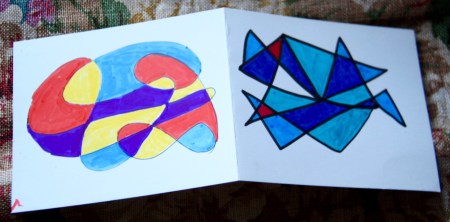
As any who have seen my drawings know, I cannot draw. However, I can take a line for a walk. And that’s what I do. Then I color the spaces I create. My friends thought I was wasting my time and I believed them until I read one of Matisse’s sayings: “My ambition: to liberate color, to make it serve both as form and content.” Voilà: I have my raison d’être. Nature abhors a vacuum. When you create a space, color and meaning rush in.

(3) I take photos

The capturing of a moment: a sunset, a new bird at the feeder, deer wandering through the garden, a black bear visiting, rain on a spider web, sunlight through a prism, a cat made out of cherry stones … the re-creation of the moment is the creation of the memory. More bubbles flow on the surface of the stream.

(4) I go for a walk, look at nature and the world around me, people too

It is incredibly important to do this. A visit to the local coffee shop, a walk around the super-market or corner store, a seat in the park on a sunny day … just be, watch, relax, look and listen, empty yourself, let the world flow back in … look at the ducks on the lake or the goldfish in the tank … more bubbles on the water, more ideas floating down the stream …

(5) I listen to music

De gustibus non disputandum … we can’t argue about taste. Where music goes, to each his or her own … the music I like fills my mind, relaxes me, flows out when it ends, takes my mind for a walk and leaves … a vacuum … into which dreams and colors, words and ideas, build like clouds …

(6) I cook

Cooking has always relaxed me. Sometimes the repeating of an old recipe helps clear my mind. Sometimes I have a need to invent something new. Hands and mind occupied, the secret, sacred underground river of creativity flows on …

(7) I sew

Last summer, an unexpected event led me to join a quilting group … oh what fun … a man quilting among a dozen women … I learned so many things … so many different ways of looking at the world … so many concepts that I would never have dreamed of on my own … Sewing runs in the family: I still have my grandfather’s sewing kit … darning and sewing needles that served him for two years before the mast … that darned his socks as he survived in the trenches of the First World War … it bears his name and I use it with pride … and what memories arise in my mind as I choose the needle … his needle … the one that will lead me into the next adventure, be it quilt, button or patch …

(8) I keep a journal

… and come hell or high water, I write in it every day and have done so since 1985. That’s 31 years during which I have scarcely missed a day. The writing maybe banal, it may be nothing but a note on the weather or a comment on a sporting event … but it’s there … a vital challenge to the idea that Writer’s Block can take me over and can win. This journal is 95% drivel … maybe more … but bobbing along the stream of words are ideas, verses, rhyme schemes, choruses, stories, flashes of inspiration, jokes, memories, magic moments, falling stars, … the secret is to catch these falling stars, to recognize these rough diamonds and to return to them and polish when the moment is ripe … and it will be, sooner or later … for bubbles are buoyant and will lift you to the stars.

(9) I believe

Through all this runs a thread of belief … belief that the black cloud of despair will not win. The Writer’s Block will go. Creativity will never be not lost. It is there, beneath the surface, always ready to be contacted, waiting to rise and take you over again. And all too soon and quite unexpectedly, one form of creativity slips into another and the creative writing (it never really went away because of the journal) comes back.

Writer’s Block: it does exist. It’s how we deal with it that’s important. Creativity rules: forget Writer’s Block and let creativity and the multiple ways back to creativity grow and flow. Sooner or later the clouds will lift, the sun will return, the block will unblock and the words will flow again.

Remember the words on the Roman sundial: Horas non numero nisi serenas … I count only the happy hours. And remember: the clouds will lift, the sun will return.

Trust me.

And believe.