Wednesday Workshop: Vis Brevis


IMG_0068 (2)

Wednesday Workshop
18 April 2018
Vis Brevis

Rain. Persistent rain. Cornish mizzle that chills and wets. Basque chirrimirri penetrating flesh and bone. Low cloud blankets buildings, wraps itself round the windshield. Clings with the tenacity of Saran wrap. Visibility variable, now clear, now a muffler round the car’s headlights. Darkness gathered, still gathering. Lights moving, cars moving, the road moving, blending first with the lights then with the shadows, shape-shifting.

Down the hill now, out of the city lights, into the countryside. The road changing, patches and potholes, lights flickering in and out, darkness and light. Small animals of light, the potholes, shimmering, bumping by. Another pothole, moving, turning from side to side, a pothole with a ringed tail and two tiny eyes. A baby pothole, misses the front wheels, not the back. One dull, dry thump.

What were you doing there, in the middle of the road? Why alone? Why no mother, no brothers? Why so small? I didn’t mean to … I didn’t want to … Why me? Why now? If only …

Light breaks through the darkness clouding my mind. Memories: the driver on the road to Kincardine, chasing a jackrabbit, trapped in the headlights, a Belgian Hare, dodging down the middle of the country road. Laughing, the driver, with the joy of his hunt. Then: one dry thump. The car stopped, the hare, still twitching, held by its long ears, shown as a trophy at the car window, then thrown in the trunk. Memories: two lads in a half-ton, on a back road by Grand Lake. A sunny Sunday. Spotting the ground hog at the roadside. Driving at it with the truck. Swerving to hit it. The joy and laughter in their faces, looking back. One dry thump. The ground hog, front half viable, spine fractured, back legs paralyzed, dragging itself with its forearms to the roadside, dropping into the ditch.

Legend tells of the man who met Death in Cairo. Death looked surprised to see him. “What are you doing here?” he asked. Fear filled the man. He ran, packed his bags, left Cairo with its vision of Death. Travelled to Bagdad. Met there with Death, who welcomed him. “Why were you surprised to see me in Cairo?” the man asked. “Because we had a meeting here in Bagdad, tonight,” Death replied. “And I didn’t know if you’d show up.”

“Every morning, at day break,
oh Lord, this little prayer I make,
that thou wilt keep thy watchful eye,
on all poor creatures born to die.”

Dylan Thomas wrote those words in his poetry play for radio, Under Milkwood. All poor creatures born to die. That’s us. That’s you and me. We don’t know how, or why, or where, or when. And it doesn’t matter. That’s the whole point: it doesn’t matter. Our death is born with us, walks with us, lives inside us, and one day will take us, each of us, we poor creatures born to die. What matters is that we live while we can, rejoice while we can, thrive while we can, think while we can, write while we can …

Enlightenment came last night, at the darkest, wettest of times. It followed me home and crept with me into my bed. I thought of all the creatures found each spring morning, their lives cut short at night along the sides of our New Brunswick roads: deer, porcupine, squirrels, groundhogs, foxes, domestic and feral cats, dogs, skunks, and yes, one, very special, baby raccoon, a tiny raccoon, so small as to be almost invisible in chirimirri, mizzle, and mist.

His spirit came to me in the under-blanket dark, wrapped itself warm around me, and brought me comfort. “You too,” he whispered. “You too. But not just yet. My work is done. I can go now. But you still have lots of work to do. Remember: Vis brevis, ars longa,”  his raccoon spirit nuzzled me and I reached out and patted him. Then both of us settled down to dream our different dreams of a life and death that is surely nothing but a game of touch and go.


Wednesday Workshop: Attending a Reading

weir 2

Wednesday Workhop
Wednesday, 04 April 2018
Attending a Reading

            Number one piece of advice: don’t arrive late. I thought last night’s reading at the Oromocto Public Library began at 7:00 pm. I used Google maps to locate the library and I left plenty of time to get to there early. The Oromocto Public Library is just off the main road, tucked sideways on, so you are driving past it before you see it. I didn’t see it.

            I drove to the first roundabout, went straight through that, looked again: no library where the library ought to be. So I drove to the second roundabout. Still no library, and now I was running out of road space and the highway beckoned. So, I went right around the second roundabout, scanning both sides of  the road for the library as I drove. Still no library. I returned to the first roundabout, went right around it, drove back to the second roundabout … I was becoming fixated on driving in circles … then back to the first again.

            Just past the first roundabout, I spotted a gas station. I pulled over to ask the way to the library and there it was, just in front of me, right beside the gas station, facing the new Japanese restaurant, and sideways on to the road. There was one parking spot left and I took it.

            When I got inside, the library was very silent. I asked directions to the reading room and was directed to the back of the building. The reader stood before the audience, with the podium at his back, and was already talking. It was 6:50 pm. “Wow,” I thought. “He must have started early.”

            I have known Chuck Bowie, the invited reader, for several years and we share the same writer’s group, a group which he organized. He invited me to join it and we meet regularly (there are seven of us), once a week, on Tuesdays. Regularly: this is Canada … regularly, when it isn’t snowing, when there’s no icy rain, when the temperature is above -30C, when the wind doesn’t threaten to blow the car off the road … regularly, you know what I mean. There are usually three or four of us at each meeting.

            “There’s Roger,” Chuck announced my presence as soon as he saw me.  The audience turned round and several people whom I knew gave me a smile and a wave. There were no vacant chairs. A lady at the back gave me hers and went to fetch another one for herself. I found out later that she was the organizer and I thanked her profusely for her generosity.

            Chuck, as I found out later, had started at 6:30 and was well into his stride. He mixed anecdotes from his stories with advice about writing. As I was settling, he was explaining how much research he had done into wine and wine growing for the winery scenes in his four Donovan novels (the series is called Donovan: Thief for Hire). I love wine and I have visited several excellent vineyards in Rueda and La Seca (Spain). Chuck’s deep knowledge of the vines impressed me. “Roots,” he told us, “sometimes going down twenty-one to twenty-four feet.”

            I thought of the Spanish wines with their denominations of Old Vines, Reserva, Gran Reserva as Chuck dragged me from the outside world to the inside world of the winery laboratory where the crime had taken place. Then he read an excerpt from his novel, four or five pages that illustrated the use to which he had put his knowledge of the vines (Book Four of the series, Body on the Underwater Road).

            Chuck then talked about writing from memory (Rumania) and emphasized that memory alone was not enough. Memory gives atmosphere but accurate details come from many places, including the ubiquitous, omnipresent, and virtually omniscient Google search. Thus, as he explained, cum grano salis, the churches in Rumania are circular, constructed that way “so the devil may not corner you.”

            From memory and Rumania, he moved to Manchester Gangs in the 1980’s (Book Three: Steal It All), a simple anecdote about how the neighborhood protection racket protected the local families who in turn protected the criminals, while all crime was committed outside the area. Chuck’s ability to turn a table-top conversation into the idea for a story, or in this case, a full novel, is exemplary. How many creative seeds are scattered on stony ground, never to come to full fruition?

            Violence can play a meaningful role in the crime thriller but it has to be meaningful, and it must be accurate. Chuck spent some time explaining how he had researched guns and armaments so that the right weapons would always be carried by the right people and used in correct fashion at the right time. He talked a little about entry and exit wounds and I had visions of Rumpole, in the Penge Bungalow Murders, stabbing a ketchup filled sponge in the kitchen of his suburban home on The Gloucester Road, to see how the stains spattered, much to the disgust of She-who-must-be-obeyed.

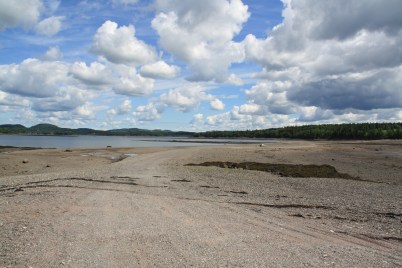
            Chuck’s next book, the fourth in the Donovan series, Donovan: Thief for Hire, is called Body on the Underwater Road. Much of this story takes place in St. Andrews, New Brunswick, and Chuck explained how he had scouted out the local area and, in particular, the ‘underwater road’ from the mainland to Minister’s Island. The Fundy Tides, the highest in the world, cause the roadway to disappear at high tide, thus making the island inaccessible for long stretches of time. It also makes the underwater road a natural fishing weir for dead bodies. This research work involved live interviews with the local RCMP and others on the movement of bodies in the Fundy Tides, where would they end up if they were inserted into the water at place A, B, or C. That sort of thing.

            Chuck ended with a request for questions and the audience announced their own engagement by asking questions on how to develop characters, how to name characters, how to thread narrative arcs, and on how much rewriting is necessary if an arc goes wrong. The answer: “Lots. Sometimes you need to abandon the arc completely; other times, you must rewrite it from top to tail. But cave scriptor / writer beware: if you make a change on page 272, make sure that it checks out all he way backwards, page by page, back to the book’s beginning on page 1.”

            The use of humor within a thriller series serves to illustrate the layers of complexity that the characters manifest. The insertion of this element serves notice that genre writers who are serious about their craft write with the intention of elevating words, their sense, and their impact on the discerning reader. It also serves to layer the novel with additional meaning. Such layers of complexity spark joy in the writer.

            An interesting evening, then. With some old friendships renewed and some words of wisdom cast before an appreciative audience by the Atlantic Provinces Director of The Writers’ Union of Canada and local Fredericton author, Chuck Bowie.  I attach his web page. Do some research: check it out.  http://www.chuckbowie.ca

Painting credit: Roger Moore. Fundy Weir Poles (acrylic), St. Andrews, NB.

Wednesday Workshop: Why I Write II

IMG_0055

Wednesday Workshop
Why I Write II
28 March 2018

Joan Didion’s autobiographical note did not appeal to me in the same way that George Orwell’s did, but then, I was born on the same side of the Atlantic as Orwell, and yes, that does make a difference. So much in Orwell is familiar, so much in Didion is alien.

For Didion, Why I Write (borrowed from George Orwell) is composed of three short words, each of them emphasizing the first person singular I + I + I. She sees writing as an ‘aggressive, even a hostile act’ in which she, as writer, imposes herself on other people (her readers) saying ‘listen to me, see it my way, change your mind’. From this idea of imposition springs the second idea of the ‘aggressive, hostile act’. This, in some ways, can be seen as a sort of combination of Orwell’s first, third, and fourth points (1) sheer egoism; (3) historical impulse; and (4) political purpose with possibly the first dominating.

That said, I like the idea Didion presents of ‘pictures in the mind’. She carries these pictures with her and then writes from them. She writes from the physical, the tangible, the ‘taste of rancid butter’, the ‘tinted windows on the bus’, the concrete nature of these things and her desire to describe them as accurately as possible, led her to discover herself as a writer.

When I apply her descriptions to my own writing, I gaze at my own memories of my childhood. They are like photographs, still, black-and-white photographs, like those we used to see when I was a child at the entrance to movie theaters. The skill for me in writing is to allow these pictures to spring back into life. Much of my writing, especially my stories about Spain, Mexico, or Wales, is autobiographical in its beginnings. However, as the pictures move and speak they tell me things and I write them down. What starts out as a story is very rarely the story that ends up on the page. A metamorphosis takes place. Words slip and shift and change their shapes and meanings according to the whims of characters and the situations in which they find themselves. In the beginning was the picture: that, I guess, is what Didion and I hold in common. But my writing is not her writing, and her pictures are not my photos, how could they be?

Interesting in my own original photos is the lack of sound, the lack of movement, the lack of taste and touch. First the figures are stiff and stolid. When I study them, they shift and move, and next they begin to speak. Alas, what they tell me when they speak to me in the shiftless shadows of my dreams at night is not necessarily what they lazily lisp in the full sun of my waking mind. A long time ago, I struggled to recall the exactness of that dream world and I tried to pummel the words and thoughts on my mind’s anvil and to hammer them into shape aided by the heat of my seemingly inexhaustible creative energy. Now I am more relaxed: I just listen to the daylight voices and allow them to shape themselves and their situations in their own way.

When I do this, background sounds and the tell-tale smells of time and place slip slowly in. Boarding school: the unforgettable stench of burned porridge. My auntie’s house: the whir of the cuckoo clock as it coiled itself up in preparation for the little bird to whip out and enchant the hours. My grandfather’s grandfather clock: the metallic lightness of the clock hands as I adjusted the minutes and the hours when the clock ran down and I sensed the tautness in the piano wires as I turned the key and wound the heavy brass pendulums back into their starting positions. My grandmother’s house: the bubble of water boiling on the hob, the warmth of constantly brewed tea, strong as a farrier’s horse and quite undrinkable without the second, third, or fourth watering and, of course, always the smell of boiled white fish cooling for the cats’ supper.

My best writing comes from deep inside myself. I find it  in the midnight coal mine of my mind where ghost-like figures drift and roam as they seek that special person, the one who will drag them to the surface and bring them back to life. Poor, pale, thin imitations of a reality that never was, I do my best to revive them. Often, my best is just not good enough and I must cast them away and drop them back into the depths to ghost away and prepare themselves for another day when perhaps, they and I will each be ready to deceive each other.

Apologia

weir 2

Apologia pro vita mea
(for Ana)

          Late last night, I opened Alistair Macleod’s book The Lost Salt Gift of Blood and I re-read the first story. I was soon dabbing my eyes with a tissue and blowing my nose.

This morning, I want to destroy everything I have written. I know I don’t possess the verbal and emotional genius of the great writers and I sense that I cannot write like them. Graduate school taught me to be passive, not active, and to write impersonally, choking every emotion when I write. Academia also taught me how to kiss and how to run away with my thirty silver pence. “Never challenge the status quo,” my professors told me. “Learn the rules and disobey them at your peril.”

But here, in this private space where I create and re-create, there are no rules. The enemy is not clear any more and the fight is not one of black against white. It is rather a choice between diminishing shades of grey, and all cats are grey in the gathering dark that storms against my closing mind. Should I destroy all my writing? I won’t be the first to do so; nor would I be the last. And I won’t be the first or the last to destroy myself either. Intellectual, academic, and creative suicide: as total as the suicide of the flesh.

I carry on my back the names of those who have gone on before me as if they were a pile of heavy stones packed into a rucksack that I carry up a steep hill, day after day, only to find myself, next morning, starting at the bottom once again. But this is not the point: the point is that if I cannot write like the great writers, how can I write?

I think of Mikhail Bakhtin and his cronotopos, man’s dialog with his time and his place. I have no roots, no memories, and that is where my stories must start: in the loss of self, the loss of place, the loss of everything. I was uprooted at an early age, soon lost my foundations, and only survival mattered.

I look at the first page of one of my manuscripts. My writing manifesto is clear before me: “And this is how I remember my childhood,” I read. “Flashes of fragmented memory frozen like those black and white publicity photos I saw as a child in the local cinema. If I hold the scene long enough in my mind, it flourishes and the figures speak and come back to life.”

I am aware of the words of T. S. Eliot that “every attempt / is a wholly new start, and a different kind of failure / because one has only learnt to get the better of words / for the thing one no longer has to say, or the way in which / one is no longer disposed to say it” (East Coker).

Are these stories an exercise in creativity or are they a remembrance of things past? How accurate is memory? Do we recall things just as they happened? Or do we weave new fancies? In other words, are my inner photographs real photographs or have they already been tinted and tainted by the heavy hand of creativity and falseness?

The truth is that I can no longer tell fact from fiction. Perhaps it was all a dream, a nightmare, rather, something that I just imagined. And perhaps every word of it is true.

I no longer know.

Wednesday Workshop: Editing Plus

IMG_0068 (2)

Editing Plus
Wednesday Workshop
14 March 2018

We all need a second pair of eyes whether we are editing our own work or when we edit the work of others. Clearly,  there are several levels (layers is also a good word) at which editing can place.

1. Self-editing: I think we are better off creating the work first and editing it afterwards. However, whether we like it or not, self-editing, and even self-censorship, often takes place during the act of creation as we shuffle sentences, change words, and search for appropriate metaphors. Finish the first draft. When the piece has been drafted, we can look at editing it. I very much like the idea of going to an unfamiliar place so that we re-read in an unfamiliar setting. If familiarity breeds contempt, then unfamiliarity can often breed better editing. That is why I like to leave pieces fallow for a while, before returning to them.

2. Self-editing: One of the best forms of self-editing for me is publishing work on my blog or reading it at an open mic session. When I publish on my blog, I think of the offering, be it prose, poetry, memoir, or criticism, in terms of the ‘other’, those other eyes that will read it. When I read at an open mic session, I think of the people who will hear my spoken word. In both cases, I usually make changes in response to the audience and the perceived audience. Sometimes I make these changes as I read … realizing as I speak my offering that certain phrases are better said in a different fashion or left out altogether. Open Mic readings: I always read my offering aloud and time it before I read in public. Viva Voce is the best way, in my opinion, to catch errors in rhythm and to improve word usage.

3. BETA Readers: Many of my friends use BETA readers, trusted friends who read and criticize their work in early format. I like this idea, but I trust very few readers. Those I do trust are often too busy with their own writing to have time for consistent BETA reading.  Trust is a key issue here. If you have a good, tried and trusted BETA reader, shower them with gifts, buy them presents, keep them by your side.

4. Copy Editing: This comes at several levels that vary from the friend who corrects the occasional error, to the copy editor who fine combs your work and corrects grammar, accuracy, and punctuation. Good copy editors rarely work for free. However, it is well worth while to prepare a manuscript with great care, and some cost, before sending it away, especially to a professional publishing house. Again, trust is an important issue here.

5. Structural Editing: The editor who can deal competently with structural issues is both rare and priceless. We often see and hear how brutal editing can be, both on the writer and the text. While structural editing  can be destructive, both to the text and the writer, if well done, it can be very constructive. I think of Ezra Pound’s notes and changes to Eliot’s Waste Land as an example of exemplary editing. There are many others.

6. Editing and Publishing: I know of authors whose first books were edited heavily by the presses that published them. I also know that in some cases they never published again and in other cases they were frozen into a ‘what will the editor say mode’ that disabled their creativity enormously. Editing can be destructive as well as constructive. Alas, if we want that elusive publication, sometimes our professional editors give us very little choice. Publish or Perish + Change OR Else = an uncomfortable situation in the course of which the original wok can change shape in ways the author cannot control. This is doubly true if the writer belongs to the Truth is Beauty and Beauty is Truth school. And remember, beauty lies in the eyes of the beholder who just happens to be editing and then offering to publish your work.

This is an interesting topic and there is so much more to say. I hope I haven’t wasted too much of your time with this.
Roger,
waiting for the snow to arrive,
in Island View.

My Body

IMG_5811_2

My body

My body has so many rooms and you,
my love, possess me in them, wander
through them, and I see you, here, there,
everywhere, your presence a shadow
glimpsed in a mirror, or your warm touch
a breath upon forehead or cheek. Where
have you gone? Why did you leave me
here on my own to languish in your absence?
I walk from room to room, but when I knock
you open no doors, and though I seek,
I fail to find. I know you are somewhere near.
I hear your footstep on the stair, your voice
in the silence that surrounds me. My name,
a syllable or two, whispered in the way
I so clearly remember. How can it be true,
my love, that you have gone, that you have
left me here and forged ahead into another
time and space? I count the hours and days.
Will you prepare me a place? Will your face
be there to greet me? Alone, I clutch at straws,
embracing dust motes, counting the angels that
dance on the rainbows on the head of a pin.

Plagiary: Wednesday Workshop

img_0177

Plagiary
Wednesday Workshop
9 August 2017

No, plagiary has nothing to do with the plague, though it might do in certain circumstances, especially if a plagiarist is plagued by lawsuits from others who think that the thief has benefitted financially or unfairly from the theft.

What is plagiary? The Merriam-Webster dictionary suggests the following, and I quote, with references:

Plagiarius, the Latin source of “plagiary,” literally means “kidnapper.” “Plagiarius” has its roots in the noun “plagium,” meaning both “kidnapping” and “the netting of game,” and ultimately in the noun plaga, meaning “net.” The literal sense of “plagiarius” was adopted into English; in the 17th and early 18th century, a kidnapper might be referred to as a “plagiary,” and, in the legalese of the time, kidnapping was “plagium.” But “plagiarius” also had a couple of figurative meanings – “seducer” and “literary thief.” It is the latter that has made the most enduring contribution to the English language. A “plagiary” could also be one who commits literary theft (now usually referred to as a “plagiarist”) or the act or product of such theft (now, more commonly, “plagiarism”).

https://www.merriam-webster.com/dictionary/plagiary

From the above definition, we can conclude that plagiary is theft, the stealing of another person’s work, and, above all, the presenting of that work as if it belonged to the plagiarist. In other words, creators create: they are not meant to steal and misrepresent.

Does plagiary matter? Of course it does. By its very definition, theft, it is one of the Ten Commandments, and therefore something to be avoided: Thou shalt not steal. However, as with all things, the gravity of the crime depends very much upon the circumstances. In academia, where creativity and original thought is the ‘name of the game’, the theft of intellectual property is considered by the gatekeepers of the purity of knowledge to be a very serious offence. That is why so many universities so carefully define plagiary / plagiarism and place such stiff academic penalties on the plagiarists who offend. By extension, certain professions, such as journalism and science (in the broadest sense, the creation, protection, and distribution of knowledge) must hold to very strict rules on the subject of intellectual theft.

The article on plagiarism in Wikipedia [ https://en.wikipedia.org/wiki/Plagiarism ] opens several horizons. It stresses that academia (with its spin off into scientific and industrial research) and journalism (with its theory of scooping) are the two biggest areas in which plagiarism is considered offensive. Plagiarism, the article stresses, more than anything else, is re-quoting other people’s material while claiming it as one’s own and without citing the sources from which it was taken. This quickly leads to the infringement of copyright and this is a much more serious and complicated legal matter, as the article points out.

As for literary and artistic plagiary, this is a very different kettle of fish as artists seem to borrow from each other in the most curious of ways. Molière, for example, proudly announced that, as for his artistic material, “Je le prends où je le trouve.” This roughly translates as “I take it from wherever I find it.” In his day and age, imitation was a favorite rhetorical device, and the imitation of other people’s work was considered more like flattery than theft. Miguel de Cervantes, in the Don Quixote, that most original of novels, took the first sortie of the famous and ingenious knight almost word for word from an earlier entremés (short play to be performed in the interval between the acts of a longer play) entitled El entremés de los romances. This is not so much ‘Homer nods’ as Homer ‘carries a gun and holds up a local bank’. Do we cry plagiary or imitatio when the similarities between the play and the novel’s opening are such that for a long time people attributed the Entremés de los romances to Cervantes and referred to it as his early work?

I follow the Spanish tradition and often use lines and words from other authors in my own work. However, I think that what I borrow is in most cases well enough known for it not to need quote marks, nor to need identifying. Though Lovers Be Lost and Broken Ghosts, two of my book titles, come directly from Dylan Thomas’s poetry. However, I quote the verses in the opening pages of each book and Dylan Thomas’s name is clearly attached to them. If, however, I write “Rage, rage against the dying of the light” … or “Rage, rage … ” against anything, I think personally that the attribution should be clear as should the literary dialog that I am starting within the text. Similarly, if I write that “July is the cruelest month, because we expect the sun and it is always raining”, then surely the reference to T. S. Eliot is clear as well, and so is the attribution and twisting of his ideas. I have used the phrase “Jack Pine Poems” before now, without referencing Milton Acorn, but most Canadian poets will be aware of the origin of the term without my writing “following in the footsteps of Milton Acorn and his Jack Pine Sonnets” ….

To further complicate the matter, plagiarism is a hydra, and its many heads may take a multitude of forms. Wikipedia suggests that there may well be a whole epidemic of what might be called ‘literary borrowings’ that verge on plagiarism; there is, for example, a touch of ‘literary theft’ about all of these: “plagiarism, literary theft, appropriation, incorporation, retelling, rewriting, recapitulation, revision, reprise, thematic variation, ironic retake, parody, imitation, stylistic theft, pastiches, collages, and deliberate assemblages.”

However, as the Wiki points out: “There is no rigorous and precise distinction between practices like imitation, stylistic plagiarism, copy, replica, and forgery. These appropriation procedures are the main axis of a literate culture, in which the tradition of the canonic past is being constantly rewritten.” The quote marks show that this list is lifted bodily from the Wikipedia article.

What I would underline most strongly is that “the canonic past is being constantly rewritten.” Literature is, to a large extent, a writer’s dialogue not only with (in my case) his own times, but also with the way other writers have seen the world and written about it. And not just written about it: think of the geometric expansion of oral literature. We hear so much, so much is repeated, words and phrases slip in and out of common usage. There is usually a prime over, an original author, but when a word r a phrase slips into what might be called ‘common usage’, then plagiarism takes a turn in a different direction.

“To borrow from one author is plagiary, to borrow from many is research,” as Oscar Wilde is rumored to have phrased it. As a result, what is considered to be a can of worms in academia, science, and journalism, may turn into an interesting and not necessarily a dishonest practice in the artistic world. How about the erotic cowboy novel that I am thinking of writing? I am going to call it Fifty Shades of Zane Grey … how many copyright laws am I breaking with that little joke? None, in my opinion, yet given a competent lawyer and two or more clients greedy for money, and virtually anything can be turned into a fertile battleground for legalistic dispute. Hopefully, the pitiful pennies that I own and the innocent and innocuous literary discourse that I exchange with other authors, many of them long dead, will not bring on a flurry of lawsuits.

“Where there’s muck, there’s money,” as a famous Yorkshire millionaire once said. So quit mucking about with even the possibility of plagiary, check your sources, and, if in any doubt at all, make sure that you add those quote marks and those references. And remember, it’s better to be safe than holding up your hand in court and saying “I’m very, very sorry, M’Lud.”

Battle Axe

IMG_0155 2

Battle Axe

A battle axe, the children call her,
grim-faced, ageing, wrinkles
bone-deep scarring her skin,
a grimaced frown, much practiced,
worn like a fencing mask to keep
the world’s sharp teeth at a distance.

Over her shoulder, the mail-pouch
slung like a Viking’s shield,
swung to keep stray dogs at bay.
At her hip, mace and pepper,
twin guns in separate holsters, ready
for Rotty,  cross-breed, and Pit Bull.

Wrapped in her coat of mail,
her eyes aflame, trigger finger twitching,
ever on the lookout for that one wild dog
to run the gauntlet of her gaze
and launch its all-out, mad dog attack.

Comment: I was disappointed with my earlier version(s) of this poem, entitled Mail Lady, and wanted a stronger, more forceful set of images that hinted at the perils of dog attacks on mail (and fe-mail [sic]) workers. This is the result.

Mont Blanc

IMG_0026 (3)

Mont Blanc
(for Chuck Bowie)

“But what is that stick-like thing
between notebooks and mouse?”

“That stick-thing by my mouse,
as you so elegantly phrase it,
is my Mont Blanc fountain pen.

It’s also a metaphor app.
You stick the blunt end in your ear
to wind up your brain,
then you carefully clean
the tip on a piece of paper.

If it leaves suitable marks,
you read them like Runes
and use them to create metaphors.

You can also use it to conduct music
or to take a thin, blue line for a walk.
It’s very useful for poets who don’t like
staring at computer screens, and with one
they rarely suffer from writer’s block.”

Words

IMG_0127

Words

Waxing gibbous:
gibberish to most, or jabberwocky.
How now the moonraker
dragging the village pond for gold,
or the witch on her ducking-stool
accepted by God if she drowns,
but burned alive if she survives
and the Omnipotent rejects her?

Words rise and fall like trout to flies.
In words, out words, taboo words,
code words, the ebb and flow words
that see conversational tides
rising and falling, waning gibbous
beneath a failing lexicon, sacrificed
at the altar of barbaric speech to appease
the new gods and falsify the old:
nuance, shades of meaning, language,
meta-language, para-language,
raised, a supercilious eyebrow,
that lip curled in the snort of a sneer.