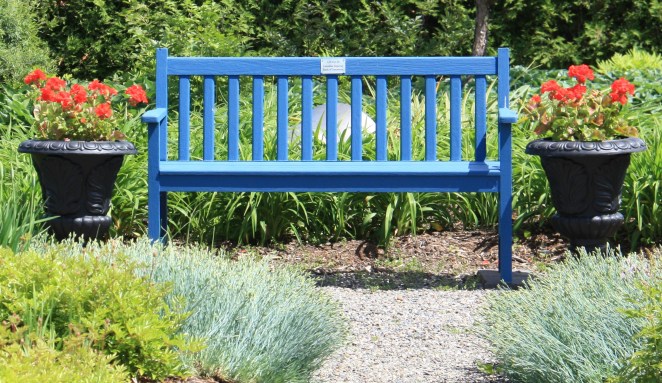
Feathered Kangaroo

IMG_0125.JPG

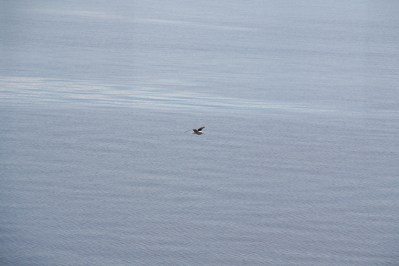
This is a photo of a Feathered Kangaroo
water hopping on PEI, Canada.

Feathered Kangaroo!

A long time ago, still wrapped in the stifling chrysalis of academia, a friend of mine tried to flutter her immanent butterfly wings by making a joke at a very serious conference. She was delivering a paper on one of my favorite Spanish poets, in which she examined the sundry variants of a sonnet that the poet first wrote in 1603, then re-wrote in 1613, revised again in 1627-28, and revised a couple more times before its final revision in 1643, about two years before his death (1645).

At the end of her paper, she was caught off-balance when faced by an apparently serious question from the audience “Did the poet make any more revisions after 1645?” In an effort at humor, she replied, “Well, actually, no. But when they were carrying his body to the church for the funeral, he popped his head out of the coffin and proclaimed in a loud voice ‘Hell, no, I won’t go. I haven’t finished revising the poem yet.’”

This off-hand academic pseudo-joke was greeted with a babble of excited voices and an elderly fellow scholar clapped his hands, exclaimed “Wonderful!” and, in the ensuing silence, asked her what documentary evidence she had for this astonishing revelation, hitherto unknown to the academic world. If she was off-balance before, she was clearly reeling at this stage: a punch-drunk amateur academic swaying before the hypnotic fists of Dr. Muhamad Ali. She smiled sweetly, said she would produce the proper evidence at the appropriate time, and left the podium.

Later, sharing drinky-poos with some fellow scholars, I listened to her as she made excuses for her strange sense of humor and I smiled as explained the situation to them. They were not amused. “You, madam, are an acknowledged expert in your field,” one of them told her. “Your fellow academics trust you and believe you when you make such statements. You must be very careful about what you say.”

Feahered Kangaroo, indeed, water-hopping on PEI!

Now I must make an apology on my own behalf. Alas, if you read the blog item I posted recently, you might be puzzled by the Gazunda tree. I am forced to admit there is no such thing, to the best of my knowledge, as a Gazunda tree, not in the main square in Oaxaca, nor anywhere else in the world. Of course, when it rains people have been known to go under certain trees to use them as an umbrella and thus to take shelter from the rain, but this is the full extent of the origin of the name: the tourist or the golfer or the walker or whatever goes under (say it fast — Gazunda) the tree when it rains. There is nothing more to the Gazunda tree than that little joke.

And this brings us to a really serious series of questions: how do we know things are true? How do we establish the truth of a statement? Why do we believe some people and not others, some facts and not others? How do we choose between a series of alternate truths all of them presented as factual realities when, in actual fact, not all of them are true? This leads us on to the basic foundations on which our knowledge is built: how do we distinguish between scientifically established facts, and hearsay, and gossip if we are ignorant of basic scientific knowledge and principles?

To this we must add the triple increases that threaten us. These are (1) the increase in the availability of real scientific knowledge that bombards us every day with fresh facts and new information; (2) the increase in sources of information and the easy access to those sources; (3) the fact that many of these sources, far too many in my opinion, present us with a fictional or heavily biased version of a pseudo- or alternate truth. And yes, in light of telling the truth, the whole truth, and nothing but the truth, we are indeed entitled to question the existence and indeed the very meaning of these words: alternate truths.

These considerations seem modern and up to date, but of course they are not. They can be found in Miguel de Cervantes’s novel, Don Quixote (Part One, 1605, and Part Two 1615). They are present throughout the meta-theater created by playwrights like Pedro Calderón de la Barca (1600-1681), who set similar dilemmas of truth and fiction in, for example, his play La Vida es Sueño (Life is a Dream) as well as in the twelve plays he wrote based on Cervantes’s masterpiece. They are also present in the writings of some of the philosophers of the day. This is exemplified in the following passage that comes, I think, from René Descartes:

“There is no earth, no heaven, no extended body, no magnitude, no place and that nonetheless I perceive these things and they seem good to me. And this is the most harrowing possibility of all, that our world is commanded by a deity who deceives humanity and we cannot avoid being misled for there may be systematic deception and then all is lost. And even the most reliable information is dubious, for we may be faced with an evil genius who is deceiving us and then there can be no reassurance in the foundations of our knowledge.”

“There can be no reassurance in the foundations of our knowledge.” These are chilling words and present us with the unfortunate fact that unless we ourselves, each one of us, to the best of our abilities search out the absolute truth about all we hear, say, and do, we are indeed lost and we must wander in the dark with no light to guide us. ‘A sad life this, when beneath the axe, we have no time to check our facts.’ So: hie thee to Wikipedia, or Google the infamous Feathered Kangaroo. Or you can take my photo and the words accompanying it for the truth, the whole truth, and nothing but the truth. The choice, my friends, is yours.
Twits or Tweets

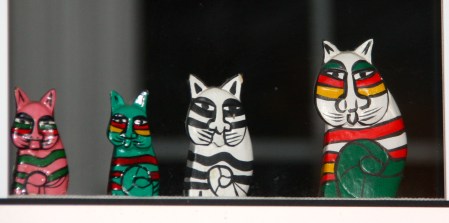
IMG_0010

Twits or Tweets
(A Roger’s Rant)

Poor poets of today
sweet birds reduced
one hundred and forty letters
the song you tweet

oh twitter away your tune
your readers will not swoon
over anything longer
than the shortest rune

and if go on you must
the tv commercial calls
thirty seconds to adjust
words for everyone’s lust

sound bytes bark louder
than sonnets now beware
the dog byte of radio
and tv making a mockery
of all you once held good

no film rights for a sonnet
no actors no models
on the cat walk no talk
of moneyed contracts
honeyed words that brook

no contacts with either
upper or lower class
none of whom today
would stoop to make a pass
at passing poets
or offer to kiss their arse

Identity: Wednesday Workshop

IMG_0067


Identity
Wednesday Workshop

5 July 2017

Today’s workshop settles on the question of identity, loss of identity, and the attempt to recover any form of cultural identity that one feels one has lost. These questions are particularly important in the current age when so many differences are so easily erased. Language, culture, identity, music … they are all tied closely together.

The search for identity runs parallel to the search for the poetic voice (or the writing voice) that is so unique to each good writer. In fact, one can distinguish between good writers and lesser writers merely on the basis of voice. Lesser writers rarely establish a distinct voice while good writers usually have voices that are uniquely their own.

What to do we mean by voice? When we read Shakespeare or Miguel de Cervantes we know almost immediately whose work we are reading. The same is true of the great musicians. Bach, Mozart, Beethoven, Mahler, all have sequences and styles that are individual to them, as do Scarlatti, Brassens, The Beatles, Gordon Lightfoot, Gilles Vigneault, Edith Butler … their style, their voice is established. We listen to them and we know who they are.

Cultural identity is also very important. It is tied into language, childhood beliefs, fairy tales, myths, the basic culture that we receive as children. When we all listen to the same radio stations, or download the same ITunes, or watch the same TV programs with their infinity of ad nauseam advertisements, then we are socially engineered to be the same or, if not the same, remarkably similar within a series of very limited and extremely limiting patterns. When we establish our own identities, — and this is always difficult both for people who have had their culture taken from them and for immigrants, or the children of immigrants, who want to retain their culture at the same time as they blend in and fit in socially — then at the same time we develop our own voices.

When I hear the poetry of Lorca, of Antonio Machado, of Miguel de Unamuno, of Octavio Paz, of Dylan Thomas, of Gerard Manley Hopkins, of Wilfred Owen, I hear their very distinctive voices and recognize their individual styles and the cultural / poetic identities that they have established. The goal that we, as writers, are aiming for is to establish our own style, our own voice. To do this, we must listen to ourselves and discover how we think and how we feel. Then we must listen to others of our own generation. We must make comparisons and establish what we do differently, why we are different, what forms our differences … our own individual voice may come from speech rhythms, from language usage, from the establishment of a certain form of narrative, from the use of imagery or metaphor … there are so many different ways in which we are, each of us, different … or capable of being perceived as different.

When we write often enough and frequently enough, we at last begin to recognize those words, those phrases, those rhythms, those ideas, that are ours and nobody else’s. This is when we start to discover our own voices and our own personalities. It is a goal worth striving for … step by step … poco a poco … little by little … and a step forward everyday … until we grow into the type of writer or poet, fully established (or establishing), that we were always meant to be.

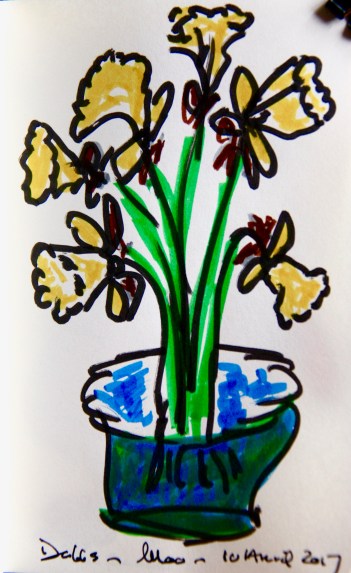
It is never easy to capture oneself and place oneself on the page in readable form. It’s a bit like trying to draw Picasso’s blue vase using only one blue pencil: not easy. It’s much easier to take a selfie with a flashy cell-phone.  Cell-phone selfies are easy, but verbal selfies are what we are seeking for. They take much longer to ‘produce’ and it is only when we finally achieve them, that we realize how difficult they are to actually achieve. But remember, read and re-read my earlier postings: don’t give up; don’t get off the bus!


Residency: Thursday Thoughts

Chaos

Residency
Thursday Thoughts
29 June 2017

Application:
I would not have applied for the residency at KIRA had I not have been encouraged to do so by my writing group friends and by a friendly voice on the Kingsbrae phone.

Acceptance:
I was surprised to receive notification of my acceptance. It arrived on 2 March 2017. On 3 March 2017, I started to peruse the Kingsbrae web page and make the first drafts of poems that I would later complete on site.

The Red Room:
I was lodged in The Red Room in the KIRA Residence and I had a small desk at a window overlooking Passamaquoddy Bay. I spent a whole month looking out of that window and writing at that desk … or was it the other way round?

Community Commitments:
These were multiple, but they were always art orientated and therefore most enjoyable. They included working with school children, attending various unveilings and openings, and being present in our studios and discussing our art with visitors. On 26 June we had an exhibition in which each one of us either showed our work or produced a live performance.

Evening Salons:
Most evenings we had a literary / artistic salon in which we discussed various aspects of our art. These lasted two to three hours and some were summarized while others were video-taped. These quick-fire exchanges provided a backbone to our daily work.

Trips:
There was time for local trips and we travelled, individually or in groups, to many places including Deer Island, Passamaquoddy, Campobello, St. Stephen, New River Beach, Holt’s Point, Greenlaw’s Mountain, Jarea, Minister’s Island, Ile Ste. Croix, and several other locations. The photographic records enabled us to build our creativity.

Artistic Development:
This was individual to each of us, but we all remarked on a widening of our perspectives, a new commitment to narrative and theme, and a broadening of our artistic horizons.

Returning Home:
On my return home, I turned to my everyday life in which art, in my case writing, was of secondary, not primary, importance. The need to cook, to shop, to do normal household duties suddenly conflicted, once again, with my need to be a writer.

24/7:
24/7 is indeed a cliché. But for 28 days it became the pattern of my writing life. It was indeed a fertile time. I wrote some 100 poems, 25% of which will be rejected, with a possible thematic structure and three revisions already completed. Sooner or later, I will produce a book about this experience..

Conclusions:
This type of time commitment turns us from budding /artists into the real thing. We must strive to re-create these last 28 days in what remains of our creative lives. There can be no lesser or secondary choice, if we are to be serious about our art.

The Journey:
If we wish to travel from Halifax to Vancouver by bus, we must make several decisions.
1. We cannot get off at Moncton.
2. We cannot get off at Montreal, nor at Toronto.
3. Winnipeg, Regina, and Calgary are beautiful; but we mustn’t get off the bus.
4. If we do, we will never get to Vancouver.

Conclusion:
Art is a life-time journey: don’t get off the bus.


Standing Stones

IMG0039_1

Kingsbrae 21.4
21 June 2017

Standing Stones

Standing in a stone circle,
surrounded by standing stones,
listening to their voices.

The reverberation of their uprooted rock
remembers its birthplace,
recalls the sculptor’s toil,
the polishing of granite and grain.

I’ll never forget those other stones:
bluestones at Stonehenge,
the Bronze Age tomb in Wick,
the toros de Guisando,
the danzantes at Monte Alban,
Hengistbury’s double-ditch and wall,
stone circles in Singleton
the Gorsedd ring in Caer Dydd.

Nor will I forget the deep-voiced
song of stone, here at the solstice,
standing in the middle
of three powerful granite statues,
their energies released
at this afternoon’s unveiling.

When I closed my eyes
I opened my mind and heart
to the deep earth-soul song
strummed in tune with the sunshine.

I breathed it in, retained it,
then allowed it to shine out
through the lantern of my heart.

Rain

Empress 005 (2)

Kingsbrae 20.4
20 June 2017

Rain

Hand in hand, we walk
beneath black umbrellas.
Grass beneath our feet is wet
and water seeps through
our shoes, soaking our socks.

Cold and numb in spite of the date
(the summer solstice draws near),
my ears strain against the pitter
-patter of falling rain to catch
the nearby robin’s song.

He has mislaid his voice
and I can no longer translate
his liquid notes into soul music
that might lighten mind and day.

Clouds gather and empty themselves
over our umbrella-covered heads.
In spite of damp and dark that rule,
thoughts abound and hop around,
like frogs in a summer pool, while
light bulbs explode in my brain.

Water Tower

IMG_0452

Kingsbrae 19.3
19 June 2017

Water Tower
(for Geoff)

Asked where he got the material
for his plays, Molière said:
“Je le prends où je le trouve,”
“I take it from wherever I find it.”

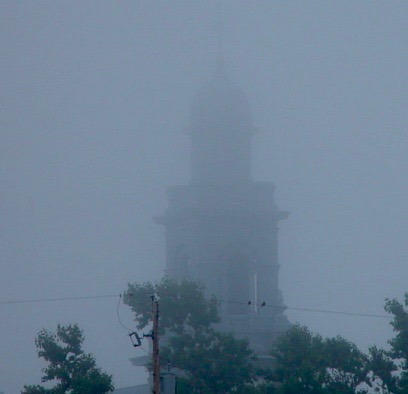
Here, before the water tower,
I find the tower to be a ground
level water tank, no tower at all.

The first steel band, the horizon,
is composed of yellow lilies.
Above them, the Kingsbrae Café shares
the second band with the gardens’ windmill.

Twin pointed roofs and the windmill’s
thin sails reach up to the skyline
with its background of trees
silhouetted against an egg-shell sky.

Art is in the eye of the beholder
or the artist and can be seen
wherever it can be found.


Writer

IMG_0024

 Kingsbrae 17.2
17 June 2017

Writer

Writer, write not your words in the sand.
The seas are rising on an incoming tide.
Strong winds push waves towards the shore
and night descends.

Your words are shadows written on sand.
Like footsteps they will wash away and soon
you, your words, your footprints,
will exist no more.

Writer, cast your words in stone.
Stamp them into monuments.
Sculpt earth’s bones into words
and let them take form.

Climb high into the hills. Heaven will bring
words on the white wings of gulls.
Carve them slowly on stone tablets.
Bring them home from the hills.
The world will rejoice in the magic of your words.

This Old Man

IMG_0067.JPG

Kingsbrae 16.1
16 June 2017

This Old Man

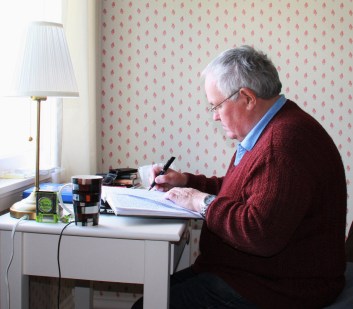
This old man, with his bundle of memories
carried on his back like a snail carries his shell,
a broken record, he played, with the gramophone needle
stuck in a groove and the same tales repeated.

The ancient  mariner who lives in his brain
stops people in the street and retells
the old story: life’s doldrums where
no winds blew and his ship just drifted,
with no wind to bring it home.

Then blew the wind of change, and suddenly
the sun was just as warm as it was in his youth.
The sea became blue again.  Flowers flourished
brighter, stronger. Birds chirped in the trees.
Light grew bright and he felt beauty return to
the new-born world of his second childhood.

Comment: My journal tells me that I wrote the original version of this poem on Friday, 21 April 2017, and posted it to my blog on Sunday, 23 April 2017 . Today’s rewrite changes the structure and tone of the poem and illustrates how time and place can influence any previously generated word sequence. For time and place we can also substitute attitude and change of heart, as Ludwig Wittgenstein suggests. More important, perhaps, our attitude and outlook can change with the weather and the state of our digestion. This is the same poem, then, written by the same person, on two different days. Or was it the same person? My stay at this residency would suggest that perhaps the person has changed along with his attitude, his outlook, his digestion, and the weather.

Creativity: Thursday Thoughts

IMG_0070.JPG

Creativity:
Thursday Thoughts
Kingsbrae 15.1

15 June 2017

The KIRA experience has been very kind to me. It has enabled me to spend time writing and thinking without the necessity of worrying about the daily rituals and necessities of everyday life. In addition, the daily conversations with the other artists in residence have kept my mind focused on the process of creation and this has allowed me to study how I am creating. As many on this blog have noticed, I have been very productive during this residency, and there are several reasons for it. I would like to share some thoughts and ideas with you.

Journal: On 2 March 2017, I received an e-mail telling me that I had been accepted for the arts residency at Kingsbrae. As most of you know, I keep a journal and write in it every day. On 3 March 2017, I started my Kingsbrae poetry sequence. I began by reading the entirety of the Kingsbrae web page and then watched the Kingsbrae Garden videos online. Then I began jotting down in my journal poems and snippets of poems, creative thoughts, metaphors, images,  and ideas. By the time I came to Kingsbrae, I had 90 proto-poems in place. Since they were taken from photos and videos, and were not written in situ, I saw them as prototypes, rather than as the real thing.

The Journal as Poetic Quarry: I look on the journal as a poetic quarry. It contains many stones, some tiny, some larger, some useless, and some very precious indeed. One part of my poetic journey here at Kingsbrae is to go back over these stones, turn them over one by one, discarding the dross, and concentrating on the precious material that has lain there waiting to be re-discovered. Now that I am on site, it is easier to distinguish between those essential words, the ones that really count, and the lesser words, the ones that can be dismissed. This sifting process needs time and thought, and that is exactly what the residency has given me. Writing tip: keep a journal. Mark in red those passages that contain seeds of poetry, images, metaphors, rhythms etc. Return to them when you have the time to do so. Time and space are essential: a time in which to work and a space in which to work. Without these two things , we are lost as writers. ‘I don’t have time,’ you think. Ask yourself: ‘what is more important than a little time each day, spent on yourself and your writing?’ As writers, we MUST indulge ourselves with those two little gifts, time and space. An hour a day is more than enough: find that hour, use it. Ten to fifteen minutes a day is enough to keep us ticking over: if we can’t find that ten minute space, then we are unfortunate indeed.

The Revision Process: As I develop as a writer (and believe me, I am still developing), I realize that the ability to recognize good writing is one of the most important skills that we possess. Re-reading is one thing. Distinguishing the great (oh yes, there are great thoughts and metaphors in those journals), from the good, from the average, from the futile and meaningless is a key skill. All of us have wasted precious time on an idea that just didn’t work. We have worried at it like a dog at an old bone, drooling, gnawing away, growling at ourselves and the bone, getting no nourishment. Leave those ‘dead’ ideas, those ‘dead’ metaphors. Move on to the good ones asap. Our writing time is precious: don’t waste it. Learn to recognize the good and workable from the lesser writings that waste our time.

The Creative Process: “What is this life if, full of care, / we have no time to stand and stare?” This is the first line of one of W. H. Davies’s poems. The Kingsbrae Residency has given me time to stand and stare. It has also given me time to sit and stare. Emptying myself of the daily drudge, I have been able to allow light and inspiration to enter my mind and fill me with creativity. I have discovered that there are ways to do this: meditation, an open mind, an emptiness within that slowly fills, and, above all, carpe diem, the ability to recognize that moment and seize it and exploit it. None of the above is unique to me. If we are at all creative, we are all faced with a simple choice: to develop our creativity or to let it wither. Most of us are too ‘busy’, in the worst sense of the word, to allow ourselves the time we need to create. This is a process we must reverse. We must return to self time, thinking time, emptiness time, metaphoric creative time.

The Value of Art: The modern corporate businessman’s mind is of the type that knows the price of everything and the value of nothing. As a result, we have the tendency, as artists, to fall into the ‘price’ mold rather than the ‘value’ mold. If we do not stop and think, if we do not find the time to create, if we do not search for the absolute values that are represented by our art and our creativity, then we count the pennies, add up the costs, and look at the price. Nobody said art was facile. Nobody said that creating the time and space in which we could create would be easy. This residency has convinced me of one thing: that without that time and space, we are nothing but drones, workers, lifeless puppets, going through the motions as other people pull the strings, lacking the spiritual wherewithal … We must stand up for creativity, for being different, for doing things differently, for being ourselves. We must stop being digitalized consumers and become, or continue to be, active, thinking creators. The world needs creativity and art. It needs people who stop and think. It needs people who think differently. It needs artists and creators. It needs us. What we do as artists and creators is precious and valuable. Never doubt it. Never forget it.