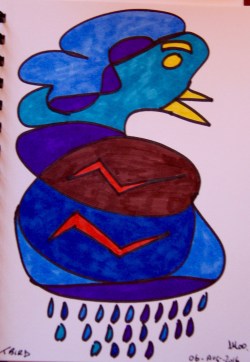
Old Man

img_0221

Old Man

He stops old friends
in the supermarket
and, when he starts to talk,

they stand there,
tapping their feet,
trapped in a doldrum
where no winds fill
their sails to move them on.

He has turned into
a babbling book of hours,
life’s moribund albatross
a warm scarf heavy
on his reluctant throat.

Caught in multiple mirrors
surrounding the barber’s chair,
his tongue is an open razor
constantly stropped.

Cat

img_0141-2

Cat

The other day, upon the stair
I met a cat who wasn’t there.

She wasn’t there again today.
I wish that cat would come and play.

Her body length is long and thin,
and so is her bewhiskered grin.

She never ever stops to play.
she wasn’t there again today.

I’m being very, very good.
I wash her bowl and give her food

and she cleans her bowl of every dish,
eggs and bacon, cheese and fish,

but never ever stops to play.
She wasn’t there again today.

That cat builds castles, tall and neat.
I see the prints of her little feet.

Her kitty litter fills up fast.
I clean it when I’m walking past.

But she never ever stops to play
and wasn’t there again today.

I put nice cat food in her bowl,
but I never saw her, poor lost soul.

I’m sure she’s only teasing me,
never, ever pleasing me,

I want to hug her and to play,
but she wasn’t there again today.

Old Man

15 May 2002 Pre-Rimouski 109

Old Man

An ancient mariner lives in my brain.
Many seas has he sailed, seen many things.
A knapsack of memories, a snail shell
on his back, weighs him down.

His life: a broken record
on an unstable turntable.

He stops people in the street,
tells again the story of his ship,
trapped in the doldrums
where winds no longer blew.

Ghost days weight heavy.
Does he wait for the black patch
carved from the bible
to summon him home?

Photo: The Museum for the shipwreck of the  Empress of Ireland, Pointe-au-Pere, Quebec. The Empress sank off Ste. Luce-sur-mer on 29 May 1914.

Age of Spillage

img_0363

Age of Spillage

Fingers turn to butter, permit cups to slip,
flying saucers to take off, stall, and crash.

Broken bodies rest in peace and pieces
on kitchen floor, waiting to be swept up.

Worse: bottle tops refuse to open.
Plastic wrapping, flagrant in its

defiance, wages its guerrilla war
against ageing, in-articulated

arthritic fingers. So many slips, so
many precious things all liable to

fall and break. So hard to bend and pick them
up, even with my new mechanical claw.

Diagnosis

IMG_0457

Diagnosis
(sonnet)
posted apparently a year ago today

Diagnosed with a terminal illness
called life, I know it will end in death.
For more than seventy years, that end
has lived within me, walked beside me,
sat at my bedside, and shared my sheets.

We have shared so many things: laughter,
joy, victory, defeat, the soul’s dark night,
the winding ways of fortune’s labyrinth.
When cancer called, we faced it together,
and life won out for a little while longer.

Hand in hand, we are together again,
our ménage à trois, engaged in a three
-legged race, blindfolded, unsure of who,
what, why, where, and especially when.

MT 2-2 Monkey Visits the Snake Pit

img_0181

Monkey Visits the Snake Pit

Monkey’s masculine penis envy
focuses on the great snakes,
pythons, boa-constrictors, anacondas,
basking beneath hot-house lights
that maintain a rigid temperature,
desert and jungle warmth and moisture
ready at the flick of a switch.

They lounge in glass cubicles,
checking each other out
for size, weight, length, girth,
with a roll of the eye and a casual flicker
of a forked lightning tongue.

Fed for far too long
on fetched food
from the untroubled tenured trough,
many have become sedentary,
and much too comfortable

to even think about
renewing their lives,
or sloughing their skins.


MT 2-1 Kinder Monkey Garten

img_0181

MT 2-1
Kinder
Monkey Garten

Give him a magnifying glass
and monkey nit-picks!
He likes nit-picking.

Hunting for fleas,
he combs through the fur
of less fortunate monkeys.

Monkey see: monkey do,
and what monkey does best
is crack fleas between his nails
and stick his paw in the jam jar.

Here, in the Kinder Monkey Garten,
young monkeys learn monkey skills:
how to conduct monkey business,
how to throw a monkey wrench
into other monkeys’ plans,
how to wear monkey suits,
how to square round pegs
and fit them into triangular holes,
how to build better monkey traps,
how to reinvent the monkey wheel,
again and again and again.

Monkey likes to perch enthroned
at the top of the monkey temple.
Paradise is to squat
on the organ-grinder’s shoulder,
top banana that.

Monkey also likes to visit the rest of the zoo.


Lullaby

IMG_0124

Lullaby
Wednesday Workshop
11 July 2018

One of my close friends asked me if I would write her a lullaby. Without a moment’s hesitation, I said “Yes, of course”. Like a fool, I rushed in where no angel would ever care or dare to tread. I sat down and straightaway started to write.

The first thing I discovered was that a lullaby has to rhyme. I couldn’t write one unless it went bumpety-bumpety-bump + rhyme. I wrote several of those and they were all awful. Well, I thought so anyway, and I couldn’t imagine any young child willingly go to sleep while having an adult leaning over them and chanting at them.

The next thing I found out: it’s not easy to write poems, even a lullaby, for other people. Why not? It took me some time to understand that while I write poetry from within myself, heart, stomach, and gut, the lullaby I was writing was not written for me, but for a second person who was not me. What would this friend like to read? How would they like it to sound? By extension, there were not two people involved: I was also writing for an unknown child whom I had never seen. I didn’t know their likes and fancies, nor what would fill them with fear, nor what would successfully send them off to sleep. This three-way traffic was unnerving.

Third problem: a lullaby is a cliché and is filled with clichés. Close your eyes. Sleep, baby, sleep. I will rock you. More important, perhaps, the clichés are not just verbal, they live in the rhymes as well: sleep, deep, keep.

My telephone talks with other writers led me to the theory that rhythm was what mattered. Rhythm, comfort, rhyme, gifts, and the allaying of fears. So easy to write, so hard to fulfill, especially in an age of instant communication. As I wrote, so different formulae marched through my head. I recalled the lullabies my parents and grand-parents sang for me, apparently not very successfully, I was a terrible infant at bed-time. I have more memories of being set to bed, often without supper rather than being sang to in bed. Then there was boarding school (age 6) and the faceless matrons in comfortless dormitories where, more often than not we cried ourselves to sleep. Hush little baby don’t you cry.

So, rhythm, rhyme, nonsense words, dream worlds where everything is good. Along with traditional lullabies like All through the night / Ar hyd a nos, my head filled up with reminiscences of Dylan Thomas, and in the evening, when the sun goes down, / I ask a blessing on this town, and Federico García Lorca, La luna vino a la Fragua / The moon came to the forge.

So much happening. So much laundry passing through the washing-machine of my mind where the waters churned away and rhymes were soaped, rhythms were bleached, ideas were blended and rinsed. I wrote five. I am not sure of any of them. They certainly kept me awake most of last night, syllable counting on my white woolly sheep-fingers, that brought no sleep. I tried counting my blessings too, but that didn’t work either.

Question: does anyone actually want to read my lullabies to keep a child awake? If so let me know. You might persuade me to post one or two.


Shadows

img_0182

Shadows

My front door stood open,
but I thought I’d left it
closed.

I tip-toed in and called:
“Is anybody there?”

Echo answered
‘… there, there, there …”
then silence.

I walked
from room to room,
startled by shadows.

I opened doors,
looked under the table,
searched behind chairs.

Nothing. No one.
The house stood
still and empty,

save for the fear,
the silent fear,
that lurked
like a remembered cancer
and occupied each room.

First published on this blog, Shadows, 27 April 2017. Here now with some minor changes and a voice recording.