Commentary:
Another game.
Once more you must click on the link.
For me, this is fun … for you … the visitor …
well, I am not sure how this affects you.
Click on Sandspit and you’ll find out.
And please let me know what you think.
Commentary:
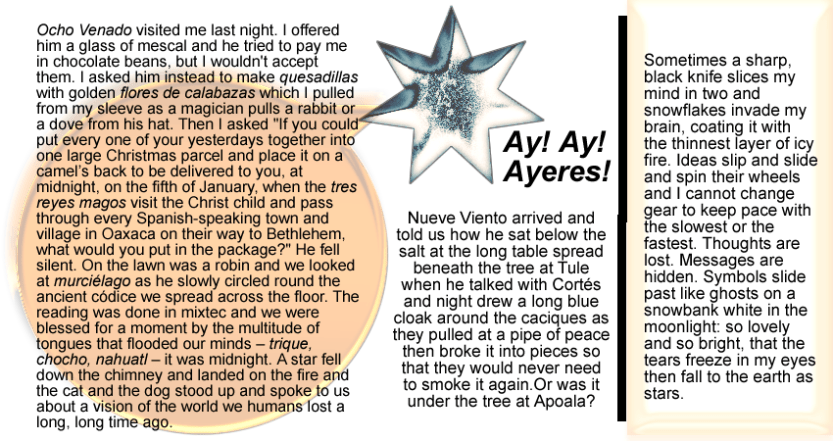
Ocho Venado / Eight Deer is a legendary person who is described in the pre-Columbian Miztec códice known as the Zouche-Nuttall codex. He lived from 1063 to 1115, the date of the codex. The códice describes his life and conquests. I brought a facsimile copy of this códice home in 1995 and my beloved started reading it on Boxing Day. It took her two days to decipher the first page. One day for the second page and, by my birthday, she had read the whole thing. She inspired my love of the codices and they figure largely in my writings from that time, especially The Oaxacan Trilogy (Sun and Moon, Obsidian’s Edge, and Obsidian 22, the first two available on Amazon).
Eight Deer appears frequently in my poetry, partly because we have a family of deer, often as many as eight (!) that walk through our garden in Island View. The joining of the Canadian natural world with the Oaxacan historical and mythical world brings me great joy and it is wonderful to weave stories and poems where the two worlds mingle and become one. Hence the dream world of the prose poem that figures above. Chocolate beans, incidentally, were one of the cash currencies used in Oaxaca at the time of the arrival of Cortés and the Spanish. Oaxacan chocolate (xocotl) is something wonderful.
Commentary
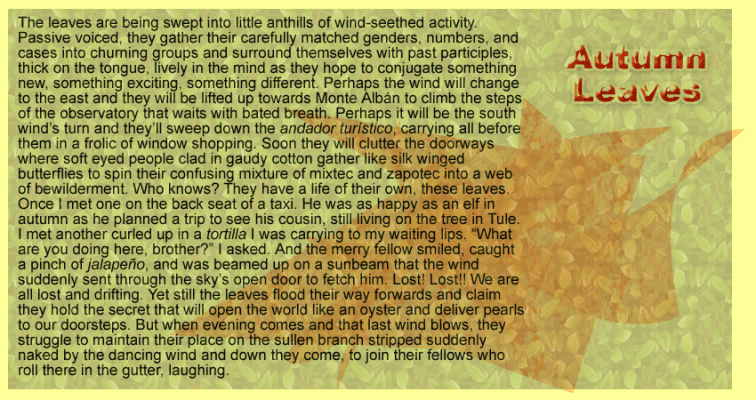
This is another of my beloved’s multi-media mock-ups for one of my Oaxaca Prose Poems. I have enlarged the photo so the text of the prose poem is more easy to read. I have several more of these and will post them one by one. I visited Oaxaca regularly, teaching there in November -December (1995-2001). I came to love the city and I was entranced by its streets and squares. The casco histórico was particularly interesting.
Coffee in the zócalo, a walk through the cathedral, up the andador turístico to Santo Domingo where the old lady sang so beautifully, every day at twelve. Then back via the shops and home for lunch. I was always astonished by the leaves that swirled through the zócalo. They hustled, rustled, and bustled through the arched colonnades on the main square, gathered at the post office, and hurried and scurried away from the trees where they dwelt to drift, who knows where, on the wild winds that blew in from nowhere and then blew out again.
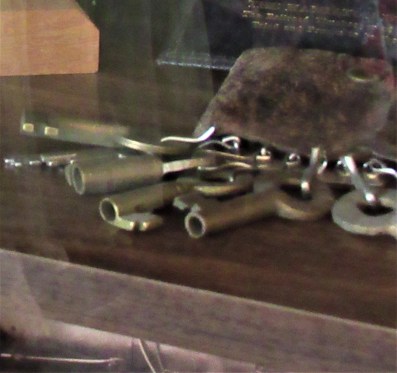
Keys
“Thirty-four doors and a key for each door,
sometimes two, and that’s only for the outside.
No master keys back then. A key for each lock,
if you please, and each door locked every night.
It’s still quite the task, a real responsibility. They
kept a turnkey, in those days, a full-time employee
whose job was to keep the keys and remember
which key fitted each door. Was it a double turn,
a single turn, a dead-bolt? The turnkey knew them
all. He also understood the interior doors and had
to wind the clocks, open and close cabinets, cloak
rooms, kitchens, desks, cupboards, drawers.
Others kept their own keys, and we often dismiss
them as lackeys, especially if they were black,
but they held the key to everything. Locksmiths
too, they could remove locks, take them apart,
cut keys, no job for a flunky. It took a smart man
to be a turnkey. He needed training, patience,
skills, knowledge, strength. Huge railway keys:
he knew how to look after them as well. Have you
seen the size of those old, brass carriage keys?”

The Joy of a New Book
Very little to beat it actually, the joy of receiving and opening a new book, especially when it is one you have written yourself, in cooperation with a group of friends. In this book are the twenty-four (24) poems that I wrote for McAdam Railway Station.
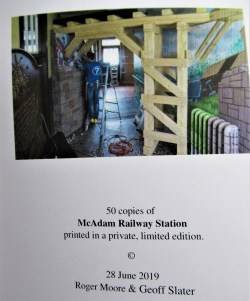
I went to McAdam to watch Geoff working on his mural and installation (diorama). While there, I heard stories about the railway and started to write them down in stanza form. While I did write them, most of them were based on stories and anecdotes heard or overheard while the guides were guiding the tourists round the site. This is indeed a limited edition. We originally intended to print only 50 copies, but when we heard that there might be up to 300 people at the unveiling of Geoff’s mural, in McAdam, at 1:00 pm, Sunday, 30 June, 2019, we doubled the number of books we printed. I will be donating the majority of the 100 to McAdam Railway Station Historical Association. They can either give them away or sell them to help fund and support the impressive restoration work they are doing.
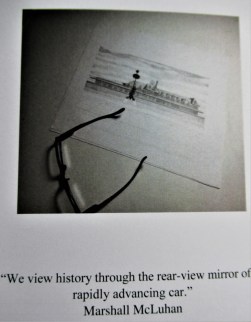
“We view history through the rear-view mirror of a rapidly advancing car” … and writing these poems was a veritable journey back into the past. Geoff left his glasses by his half-finished drawing, and that’s when the idea of linking McLuhan to Moore to McAdam occurred. Several of the poems focus on my own experiences of railway stations. Travel by train was a frequent choice in my childhood and I went almost everywhere by train. A local in-town train ran from the station at the end of our road and I often took it when visiting friends, shopping in town, or following the local soccer team, Cardiff City, aka the Bluebirds. As a result, much of the imagery within the poems involves my own knowledge and love of trains, while the narrative structures themselves are often based on those overheard words.
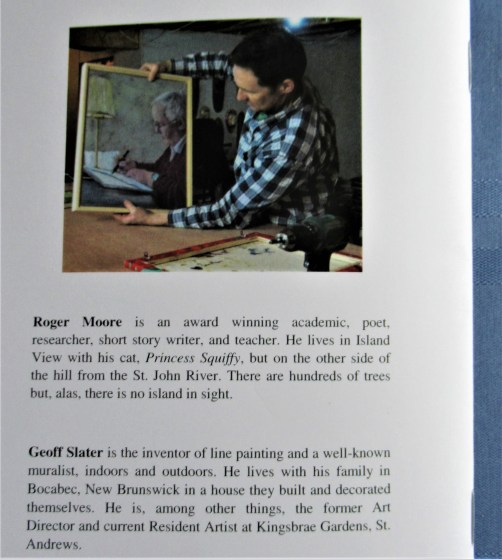
We wanted a photo of Geoff and me on the back cover and I discovered this one in my files. The portrait was done by Ruby Allan, my fellow artist in KIRA (June, 2107). She painted Roger Writing in the Red Room from a photo taken by another KIRA resident artist, Carlos Carty, the Peruvian pipe, as I was working at the desk in my room. Geoff framed the portrait and Mrs. Lucinda Flemer gracefully allowed it to be hung over the desk in the Red Room at KIRA, an honor for which I am exceedingly grateful. What a nice way to put our pictures on the cover of our book! If you are down McAdam way this Sunday, 30 June, drop in and see us. We’ll be there. Books and all.

Westbury
White Horse
Winter in Somerset. No trains from Frome.
They sit in the engine sheds, boilers frozen.
Clare drives me to Westbury, in Wiltshire,
the neighboring county. She leaves me there
and I stand on a platform as white with snow
as Westbury White Horse towering above.
People arrive, flapping their arms, stamping
their feet, walking around trying to stay warm.
Finally, to shouts, cheers, and laughter, a train
arrives, its boiler successfully thawed. People
rush forward, open doors, claim their seats.
It’s a corridor, not a compartment train.
“Is this the eight-fifteen to Temple Meads?”
I ask the porter. “Nope,” he says. “That wll
be arriving later.” “When?” “About ten
or eleven, I expect.” “What train is this?”
“Ah, now this is the six-thirty to Bristol.
Running about two hours late. Better be quick.
The guard’s waving his flag. She’s about to leave.”
I open a door, climb on the train. All
the seats are taken. I stand in the corridor,
shivering, all the way to Temple Meads.
Gower
To be Welsh in Gower is to spell it funny
and pronounce it worse: Gwyr.
It’s to know how to say Pwll Ddu.
It’s meeting the cows in the lane to Brandy Cove
and knowing them all by name and reputation,
which one kicks, which one gores,
when to walk in the middle of the lane,
and when to jump for the safety of the hedge.
It’s to know the difference between the twin farmers
Upper and Lower Jones.
It’s to recognize their sheepdogs, Floss and Jess,
and to call them with their different whistles.
It’s knowing the time of day by sun and shadow;
it’s knowing the tide is in or out
by the salt smell in the air
without ever needing to see the sea;
and now, in this far away land called Canada,
it’s hearing your stomach growl for crempog or teisen lap
whilst memory’s fish‑hook tugs at your heart
in the same way your father hauled in salmon bass
at Rhossili, Brandy Cove, Pennard, Oxwich, and Three Cliffs.
Commentary: I was checking Gwyr, the Welsh for Gower, where I was born, and found this interpretation of the name. <<G is for generous, your giving nature. W is for wise, more tomorrow than today. Y is for young, the years never show. R is for rapport, friends seek you.>> I don’t know if that’s me, but it certainly wouldn’t be a bad set of descriptors to live up to.

Growing Up
in Brynmill
They drag the kids kicking and squealing
from childhood’s universe into an older
world of smoking and drinking, forbidden
fruits stolen after Christmas dinner when
drowsy grown-ups’ eyes are turned away.
Why do bigger boys follow smaller ones,
buying their sisters’ kisses then thrusting
their fingers into little girls’ knickers, or
invading Woolworth’s and tucking stolen
goods in shirts with their buttons undone?
The games they play: offering a little girl
a cigarette or a sweet while two boys
wait behind the garden gate with a sharp
knife to press against the victim’s throat.

Dies irae
Nowhere has she found peace, save
in the dregs at the bottle’s bottom.
She solves life’s dilemmas with single
malt or grape’s blood fresh-plucked.
Doctors tell her that she must stop drinking,
not stoop to conquer yet another bottle.
The remedies they suggest will never suit her.
Family and friends lecture her in vain.
She knows she will not live forever,
that one day a higher power will call.
So she opens another bottle of Scotch,
just a drop before she goes. She falls
to the floor, and lies asleep. Three still
born babies cover her with their love
to keep her warm. “Sleep well,” they say,
“you’ll find greater peace in eternity.”
Commentary: Another poem that was not easy to write. The last line is a tribute to Seamus Heaney and his poem, Yellow Bittern, the inspiration for this one. “You’ll be stood no rounds in eternity.” In the literary theory of Intertextuality, texts talk to texts and a series of interlaced textual dialogs move across time and space. Hablo con mis ojos a los muertos, I speak through my eyes with the dead, as Francisco de Quevedo said in the 17th century. He was reading Seneca, another great writer born in Spain, when he wrote those words.
I restructured this poem three times. I began, following Seamus Heaney, with the first person singular [I]. Then I changed it to the second person singular [you], but you, in English, can never approximate to the intimacy of tu [versus vous] in French, or the multiplicity of tú [versus usted, vosotros, vosotras, ustedes} in Spanish. Finally I settled on the third person and settled on she [rather than he]. I guess when a woman loses three children, she is entitled to lose herself in a bottle of Scotch and shut out the world.