Spotify Remember to scroll down to appropriate audio episode.
Vets A Thursday Thought
Mary Jones
I met her unexpectedly in a restaurant in St. George. I was masked, but she knew me right away. She hadn’t changed. How could she have? She is as she is. Straight forward, upright, honest, true to her words and her values. Ex-military. A United Nations Peace-Keeper. A Blue Beret. World traveller to some of the roughest, toughest, ugliest, craziest spots. Everywhere she went, she helped keep the peace.
She came back home to find out what she already knew: that rural New Brunswick was as wild as anywhere she had been. She was anonymous, here, was just another number in a book, a casualty in a nameless war of attrition after which the winners rewrite the history of events, twisting them this way, that way to suit themselves and their own instincts and interests.
“Best of the best,” I wrote in the book I gave her. Fortuitous, it was, finding her again, finding that copy close to hand, reserved for her alone. That book and this poem are my tribute to her for her courage, her fortitude, and her strength of will. They are also a tribute to her role in making the world a safer place in which others, less fortunate, can create, without fear, their lives.
Comment: There is very little more to be said. Each former soldier is an individual with a history and personality of their own. This is my tribute to a very good friend who served her country and the United Nations Peace Keeping Forces with pride and distinction. Mary Jones, I, an academic, a writer, and a non-combatant, salute you for all the positive values which you have brought into this sometimes troubled world of ours. You and your well-being are in my Thursday Thoughts.
The Nature of Art and the Art of Nature is a book of poems each one of which celebrates humanity’s relationship both with the natural world and the way that world is recreated by artists in so many different forms. In order to read these poems and receive full value from them, it would help to know how to approach them.
Preparing to Read
First, de-clutter the mind. Poetry cannot be hurried or rushed. Remember, it is better to read one poem a hundred times than to read one hundred poems once. Prepare yourself mentally and physically for your reading. Sit down. Make yourself comfortable. Close your eyes. Concentrate your mind on something you find peaceful: a sail on Passamaquoddy Bay, a rose in Kingsbrae’s Rose Gardens, a butterfly in the Butterfly Garden, or a fine white cotton cloud in a cerulean sky. Breathe in and then breathe out. Now slow your breathing down. Breathe in, count up to four, slowly, breathe out, counting up to six. Breathe in, count up to six, slowly, now breathe out, counting up to eight. Breathe in, counting up to eight, and breathe out, also counting up to eight. How long will you sit there? When your breathing has slowed and your mind is clear, you will be ready to start. You will know when that is.
Open your eyes. Take your book and begin to read. Don’t start on page one and rush through. Dip in, here and there, find a title or a first line that you like, and read that poem. Read it two or three times. Then move on, randomly to another poem. Select individual lines, phrases, sentences. Savour the words. Roll them around in your mind. Read them to yourself, quietly. Then read them out loud. Try to capture their essence, their rhythms. Taste them, as you would a fine Spanish Manzanilla wine. Select another word, another line, another poem. Seek and you will find some sequence that you like. Return to it often.
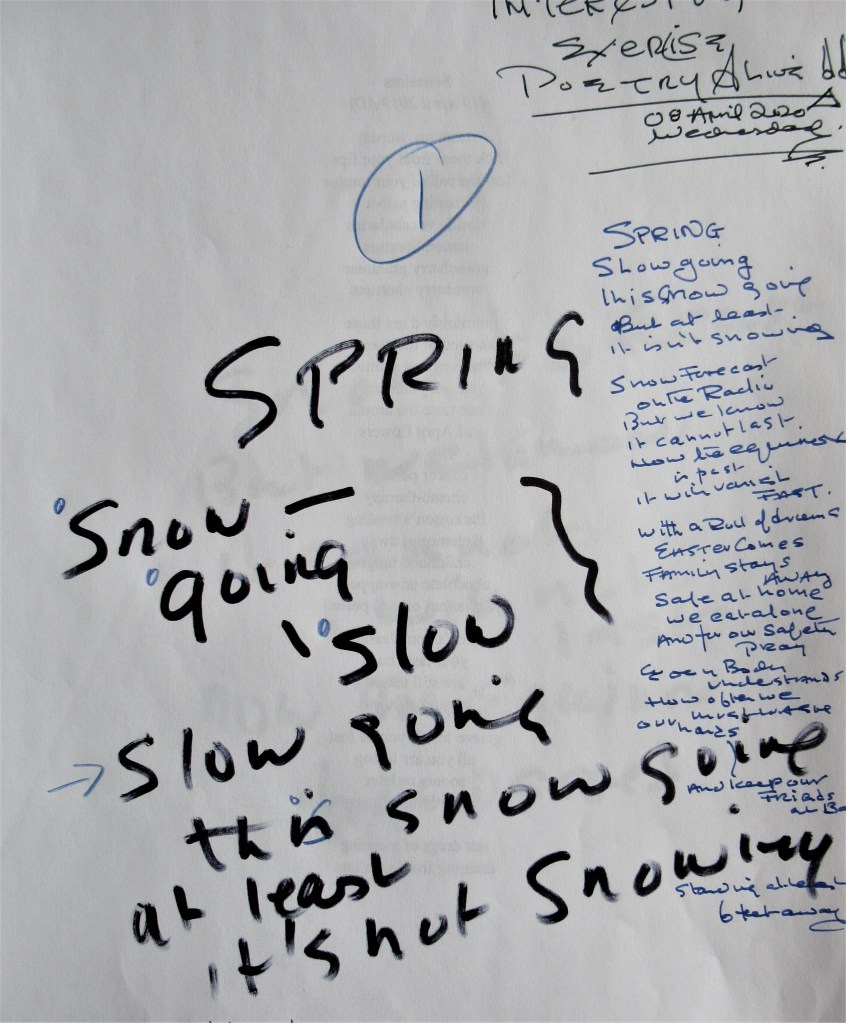
Comment: I will restart my Wednesday Workshops. The Nature of Art, the manuscript on which I am currently working, has an Introduction on The Nature of Poetry. I will put this up in installments. The handwritten opening page comes from an online video on Creativity and Writing Poetry during the Pandemic. This poetry video is the first one in the series. Click here for link. Other workshops on writing can be found by searching Writing Workshops on the Blog search (top right hand corner) or by going to this link Poetic Creativity and Thoughts on Writing
She is an oyster, silent at low tide, yet with a host of pearls waiting inside her, ready to be released. When set, she will release those pearls herself, stringing them together, like Chantal’s beads, into a skein of meaningful, enigmatic moments.
Enigmatic, yes, but, like Elgar’s Enigma Variations, a Russian Doll puzzle of secrets and intrigue. Comic book artist, she evolved to graphic designer, then multi-tasked first to Kinetics, and then to a painter who reaches out in empathy to the world around her.
For her, all art is linked and communications are key, on many levels. Visualization. Achievable goals. A step-by-step process with each step foreseen, planned beforehand, and each step always taken with an open mind that accepts the true response, leaving falsehoods behind.
Kinetics, yes, but she is above all a loner. Kayaking. Hiking. Weight-lifting. Yoga. Meditation. Mindfulness. Caring. Sharing. She sends me her web page and I am blown away by her empathy with birds and the natural world, that world her oyster and her, an oyster in that world.
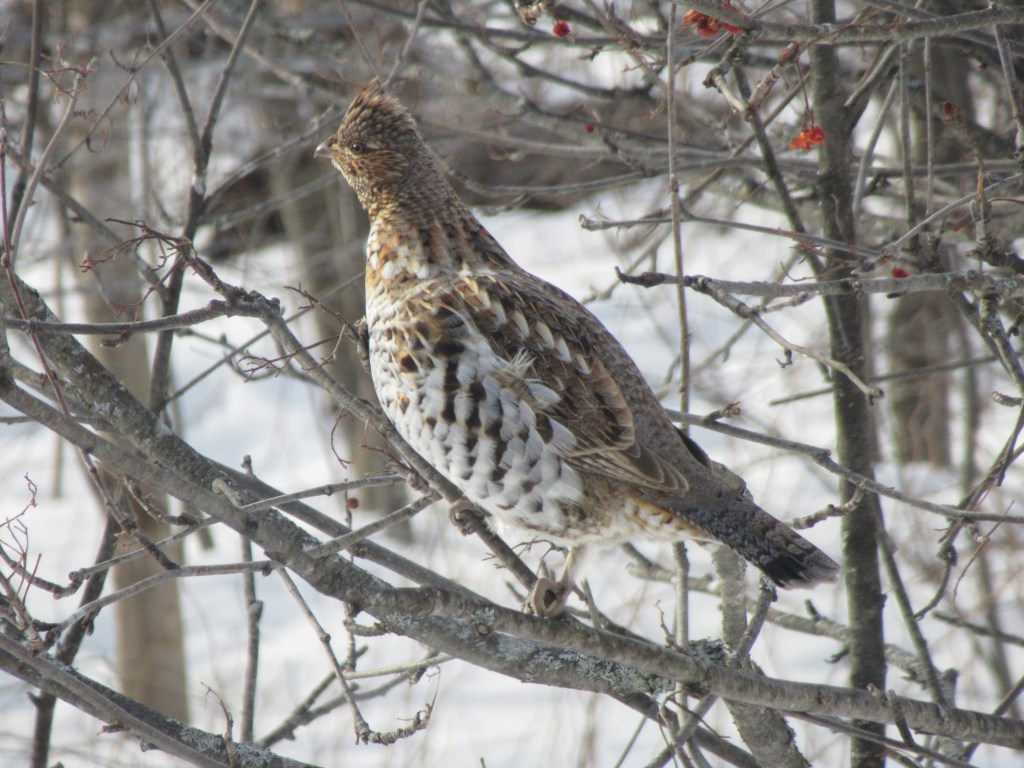
Comment: This particular bird visited our Mountain Ash in the garden at Island View. Kaitlin saw my photo and asked if she could paint it. I sent it to her, and this is the result. Wild life to Still Life to art and never Nature Morte! Together, Kaitlin and I have preserved forever the surprise visit of this beautiful bird.
Spotify Remember to scroll down to the appropriate audio episode.
Sculptures in the Gardens
It’s the only sculpture garden in Canada. It may even be the only one in the world in which the sculptures shake off their shackles and come alive at night when the moon hangs heavy in the sky and shifting shadows prowl beneath Kingsbrae’s trees. Deadly nightshades, roaming with no thought for the humans who walk around by day taunting these sculptures, thinking they are lifeless, mere images set in stone.
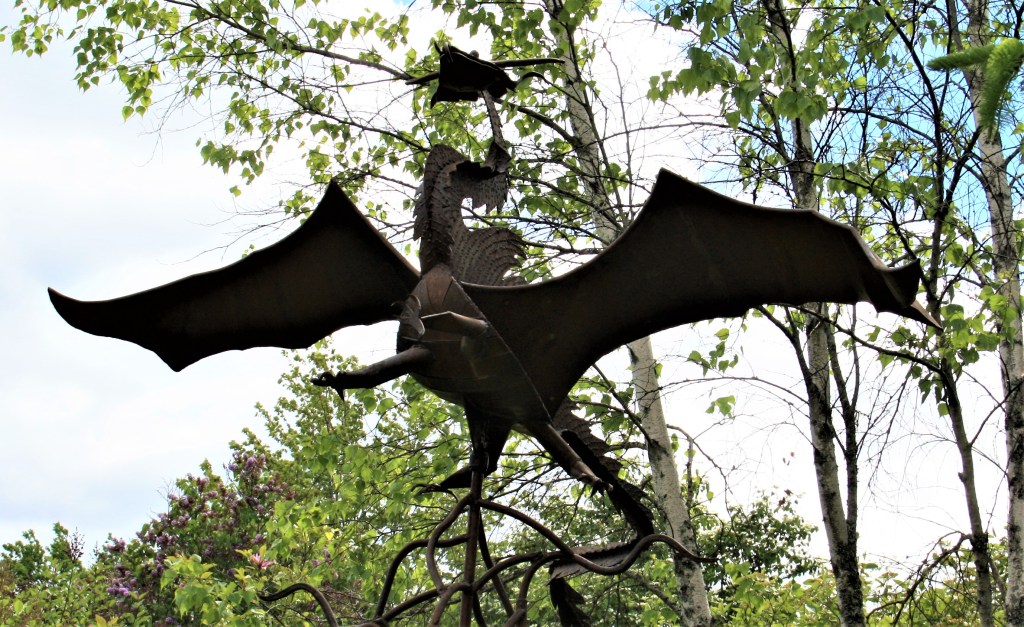
Beard not the lion in his den, nor the fox running wild, nor the chubby bear whose clumsy run belies his speed and strength. The dragon opens iron wings, but beware of the hot forge lodged in the snap-dragon’s mouth.
Have you seen the cerulean whale, marooned and ship- wrecked on these foreign soils? Once upon a time, in a fairy tale, he roamed the seven seas and plundered men and ships with abominable ease. Ease and the easel, plein air paintings, sculpture portraits taken from life and converted to a ship’s canvas that will never sail.
Ask not who is that bearded man, for he might be the one Don Juan invited to supper. Ah, the hard rock ship-shock when with a thunderous knock he arrives, an unexpected guest, at the coward’s door. And shake not his hand lest his fearsome grip turn you to stone or drag you down to hell.
Spotify Remember to scroll down to appropriate audio episode
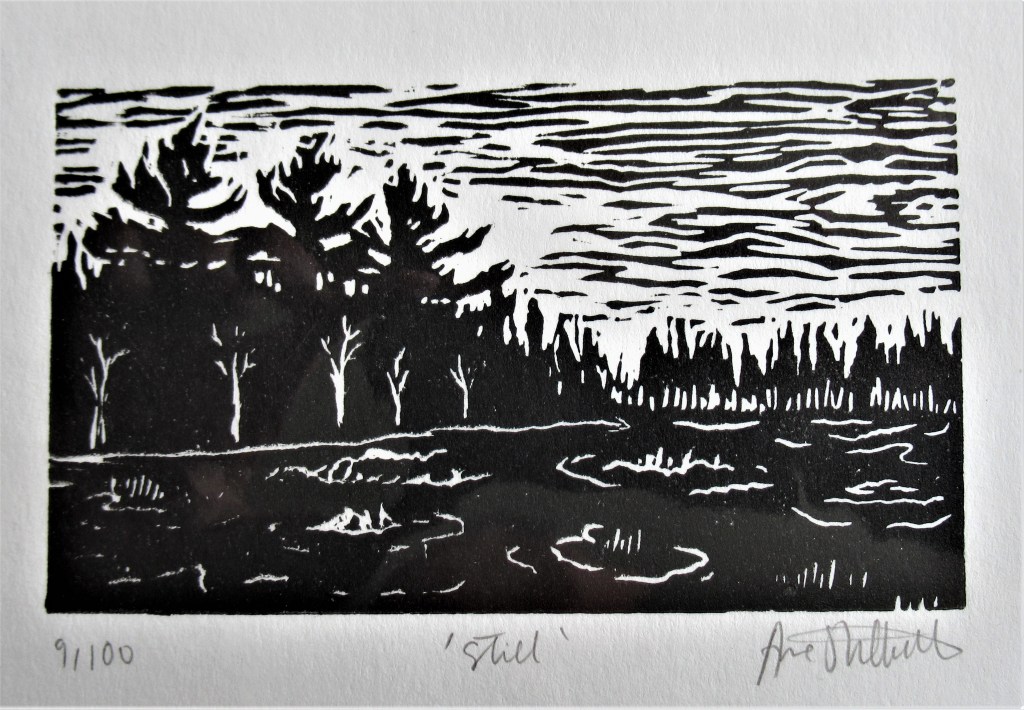
Painting a School Outing Beaver Pond, Mactaquac
The yellow of the school bus is easy, but what colors do you give the rainbow of kids arcing out through the exit? And how do you portray their energy, their noise, their origins when such a variety of accents assaults your ears and drives the wildlife into silence?
What colors would Rimbaud have given to their vowels, their consonants, their high-pitched tones? You can sketch their orderly rows as they snack on the top-hat magic pulled out of backpacks. But it’s not so easy to paint the pop of cans, the scent of chocolate bars, or the crackle of chips released from packets and popped into mouths.
Running round after lunch, they drive the wild birds wild with their unorganized games of tag, their impromptu dances, their three-legged races, their winners and losers, their joys and sorrows. Fishing nets are produced from nowhere. Girls, boys wander to water’s edge in search of prey: incipient frogs, newts, tadpoles, bullheads, but how do you paint the wet and wriggle of them?
Try painting this. Whistles sound. Kids regroup. The bus reloads and goes. Now paint the silence. Sketch the tranquility of woods, bird-calls back, of the beaver pond with its lilies stretching their green necks skywards towards a pale blue sky where cotton clouds cluster together in celestial flocks. A pastoral scene, this painter’s paradise.
Comment: The woodcut was a gift from my fellow KIRA artist in residence (May-June, 2021), Anne Stillwell-Leblanc. It goes well with this poem about nature, noise, and the absence, then presence, of silence. For those of you who do not know the Beaver Pond at Mactaquac, it is well-worth a visit. My thanks to Anne for her permission to use her art work.
Spotify Don’t forget to scroll down to appropriate audio episode.
Cave Paintings Cantabria
Who painted these pictures on the walls of night’s cave? This grayish hand, fingers flexed, outlined in black soot, that deer dancing, those bears, horses, bison, running?
Did they come from nowhere, plucked from nothing but the artist’s memories of what he saw as the ice age faded and heat and warmth returned to warm his world? Drawn from life, without doubt. Unless these Neanderthals were truly creating art from a literal vacuum with nothing new invented since according to Picasso. And he should know.
Imagine them as sounds, as letters from distant relatives, as colored vowels scored on the blocks of a child’s first alphabet set. Sit and stare. Watch flames flitter over sharp shapes. See life enter the drawings as flimsy light flickers over the cave walls’ dips and bumps.
Once seen, never forgotten. Not just the paintings, but also the clammy cave damp, the red hanky draped over a pocket torch to imitate firelight, the drip of water, slow growth of limestone deposits growing into stalagmite and stalactite. Such things flit in and out of my mind like owls or bats, drop in on my sleep wake me with predatory beaks and claws, calling for my skull’s shut doors to open wide, to let them in, and to bring them back to life.
Comment: The picture comes from an ash-tray my parents bought at the Cuevas de Altamira, in Santillana del Mar (Cantabria, Santander as it was known then) in 1963. We visited many cave sites in Cantabria including Puente Viesgo, where we saw the sooty hands. Back then, the caves had only just been opened. At Altamira, a young lady came to greet us. We asked her if we might view the caves and she whistled loudly. Her husband came down from the fields where he was working. He took a large iron key from his pocket, opened a huge door set in the rock, and in we went. One light bulb illumined the inner chamber. Only a small segment had been dug out. We reclined on a rocky bank. He doused the electric light, took a torch from his pocket, and covered it with a red pocket handkerchief. He moved this back and forth to imitate firelight and immediately the whole wall came to life and the animals moved in the flickering light. Pure magic. Unforgettable. We were the only people there. Four of us. A few years later, you had to book an appointment and a place. Within six years, the caves were closed as the heat of human bodies raised the cave temperatures and caused the paintings to deteriorate. I was so fortunate, so privileged, to see those paintings in what was almost their pristine state. In 1991, I visited the facsimile of the caves built in Madrid. I paid my money, went in, sat down, and came out crying for all those things we had lost, for all that beauty that had been denied.
Spotify Don’t forget to scroll down to appropriate audio episode.
Daybreak
… early morning sunshine creepy-crawly spider leg rays climbing over window and wall my bed-nest alive to light not night’s star twinkle but the sun’s egg breaking its golden yolk gilding sheet and pillow billowing day dreams through my still sleepy head …
… the word feast festering gathering its inner glimpses interior life of wind and wave the elements laid out before me my banquet of festivities white the table cloth golden the woodwork’s glow mind and matter polished and the sun show shimmering its morning glory on garden and porch …
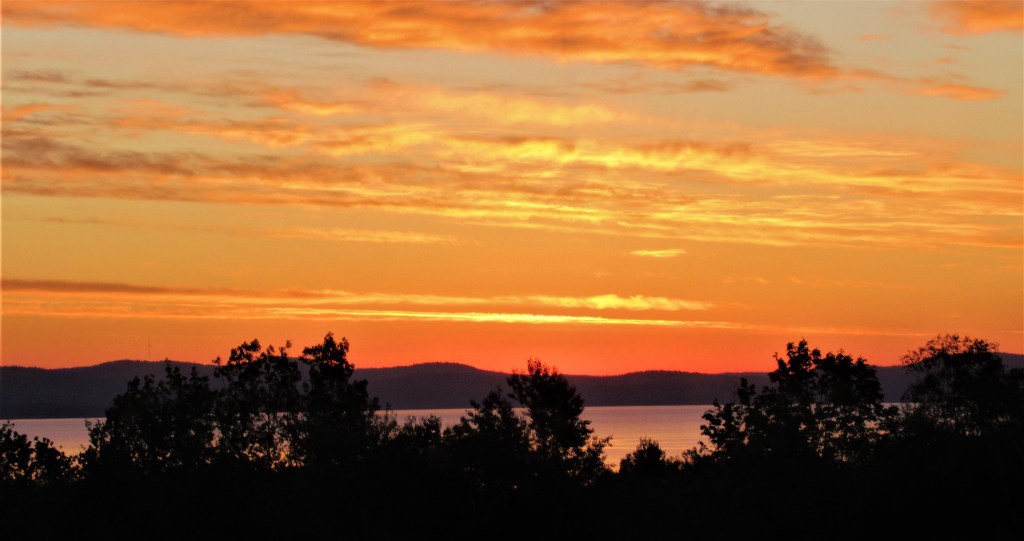
Comment: Not every day is the same, nor are the colors the same. Monet would watch the sun crossing the face of Rouen Cathedral. Every hour brought a different set of colours and a changed palette of impressions. No two mornings in the Red Room are the same. Each one presents a changed light, changing moments, changing impressions, but all (or almost all) are unforgettable. The poem, incidentally, can be found in One Small Corner. A Kingsbrae Chronicle (available at this link).
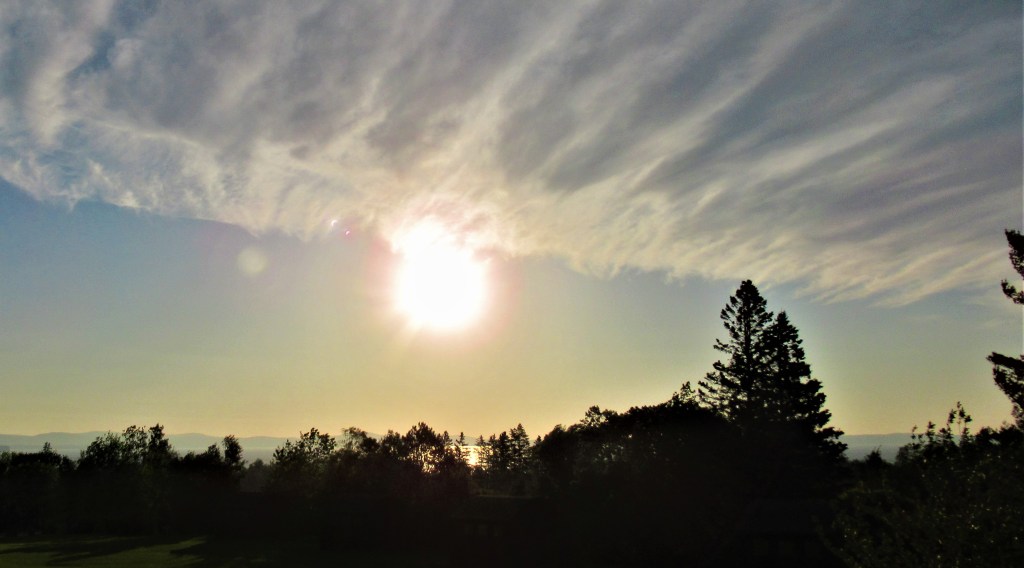
Comment: Another moment of magic: this is the morning of the partial eclipse (Thursday, 10 June, 2021). However, there’s enough cloud cover for me to have missed the actual moments of the eclipse. That said, the sun is all distorted and not at all clear, as it usually is when seen early from the Red Room, nor is it the same rich colors at all, so perhaps I did catch something worthwhile after all. More than worthwhile, this too is a magic moment.
Spotify Don’t forget to scroll down to appropriate audio episode.
Dawn at KIRA
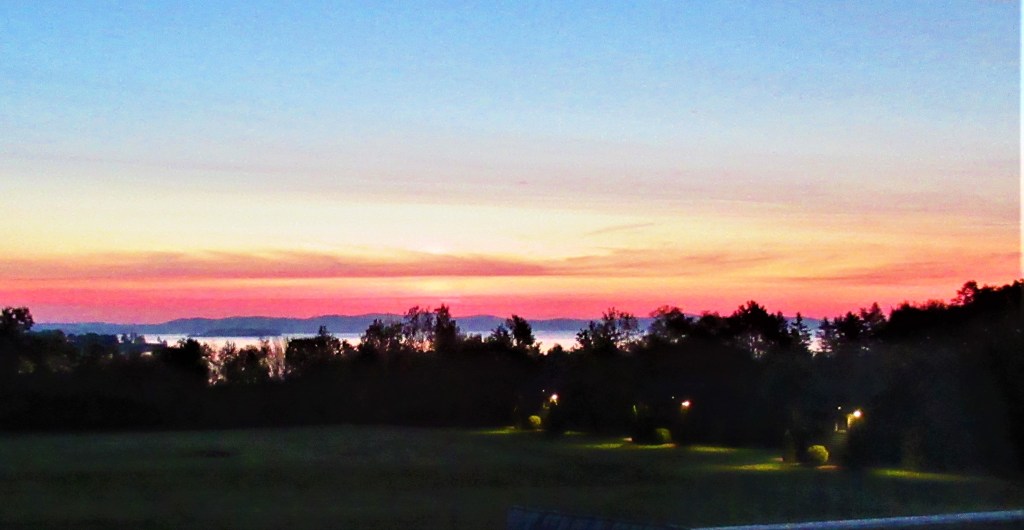
A fiery wedge, fierce beneath black-capped clouds, alive the firmament with light, breaking its waves over woods, waters, tranquil the bay, grey, yellow-streaked, then blue, the new day dawning, driving night away, false shadows fleeing.
To rock this new born babe, to swaddle it in a cloak of cloud, disguised for a moment its promise, nature nurturing heart and mind, filling the flesh with memory’s instantaneous flash breaking its light into the dark where no light shone, fearful, the dream world, gone now, dwindling, as day light shafts its arrowed flight.
How thoughtful My Lady who placed me here, at this desk, at this window, at this moment of time.
Glorious, this day-break: words no justice can do to peace and light, this early morning, filtering sunlight through the waking mind, relighting the fires within the heart, and glory a word’s throw away outside this window.
Comment: The poem dates from June, 2017, my first KIRA residency, and can be found in One Small Corner. A Kingsbrae Chronicle (available at this link). The photo, however, dates from this morning, Friday, 11 June 2021, and coincides with my second KIRA Residency. The early morning light in the Red Room is indeed glorious, and the room well deserves its name. The small table by the window overlooking Minister’s Island and Passamaquoddy Bay is a wonderful place for a writer who wishes to create nature imagery based on impressions of light and changing light.
Wake up, sleepy heads, get out of bed and admire the sun as he starts his daily climb. He has left the underworld and his horses have started to draw his chariot on its daily trip up the sky. Look closely, and you can just see the hot breath of their efforts, up there, just above the sun.
Spotify Don’t forget to scroll down to appropriate audio episode.
Ginger Marcinkowski (KIRA, August, 2019)
“My walk each morning, rain or shine, feathers my black galoshes with dewy grass. There I would ramble through gated doors that kept out the world and sealed in my pen’s work for that day.
I often found myself sidetracked, exploring paths that led through flowerbeds, and up to my favorite sculptures. I paused to watch my fellow artists as they focused on chosen subjects unaware that I was eavesdropping.
Then silently, I would steal away along the well-trod path to my studio, pausing long enough to greet the llamas and baby goats. If I listen carefully I can still hear their bleating.
In wonder, every day, I climbed the steps of wood that led to my studio, opened the door, and turned to breathe in my good fortune. “What a blessed woman you are,” I would tell myself before taking my place for hours on end at my desk, each moment, each stroke of the pen, each letter added to the growing lines on the page, a gift.”
Comment: I have been writing poems about the KIRA artists as part of my next poetry book, The Nature of Art and the Art of Nature. This is my KIRA2021 project. The Nature of Art is a revision and expansion of a poetry manuscript of the same name that placed second in the WFNB’s Alfred G. Bailey Award (2020). This poem appears in the section entitled Impressions of KIRA Artists. Currently this section contains eleven poems, but it is still under construction. This poem is interesting in that it is a ‘found’ poem, in the sense that Ginger wrote these words to me in an e-mail. I removed them, reordered them, polished them, and sent her back her own poem in her own words. What fun! This should help explain the use of inverted commas at beginning and end, for this poem is spoken in Ginger’s own words.











 rogermoorepoet