Patience

Thursday Thoughts
Patience

Patients must be patient.
The waiting-room
is where the doctor
makes them wait.

My father waited, patiently,
to see the specialist.
At the stroke of noon,
nurse told the waiting patients
not to wait patiently
and to all go home.

“Come back next week,” nurse said.
“What’s up?” I asked.
“The doctor,” she said,
“has a very important meeting.”

I hurried for a taxi.
My father on his Zimmer
followed slowly behind.
On the hospital steps
I met the doctor.

“Damnation!” he said,
into his cell phone.
“I’m going to be late
for that appointment.
I’ve left my golf clubs behind.”

Thursday Thoughts: I remember that day well. My father was due to visit the hospital for his appointment with the stroke specialist. I wanted to drive him there, but he insisted on waiting for the old folks’ ambulance. It was due at 9:00 am and his appointment was for 10:30 am. We waited patiently, watching the hands on the clock moving slowly round. 9:00 > 9:15 > 9:30 > 9:45. “I can drive you,” I said. My father shook his head: “If I don’t take the ambulance, they won’t come to pick me up again. They’ll say I have other means of transport.”

The ambulance / ambwlans (in Welsh) arrived just before 10:00 and dad was sure they’d make his appointment time. Except there were still empty seats and that meant more passengers to pick up. Used to the system, my father waited patiently while I got more and more frustrated. Finally, the ambulance was full and we made our way to the hospital, getting there about 10:45. “Run,” my father said, thrusting his appointment papers at me, “tell the nurse I’m on my way.” Run I did. When I got to the waiting room, I found it full of people with never a chair for my father to sit on. When he arrived, a younger patient offered him his seat and he flopped down into it.

Names rang out. Patients disappeared. Some returned to the waiting room, then walked out. Some didn’t return. At 11:15 my father demanded tea. I got him a cup. At 11:30, a man stood up and started to preach to his captive audience. “Does that every week,” dad muttered in my ear. “He’s mad.” “You can’t take it with you,” the preacher thundered. “There aren’t any pockets in shrouds.” People fiddled and looked uncomfortable. Most had teacups perched precariously on saucers, and some rattled them, whether in applause or anguish, I still don’t know.

Then at noon the nurse appeared and announced what you have read above. “Dr. XXX’s patients: you can all go now. Dr. XXX has an important appointment. Come back next week.” My dad pushed me. “Run,” he said. “Get a taxi. They’ll all be wanting one and by the time I get there there’ll be none left.” That was the only visit I made with my father to that particular hospital. I had so many questions to ask that specialist, but, alas, I never met him.

What I did learn was that patients must learn patience. Hospitals, like airlines, run to their own schedules. A sign should be placed above every hospital door. “Abandon hope, all ye who enter here.” Just a thought, nothing more. The delays in all our medical systems, caused by the Covid-19 pandemic, have been disastrous for many people, especially the old. Missed appointments. Delayed and cancelled treatment. Long waits and delays. The medical staff have been placed in such stressful conditions. Many are finding it difficult to cope with their inability to fulfill their desires to help their patients. Many are so stressed out. Two of my own doctors have cried when talking to me. I think of it as Covid Collateral Damage, CCD, just like the Colony Collapse Disorder that wiped out our bee population a few years back. Now we are the bees and hospitals and nursing homes are the hives.

Looking back, that morning spent waiting with my father, was a lesson in what old age has in store for us Golden Oldies as we age. Patience: as patients, we must learn patience. And remember, as Bette Davis once said “Old age is not for cissies.” And those are my thoughts for today!
Prostate

Prostate

Pictures and models.
1 Prostate: normal size and shape.
2 Prostate enlarged.
3 Prostate enormously enlarged.
4 Prostate lumpy, malformed,
          cancerous, and me prostrate.

Lumpy and treacherous:
a gross shape growing
its grossness within me.
Gross, but mine and a vital
part of my living body.

A mad world this, twisted
time and fairground mirrors
distorting everything, and me
grossed out by the mechanical
clockwork, tick-tock, snip-snap,
removing samples for some
lab to examine and test.

“Give them back!”
I want to scream.
I guess I’ll get them back
on Judgement Day,
when the body resurrects
and I am whole again,
warts, cancer, and all.

Meanwhile, the biopsy’s done.
I get up from the bed
and the nurse hands me a towel
so I won’t drown my sorrows
in my body blood, a crimson
tide, ample, thick, flowing red.

Comment: After a couple of phone calls, some e-mails, and some messages on Facebook, I realize that some of my friends are actually following this blog and reading it. Thank you for the care and attention you have shown me by writing or calling to inquire about my health. All is well. I visited my urologist yesterday for a regular check-up and sat there a little longer than usual, waiting. Never one to waste time, I studied the things in the office and discovered a model prostate over which I could run my fingers (I didn’t!). It showed the four stages of prostate enlargement and cancer development as outlined above. I had no paper with me, so I jotted down four poems on the back of the paper bag in which I carried the injection I would later receive. This poem was one of them. The reference to Judgement Day and the recovery of body parts comes from one of Quevedo’s Suen~os, El suen~o del infierno, I believe. Anyway, my apologies, if I have worried you. I am fine, thank you. However, as Quevedo also wrote, “The day I was born I took my first step on the road to death”. Alas, I too am one of Dylan Thomas’s ‘poor creatures, born to die,’ as are we all. If not now, when? Not too soon, I hope. Blessings and thanks to all who read this. Take care and stay healthy.

Christmas Angel

Christmas Angel

Once upon a time
he sang carols,
but now he chokes
on red-herring bones
and obscure meanings.

When he opens his mouth,
his tongue falls bleeding on the silver tray
encased in wood
passed round to collect the money.

His knees are dusty from lack of use.
What wooden doll’s head
rocks back and forth on his shoulders?

On Christmas Eve, a painted
clothes peg lies in a wicker cradle.

He swaddles it with birdsong
and hums forgotten words
to half-remembered tunes.

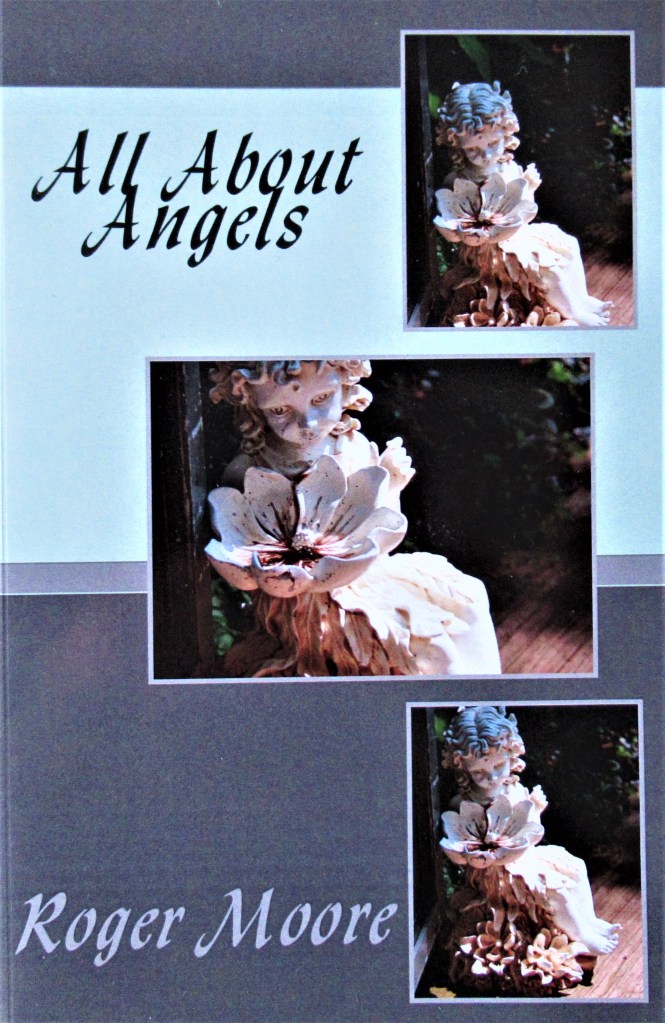
Christmas Angel can be found in
All About Angels.


All About Angels
Paperback edition


All About Angels
Kindle Edition

Building on Sand

Building on Sand

Everywhere the afternoon gropes steadily to night.
Some people have built fires,
others read by candlelight.

Geese, drifts of snow their whiteness,
settle on the riverbank. They walk
on thin ice at civilization’s edge.
Around them, the universe’s clock
ticks slowly down.

Who forced that scream
through the needle’s eye?
Inverted, the Big Dipper,
hangs its question mark
from heaven’s dark eyelid.

Ghosts of departed constellations
stalk the sky. Pale stars bob
phosphorescent on the flood.

The flesh that bonds,
the bones that walk,
the shoulders and waist
on which I hang my clothes,
now they stand alone
and listen at the water’s edge
to the whispering trees.

They have caught the words
of snowflakes strung between the stars.
Moonlight is a liquor
running raw within them.

Comment: The verse version (above) is from Though Lover’s be Lost. The prose version (Below) is from Stars at Elbow and Foot.

Building on Sand

Everywhere the afternoon gropes steadily to night. Some people have built fires, others read by candlelight. Geese, drifts of snow their whiteness, settle on the riverbank. They walk on thin ice at civilization’s edge. Around them, the universe’s clock ticks slowly down. Who forced that scream through the needle’s eye? Inverted, the Big Dipper, hangs its question mark from heaven’s dark eyelid. Ghosts of departed constellations stalk the sky. Pale stars bob phosphorescent on the flood. The flesh that bonds, the bones that walk, the shoulders and waist on which I hang my clothes, now they stand alone and listen at the water’s edge to the whispering trees. They have caught the words of snowflakes strung between the stars. Moonlight is a liquor running raw within them.

Click here for Print Version

Click here for Kindle edition

Monkey Presses Delete

Monkey Presses Delete

Monkey loves walking behind the gorillas.
The gorillas break and enter:
and when they do, monkey simply points
and gorillas do their thing:
it’s that simple …

Monkey has a code word
that he took from his computer course.
“Delete!” he says with delight
and the gorillas delete whatever he points to.

Monkey loves burning other people’s books.
He also loves deleting parents
especially in front of their children,
and deleting children in front of their parents
can be just as exciting.

The delete button excites monkey:
maneuvering the mouse
tightens his scrotum
and he feels a kick like a baby’s
at the bottom of his belly
as he carefully selects his victim and
“Delete!”

The gorillas go into action:
ten, twenty, thirty, fifty, seventy years of existence
deleted
with a gesture and the click of an index finger
pointed like a gun.  

Monkey’s Clockwork Universe

Monkey’s Clockwork Universe

Some days, monkey winds himself up
like a clockwork mouse.
Other days he rolls over and over
with a key in his back
like a clockwork cat.

Monkey is growing old and forgetful.
He forgets where he has hidden the key,
pats his pockets, and slows right down
before he eventually finds it
and winds himself up again.

One day, monkey leaves the key
between his shoulder blades
in the middle of his back.

All day long, the temple monkeys
play with the key, turning it round and round,
and winding monkey’s clockwork,
tighter and tighter, until suddenly
the mainspring breaks

and monkey slumps at the table
no energy, no strength,
no stars, no planets, no moon at night,
the sun broken fatally down,
the clockwork of his universe
sapped, and snapped.

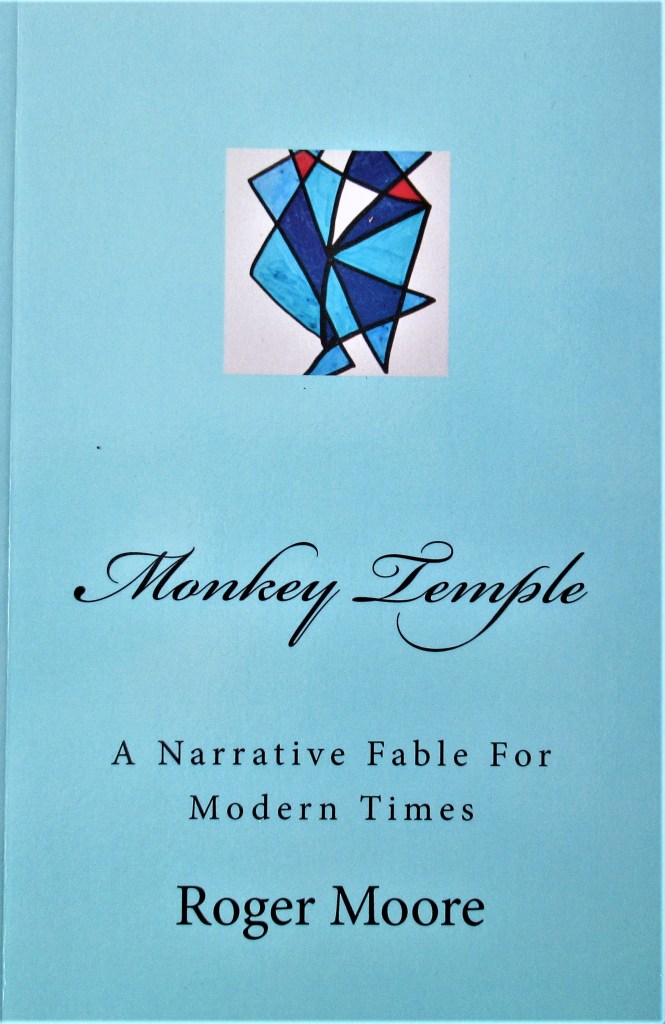
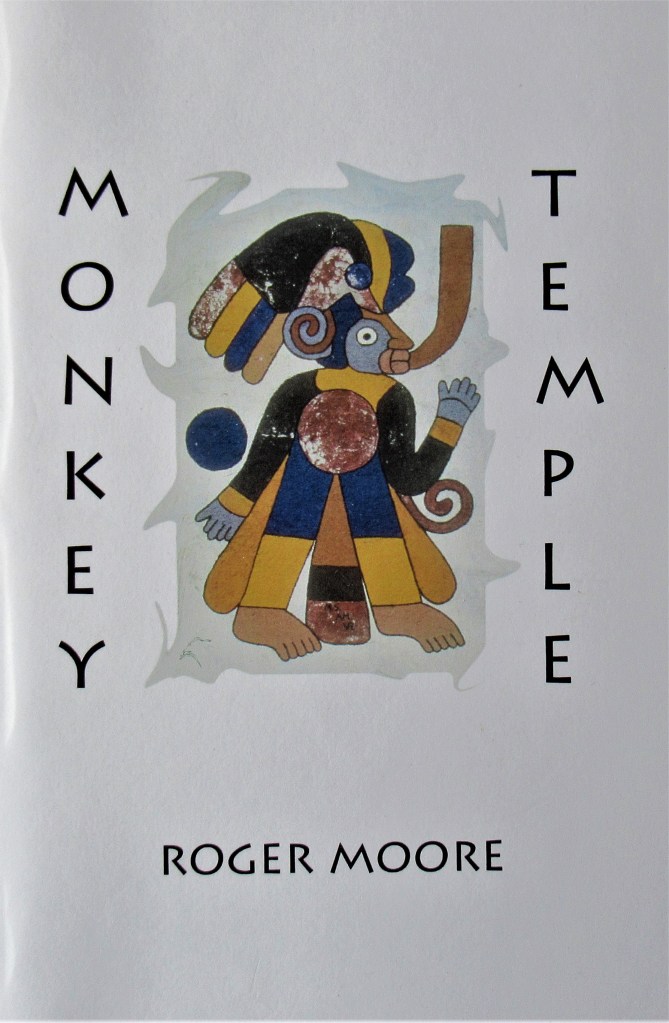
Comment: Monkey Temple is A Narrative Fable for Modern Times written in verse. The poems show strong links to Surrealism and Existential Philosophy. They portray the upside-down world of Carnival and out line Monkey’s Theory of the Absurd in a dystopian world that mirrors that of George Orwell’s Animal Farm, LaFontaine’s Fables, the esperpento of Valle-Inclan, and the witty conceptismo of Francisco de Quevedo. This is a walk through the jungle of the Jungian innermost mind. But watch out for those monkeys: they bite.

Online Edition
First Edition

Click below to purchase Monkey Temple online.

Monkey Temple
paperback

Monkey Temple
Kindle

Rainstorm in Granada

Not the Alhambra, but a blood red sky!

Rainstorm
Granada

 Black umbrellas burgeon beneath sudden rain.
Waterproof cloth opens to provide protection.
Churches fill with defenseless passersby.

The cigarettes they smoke flare shooting
stars through finger bars of flesh and bone.
After the rain, gypsy women flower in the street.

Carnations carve wounds in their sleek, oiled hair.
They offer good luck charms and fortune telling.

“Federico! Federico,” the gypsies cry out,
“tomorrow, the guards will take you from your cell.
They will drive you to the hills and shoot you dead.”

“Tonight,” Federico replies, “I’ll paint the city red.
And tomorrow… ” “Tomorrow,” the gypsies sigh,
“the Alhambra’s walls will run red with your blood.”

Comment: I have made some minor changes to the sonnet that was published in Iberian Interludes (available online at this link) The sonnet is a Golden Oldie, going back to our visit to Granada in 1986. I asked my pre-teenage daughter if she would like to go to a country where there was no snow in winter. She laughed at me. “Don’t be so silly, dad, there’s no such thing as a winter without snow.” We got to Madrid on January 5 and awoke to 3 inches of snow on January 6. “There, dad,” she said. “Told you so.” We took the train down to Granada and that year they had six inches of snow in the city center, for the first time in forty years! It also rained, and this is a poem about the Granada rain.

Iberian Interludes

Closed and Open Images

Open and closed blossoms on the geranium

Closed and Open Images
Wednesday Workshop
28 July 2021

            A closed image is one that leads the reader in a specific direction and offers a fixed vision of the world. For example, “White moths wing their snow / storm through the night” (Cage of Flame, below). One summer evening, a long time ago, when I was in Chatham, N.B., now Miramichi City, I saw white moths swarming beneath a street light. The air was thick with them and they circled and dazzled like falling snow. A reader may not catch this image first time through. However, after a couple of readings and a little thought the image makes perfect sense. Now add the personal dimensions. Have you had a similar experience? What associative fields do you structure around white moths > wing > their snow storm >? This is where the image opens up and becomes more personal. You may not have been in Chatham that night, but you may well have experienced something similar.

            An open image is one that leads you outwards into your own world. “Now you are a river flowing silver beneath the moon” (Cage of Flame, below). Now the image is more open and asks questions of the reader. Who is the you referred to in the second word? Is it the reader? Is the narrator speaking to a third person? You are a river: how can a person be a river, more, can we be sure this you refers to a person? What else could it refer to? You are flowing silver: there is no sense of concrete meaning here. This is not a piece of information to be processed as you would process a headline in the newspaper (print or digital). What does it mean? I don’t know but, as Salvador Dalí said of one of his own paintings “I don’t know what it means but I know it means something.” And that something is the essence of poetry. That one word, river, will conjure up different images for each individual who reads the poem. River: which river does the poet mean? Is he referring to the Miramichi, the St. John / Wolastoq (Wəlastəkwewiyik means “People of the Beautiful River,” in Maliseet), the Thames / Támesis (to the Spanish who lived in London in 1560-1580), the Severn / Sabrina (to the Romans who invaded Britain in 55-54 BC) that divides Wales from England? And what happens when we restore the old names to the rivers that former generations, some of them our forefathers and foremothers named? How does it change our picture of the permanence of rivers and the impermanence of names and people?

            Metaphors are always hard to understand. This is because they have no exact meaning and vary with each reader. Take a metaphor like icy fire. We know that ice can seem to burn the skin, but what does icy fire mean? Think of those drawings in which a vase becomes a face and the face metamorphoses into in a vase. Most people can see each image separately, but it is difficult to hold both shapes in the mind’s eye at the exact same time. The image flits between them with the result that the reader’s determining mind, the one that yearns for le mot juste, the exact meaning of words, is trapped between two mirrors and moves from the one to the other without being able to settle on either.  This is what happens with metaphoric meanings: a flickering between the different terms of the metaphor and an inability to settle. Take this couplet, for example: “there is nothing so hot as the female desire, / as cold as new snow yet it burns you like fire” (In Praise of Small Women, El Libro de Buen Amor, Arcipreste de Hita, circa 1283 -1350, my translation). Such metaphors have been around for a long time, as has the juxtaposition between hot and cold, the Petrarchan ice and fire, used as a poet’s description of lovers.

            No, poetry is not, definitely not, an exchange of information. It is more an exchange of dreams, cultures, multiple meanings, each constructed, de-constructed, re-constructed in the space between the minds of reader and writer. A poetry book is very similar to a river. You must take it on its own terms, adapt to it, work with it, run your fingers and hands in its waters, paddle in it, swim if you want to. You must do all of this on your own terms and in your own way. Whatever you do, don’t, don’t get out of your depth. And please, please, don’t let yourself drown. Just lay back on the water, look at the clouds in the sky, choose the ones you want to follow, and float a few minutes of the day away.

Fall

Fall
13 October 2016

Just one leaf dropping from the tree
and the fall a call of nature and no freak
chance of fate. What throw of the dice
eliminates Lady Luck? None at all,
or so the poet says, lying there, indisposed,
his ribs cracked hard against the wooden
boards of the porch and his right foot
caught in such a way that the hip slips
slightly from its socket and try as he may
he cannot stand but lies there in the chill
evening wind, a lone leaf, getting on in age,
plucked from his tree and cast to the ground.

Comment: And don’t forget the family of crows, sitting in the tree, giving me the eye. watching every movement. I half expected them to flap down on to the balcony, and take a closer look, but when I started to move, it was game over, Rover, and they all cawed and flew away.

Terza Rima

Terza Rima
Apologia pro carmina mea

Dear reader who reads my poems: sometimes
I say what I do not mean to write
and write what I don’t mean to say. Rhymes

make things clearer, for I puzzle what I might
say, and plan ahead so an awkward word
will not intrude. Words, birds in flight,

bright as postage stamps across the absurd
white snow of a page or a digital screen.
When I think about it, I assume about a third

of what I say, I really mean. Who has seen
the early morning wind drifting our thought-cloud
across the lawn, moving shadows cast on green

blades of grass, as we think our thoughts aloud,
each thought a pea in a pod, as some we clasp
between finger and thumb while others crowd,

and the loud, uneasy word slips from our grasp
to wound or injure or otherwise to hurt and maim.
It’s not my aim to do this. My word is not an asp

or a viper or a screw to be driven. I lay no claim
to hurt and yet sometimes a word slips sideways
and does not say what I mean it to say. I aim

to please, to tease, to provoke, in so many ways
and yet I often hurt where no hurt is intended.
If I have done you wrong and my word displays
unintended ends, forgive me: let all rifts be mended.