Night Thoughts

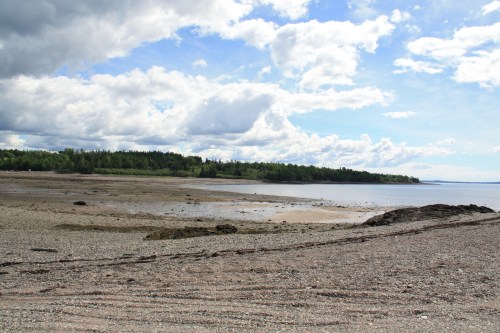
15-may-2002-pre-rimouski-224

Night Thoughts
(for Tanya Cliff)

The weight of the weather
with its dark clouds pushing
down on my shoulders
bends me to its omnipotent will.

I know my back doesn’t have
the power to lift up my heart
and soar above such heavy clouds.

I need a chariot of fire …
yet the clouds are so strong,
and the light is so weak
it won’t break through,
except in sudden flashes.

I hear the creak of sodden wheels.
Clouds blinker the lightning
as thunder crashes through my brain.

I listen to the pouring down of rain
and pull the bed sheets over my head.

Damnatus

IMG_0041

Damnatus / Doomed

‘Poor poets of today: condemned to be nothing more than the dry dust of an unread doctoral thesis.’ They languish, empty headed, in dark rooms, those poets, hunched over their computers, waiting fr someone or something to fill up their heads. They hammer away at their keyboards, correcting their spelling with an  ever cautious spell-check. Intent on making their poems cryptic, they shrug off the sunshine, the beach, the flowers in the garden,  the cardinals, orange and red, who clamor at the feeder, and concentrate on abstract meanings, abstruse words, and twisted thought.

Phone calls go unanswered. Friends are left hanging on the vine to dry. These poets are worse than wallflowers at a dance or lemons out on a date as their crowded heads fill up with metaphors and myths that limp their unsteady ways onto screen and page. Oh pity the blisters on their fingers, the calluses that harden their fingertips to the delights of re-writing, again and again, for they are not real writers but real re-writers, and every thought is a skirmish with unreality, a pledge to continue their servitude to their life’s mission: the curdling of words and the nurdling of poetic thought. What better poetry is there than a hamburger for the hungry or a helping hand stretched out across a street to help a beggar in need … but there are neither burgers nor beggars in these un-windowed buildings, just the poverty of a poetry undiscoverable in its lack of lustre gloom..

Where is the graduate student, earnest, destined to be penniless, who will delve into the notebooks of these poets’ lives and dig out the thought-gems, the diamonds that will make everyone great, publisher and published, poet and practitioner of the uncritical art? Will someone not take that student by the hand and lead him to pastures green, or to the sea, to taste and test the blessed salt and the winds that will drive away the mind’s unwholesome fog and bring light and understanding that will un-cuff the wrists and heal the immortal wounds for, left untreated, they will bleed for all eternity?

Oh the bright bracelet of learning bound round the heart-bleed wrist. Oh the false knowledge gained, that leads poet and critic up and down the slippery garden path towards promotion, tenure, and a seat on the picket fence. Oh those grey human bodies chained to their wooden desks in a dusky library or transfixed on metal seats in academic meditation. Sit and watch while cobwebs sprout in the unused brain and the only certainty lies in footnotes and bibliographical entries that rise like a surging tide to flood the drowsing mind that craves more sleep.

What bright word, what metaphor dim, has poisoned the wit so it effortless moves into the serenity of contemplation? Look on this pathless sea of words, ye mighty, and despair. But take great care: for what if this sylvan warrior awakes, steps out of that figmented dream, sees the reality beyond the shadows, demands a proper challenge, a walk in the park, a vision of the grass that is so much greener on the other side where the administraitors gather and garnish paper and paperclips as they strive for the privilege of herding more and more slovens in their poetic pursuits?

Oh grant them more grants, these purloined poets. Gift them pure visions of things that never were and will never be. Never let them break away from their dissolute dreams that wrap their disadvantaged forms in the ignorance of mental slumber, half-sharpened pencils, and a box of blunt sharpeners..

Identity: Wednesday Workshop

IMG_0067


Identity
Wednesday Workshop

5 July 2017

Today’s workshop settles on the question of identity, loss of identity, and the attempt to recover any form of cultural identity that one feels one has lost. These questions are particularly important in the current age when so many differences are so easily erased. Language, culture, identity, music … they are all tied closely together.

The search for identity runs parallel to the search for the poetic voice (or the writing voice) that is so unique to each good writer. In fact, one can distinguish between good writers and lesser writers merely on the basis of voice. Lesser writers rarely establish a distinct voice while good writers usually have voices that are uniquely their own.

What to do we mean by voice? When we read Shakespeare or Miguel de Cervantes we know almost immediately whose work we are reading. The same is true of the great musicians. Bach, Mozart, Beethoven, Mahler, all have sequences and styles that are individual to them, as do Scarlatti, Brassens, The Beatles, Gordon Lightfoot, Gilles Vigneault, Edith Butler … their style, their voice is established. We listen to them and we know who they are.

Cultural identity is also very important. It is tied into language, childhood beliefs, fairy tales, myths, the basic culture that we receive as children. When we all listen to the same radio stations, or download the same ITunes, or watch the same TV programs with their infinity of ad nauseam advertisements, then we are socially engineered to be the same or, if not the same, remarkably similar within a series of very limited and extremely limiting patterns. When we establish our own identities, — and this is always difficult both for people who have had their culture taken from them and for immigrants, or the children of immigrants, who want to retain their culture at the same time as they blend in and fit in socially — then at the same time we develop our own voices.

When I hear the poetry of Lorca, of Antonio Machado, of Miguel de Unamuno, of Octavio Paz, of Dylan Thomas, of Gerard Manley Hopkins, of Wilfred Owen, I hear their very distinctive voices and recognize their individual styles and the cultural / poetic identities that they have established. The goal that we, as writers, are aiming for is to establish our own style, our own voice. To do this, we must listen to ourselves and discover how we think and how we feel. Then we must listen to others of our own generation. We must make comparisons and establish what we do differently, why we are different, what forms our differences … our own individual voice may come from speech rhythms, from language usage, from the establishment of a certain form of narrative, from the use of imagery or metaphor … there are so many different ways in which we are, each of us, different … or capable of being perceived as different.

When we write often enough and frequently enough, we at last begin to recognize those words, those phrases, those rhythms, those ideas, that are ours and nobody else’s. This is when we start to discover our own voices and our own personalities. It is a goal worth striving for … step by step … poco a poco … little by little … and a step forward everyday … until we grow into the type of writer or poet, fully established (or establishing), that we were always meant to be.

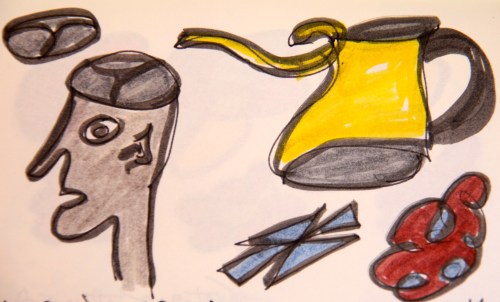
It is never easy to capture oneself and place oneself on the page in readable form. It’s a bit like trying to draw Picasso’s blue vase using only one blue pencil: not easy. It’s much easier to take a selfie with a flashy cell-phone.  Cell-phone selfies are easy, but verbal selfies are what we are seeking for. They take much longer to ‘produce’ and it is only when we finally achieve them, that we realize how difficult they are to actually achieve. But remember, read and re-read my earlier postings: don’t give up; don’t get off the bus!

 

Residency: Thursday Thoughts

Chaos

Residency
Thursday Thoughts
29 June 2017

Application:
I would not have applied for the residency at KIRA had I not have been encouraged to do so by my writing group friends and by a friendly voice on the Kingsbrae phone.

Acceptance:
I was surprised to receive notification of my acceptance. It arrived on 2 March 2017. On 3 March 2017, I started to peruse the Kingsbrae web page and make the first drafts of poems that I would later complete on site.

The Red Room:
I was lodged in The Red Room in the KIRA Residence and I had a small desk at a window overlooking Passamaquoddy Bay. I spent a whole month looking out of that window and writing at that desk … or was it the other way round?

Community Commitments:
These were multiple, but they were always art orientated and therefore most enjoyable. They included working with school children, attending various unveilings and openings, and being present in our studios and discussing our art with visitors. On 26 June we had an exhibition in which each one of us either showed our work or produced a live performance.

Evening Salons:
Most evenings we had a literary / artistic salon in which we discussed various aspects of our art. These lasted two to three hours and some were summarized while others were video-taped. These quick-fire exchanges provided a backbone to our daily work.

Trips:
There was time for local trips and we travelled, individually or in groups, to many places including Deer Island, Passamaquoddy, Campobello, St. Stephen, New River Beach, Holt’s Point, Greenlaw’s Mountain, Jarea, Minister’s Island, Ile Ste. Croix, and several other locations. The photographic records enabled us to build our creativity.

Artistic Development:
This was individual to each of us, but we all remarked on a widening of our perspectives, a new commitment to narrative and theme, and a broadening of our artistic horizons.

Returning Home:
On my return home, I turned to my everyday life in which art, in my case writing, was of secondary, not primary, importance. The need to cook, to shop, to do normal household duties suddenly conflicted, once again, with my need to be a writer.

24/7:
24/7 is indeed a cliché. But for 28 days it became the pattern of my writing life. It was indeed a fertile time. I wrote some 100 poems, 25% of which will be rejected, with a possible thematic structure and three revisions already completed. Sooner or later, I will produce a book about this experience..

Conclusions:
This type of time commitment turns us from budding /artists into the real thing. We must strive to re-create these last 28 days in what remains of our creative lives. There can be no lesser or secondary choice, if we are to be serious about our art.

The Journey:
If we wish to travel from Halifax to Vancouver by bus, we must make several decisions.
1. We cannot get off at Moncton.
2. We cannot get off at Montreal, nor at Toronto.
3. Winnipeg, Regina, and Calgary are beautiful; but we mustn’t get off the bus.
4. If we do, we will never get to Vancouver.

Conclusion:
Art is a life-time journey: don’t get off the bus.


Blockhouse

fundy-05-mistwolfepipers-081

Kingsbrae 19.4
19 June 2017

Blockhouse

We have become comfortable together.
We sit, food untouched on the table,
and play catch-up with our lives.

I tell her about my writing problems
and she tells me about her hopes and
fears for the future now her partner’s
walked out and left her for a younger girl.

Later, I sit in the car while she walks
on the headland by the blockhouse.

Mist covers Passamaquoddy Bay.
There was a time when I thought
she might walk out into that mist
and fade away, but she was strong.

Now I watch her walk away and
know that she’s really here to stay.

Water Tower

IMG_0452

Kingsbrae 19.3
19 June 2017

Water Tower
(for Geoff)

Asked where he got the material
for his plays, Molière said:
“Je le prends où je le trouve,”
“I take it from wherever I find it.”

Here, before the water tower,
I find the tower to be a ground
level water tank, no tower at all.

The first steel band, the horizon,
is composed of yellow lilies.
Above them, the Kingsbrae Café shares
the second band with the gardens’ windmill.

Twin pointed roofs and the windmill’s
thin sails reach up to the skyline
with its background of trees
silhouetted against an egg-shell sky.

Art is in the eye of the beholder
or the artist and can be seen
wherever it can be found.


Waves

IMG_0013

Kingsbrae 19.2
19 June 2017

Waves

Some nights,
the stars leave
their constellations
to walk alone.

The planets, too,
grow tired of company
and shine in solitude.

Where now the Zodiac
and Plato’s Platonic
dance of the spheres?

Who knows why a man
will one day walk out of the house,
and never return?

Who knows why a woman
will abandon her children,
turn her back on her lover,
and look only at the wall?

I only know this: that the tide
is composed of multiple waves,
and that each one lives and dies,
alone on the beach.

Sandman 2

IMG_0052.JPG
Kingsbrae 17.1
17 June 2017

Sandman 2

The sandman brings sand
to put in the sandwiches
we have packed for the beach.
It’s as coarse and fierce as salt
flowing through an hourglass,
or red sand in an egg-timer,
not clockwork and wound,
but the sort you turn upside
down. Sand: it counts each
minute of each day, turns
minutes into hours, hours
into days, sands the stone
block of our lives, like a sculptor,
into smaller, more manageable
shapes and chunks. Sand sticks
to our clothes, makes us wash
our hands and brush ourselves
thoroughly before we sit down
to eat the sand that has sneaked
into the lunch-time sandwiches
we brought to nibble on the sands.

Comment: This is another example of the effects of a rewrite that takes place in a different time and place. The original of this poem appeared in the blog on my father’s birthday, 17 May 2017. Sandman 1 can be see by clicking on the title. A quick comparison shows how the themes have changed an meaning has been deepened in the later version, Sandman 2, published above. I am intrigued by the differences caused by a change of time and place.  There is room for still more development in this poem. It will be un to see Sandman 3, if it evolves further.

Y Ddraig

IMG_0094.JPG


Kingsbrae 15.2
15 June 2017

Y Ddraig

“Here there be dragons!”
The old maps used to say.
A sea-serpent decorated those maps,
a kraken, perhaps, or another monster
drawn from the depths of the unconscious.

In Wales there used to be dragons.
Old massive bones rose to the surface,
long ago, and there were skulls
and other artefacts lurking in the coal seams
that snaked through dark mines.

The fear of dragons is still within us.
We know they can fly in from nowhere,
setting fire to the crops, burning the houses,
killing people in an unequal battle in which
one party can fly while the other
can only run and hide,
or else burn publicly in the open streets,
Guy Fawkes figures in their multiple bonfires,
flaring in those deadly white phosphor flames.

Bonfires and bone-fires:
I have also seen the Cancer Dragon
growing within the human body
and burning the poor patient alive,
from the inside out.

Y Ddraig Coch:
the Red Dragon of Wales:
long may he stay on our flag
and rule the skies from his flagpole.
Those who wish for the dragon’s return
yearn indeed for sadder, madder, darker days.

Comment: Another ‘raw’ poem, but one that I have been thinking about for some time. It was driven from the back to the front of my mind by Carlos’s photo of the dragon in Kingsbrae Gardens. Carlos is my photographer and travels far and wide, taking photos that he then shares with me. I am very grateful to him for this sharing. I usually work my photos on the IMac, but here I am working with a PC that I am only just beginning to understand. There are so many new things happening that it is difficult to keep pace with them all. Oh yes, and this poem is an allegory [a representation of an abstract or spiritual meaning through concrete or material forms; figurative treatment of one subject under the guise of another, definition from dictionary. com], but I am not sure that I know what the hidden meaning actually is.