Time changed with the clocks and my body clock is no longer in sync with the tick-tock chime that denounces each hour.
Hours that used to wound now threaten to kill. They used to limp along, but now they just rush by and I, who used to run from point to point, now shuffle a step at a time.
Around us, the Covidis thrives and flowers. Wallflowers, violets, we shrink into our homes, board up the windows, refuse to open doors. We communicate by phone, e-mail, messenger, Skype.
Give us enough rope and we’ll survive a little while, fearful, full of anguish, yet also filled with hope.
Codes and Coding Where’s Home? (4) A continuing open letter to Jan Hull.
“Languages: they say that to learn another language is to gain another soul and another set of eyes through which to view the world.” I wrote these words on March 23, 2020, on the 22nd day of our Covid-19 lockdown. Why recall this article now? Because Jan Hull talks about Nova Scotian conversational language codes in her book Where’s Home? and her ideas rang a bell and tugged at my memories. CFA, for example, and CBC, and my own invention WAH. Then there are her coffee shop codes of Tim Horton’s and her Burger codes of MacDonald’s, and I mustn’t forget her other small town talking codes of former times and newly named places, must of which are bewildering to the outsider, aka CFA.
Why codes and coding? A rhetorical question, of course. But codes and coding are the basic elements through which language transfers thought, our thoughts. What is a code? Well, we know all about Morse Code and the elaborate codes through which spies from all countries communicate their needs. A code is a way of converting language, changing it, making it available to those initiated in the code and unavailable to those who have not received such initiation. Sounds simple, doesn’t it?
When I was travelling regularly to Spain for research in Spanish libraries, my first port of call was always the local barber shop. I did this for several reasons. In the first place, my Canadian haircut gave me away as a foreigner. This is the hairdresser’s code. The barber’s shop was always the centre of local gossip. Here, buzz words changed hands, politicians were discussed, all the local news was immediately available. Each of these items was a code, a code that made an insider (acceptable) versus an outsider (not to be spoken to). I remember, one summer in Madrid, not getting served in any bar or restaurant. Check haircut: okay. Check shoes: bought new Spanish pair. Check shirt, jacket, tie: all up to date. Inspect lucky customers who are being served … ah … they are all wearing a shiny brass pin showing the symbol of Madrid: El Oso y el Madroño, the bear and the strawberry tree, as seen in La Puerta del Sol.
The next bar I entered saw me sporting El Oso y el Madroño in my lapel. Qué quiere el señor? Immediate service and with a smile. These are social codes, the codes that include the winks and nudges of the upper class, the secret handshakes and foot positions, the names dropped so gently and quietly that they never shatter when they hit the floor. There are also language codes. Northrop Frye wrote The Great Code: The Bible and Literature, a study of the mythology and structure of the Bible, and it was published in 1982. In this wonderful study, Frye showed how themes and language from the bible have influenced the structure of Western Literature, particularly that written in English. Within this code, names, themes, miracles, parables, psalms form a body of common knowledge available to all readers who are christian and whose first language is English.
But there are other codes. Think Courtly Love. Think Petracharism. Petrarch’s poetry, originally written in Italian, was widely imitated throughout Europe. Italian literature, Spanish, French, English, all dip into that code, as does Shakespeare among so many others. Think the Great Chain of Being. Shakespeare is incomprehensible in places unless you unlock this particular code. Think Platonism, Neo–Platonism, Stoicism, Existentialism … okay, so all this is academic, and I do not want to lose you in a sea of academia. So think NFL, think NBA, think NHL, think baseball, think cricket, think rugby, think darts, think all of the things we manipulate on a daily basis in our lives and think how they include some people (those who know and share our codes) and exclude others (those who are unaware of them). LBW, c&b, c. A, b. B, st. A b. B, w, W, b, lb, lbw, dec., RSP … and think of the hand gestures that accompany them! You would have to be an ardent follower of the mysterious game of cricket, as I am, to immediately understand all those letters and signs.
This is a wonderful line of discussion. It follows along the lines of micro-language and macro-language. Macro-language is accessible to all who happen to speak that language. Micro-language in its multidinous forms incarnadine belongs ONLY to those who share the micro community, be it family, household, village, town, county, region … all that is closest and dearest to our micro-hearts.
When I was in Moncton (2015), at the Auberge Msgr. Henri Cormier, I spoke French on a daily basis. Being an academic and a linguist, I was fascinated by the levels of French that were spoken in that small community. Here are the levels I identified: (1) LFI, Le francais international, the central French language that I spoke and everyone understood. (2) Acadian, a beautiful language with regional variations, a different accent and rhythm, and some very different words and phrases. (3) Chiac, the mixed English-French used by the citizens of Moncton, whose wonderful poets are trying to get it established as a literary language. (4) Community French, five families from Paquetville were there and when they spoke among themselves about their home town, references, history, culture were all barriers to those who did not come from Paquetville. (5) Family Groups, and this is easy to understand, for all families have their in-jokes, their coded speech, their conversations that keep the outsider outside of the family group.
It is a fascinating study, that of coded languages, and I thank you, Jan, for re- opening it and reminding me of it.
Between Two Places Dianne Fitzpatrick Where’s Home?
Where’s Home (3) Part III of an open letter to Jan Hull
The Little Things
In 1898, Spain fought and lost a war with America over possession of Cuba. Cuba was the last of Spain’s overseas Empire and when it went, the all conquering fatherland, upon whose empire the sun never set, was reduced to its original territory in the Spanish Peninsula. That same year, the literary Generation of 1898 started a new movement, one that made Spain itself central to its imagery and thought. Theirs was not the Spain of Imperial History, with its wars and treaties, battles and conquests. Theirs was the eternal countryside of Spain, the Spain of Old Castille that was rooted to the soil, and that had remained virtually unchanged in the small towns, fishing ports, and villages, for hundreds of years. This was the Spain of Miguel de Unamuno’s Intra-historia: the history of small things.
St. David, Dewi Sant, the patron saint of Wales, a historical figure flourishing circa 600 CE, is famous within Wales for his many sayings. But for me, one stands out. “Byddwch lawen a chadwch eich ffyd a’ch credd, a gwnewch y petheu bychainmewn bwywd” / Be joyful and keep your faith and creed and do the little things in life. In these times of stress and strain, faced by enormous changes brought about by the pandemic, to these prophetic words I turn.
Poets, creators, artists, stoneists, craft-workers of all kinds … we are the antennae of the people. We sense the directions in which life flows and will flow and we are ahead of our times, not behind them. We are the ones who ‘do the little things’, often abandoning larger, more financially rewarding projects in favor of smaller ones that spiritually enrich both us and the people around us. And that is what I am now reading in Jan Hull’s Where’s Home? People, real, live, flesh-and-blood people, many of them artists at heart, abandoning the big city’s rush and rock and roll to enjoy the quietude of small communities which they help to build with their own hands.
Troglodytes, cavemen, people living in the past, I have heard ‘so-called saner citizens’ mutter about some of our contemporary artists. They live off hand-outs and charity and welfare, and they live in the past. Grey-suited, working in concrete boxes, these well-heeled critics are all made out of ticky-tacky, as the old song says, and they work in little boxes, and they come out all the same. Fine fr some, but you certainly cannot say that of the characters who inhabit the small towns, villages, and ports, as Where’s Home? demonstrates so clearly, with quote after quote from contented people, all resident in Nova Scotia, some CFA (Come From Away), others CBC (Come By Choice), and yet others native to the province.
Living in the past … when Hurricane Arthur struck, we went without power for twelve days. No water, no warm food, no cooking, no refrigeration, no flush toilets, no showers, no air conditioning, no television, no Wifi, no internet … In 1928, my grandfather and my father built a summer home, a bungalow, in Gower. I remember, even in the late fifties, living there during the summer with my grandparents: wood stove, rain water barrels, no running water, outhouse, no electricity, no refrigeration, oil lamps … Hurricane Arthur … and Clare and I went back to bungalow living. Several of our neighbors did not know how to cope with the ‘problems’. A couple moved into hotels or stayed with family elsewhere until the crisis was over. As for us, this was the life I was used to as a child. We went into bungalow mode and had more fun than anyone could imagine… living in the past? … or preparing for the future? … Think about it, and don’t jump too quickly to the wrong conclusion.
Above all, Jan Hull’s book, Where’s Home?, has made me think. It has made me think deeply about my own life, my own memories, my own restless, rootless existence, my own attempts to settle and resettle. More, in light of the pandemic with so many working from home, so much home schooling, and so much online back and forth, maybe we, the artists, the returnees, the WAH (Work At Homers), maybe we are not stranded, forgotten, on the back-burners of modern life. Maybe, just maybe, we are the fore-tellers, the front-runners, the pioneers of how a better, more meaningful existence may be created and kept. Thank you, Jan, and please thank all your contributors on my behalf.
“Ah, would some power thegiftie ge us / to see ourselves as others see us.” Robbie Burns, a Scottish Poet.
And sometimes I think the flowers would like to be seen as they see themselves, not as we see them with our imperfect eyes, not with the cataracts of the Elderly Monet, not with the blunted vision of many artists who have stopped, and sniffed, and bent their heads, and wondered at the colors that entered their paint brushes through the nostrils. Vision and reality: the photo versus the objects as we see and sense them. The reality versus our own version of it.
So who is this anonymous artist who delivers these visions to my blog and allows me to glimpse alternate realities that are so different to my realities. I think of Lorna Crozier, The Garden Going on Without Us. I think of Kingsbrae Gardens, at night, when the flowers are alone and talk only to themselves. I think of Monet at Giverny as his vision lessened and his instincts grew. Who are we? What are we? Do we see ourselves as others see us? Do others see what we see? Color, shade, light, hue … El ojo que ves no es ojo porque lo ves, es ojo porque te ve / the eye you see is not an eye because you see it, it is an eye because it sees you (Antonio Machado). Does the man or woman looking out at us from the television set see him or herself as we see them?
The night before last I sat alone in a hotel room. The television screen was much, much wider than it was high. All the facial images were greatly distorted. I didn’t recognize the people I saw, except by their voices. Who will distinguish the reality of the flowers, each by each and one by one, privatim et seriatim? Who will listen to their floral voices and call them by the names they have given themselves, rather than by their horticultural names?
Tell me, what reality do we see when we see the flowers? What reality do the flowers see when they see us? The anonymous painter who painted this picture that Geoff Slater, my anonymous friend, framed so nicely did not see those flowers the way that I saw those flowers. Why not? Why can’t I see like him (or her)? and why can’t she (or he) see like me?
Don’t look out the window, you don’t want to know what’s lying out there. Don’t look out.
Play ostrich. Place your head in the sand, pretend there’s nothing there to worry you. Pretend you can see the missing PPE, the vanished masks, the surgical gloves, the sanitized hand-wash that everybody needs. Just don’t look out the window. Don’t look out.
Pretend there’s nothing out there. Deny that nearly two million people are ill. Deny that a hundred thousand have died, not in vain, but from ignorance and vanity and a total denial of scientific truth. Just don’t look out the window. Don’t look out.
Just look at these walls that surround you. Smile back at the smiling faces, the nodding heads, the puppet-string politicians who agree with every piece of nonsense that issues, meaningless, from empty mouths. Surround yourself with people who believe what you believe, who think and do like you, fellow narcissists and bullies, cheats and liars, who have deceived and stolen, lied like you, to build enormous fortunes while they have cheated on their wives, gone bankrupt, and borrowed shady money in questionable deals with shabby, foreign banks. Don’t look out the window. Don’t look out.
All those employees know a bum deal when they are on the sharp end of one.
But nobody speaks out and nobody, but nobody, dares open those curtains for fear of seeing that reborn beast, its hour come at last, slouching down the streets. Close your eyes. Don’t look out the window. Don’t look out.
Comment: I rarely comment on political events, let alone write poems about them. That said, I do not consider this poem to be a political statement. For me, the key to the poem can be found in the final five lines beginning with ‘for fear of seeing …’. I have explored inter-textuality before in these pages. I hope the reference to W. B. Yeats’ poem The Second Coming, is clear.
“Write about that chair,” Margie said,
and I wondered what was in her head.
How can I write about that chair
when those who sat in it are not there.
Before the coal fire my grandfather sat,
snoring away, on his lap slept the cat.
At three years old, I climbed that chair,
and blew on the bald spot in his hair.
So many things we no longer know:
my grandpa did the same thing, years ago,
and years before that, his own grandad
did just the same to make his old man mad.
Now I, in my turn, when I drink deep,
like to sit in that chair for a little sleep,
and my grand daughter, there’s no grandson,
climbs up that chair, as others have done,
and sees the bald spot in my hair
and blows and blows as I snooze there.
The years roll back and I see the smiles
of generations woken by a young child’s wiles.
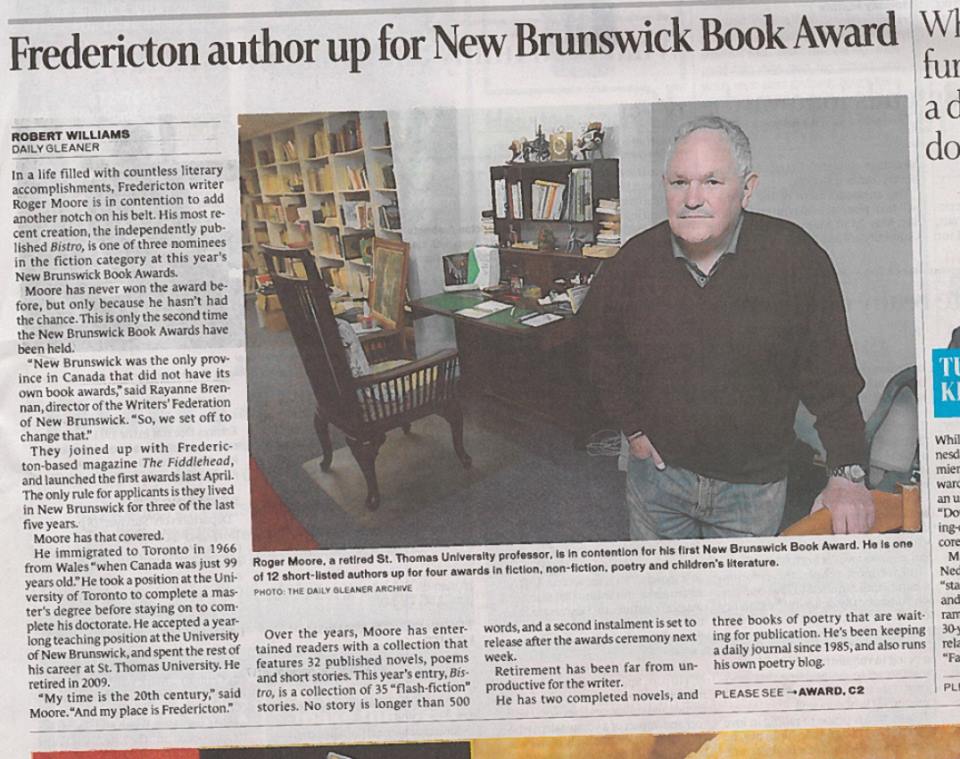
Comment: Talking the other day, I mentioned my grandfather’s chair, the only piece of furniture rescued from my parents’ house, and Margie said I had to write a poem about it. So, last night I did. The result is something very different from what I normally write. This is what in Spanish is called an occasional poem and it celebrates a specific occasion, a specific set of circumstances. Thus, it is written under different rules, rhyme, rhythm, stanzas. It is always an adventure to write something suggested by someone else. Poems like this cross the boundary between poetry of play (which this is) and occasionally enter the realm of poetry that expresses the authenticity of being which, to a certain extent is present in this poem too. The above photo, from our local newspaper, The Daily Gleaner, is the only one I have of the chair which resides in the basement where I keep my books. The article is an old one (2017), but the photo is nice!
When I was very young, a long time ago, in Swansea, many of our streets still had gas lamps. The lamp-lighter would appear in winter around three or three-thirty to light those lamps. I remember him walking up the street with his long pole over his shoulder, moving from lamp to lamp. We had one outside our front door. He would turn on the gas, then light the lamp from the lighted wick at the end of his pole. Sometimes he carried a ladder with him. Then, every so often, when the lamp needed tending, he would climb the ladder and adjust the wick. These gas lights were not very bright but they stood out like light houses between stretches of darkness and we would walk from pool to glowing pool, as if they were stepping stones leading us up the hill to home. We all knew the lamplighter and he would often wave to us as we sat in the front room window to watch him walk by. We rarely saw him in the mornings when he came back to turn off the lamps. We were all tucked safely into our beds. I remember that I wanted to be lamplighter. Later I realized that there are many ways to light a lamp and spread brightness through the world. When I grew up, I became teacher, a coach, a faculty adviser, a mentor, a creator, and those roles allowed me to establish myself as a lighter of a very different set of lamps.
… bends like a boomerang,
flies too rapidly away,
limps back to the hand.
Endless this shuffle of unmarked
days dropping off the calendar,
extinct so many animals
that exited Noah’s Ark.
Hands stop on the clock.
The pendulum swings:
time and tide stand still,
do not move.
‘As idle as a painted ship
upon a painted ocean.’
The print in my grandma’s house:
seemingly moving seas,
sails swelled out,
the ship stays firm in its frame.
Our garden fills with birds
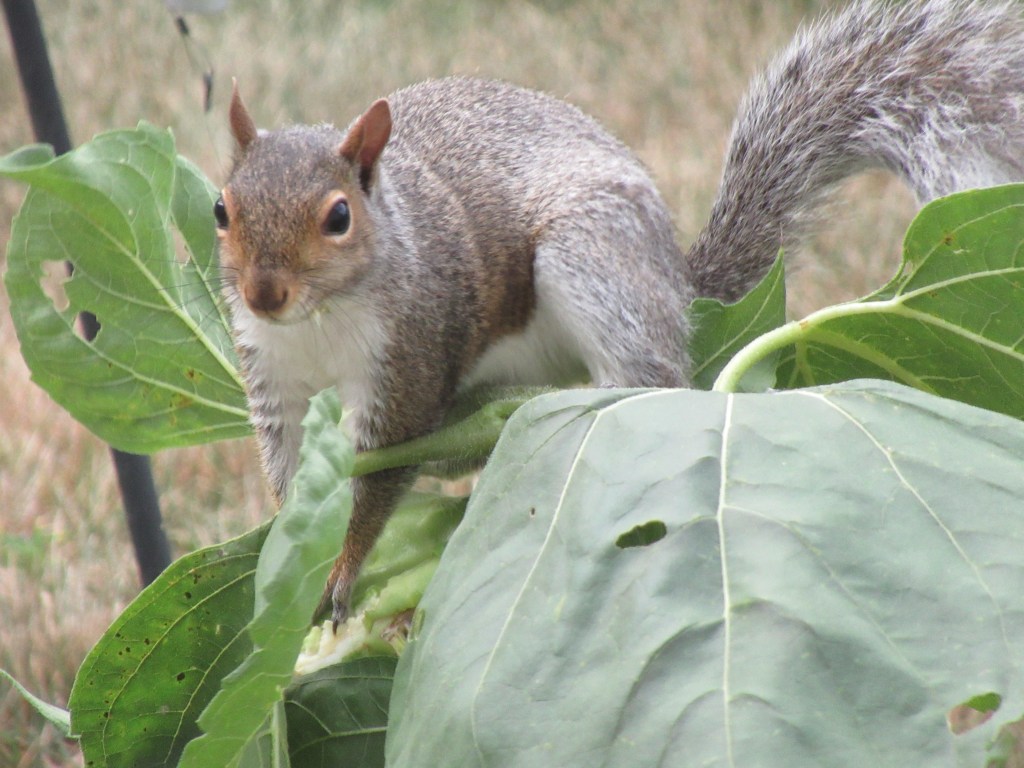
and squirrels, light and dark.
Morning ablutions: each day
a twin of the day before.
The TV screen fills up its washbasin:
tired, shadow faces boring us
with endless wit and wisdom.
Time flies:
an albatross around the neck,
an emu, an ostrich, a dodo,
all flightless,
an overweight bumble bee,
too clumsy, too heavy to fly.
Comment: The top photograph shows the year 1555 marked in standard figures and in glyphs from the Mixtec calendar (Oaxaca, Mexico). … time flies you can’t they fly too fast … This is a conundrum from the General Knowledge Paper in the school leaving exams (1961). Punctuate this sentence: time flies you can’t they fly too fast … Proposed answer: “Time flies? You can’t. They fly too fast!” I seem to believe there were about ten of these on that paper. However, never trust your memory.
The second photograph shows fledgling storks in Avila, Spain, trying to fledge, to fly, to leave their nests. Some will succeed earlier than others. Those who do not manage to fly, who are not brave enough to leave their nests, will sit there. After a while, their parents will not feed them. And then they must fly or starve. Sometimes, time flies. Sometimes, time sits on its hands and the clock hands refuse to move. Think: time enjoying yourself (it just flows by). Think: time in the dentist’s chair with a root canal, time lying prone having an anal biopsy for prostrate cancer, time spent, those everlasting ten minutes, while a cataract is being removed and a new lens is inserted.
Oh yes, time is flexible. Not only is it flexible, it is insistent, inexorable, unstoppable. Those clocks tick on, whether we are awake or asleep. The seconds lull us with their security, the minutes lull us with their monotony, hours lull us with their harmony, days faze us, daze us … hours: each one wounds, the last one kills. Time marches on. We can rewrite the past (revisionism), but we cannot relive it, except in our dreams.
I sense the rust in her mind’s clockwork
clogging her brain, slowing down thought.
I watch her search for words, stumbling through
sentences. “Wind up the flowers,” she says
handing me the key for the grandfather clock.
When she says “water the clock” I receive
the plastic watering-can meant for the flowers.
Fellow travelers, we journey side by side on life’s
train. I watch her as she looks out of the window
at the passing countryside with its tiny stations.
She frets as she clasps her weak hand in her strong
one and I realize she’s worried because she no longer
knows when, where, or how the journey will end.
Comment: I wrote this originally in memory of my grandmother. However, as I have been involved in the rediscovering / revision / rewriting of older poems, I have come to realize that, as our visions change, our poems become more accessible to a wider audience. In other words, given what is happening right now with the pandemic, none of us know when, where, or how the journey will end. This leads directly into the twin themes of the fragility of life and the nature of memory. What do we remember? Why do we remember a particular incident? Did it happen just as we remember it or have we already doctored our memories, re-creating them, so to speak.
I have a clear memory of seeing Sir Frank Worral batting at St. Helen’s in Swansea, when I was about 11 years old. A close friend of mine, an outstanding cricketing historian, checked the details in Wisdenand told me that Frank Worral wasn’t playing in that match, so I couldn’t have seen him batting. And then there was Sir Everton de Courcy Weekes: I swear a saw him score a century at Bristol, yet, again according to my friend who checked the records, he only got fifty in that game! Games: what mind games the mind plays with us as we age. So, do I go with the fantasy land of my memories in which much has been (re)-invented? Or do I go with the world of truth and checkable reality? As an academic, I lived in the latter world: research, check, double check, avoid expressing personal opinions, facts, facts, facts, and exact dates. As an ageing poet, I would much rather live in that former world where truth and reality march hand in hand with fairy-tale and fiction, a little bit of one and a smattering of both.
How far is from fairy-tale and fiction to the dream world we inhabit at night? Just a short step, I reckon. Sometimes I remember my dreams and write them down when I wake up. Sometimes they vanish and I can only recall some vague feelings of joy and anguish. And what is life, that fragile, dream-like reality? Is it really a dream, as Segismundo tells us in Calderón’s La Vida es Sueño? Or is it a real world? And if it is real, do we create that reality or do we dream it? And if we dream it, do we sleep walk, sleep talk, sweet talk our way through it? Or do we portray it just like it really is, with no creativity, just a factual repeat of reality as we know it?
¿Qué es la vida? Un frenesí. ¿Qué es la vida? Una ilusión, una sombra, una ficción, y el mayor bien es pequeño, porque toda la vida es un sueño, y los sueños, sueños son.
What is life? A frenzy. What is life? An illusion, a shadow, a fiction, and the greatest good is small, because life is a dream, and dreams are nothing but dreams, after all.





 rogermoorepoet