I remember pushing my father around the ward. Two weeks we had together. He sat in his wheel chair and I wheeled him up and down.
“Cancer, ” they told me. “But it’s kinder not to let him know.”
In those days, it was better to die, without knowing why. Did I betray him by not letting him know what I now need to know?
One day, he begged for help and I lifted him onto the toilet. He strained and strained but couldn’t go.
“Son,” he said, sitting there. “Will you rub my back?” How could I say no?
That strong man, the man who had carried me on his back, and me standing there, watching him, trousers around his knees, straining, hopelessly, and me bent over him, rubbing his back, waiting,
Seize the day. Squeeze this moment tight. Nothing before means anything. Everything afterwards is merely hope and dream.
A tiny child, you chased wind-blown leaves trying to catch them before they hit the ground. Elf parachutes you called them and trod with care
so as not to crush the fallen elves as they lay leaf-bound. I stand here now, a scarecrow scarred with age, arms held out, palms up, in the hope that a leaf
will descend, a fallen sparrow, and rest in my hand. When one perches on my shoulder and another graces my gray hair, my old heart pumps with joy.
I remember pushing my father around the ward in the hospital. Two weeks we had together.
My father sat in his wheel chair and I wheeled him up and down.
“Cancer,” they told me. “But it’s kinder not to let him know.” In those days, it was better to die without knowing why. Did I betray him by not letting him know what I now need to know?
One day, he begged me for help and I lifted him out of his wheelchair and placed him on the toilet. He strained and strained but could not, would not go.
“Son,” he said, sitting there, “Will you rub my back?” How could I say no?
That strong man, the man who had carried me in his arms, on his back, and me standing there, watching him, his trousers around his knees, straining hopelessly, and me bent over him, rubbing his back, waiting,
for him to go.
Comment: Thank you, once again, Alejandro Botelho of Diverse TV. This was a great reading. If you, dear reader, are interested, you can listen to it HERE. Alejandro’s reading of my poem begins at 40.52 and ends at 42.33. But remember, the other poems are also well worth listening to and Alejandro has a great voice and wonderful interpretation. A further comment: first there is the text. Then there is Alejandro’s excellent reading. Then there is my own reading. From each of these the observant reader and / or listener will extract a slightly different emphasis and meaning. In my own case, following Alejandro’s reading of the original text, I have added some minor changes, to add to the intertextual rhythm of the words. Tolle, lege et vade mecum. A Cancer Chronicle is available HERE.
Jackson Pollock it ain’t. But just look at those fledgling storks launching themselves into the air. And yes, those are their nests!
Spotify Scroll down to appropriate episode.
Bird’s Nest Jackson PollockNo5 (1948)
This bird’s nest starts with a startling tweet that wins a trilled, thrilled response. A flutter of heart-string wings, creator, viewer, join
with the creation. Thin threads of life mix and match their tangled weave, existential tapestry, fathered in a feathered nest.
World without end, this labyrinth without an entry point, without a beginning, with a spaghetti-thread middle that meets
not in a breath-catch of the mind, but in a brush-flick of coloured rain, a cycle recycled of circled paint, circular
in its circumnavigation, its square eight by four-foot globe of a new world whirled in stringy whorls, reinvented beauty
drawn haphazardly from the bicycle tour de force of this artist’s inner mind.
Comment: This is a tongue-twister of a poem, much as Jackson Pollock’s painting is a twisted vision twisting the viewer’s eye. And, no, it is not easy to read. Nor is the painting easy to view. Click here for a link > Jackson Pollock < to the painting. Click here for a link to Alejandro Botelho’s reading of < My Grandfather >. Note that Alejandro’s reading of My Grandfather begins at 17.58. And note too that the other poets are also well worth listening to. Once again, thank you for this, Alejandro: your work is very much appreciated.
Spotify Remember to scroll down to correct episode.
My Grandfather
My grandfather gave me my first sewing lessons. He sat before the kitchen fire and put a grey wooden darning mushroom inside the sock, stretching woolen threads to expose the hole.
He chose with care his colors: bright yellows, oranges, reds, sky blues, anything that stood out against the sock’s dark rainy-day drabness. If the socks were thin, he split new wool, pulling it into individual strands that he would dampen with his tongue. Then he would thread the needle.
Wool in place, he would cross-hatch the sock’s hole, slowly forming a life-raft that he’d fill with color. All my life, I have darned socks, sewn buttons, and mended my sweaters. I use bright colors, to my friends’ dismay. I still have my grandfather’s World War One sewing kit, all wrapped up in a canvas bag with his needles and some wool.
It’s wonderful to touch where his strong hands were. There are dark blood traces where he pricked his thumb and deeper stains where he sewed up wounded friends.
Comment:My Grandfather, the poem, is available on DiversityTV where it is read by Alejandro Botelho. Thank you, Alejandro, for a great reading and a fine interpretation of this poem. Click here > My Grandfather < for Alejandro’s reading. Note that My Grandfather begins at 13.30. Note too that the other poems on this site are worth listening to as well.
This is another academic word that has a simple meaning. In essence, it means texts talking to texts. Quevedo (1580-1645) writes ‘escucho con mis ojos a los muertos’ / ‘I listen with my eyes to dead men.’ He is suggesting that, each time we read a text written by another person we enter into a dialog with that text and that author. His metaphoric conversations with the writings of the long-dead Seneca become intertextual the moment he put pen to paper and wrote about them.
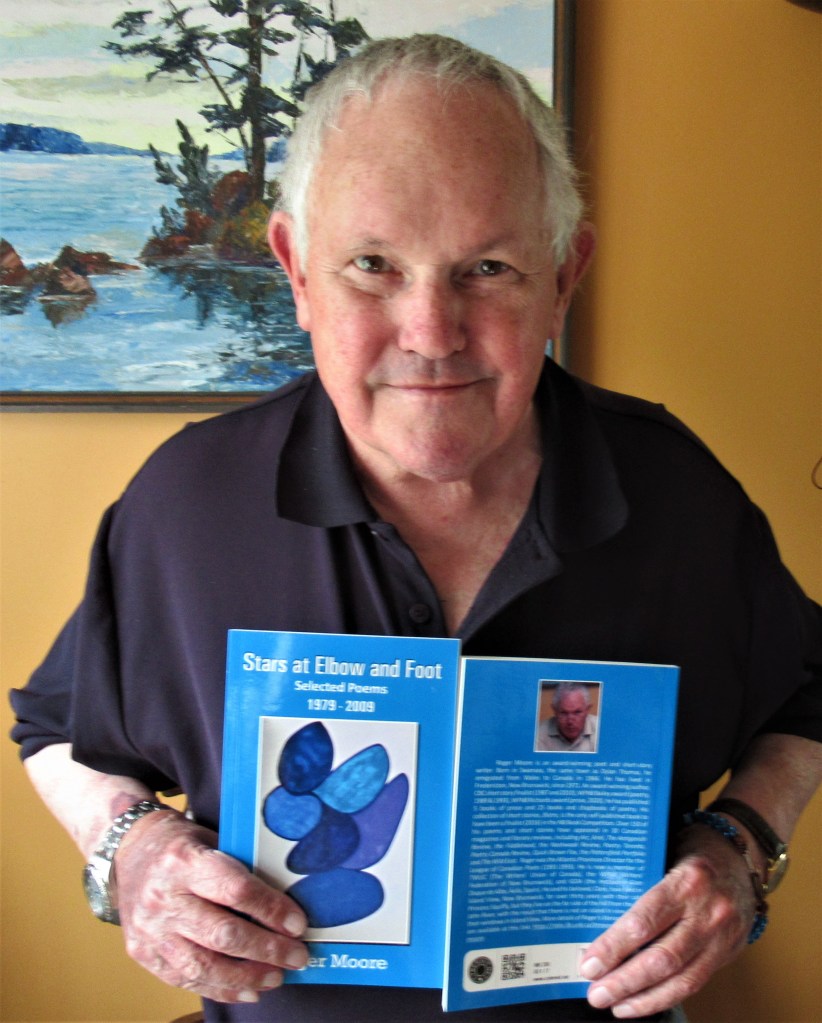
This intertextuality is a key component of my writing. You may not recognize all the phrases that I have used previously by other writers. I do. Some other readers will. Just take, as an example, the titles of some of my earlier books. The title of Broken Ghosts(Goose Lane, 1986) comes from these lines penned by the Swansea poet, Dylan Thomas (1914-1953). ‘Light breaks where no sun shines; / where no sea runs, the waters of the heart / push in their tides; and, broken ghosts with glow-worms in their heads, the things of light / file through the flesh where no flesh decks the bones.” Stars at Elbow and Foot, the title of my Selected Poems (Cyberwit.net, 2021) was also inspired by one of Dylan Thomas’s poems. “And death shall have no dominion. Dead men naked they shall be one with the man in the wind and the west moon; when their bones are picked clean and the clean bones gone, they shall have stars at elbow and foot.” The title of Though Lovers Be Lost (Kindle, 2016) also comes from this same poem, one of my favorites, obviously.
Sometimes readers are aware of these intertextual clues that I sow throughout my poems. Sometimes not. It doesn’t matter. There is a resonance in such chosen words and that resonance is there, irrespective of whether you are aware of the word-source or not. That said, the recognition and acknowledgement of intertextual relationships expands the poetic meanings of the creative world even further. It also establishes verbal links between author and author, epoch and epoch, genre and genre, thus establishing a wider intertextual network and a stronger chain of linked literary thoughts and meanings. In our creative journeys, we rarely walk alone, whether we are aware of it, or not.
The art of writing poetry about paintings is known as ekphrasis – which basically just means a verbal description of a visual work of art, whether it’s real or imaginary. The conversion of the visible (painting) to the printed page (verbal) is another link in the great chain of intertextuality, for paintings, too, are narratives with a different form of text. Other component parts are audible to verbal (alliteration, onomatopoeia), touch and feel (tactile) to verbal (as in synesthesia or the mixing of the senses) and the transfer of taste to verbal forms. Many of these transitions and transformations are present, not only in my own poetry, but in surrealism (verbal and visual) as well.
Dawn from the Red Room at KIRA. Another form of birth.
Spotify Remember to scroll down to the correct episode.
The Origin of the World Gustave Courbet L’Origine du monde
The origin of the world and where I came from, her deep, moist cave that cast me from dark to light. She loved me, she said, depriving me of her warmth, leaving me to go back to her lover, loving him more.
Was it guilt that drove her to drinking whisky? A forty-ouncer a day at the end, sometimes more. She would wake in the night, wander the house, banging against chairs, tables, walls, and doors.
She ran up bills in local shops, and the keepers would dun me for the money she owed. She also borrowed cash and some days her fingers were bare. She left pawn shop IOUs on the table and I drove
into town to redeem her rings. Once, in a drunken frenzy, she cursed her only child. A mother’s curse is a terrible thing. Living albatross, it claws lungs and heart. Its weight drove me to the bottle. I too sought oblivion.
Joy came when blackness descended, the albatross flew, amniotic waters rocked me in warmth and comfort, and my body’s boat floated once again on an endless sea. Reborn each day, mornings cast me back from dark to light.
Comment: Here is the link to the DiversityTV reading of The Origin of the World. The Origin of the World begins at 28.40. I will attach my own reading from Spotify, just as soon as I complete it. I always find it fascinating to compare the way others read with the way I do. meanwhile, I would like to thank Alexandro Botelho for his invitation for me to participate in his DiversityTV show. I enjoyed his reading very much and I wish him all success with this venture.
Spotify Don’t forget to scroll down to appropriate audio episode.
Ginger Marcinkowski (KIRA, August, 2019)
“My walk each morning, rain or shine, feathers my black galoshes with dewy grass. There I would ramble through gated doors that kept out the world and sealed in my pen’s work for that day.
I often found myself sidetracked, exploring paths that led through flowerbeds, and up to my favorite sculptures. I paused to watch my fellow artists as they focused on chosen subjects unaware that I was eavesdropping.
Then silently, I would steal away along the well-trod path to my studio, pausing long enough to greet the llamas and baby goats. If I listen carefully I can still hear their bleating.
In wonder, every day, I climbed the steps of wood that led to my studio, opened the door, and turned to breathe in my good fortune. “What a blessed woman you are,” I would tell myself before taking my place for hours on end at my desk, each moment, each stroke of the pen, each letter added to the growing lines on the page, a gift.”
Comment: I have been writing poems about the KIRA artists as part of my next poetry book, The Nature of Art and the Art of Nature. This is my KIRA2021 project. The Nature of Art is a revision and expansion of a poetry manuscript of the same name that placed second in the WFNB’s Alfred G. Bailey Award (2020). This poem appears in the section entitled Impressions of KIRA Artists. Currently this section contains eleven poems, but it is still under construction. This poem is interesting in that it is a ‘found’ poem, in the sense that Ginger wrote these words to me in an e-mail. I removed them, reordered them, polished them, and sent her back her own poem in her own words. What fun! This should help explain the use of inverted commas at beginning and end, for this poem is spoken in Ginger’s own words.
Remember to scroll down to appropriate audio recording.
Cage of Flame
Now you are a river flowing silver beneath the moon. High tide in the salt marsh: your body fills with shadow and light. I dip my hands in dappled water. Twin gulls, they float down stream, then perch on an ice-floe of half-remembered dreams. Eagle with a broken wing, why am I trapped in this cage of flame? When I turn my feathers to the sun, my back is striped with the black and white of a convict’s bars. Awake, I lie anchored by what pale visions fluttering on the horizon? White moths wing their snow storm through the night. A feathered shadow ghosts fingers towards my face. Butterflies stutter against a shuttered window. A candle flickers in the darkness and map in runes the ruins of my heart. Eye of the peacock, can you touch what I see when my eyelids close for the night? The black rock of the midnight sun rolled up the sky. Last night, the planet quivered beneath my body and I felt each footfall of a transient god. When will I be released from my daily bondage?
Oh dear, I no longer know whether I am writing poetry or prose. Maybe I should contact Survey Monkey and have a survey on the subject. Clearly the above is prose because it has no line breaks. But what happenswhen we do this?
Cage of Flame
Now you are a river flowing silver beneath the moon. High tide in the salt marsh: your body fills with shadow and light. I dip my hands in dappled water.
Eagle with a broken wing, why am I trapped in this cage of flame? When I turn my feathers to the sun, my back is striped with the black and white of a convict’s bars.
Awake, I lie anchored by what pale visions fluttering on the horizon? White moths wing their snow storm through the night. A feathered shadow ghosts fingers towards my face. Butterflies stutter against a shuttered window. A candle flickers in the darkness and maps in runes the ruins of my heart.
Eye of the peacock, can you touch what I see when my eyelids close for the night? The black rock of the midnight sun rolled up the sky.
Last night, the planet quivered beneath my body and I felt each footfall of a transient god. When will I be released from my daily bondage?
Sure, it’s the same text. But is it? And what happens if we change the line breaks? Does the rhythm stay the same in both cases? It certainly does when I read it, but how about you? Poetry or prose? Tell me if you knows! And what’s the difference anyway if the words roll off your tongue and metaphors, mystery, and magic rule?
Cage of Flame can be found in my poetry collection Though Lovers Be Lost and also in Stars at Elbow and Foot (Selected Poems, 1979-2009). Both are available at this link.







 rogermoorepoet