People of the Mist 2

img0137_1

People of the Mist
6:00 AM

… dream worlds circle outside the window in a starry sky where two moons float …  inside the bedroom, grey scalpels shaved from black obsidian inscribe red gashes on white-washed walls … the slashes turn into tulips that scrape sharp fingernails across the paint and send blood scuttling down to the floor … against a background of granite and trenchant shadows, twisted dancers, themselves old warrior kings bend themselves into pipe wire shapes as they struggle to escape their carved imprisonment … around and above them, the temples of Monte Albán tower and threaten … high priests in long black robes gape at the sky from their sanctuary in the observatory as three young women walk at an angle up the pagan temple steps … when they reach the top, a moonbeam holds them in its spotlight and they wax with the full moon’s beauty …  the doorway to an unclosed grave opens its crocodile jaws and three women descend the temple steps, ageing as they walk … they enter the tomb’s dark mouth … an old man in a faded suit follows them in … the grave swallows them and buries them in the hidden depths beneath the mound …

Down below, in the courtyard of Tim’s residence, the handy man tumble-dried a TV ad in the washing machine of his song sparrow throat. He gargled with gravel and churned stony lyrics skywards until they grated at Tim’s bedroom window and tried to drag him from his dreams.

… dream shadows back themselves into a cul-de-sac, a wilderness of harsh black scars … Tezcatlipoca catches Tochtli the Rabbit by his ears and throws him against the second sun that sizzles in the sky … his sharp teeth burrow, burying themselves deep in the fire’s red light … the second sun loses its fire and turns into the cold stone of the moon …  Tochtli’s face, the rabbit  face of death, simmers in the moon’s dwindling pool … a white rabbit, pursued by death’s hounds, scampers down a narrow escape tube through the deep dark tunnel of an earthen throat that allows him to escape from the hunter’s teeth …

… with a clicking of claws, knitting needles come together to lift the dreamer outwards and upwards towards death’s golden guillotine floating in the sky … the moon sharpens its knife edge on the keening wind and sets the dreamer’s blood tingling from toes to head … the dreamer desires to be free, free from those nightmares, those nocturnal visions that rise up from the past and stalk him as he lies in bed … he longs for the alarm clock to shuffle its pack of sleepless hours and to waken him with its piercing shriek as it tears him from these winding sheets, these grave clothes in which he lies … he  waits for the sun to shine into his window … he wants it to waken the bright jungle parrot that sleeps in the yard so that querulous caged voice will scatter night’s drawn curtains of clouds and drifting dream ….

The first waves of sunlight broke over the houses and Tim’s dreams began to fade. As the new day dawned the black bat of night flew back to its distant cave. Light fell, in the yard below, on the parrot’s cage where the bird clung to the bars, and “¡Loro, loro! I’m a parrot!” the caged bird shrieked at the sky.

New visions crawled out from the vellum codex left open last night on the table and red and green gods with black and white masks crawled through Tim’s drowsing mind. He linked them together with lines and arrows and made a silent vow that his life would never again be scarred by their furrowed frowns and secretive smiles.

The day’s first rocket climbed its ladder of sky to fizzle and smash at the gods’ front door. A second rocket extracted him like a tooth from the socket and drew him fully into daylight. The third explosion sounded much closer and a fourth rocket soon surged skywards. The fifth and sixth rockets were two fiery giants with arms reaching up to claw with their fingers at the sky.

Tim thought about getting up to see if the rocket delivery mailman was one of his neighbors, but last night’s mescal still swaddled him in lullabies and he couldn’t get out of bed.

… whoever the man is, the half-dozen rockets he has purchased have been expended now and he’ll soon be home ... maybe I can roll over and go back to sleep …

As Tim thought this, he heard the swoosh of the seventh rocket.

“Seven,” he said out loud, sitting up in bed.  “That means five more. Nobody buys a dozen rockets, unless it’s something very special.”

Tim pulled back the sheets and swung his legs out over the side of the bed. He looked out of the window. Down below him, in the street, his friend Alonso, the archaeologist, walked side by side with El Brujo, the witch doctor. Alonso held a bunch of rockets in one hand while El Brujo opened and closed a box of traditional Oaxacan wax matches. Alonso readied a rocket in his right hand and El Brujo scratched match against sandpaper and applied flame to the rocket’s blue paper. With a flash and a whoosh, the rocket soared into the air.

Alonso and El Brujo stopped, looked up towards Tim’s window, and waved.

“Come down and join us, Tim,” El Brujo called. “We’ve got a surprise for you. There’s something we want to tell you.”

Tim saw three women and a man in a suit turning the corner at the end of the street. The shadows they cast in the rocket’s red glare were those of sinuous worms slithering along the cobbles. Tim shook his head in disbelief and moved away from the window. A sudden nausea gripped him. He went to the bathroom, gagged, knelt before the toilet bowl, put two fingers down his throat, and threw up. Six wrinkled worms swam round and round leaving a thin, yellow smoke trail in the flush’s whirlpool.

Tim got to his feet and hurried back to the window but the street was empty. Before he could turn away, rockets number eight and nine climbed out of unseen hands and soared upwards to knock in mockery on the doors of the celestial gods.

People of the Mist 1

IMG0137_1.jpg

People of the Mist
Oaxaca, Mexico

Prologue

 I saw my father this evening. I walked through the zócalo, opened the main cathedral doors, looked up, and there he stood, motionless. The lights shone on the engraved glass panels and illuminated him, as if he were some long passed saint come back to visit me. We stared at each other, but I couldn’t open my mouth to speak. The hairs on my neck stood on end and my hands shook. When I forced my mouth open, words stuck in my throat. He wore his best grey suit over a light blue shirt and a dark blue, hand woven tie. This was the outfit in which I had buried him.

Three old women, dressed in black, broke the spell. One stood in front of me and wouldn’t let me approach my father. She held a large bag of knitting in her hands and the wool spilled everywhere as she pushed me away. The second threatened me with a pair of scissors that she held in her left hand. The third shook a tailor’s measuring rod in my father’s face.  He nodded, smiled sadly, and they all turned their backs on me and hurried away out of the cathedral and into the square.

 I stood there in silence. Then, as the door snapped shut, I pulled it open and ran after them. The setting sun filled the square with shadows that whispered and moved this way and that, as if a whole village had come down from the hills to walk beneath the trees and dance in the rays of the dying sun. I stood on the cathedral steps and called out my father’s name, but I could see no sign of him among the cut and thrust of the shadowy crowd.

 I ran out into that crowd and pushed at insubstantial people who stood firm one moment and then melted away the next like clouds or thick mist. I came to a side street and saw real people, flesh and blood beings, a group of villagers grouped behind their band. I stopped as the village elder put a live match to the taper of the rocket he clutched between his thumb and forefinger. The taper caught on fire and as the rocket roared upwards the village band started to play a military march. Thus encouraged, the rocket clawed its way into the sky to explode with a loud knock on the door of the gods.

 Tired of grasping at shadows and afraid of this living phalanx of men marching towards me I went back to the cathedral and knelt at the altar of La Virgen de la Soledad, the patron saint of Oaxaca. Real wax candles stood before her altar, not tiny electric bulbs, as there are in some of the smaller churches. I put five pesos in the slot and lit a fresh candle from an ageing one that had started to sputter. For the first time in years I said a prayer, first for the soul I had saved from extinction by lighting my candle from his flame, then for my mother, then for the real father whom I had never known, and finally for the man I had just seen.

 Tim closed his journal, screwed the top back on his Mont Blanc pen, laid it on the table, put his head in his hands and sat there, thinking. Then he got up, went to the kitchen, opened his last bottle of Sol de Oaxaca, poured the quarter litre that remained of the mescal into a glass. Six wrinkled worms floated down through the yellow liquid wriggling as if they were live. He pulled them out with a spoon, popped them one by one into his mouth and swallowed them whole. They tasted of smoke and garlic but he knew they would bring him visions and dreams. Then he wrinkled his nose and swallowed the mescal in three fierce, burning gulps.

He coughed, blinked the tears from his eyes and went into the bedroom where he undressed and climbed into bed. The ceiling fan droned on and on like a large propeller on a long-distance flight. Sleep did not come easily, nor did dreams, in spite of the mescal. When the dreams did come, they built like thunder clouds and he entered them with fear and a strange kind of joyous expectancy.

Comment:
This is the prologue from my first novel, People of the Mist. Following in the footsteps of my two blogger role models, Meg Sorick and Mr. Cake, I will publish People of the Mist, chapter by chapter, on this blog, as I revise it. I am a poet, rather than a novelist, as you will see. Your comments will be welcome as I start this venture in the old year (2016) and plan to continue through the new (2017).

Were you the one … Flash Fiction

IMG_0240

Were you the one …

… were you the one who awoke that morning at my side and heard with me the hammer blow fall on an echoing anvil in Oaxaca, in the central square when the rope slipped off the church bell and the priest and an altar boy, an acolyte dressed in black and white with a nut brown face, climbed into the church tower and when the priest said “now” the little boy struck the hammer against the bell’s anvil and “again” said the priest, and “again” and the cracked church bell lurched into its hourly cry of grief and morning, seven blows on the anvil, and a stray dog barked at those domestic birds whose beaks dug deep for the sun at dawn on our neighbor’s rooftop …and a cockerel cried out in the early morning, “cock-a-doodle doo, wake up you sleepy heads, wake up, do,” and the roosters found daylight buried in parched earth, and brought it skyward shining on their beaks, as thin cracks sprang out from the egg-shell sun like crazy paving as the yellow yolk of sunshine crept out from the cobbles down in the street and the Russian egg cup, doll after doll, unfolded daylight as the hammer’s silver spoon descended once more on this frail, egg shell world as our dreams shattered … and where now are those dreams of moonlight raked from a village pond as the orange spilled its life-blood to fill our crystalline goblets with its thick rich morning liquid as fierce and sweet as sunshine sacrificed on a branch and rain from a far-off cloud speckled the tree outside our window with radiance and a thousand rainbows all held in tiny diamonds that balanced and swayed at the branch’s edge then trickled and fell to form freckling pools between the cobblestones and even there the arco iris was multiplied, again and again, a thousand times … and the restaurant next door, with its semi-circular rainbow scarf and below it a painted deer on a decrepit wall, and Cuauthemoc was here, his burnt feet held to the fire that burns within us all, and that mangled man was nothing more than a string quartet of flesh and bone created from a ball of dough and baked in the oven in an earthenware dish with currants for eyes, a raisin for a belly button, lemon rind for a mouth, orange peel for hair, while the white bones stared stark naked from the burnt-out flesh at the end of his perished feet … and the man in the mirrored moon held up his hand to trap the wind as a falling leaf settled in the secret web between index finger and thumb and the cat’s cradle on his fingers bound us together like birds in a spun metal cage … the sparrow’s mighty choir chirped at the roof of the circus tent and animals ran wild all goosey, goosey gander, up and down, and nowhere can I now find my lady or her chamber, for they have gone, and with them went all hope, and hope being lost I ran in circles on the sand, my one foot dragging me inwards, and drawing me closer, ever closer to the rising tide, as night overwhelmed day, and dark soldiers invaded the shadowed beach, and where, oh where, did my little dog go, the dog I lost when he chased a seagull out into the bay and into the quicksand and he never came home and here I am alone in my loneliness wandering like a lost dog in ever-decreasing circles, round and round the central square, without you now, one step, two steps, and who will now tickle me under the chin with a buttercup, and who knows if I’ll ever eat butter again, as the tide climbs higher and the sea grass on the dunes is smooth and brown and cuts like glass with its withered, distorting mirrors of stark, staring eyes standing out in welcoming doorways with dark hands and even darker voices calling me in, again and again “are you looking for love, my love?” and yes, I am, I do seek love, I have always sought it, but I have sought it out in the open street, in the open square, in the fresh air, or indoors, where incense and candles burn, and the sun of god is nailed to his lump of wood or chained to his pillar and the Roman soldiers raise their whips to their lips and their kiss is the kiss of death, and I still search for love and my long lost dog as black eyes penetrate from the blackest paint where Satanic witches spoon salt soup between wrinkled lips, dark open holes for their mouths, and their eyes gouged pits in slatted, wooden faces, and they hover over the deaf man’s table in La Quinta del Sordo or stand shoulder to shoulder with Adam and Eve next door in Hieronymus Bosch’s bourgeois hell of furnace, flame, and factory, where the hot flesh catches fire as the feet are turned to the flame and Cuauthemoc burns, the whole world burns, and my soul catches fire as factories swarm with sparks of black imps, burning, dropping from the skies like fire-flies tumbling in a satanic dance, falling away from the heavenly meadow, lighting a way to the skies and the devil, too, is lost and bewildered, a Guy Fawkes impaled on his wooden stake at the bonfire’s tip and it’s November the Fifth, and the whole world is full of spinning star-sparks burning their Van Gogh holes through the black velvet fabric of the dark night of my still-suffering soul …

Comment:
This is a re-write of what I posted earlier today. It is the same piece but it is slightly shorter, more polished, and better focused. It also now has a clearer narrative line with less jumping between metaphors and a cleaner, clearer sequence.

Dream of Oaxaca

IMG_0165.JPG

Dream of Oaxaca

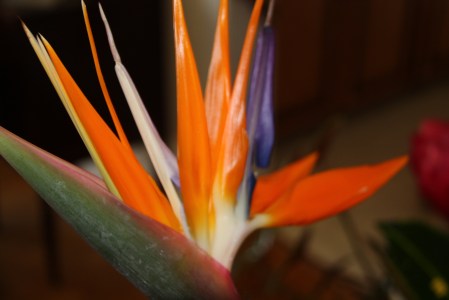
I can bring you a Bird of Paradise, but I cannot bring you the sounds and smells of Oaxaca. The pungent odour of the first drops of rain falling into dry dust, the tang of waxen candles burning in the cathedral’s dark, the high notes sung at the altar by the old woman, dressed in black, who sings each day, on her knees, before the golden images in Santo Domingo: these sounds and smells defy any words I can pen. Nor can I place on the page the bustle of the abastos, the bickering of rooftop goats, the barking and growling of the dogs who patrol the azoteas at head-height and snap at your ears.  Other things escape me: the salty taste of sweat, the heat and heaviness of the midday sun as its hammer falls vertical from the sky, the sandpaper touch of hand-hewn stone, cobbles hard beneath the feet, the visual impact of the revolutionary bullet holes still scarring the church where Benito Juárez got married and reminding the tourists that violence in Mexico is never far away. The silk smooth threads that run through the vendor’s carpets contrast violently with the harsh sharp tares still lodged in hand carded wool. Colors and scents: coffees and chocolates blending and blended in the open air-market, the spice stall with a hundred different kinds of peppers, the golden yellow flower of the gourd — flor de calabaza — as it floats on the surface of spiced soup or lolls luxurious upon Oaxacan cheese or tortilla and quesadilla. Such things are the substance of daily reality: I remember them well, but I cannot gift you with their taste, nor their smell, nor their sound. At night, strings of fireworks hang down the cathedral’s towers and, at the spark of a match, these castillos as they call them, burn. Cataracts of light flicker and flow as rockets claw upwards into the sky to knock on the doors of the slumbering gods. A bull’s head, attached to a wooden frame, bears fireworks that crackle and spurt fire as the bull charges at the gathered crowd. Sparks char cotton and wool, young girls shriek and flee, a striped, carved tiger emerges sparkling from the shadows and his eyes light up with another set of fires … But there is always something missing from these words. How much can I describe? How much am I forced to leave out? How close can I get to an imagined reality that is more imagined than real, more creation than memory? I live in a world that has forgotten poetry. I live in a world that has laid aside the great myths and replaced them with a media that misleads and falsifies. I live in a world in which the power and glory of words is used not to delight and educate, but to manipulate. I live in a treacherous world of lies and deceit, the world of Descartes’s evil genius, for not everything is as it seems to be and the people have been misled. But this world of ours is old, and older, darker powers than ours still dwell on this earth: a pinch of salt thrown over the shoulder, index finger and thumb pinched into a magic circle that wards off the evil eye, the traditional hunchback – el jorobado –, carved from jade, who packs our cares and troubles into his hump and carries them away … as I have been carried away, on this tide of creation that ebbs and flows, a virtual sea, a wave of autumn leaves that washes up to my door, then falls asleep, golden, brown, peaceful in the vacuum that is left by the wind’s sudden absence. So, for a while, after you have read these words, avoid all shadows, do not step on the black lines that divide sidewalk and pavement into squares, do not crush the elf’s dry bones hidden in a fallen leaf, avoid black cats, make sure the crow flies on the correct side of the road …  then find a quiet corner of the street where the leaves dance to the wind’s tune, and fall asleep to re-create your own life in dreams.

The Thin Man

IMG_0183.jpg

The Thin Man

The thin man
looks out of his window
and watches the leaves
as they twist and fall
like they did last autumn.

Golden carpets
spread across the grass
while under the lindens
the slender hands of children
crush flowers into perfume
and interlace bright
threads into tapestries
woven with light.

Will the thin man
give up his secret?

It cannot be clutched
by the camera’s artificial eye,
by the painter’s red squirrel brush,
nor by the tail of the dog fox
held over bandaged eyes.

Cows in the thin man’s
fields are scrawny.

They once walked
wary of the thin man
with his fistful of stones,
his pointed stick,
his sharp knife
and his slant-eyed dogs
that showed off
the basket weave of their ribs
with a rash of gravelly nipples
rippling against the skin
when they ran
snapping and slashing
with ivory fangs
at the frightened cattle.

Now the thin man is dying.
His cattle graze in peace.
His spirit wants to slide
through a gap in the cactus fence
and wander celestial pastures.

“I will light a fire,”
the witch doctor says.

He begins with the glow-
worm of a match.

That small flame smolders
as he breathes life into
shavings and dry bark.

Stars reach out
with tender hands.

A new spark walks
among the constellations.

The goats on the roof
grow grey with age.

Beside them,
a dappled donkey brays
as the thin man’s spirit
sets out on its journey to the stars.

A herd of seven goats, the Pleiades
rise above the sacrificial mound.

The witch doctor’s heart
shrinks to the size of an orange pip
when he cradles the thin man’s
body in his arms.

On the horizon,
Tochtli
gnaws at the moon’s
white skull.

Murciélago

exits his cave with evening
wrapped beneath his wings.

Tezcatlipoca
holds a stone
knife in his iron hand.

The thin man
dreams of Santo Domingo
where the golden tree
bends like a rainbow,

exposing its roots
as the end draws near.

Old Man from Tlacochahuaya

IMG_0202 (1).jpg

Old Man from Tlacochahuaya

His skin
is heavy and thick:
the leathery pelt
of a working animal.

His bare feet
poke from the scratchy
leather of rough-hewn,
home-made sandals
carved from auto tires.

His toenails are iron claws
gripping the earth:
a climber’s spikes.

When I examine them
they seem cut off from the man
as if they protruded
from a bestial hoof.

I imagine him horned,
tailed, and bearded,
leaping in a bright red
devil’s suit
through black smoke
and orange flames.

Water is the bond
that binds the earth’s poor,
so I offer him
water from my bottle.

Then I see him sparkle
and his eyes are as clear
as the water he drinks
from the bottle I gift him.

Brothers across
artificial frontiers
we shake hands,
and now we are one.

Watered,
he is my friend,
my true amigo.

“Where are you going next?” I ask.

“Nowhere,”
he shrugs.

“I am just happy to be here,
squatting in this line of shade
that protects me from the fierce
knife-blade of the sun.”

Don Nadie

IMG_0200.jpg

Don Nadie
walks past the Jesuit Church
where the shoe-shine boys
store their stands at night.

He walks past
the tiny seat where
the gay guys sit
and caress each other
asking the unsuspecting
for unexpected dates.

Nobody asks him
for a match,
for a drink,
for money,
for charity,
for a walk down the alley
to the cheap hotels

The Yalalag witch
doctor sees things
other men don’t see.

He stretches out his hand
and brushes the mosquito
from Don Nadie‘s nose.

“Brother,” he smiles.
“I too have lost the way.”

Don Nadie is the one
who stops the hands
on all the clocks
at midnight.

He’s the one who leaves
this place and comes to this place,
all places being one

Don Nadie thinks
he knows who he is,
but he can no longer
sense his blood in the mirror
as the razor blade draws
its thin red scratch
across the dry husks of his soul.

Don Nadie,
my lookalike, my twin,
stares back at me
from the shop window
and I gaze into his eyes

In the back of the weavers’ shop,
three witches watch us.

One spins the yarn,
one measures the cloth,
one wields
the obsidian knife,

that will one day
sever the thread of our lives:

gimiendo gemelo,
hipócrito rector.

Gaia Sun & Moon

IMG0073_1.jpg

Gaia

Worshipping the Earth Goddess, Gaia,
before the great altar in Santo Domingo

If the goddess is not carried in your heart
like a warm loaf in a paper bag beneath your shirt
you will never discover her hiding place.

She does not sip ambrosia from these golden flowers,
nor does she climb this vine
to mount to her heavenly throne,
nor does she recline in majesty
a pantocrator in a mandala frowning down.

In spite of the sunshine trapped in all this gold
the church is cold and overwhelming.

Tourists come with cameras
not the people with their prayers.

My only warmth and comfort:
not in this god who bids the lily gilded
but in that quieter voice that speaks within me,

bringing me light amidst all this darkness,
bringing me poverty amidst all this gold.


Tomb 104, Monte Albán: Sun & Moon

IMG_0181.jpg

Tomb 104, Monte Albán

 Crocodile wraps bat in the carved
crocodile jaws that open the doors to hell.

Cocijo clutches Owl’s feathers.
He wears a feathered headdress
as he flies on Owl’s back.

 At the back of the tomb,

a darker world hides in the shadows
beyond the finger of our flashlight:
hidden galleries,
carved and painted bones.

 Our torch
plucks faces from the dark.

 Brought back to life by our unsteady light,
shadows walk grey bristles
across cheek and jaw.

We blink like owls as we ascend
from the underground darkness.

Up here, in the false world,
the one we know and love,
our hearts sing like wild birds,
caged between red ribs.

 Above us,
the pocked skull of the moon,
bares white rabbit’s teeth.

 Tochtli
knows that life’s only reality
lies in wait for us

underground.

Sun & Moon

IMG_0231 (2).jpg

Sun and Moon was published on Amazon and Kindle today. This is the second (revised) edition of Sun and Moon, the first edition having been published in 2000. Although this is the second edition, I have returned to and revised the original manuscript. It is clearer, stronger, and better than the first edition. Here is the description of the book as it appears on Amazon and Kindle.

“They tore down our walls,” Mono whispered, “stone by stone. A new church they built on the land they stole from us.” These opening lines begin the verbal adventure of Sun and Moon. Written in Oaxaca, Mexico, between 1995 and 1999, the poems tell some of the tales  of the voiceless, of the conquered, of the displaced, of the survivors, of the people who eat and sleep in the streets of Oaxaca, spinning their myths and legends and recalling their oral histories and memories. Sun and Moon traces the relationships between two civilizations, the indigenous and the conquerors, from the first contacts between Europeans and the people of the Oaxaca Valley up to the modern day interactions between locals and tourists. In these pages, some of the ancient ceremonies and beliefs, as described by indigenous people, are brought back to life in vivid images and colorful metaphors, so sharp, they can be grasped between the fingers and examined by the light of the sun by day and the moon by night. The multiple voices in the poems are those of human beings who, like the author, himself an émigré, find themselves in exile, lost, abandoned, and displaced. As the final character cries out in the final poem: “You do not worship at our sacred places … you don’t know even know the meaning of my name.”