Fun in Fundy

Spotify:
Remember to scroll down to the appropriate audio episode.

Fundy

Salt on the sea wind sifts raucous gulls in packs,
breeze beneath wings, searching for something
to scavenge. Seaweed. The tidemark filled with
longing. A grey sea crests and rises. Staring eyes:
stark simplicity of that seal’s head filling the bay.
Next day, his body stretched dead on the beach.

The river runs rocky beneath the covered bridge.
Campers have created first nation’s rock people,
heaping stone upon stone. At low tide, on the dried
river bed, there is no easy way to say no. White foam

horses stamp and foam in the sea farrier’s forge. Cold
winds blow at Cape Enrage. Wolfe Point sees late
gales transform the beach: the sandbar carved:
a Thanksgiving turkey, stripped to bare rib bone.

Dead birds sacrificed so I can walk here in comfort,
my anorak stuffed with their plundered plumage.

Mountain Ash

Spotify:
Remember to scroll down to the appropriate audio episode.

Mountain Ash

Honey sweet bark drilled by beaks
bleeds the rowan’s life away.
Who do we kill: bird or tree?

Decision made, the sap-suckers,
claws trapped in sackcloth, fluff
their feathers, leave their feast.

Red beads on the mountain ash:
a rosary of bright berries.

Bitter on the tongue, sunset’s
first flourish tinting my dream.

Midnight gnaws at the moon.
Its white skull drifts, a stone knife,
sharpened, in the sky’s iron hand.

At shadowed garden’s shallow
edge, the sorbus aucuparia bends,
its spirit walking night’s waters.

Nochebuena

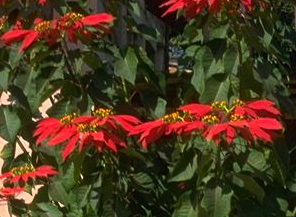
IMG0034_1.jpg
Poinsettia is called nochebuena in Oaxaca.
It also means ‘Christmas Eve’ in Spanish.

Spotify:
Remember to scroll down to the appropriate audio episode.

Nochebuena

Nochebuena / Christmas Eve:
last year, a star fell down the chimney
and landed on the poinsettia.
The cat and the dog stood up to deliver
new versions of their Christmas vision.
Birch bark: ghosts on the snow bank turned
white in the moonlight as they danced,
so slender and so bright.

This year an obsidian knife
hacks through my mind
slicing it into two uneven pieces.
Snowflakes invade its split personality.
Thin ice spreads across glacial fires.
Incarcerated birds sing deep in my rib cage.
A child’s world: with its lost toys lies
buried beneath fresh snow.

Tears freeze in my eyes,
drip from my eyelashes,
and fall to the earth as stars.
Soon I will be an enormous sunflower,
trapped in this wet clay rag of a body.

If I sit here in silence
will the world, like a garden
growing wild, go on without me?
The flowers in my yard close
their mouths and refuse to answer.

Passerines

Spotify:
Remember to scroll down to the appropriate audio episode.

Passerines

Light dances and reduces spring’s snow.
Tiny white islands float in a rising tide of green.

The late spring sun carves charcoal lines of shadow.
What remains of the winter is no longer smooth,
but dimpled and wrinkled,
glowing with a million tiny dots of color.

Dew point: occasional snowflakes
float down — feathered parachutes.

Dots of refracted sunshine spin out from the sun-
powered crystals that turn in my window.
They cut through the heavy air that the hyacinths
weight with their redolence.

The soft white flowers of the cyclamen
respond to the dancing points of light,
the curved edges of its leaves soak up the sun.

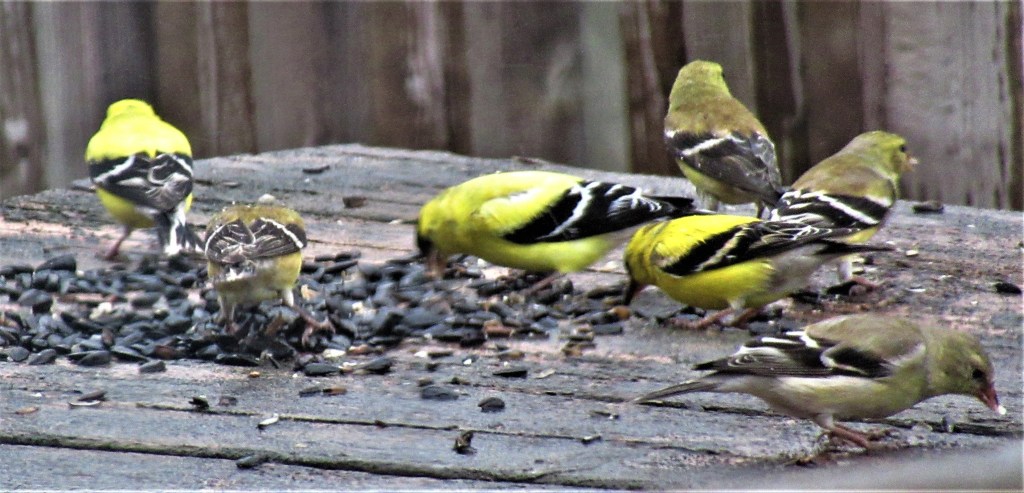
Returning passerines jostle and shove,
greedy to approach the feeder.

They are random, like thoughts,
flighty, and totally untamable.

Grosbeaks

Light dances and reduces spring’s snow.
Tiny white islands float in a rising tide of green.

The late spring sun carves charcoal lines of shadow.
What remains of the winter is no longer smooth,
but dimpled and wrinkled,
glowing with a million tiny dots of color.

Dew point: occasional snowflakes
float down — feathered parachutes.

Dots of refracted sunshine spin out from the sun-
powered crystals that turn in my window.
They cut through the heavy air that the hyacinths
weight with their redolence.

The soft white flowers of the cyclamen
respond to the dancing points of light,
the curved edges of its leaves soak up the sun.

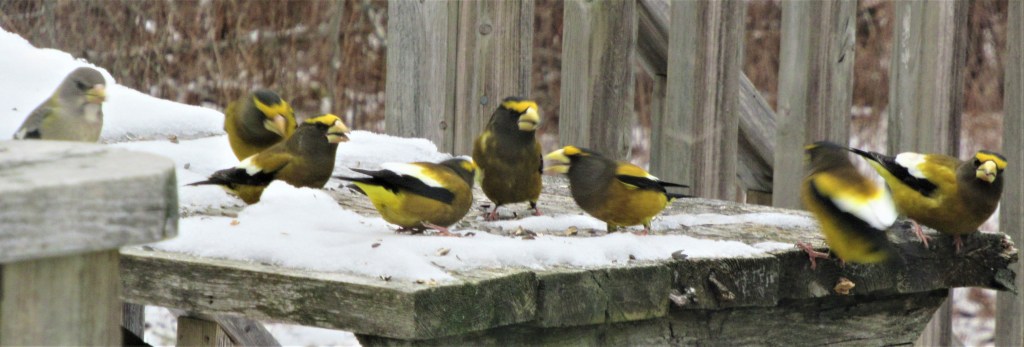
Grosbeaks, greedy for sunflower seeds,
jostle, shove, and push, to establish
their pecking order at the picnic table.

They are random, like thoughts,
flighty, and totally untamable.

Comment: What’s in a name? Change the birds and the poem changes. The same poem? Or is it? Does only the title change? I’ll let you decide. Do you have a preference? Please tell me.

Sharp-Shin

Spotify:
Remember to scroll down to the appropriate audio episode.

Sharp-Shin

She surveys her empire
from our back porch
steps into space
plunges her body’s weight
into fragile air.

A feathered arrow,
she makes contact, feet first,
bowling the unsuspecting robin
over on the ground.
His shrill shriek emerges
from a beak shredding failing air.

The hawk’s claws clench.
Her victim’s movements weaken,
eyes gaze into darkness.

One final spasm,
a last quick twitch,
and the robin is gone,
one wing dragging,
borne skywards
in the hawk’s claws.

Monet at Giverny

Monet at Giverny

1

his lily pond
a mirror shattering

shards of clouds

flames beneath the lilies
fractured fish

2

the executioner stripes evening
across the sacrificed horizon

in blood we were born
 in earth will we rest
our flesh turned to bread

empurpled this imperial wine
streaming with day’s death
 these troubled waters

3

green footprints
the lily pads
a halo
this drowned man’s beard
liquescent

like the gods
he dreamed
he walked dry
on water

flowering goldfish
this thin line of cloud

4

maples flash ruby thoughts
ripples flowing outwards

as heavy as a stone at Stonehenge
this altar tumbling downwards
through a liquid sky

5

wisteria and his curly blue locks
Narcissus clad in an abyss of lilies
imperial his reflection and perilous

slowly he slides to sleep
merging into his imaged dream

a vaulted cathedral
his earthbound ribs
the blood space immaculate

6

night and day and sun and clouds
leapfrogging over water

something survives
sepia tints
dreaming on and on

exotic this sudden movement
Carassius auratus flowering

7

Clos Normand and the Grande Allée
closed to him now
folded his flowers
their petals tight at his nightfall

dark their colours
mourning for his mornings of light
fled far from him now

8

can we soften this sunstroke of brightness
le roi soleil threatening to blind us?

rey de oros
the sun glow braiding itself
an aureate palette

a susurration of leaves

9

the lady of the lake
holding out her hand
handing him an apple

l’offrande du Coeur
 a scarlet heart of flame

monochromatic this island
brown earth in a crimson lake
the world reborn in tulips

10

Especially
 when the dying sun

molten fire spreading
a limpid light
sky brimming over into pond

trapped in low clouds
a slash of colour here
and there a tree
a fountain of gold

the sun an apple
blushing
on a setting branch

11

silver-white the money plant
moonlight between fine-tuned fingers
its rattle of seeds

blunt the moon’s bite
raked from water
gaunt its gesture

twin ripples
face to face
with the moon

12

upside down these clouds
bright in their winter boats

the night wind blows
clean dry bones
across the sky

13

fish aloft like birds
skimming wet sunshine

spring’s first swallow
rising from the depths
to snatch a golden note
quivering in the air

14

thunder raises dark ripples

lightning a forked tongue
insinuated into paradise

an apple tossed away
caution thrown over the shoulder
as sharp as salt

15

winds of change

that first bite
too bitter to remember

16

timeless this tide
this ebb and flow

oh great pond-serpent

biting yourself
forever

One Small Corner

One Small Corner
A Kingsbrae Chronicle

is available at the following link:
Click here to purchase One Small Corner

Introduction to One Small Corner

I think of my creative writing in terms of visual, verbal photos. I create snapshots in words and these snapshots come from everywhere that I have been. For me, they are precious moments caught and frozen forever in the camera of the poet’s eye. Visual and verbal, they illustrate the life I have lived and the things I have seen. These are the phenomena on which my artistic life is founded.

I am not a philosopher by any means, but I have over time developed an artistic philosophy. It started a long time ago at Wycliffe College with my A level studies of French existentialism and continued later in the Graduate School at the University of Toronto, where I studied the origins of existentialism as they are expounded in phenomenology. Both these movements have influenced my life and my writing. Bakhtin’s chronotopos: “Man’s dialog with his time and place” has also been a great influence on my creative thinking. My art is indeed my dialog with my time, my place, and the people who inhabit them.

One Small Corner is the record of my stay at the KIRA Residence in St. Andrews-by-the-sea, New Brunswick, Canada. I was selected to be the only poet in the first cohort of Resident Artists and during the month of June, 2017, I was able to work full-time on this collection.

Niche

Jane gave me the honor of writing the foreword to her book and I did so with great pleasure.

Jane Tims: Niche. KDP.
Book Review

Niche, the fourth poetry book published by Jane Tims, is a neat configuration of six segments that elaborate and illustrate the poet’s original definition of the multiple meanings of her title word niche. It is very difficult to separate the author from the act of narration as her keenly observed and skillfully executed drawings, together with their verbal representation on the page, are so autobiographical and so much an extension of her artistic and professional abilities that the objective separation of writer and text is scarcely possible. It is hard to forget that Jane Tims was, and to a great extent, still is, a highly competent professional botanist. The harnessing of the professional botanist, with her unique drawing skills and scientific knowledge, to the poet and auto-biographer is a key factor in the reading and interpretation of this text in which acute observation blends with an intimate knowledge of the observed botanical world, both flora and fauna, and this allows the poet, in her role of poetic narrator and lyrical voice, to weave a network of poems that are, at one and the same time, objective and intensely subjective.

The author emphasizes this when she writes in the Preface that “In biological terms, the niche is the quality of a space occupied by a living thing, the sum total of physical, nutritional, biological, psychological and emotional needs gathered together in one place.” She also reminds us that in human terms “niche can be a metaphor for home, community or personal space” and it is within these metaphoric spaces that the poetry text is elaborated. The text becomes a linked mixture of visual drawings, iterative thematic imagery and associative fields, all centred on the multiple meanings of niche. These terms are both biological and human in nature and the poet’s named world meets at this juncture between the human and the natural.

The section occupying space (1-19) bears the subtitle satisfying need and begins with a setting out of what this means in the following 12 poems and 4 accompanying drawings. The poem ‘apples in the snow’ with its companion drawing stands out for me. The section strategy, subtitled solidifying position (21-43) outlines in poetic terms, how plants, animals, and humans ensure their own survival. The section praying for rain, subtitled, avoiding danger and discomfort (45-68), offers views on discomforts and dangers. It also opens the discussion—relocate or stay where we are? The section mapping the labyrinth or places I have occupied (69-83), which contains the wonderful sentence “When I get lost on the road ahead, I look to the road behind me,” throws open the multiple meanings of home. The section new ways for water, subtitled coping with change (85-98), offers a double landscape, first, external, the things seen, touched, examined, remembered and described, and then the internal landscape that reflects upon them and is reflected in them. Finally, forgetting to move, with its subtitle getting comfortable (99-111), presents an autobiography that links observer (the twin personage of author and narrator) to observed (nature, both flora and fauna, and the added element of autobiography and self) via the symbiotic relationship of botanist to botany.

Two moments stand out for me. (1) Sadness is in seeking the space that is never found. (2) Loneliness is in trying to return to a space once occupied but no longer available. The whole concept of the Welsh word hiraeth is summed up in these two lines. Carpe diem, Jane Tims’ poetry indeed seizes the day and, with its minute, intense observation, it preserves so many precious moments. It also pays attention to that which has been lost, those moments that are irretrievable. They will vary for each reader, but hopefully, like me, you will take great pleasure in discovering them for yourself.

Comment: Brian Henry of Quick Brown Fox picked up this review and published it on QBF. Thank you, Brian and thank you Jane, you both do me great honor. Here’s the link: Niche on QBF 14 March 2021

Clematis

Not clematis, but bruised clematis clouds.
I’ll keep looking.
Maybe I’ll find the real things.

The clematis unfolds bruised purple on the porch. Beneath the black and white hammers of ivory keys, old wounds crack open. A flight of feathered notes: this dead heart sacrificed on the lawn. I wash fresh stains from my fingers with the garden hose while the evening stretches out a shadow hand to squeeze my heart like an orange in its skin. Somewhere, the white throat sparrow trills its guillotine of vertical notes. I flap my hands in the air and they float like butterflies, amputated in sunlight’s net. The light fails fast. I hold up shorn stumps of flowers for the night wind to heal and a chickadee chants an afterlife built of spring branches.
Pressed between the pages of my dream: a lingering scent; the death of last year’s delphiniums; the tall tree toppled in the yard; a crab apple flower; a shard of grass as brittle as a bitter tongue at winter’s end. I know for sure that a dog fox hunts for my heart. Vicious as a vixen, the fox digs deep at midnight, unearthing the dried peas I shifted from bowl to bowl to measure time as I lay in bed. I sense a whimper at the window, the scratch of a paw. I watch a dead leaf settle down in a broken corner and it fills me with sudden silence.
Midnight stretches out a long, thin hand and clasps dream-treasures in its tight-clenched fist. The lone dove of my heart flaps in its trap of barren bone and my world is as small as a pea in a shrunken pod. Or is it a dried and blackened walnut in its wrinkled shell of overheating air? Sunset, last night, was a star-shell failing to fire. Swallows flew their evensong higher and higher, striving for that one last breath lapped from the dying lisp of day. Its last blush rode red on the clouds for no more than a second’s lustrous afterglow.
I lower the delphiniums, body after body, into their shallow graves. Night’s shadows weave illusions from earth’s old bones and rock becomes putty, malleable in the moonlight. Midnight readjusts her nocturnal robes and pulls bright stars from a top hat of darkness. Winged insects with human faces appear with the planets and clutter the owl’s path. Night swallows the swallows and creates more stars. The thin moon hones its cutting edge into an ice-cold blade.

Now that’s a clematis bruise!

Water Falls

DSC01067.JPG

 Water Falls

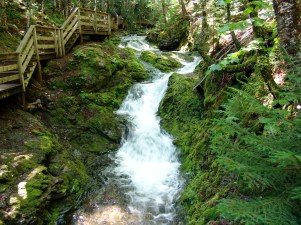
    What is it about running water
that it explodes like long, blonde
hair over moss and rock
frothing with sunlight the diamond
sparkle, the freckling sound,
light flickering downwards,
fine threads of angel hair
tumbling from above, falling,

DSC01073.JPG
white, over earth’s rocky shoulders,
pillowed across soft green quilts

DSC01045.JPG
poured down from heaven’s skies
watering the earth’s dark throat,

DSC01058.JPG
sinking through the soil
emerging in rivulets and brooks
until all waters are one
and the rains join hands
to splash, rejoicing,

DSC01055.JPG
dryads and naiads bathing
together in deep, cool pools,
nymphs reborn, acrobats over rocks
as water falls to seek the sea.