Empty

IMG_0228 (2)

Empty

Empty now the house, clean the floors where she
spattered food and scattered her toys, polished

the tables, grubby no more, where small hands
clattered fork and spoon, her breakfast not wanted.

Empty the bathroom, the tub where she bathed.
Dry the towels, full the toothpaste tubes she

emptied in ecstasy. Where now her foot
-prints, her laughter and tears, the secret

language she spoke that we never understood?
Empty too my heart where, a wild bird, she

nested for the briefest time, then flew, yet
I possess her still, within my empty hands.

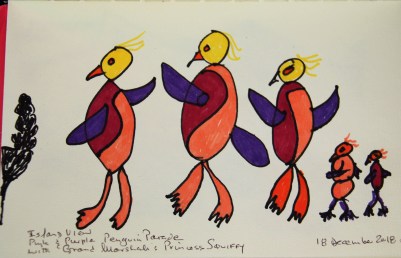
Commentary: The lead painting is the one Finley painted for me. I received it as a Christmas present, a couple of years back when she was 3 or 4. When asked if she wanted to add some more to the painting as the canvas wasn’t full, she replied: “No, it’s finished. That’s just how I want it.” Picasso once said that he spent the first half of his life learning to paint and the second half learning to see again as children see. Sometimes we complicate our art so much that we kill our inspiration and our vision. Some poets necessitate a dictionary in order for a reader to understand their words, yet when the meaning emerges, we find that the poem is convoluted, stilted, almost meaningless and even emptier than it was before.

Question: why do we try to gild the lily? Why do we lead to the slaughter the gift of the goose who lays the golden eggs? Are we writers or assassins? Are we not capable of putting meaning on paper with the directness and simplicity of a child? Good questions all. Sometimes I think that poets are like the existentialists of Albert Camus’s novels: they are the assassins of language and the murderers of direct and clear writing. And who are the victims? The words, images, metaphors, feelings that are strangled in the cradle or forced into captivity behind prison bars of jumbled lines and scattered thought.

Original ideas? No, not at all. This is the basic argument that Francisco de Quevedo (conceptismo) had with Luis de Góngora (culteranismo) in the Spanish literary salons of Madrid between 1613and 1627. The literary insults they wrote to each other are still a scandalous joy to read. These two seemingly separate styles of writing, which are actually very similar on many levels, eventually blended together and led to a total renewal of the Spanish literary language.  This in turn was bastardized by second-class imitators who did not have the skills of the original ‘super’ artists. And thus the pendulum swings: innovation > standardization > parody and satire of a worn out language > fresh inspiration and innovation.

As for me: how I would love to regain the clarity of vision and the joy of words that I experienced when I was a child. Back then, the world was a magic place, the pen and pencil were magic wands, and the empty page was a blank canvas to be filled with wonder. Alas: then I was sent to school. Rules were set. Bars were installed. Blinkers were inserted. Doors and windows were locked. Creativity ended. I will say no more.

Her Shadow

IMG_0063

Her Shadow

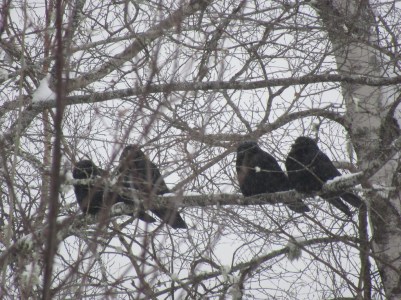
“Birds, birds,” she shrieked with delight.
“The drab one is a girl like you,” I told her,
“but the bright one is a little boy.”

“Yellow,” she cried again with joy, “Yellow.”
Tiny hands plucked at air, catching nothing.

I can still see her standing there, her nose,
all wet and runny.  She left damp, snot-stained
marks, a sort of signature, on the cold wet glass.

She’s long gone now, way back home, but still
the window stays unwashed and her shadow
often comes between me and the morning sun.

Midnight

IMG_0225

Midnight

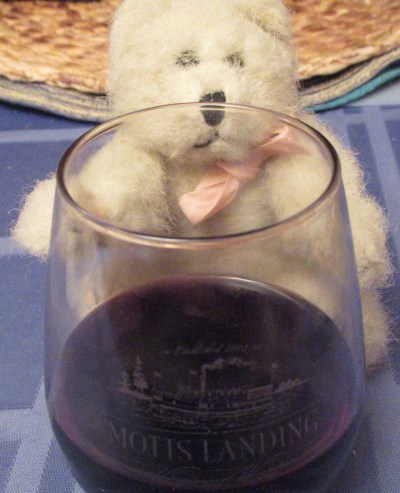
Primary red, this label, and the wine, fresh-drawn,
plucked from the bottle, tumbling tinto, into the glass.

Swirled, streaked ruby by overhead lights, bubbles
bright with hints of garnet, purple, brick at meniscus.

Sniffed, it smells of warm autumn days, scintillating
leaves, just crisping, turning color, and fruit all ripe.

Tasted: fruit bursts into hints of raspberries,
strawberries, spices, a touch of garrigue, mysterious.

Wine descends like water on a dry, hot, dusty day,
or rain after drought, when thirsty lands lap up

liquids, and rejoice in moisture’s blessings.
Raised now the glass, vineyard and vintners toasted,

midnight greeted, saluted the old day past and gone,
welcomed the fresh day walking in, swaddled, new born.

Downsizing

image1 (53) - Copy

Downsizing
Francisco de Quevedo

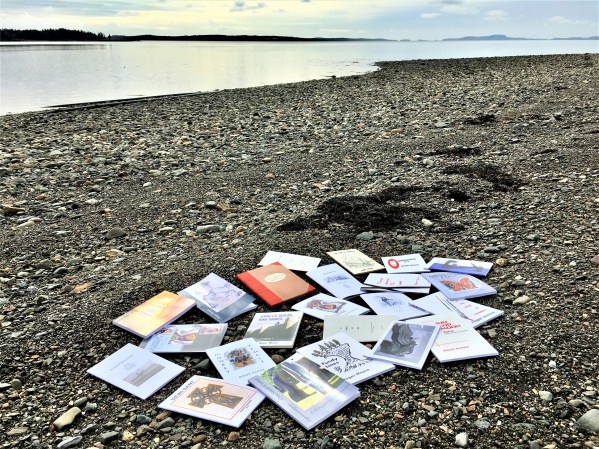
I chose each book, held it in my hands for
one last time, then placed it peacefully in
its cardboard coffin. Old friends, they were
but I broke that friendship and set them
free to fulfill their promised after-me-life
on another person’s shelves. I used to love
to listen to their lilting speech, to hear sage
thoughts with open eyes and mind. I replied
to their wisdom: words penned on each page.

Mind to mind, though they had lived five
hundred years ago, I strove to engage them
in a lively conversation, Bakhtinian dialogues
within our shared time and space, and
that space my basement library with its books.

One day, a man from the university drove up
in a hearse and bore them all away. Released
to a wider world beyond my walls, they will
nourish younger minds than mine. I hope their
new owners will bless them, welcome them,
cherish them, as I have done throughout my life.
Blind now, with tears, my eyes that devoured
their words. Deaf now, these ears of mine that
heard dead men’s words, for I can listen no more.

Comment: “Escucho con mis ojos a los Muertos / I listen with my eyes to the words of the dead.” Francisco de Quevedo (1580-1645). It was a hard thing to do, that disemboweling of my library, but it had to be done. I am grateful to the Harriet Irving Library at the University of New Brunswick for taking pity on my plight and redeeming my books. Hopefully they will have all gone on to a better life. It was sad to walk past them, to watch them slowly gathering dust, like a book on a shelf, as Elvis used to sing. It was even sadder to know that I would ever be able to peruse them all again, let alone read them from from cover to cover, certainly not in this life time.

And is that my own fate, to be reduced to words on a page, to become a dusty book lying forgotten on a shelf? Pobre poetas de hoy,  wrote my friend and fellow academic poet, José María Valverde, destinados a ser polvo seco de tesis doctoral / Poor poets of today, destined to become the dry dust of doctoral theses. So: my thought for today … rise up and resist. Take an old friend off the shelf. Dust him or her off. Open the pages. Settle down for a moment or two. Breathe deep. Begin your conversation with your long lost friend. We may not be close in the flesh, distanced as we are by lock downs and separation, but we can become closer in our minds. Pick up one of my books. Dust me down. Read me. Begin that conversation. Now. Before we too are gone, swept down stream by time’s river and lost in the mists that curtain the sea.

And, just in case you thought that last line was very good and very unique and original, here’s the conversation it came from: Nuestras vidas son los ríos / que van a dar en la mar, /  que es el morir / our lives are the rivers that will flow down to the sea, which is death (Jorge Manrique, 1440-1479). I had that conversation with Jorge Manrique in Santander in the summer of 1963. His Coplas was on the pre-university reading list at Bristol University, placed there, I believe by Salvador Bacarisse who was related to a long line of Spanish musicians and poets. If memory serves me well, our first essay, in our first week, in our first year of Spanish, entailed writing a commentary on the Coplas and how to read and understand them.

Si jeunesse savait, si vieillesse pouvait / If youth knew how, if old age was able to (Voltaire). I wish I knew then what I know now. And I wish I could do now, some of the things I could do back then. Meanwhile, do not despair: pick up one of my books or browse my blog for a poem, and have a short and hopefully profitable conversation with me as you listen to my failing voice with your younger eyes.

The Origin of the World

IMG_0265

The Origin of the World
Gustave Courbet:
L’Origine du monde

The origin of the world and where I came from,
her deep, moist cave that cast me from dark to light.
She loved me, she said, depriving me of her warmth,
leaving me to go back to her lover, loving him more.

Was it guilt that drove her to drinking whisky?
A forty-ouncer a day at the end, sometimes more.
She would wake in the night, wander the house,
banging against chairs, tables, walls, and doors.

She ran up bills in local shops, and the keepers
would dun me for the money she owed. She also
borrowed cash and some days her fingers were bare.
She left pawn shop IOUs on the table and I drove

 into town to redeem her rings. Once, in a drunken
frenzy, she cursed her only child. A mother’s curse is a
terrible thing. A living albatross, it claws lungs and heart.
Its weight drove me to the bottle. I too sought oblivion.

Reborn each day, mornings cast me back from dark to light.
Joy came when blackness descended, the albatross flew,
amniotic waters rocked me in warmth and comfort,
and my body’s boat floated once again on an endless sea.

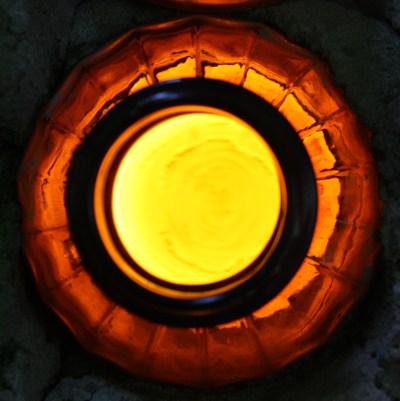
Comment: The photos show light shining through bottles in The Bottle House on Prince Edward Island. There is something very special about sunlight shining through stained and colored glass. Color distorts, speckles hands and face with a pointillistic magic, and the circular framework becomes a sun in its own right. As for Courbet’s painting, it still has the power to shock the viewer as it sets the eternal conundrum of the power relationship between the viewer (male) and the viewed (female). And remember: El ojo que ves no es ojo porque lo ves, es ojo porque te ve  / the eye you see is not an eye because you see it, it is an eye because it sees you, as Antonio Machado tells us. As for the poem, it stands or falls on its own, as does the painting. Visual shock or verbal shock: take your pick, but I hope you do not walk away unmoved.

IMG_0251


Still Life with Hollyhock

IMG_0206

Still Life with Hollyhock
Geoff Slater

How do you frame this beaver pond,
those paths, those woods? How do you
know what to leave, what to choose?
Where does light begin and darkness end?

Up and down: two dimensions. Easy.
But where does depth come from?
Or the tactility, the energy, water’s
flow, that rush of breathless movement
that transcends the painting’s stillness?

So many questions, so few answers.
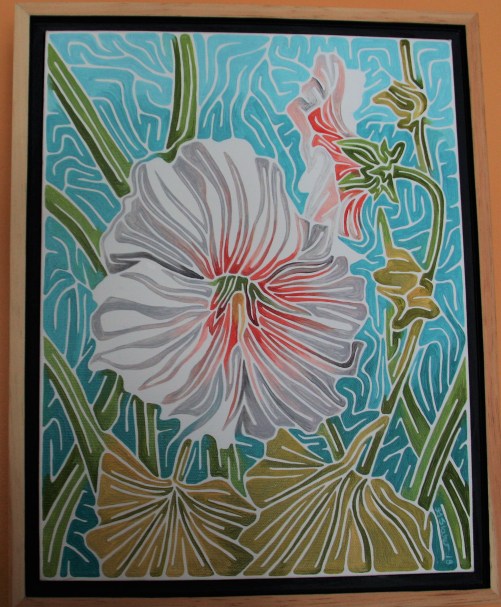
The hollyhock that blooms in my kitchen
is not a real hollyhock. It is the painting
of a photo of a genuine flower that once
upon a time flourished in my garden.

A still life, then, a nature morte, a dead
nature, portrayed in paint and hung alive,
on display in this coffin’s wooden frame.

Comment: I love the way language changes the way we look at life.  A still life painting becomes nature morte in French and naturaleza muerta in Spanish. Still life becomes dead nature. Fascinating. I also love the way in which the camera captures nature and the natural world. We think it is an accurate depiction, but really it isn’t necessarily that accurate. Filters, light and shadow, mood: they all fluctuate and sometimes we capture that which we never saw and sometimes that which we saw is never captured. Oh the subtle enigmas of creative art.

IMG_1005 (3)

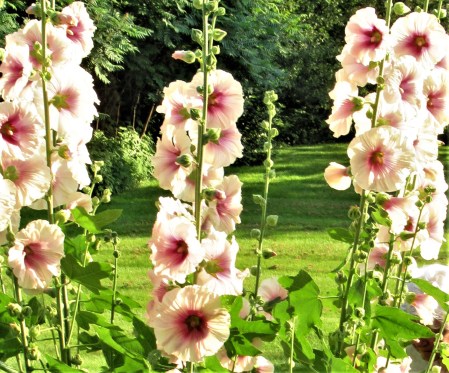
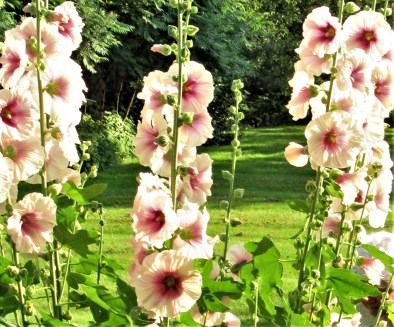
And it is the same with the hollyhock, my hollyhock, Geoff’s hollyhock. At the top of the page is Geoff’s painting of my hollyhock. The above is a photo of my hollyhock. Which bloom did Geoff capture and reproduce in paint? Language: and what do I mean when I say ‘my hollyhock’? My indicates possession, ownership. How and in what way does one own a hollyhock? How does one possess a garden, a flower bed, a tree? Are they not free, living, beings with a life and maybe even a mind of their own? Does one hollyhock talk to another hollyhock as the trees are said to converse with the trees? Do the trees in the garden possess a soul and if they do, in what sense do they possess one? And what is a soul anyway? I guess it depends upon the church and creed to which you belong. Certainly the garden has a life of its own and we discover that every spring when the grass and flowers grow back and the dandelions return.

image5

Questions: dangerous things, questions. Several of the questions posed above could have landed me in an Inquisitional institute in Spain in the 1500’s and 1600’s. That is a frightening thought. Alas, the philosophy of all that is way too deep for this poor poet and apology for a philosopher. One thing I do know, though: I love the garden going on outside my window and it is a privilege to be allowed to watch it, admire it, and follow its progress as the sun returns and the draws the birds back with it.

IMG_0198

¡Vale! Hail and fare thee well.

Scorched Earth

IMG_1783 (2)

Scorched Earth

A scorch mark
still scars this woodland
where deer grazed
until spring grass
fed the flames
sown by an unknown hand.

RCMP
cars blocked
the lower road,
uniformed officers
directed us to detour
up and away.

Below us we could see
smoke, no flames,
two firetrucks.
The acridity of ash,
breeze-borne,
filtered through the car
making us cough.

No more will the deer
roam this particular place
until wounds are healed
and all trace of the fire,
like them, has fled.

Comment: Driving to the head pond at Mactaquac, a week or so ago, we met an RCMP roadblock and were diverted by the officers. We ascended Mactaquac heights, and came down the other side, rejoining the lower road which was blocked by another set of RCMP cars. It was the week after the shootings in Nova Scotia. All we could think of was the respect we have for the RCMP. The knowledge that, if someone drove a police cruiser, stolen or faked, and wore an RCMP uniform, stolen, faked, or genuine, and flagged us down, well, we would have had no doubts and we would have obeyed that person implicitly. This was apparently what happened in Nova Scotia when the gunman, dressed like an RCMP Officer, flagged some of his victims down, then shot them as they sat in their cars. I guess the wounds of forest and deer will heal more quickly than those of the victims’ families. Pax amorque / peace and love. 

Rain


Fundy 2004 003

Rain

rain
song-birds
trilling liquid notes
spring songs
flooding gardens

oh!
competitions
ritualistic rivalries
staking out territories
winter stalwarts
versus
nouveaux venus
with their summer wealth
of well-fed health

everyone competing
for their garden niche
males en garde
guarding each square inch
their earthly paradise
carved in my yard

Comment: They lit up the Mountain Ash as if it were a Christmas Tree, American Goldfinches, twenty-four of them. The rain ran down the window panes and all the photos blurred and distorted. One at each end of the garden, two robins sang. Two pair of Purple Finches, the bright male and the dowdy female, pecked beneath the feeder as the chickadees, siskens, and juncos flitted in and out. The red squirrel scattered the ones in the tree and the grey squirrel ran at and over the ones on the ground. Chaos. And the rain, rain, rain came down, down, until the garden was empty and birds and animals had taken shelter.


Applause

DSC02548

Applause

All that I hear
around me:
the mixing and matching
of shingle and stone,
waves hissing,
grinding the beach down
as they move in and out.

Comment: We are surrounded by news, fake news, false news, and systematic deception. What can we now trust? I no longer know. But I do know that the above poem is not nihilistic. It expresses the reduction of applause and insubstantial glory to the minutiae of the daily doings of the natural world, in comparison to which we humans are nothing. “Look on my works ye mighty and despair” … hand gestures, smiles, thunderous applause from the chosen gathered to bear witness and paid to applaud, whatever the event. Alas, I cannot say it as well as Shelley. Here’s his Ozymandias (11 January 1818).

I met a traveler from an antique land
who said: “Two vast and trunkless legs of stone
stand in the desert . . . Near them, on the sand,
half sunk, a shattered visage lies, whose frown,

and wrinkled lip, and sneer of cold command,
tell that its sculptor well those passions read
which yet survive, stamped on these lifeless things,
the hand that mocked them, and the heart that fed:

and on the pedestal these words appear:
‘My name is Ozymandias, king of kings:
look on my works, ye Mighty, and despair!’

Nothing beside remains. Round the decay
of that colossal wreck, boundless and bare
the lone and level sands stretch far away.”


Biopsy

UNADJUSTEDNONRAW_thumb_2788

Biopsy

Driving home
from the hospital
after the biopsy,
thinking of the indignities
inflicted on my body,
cold, exploratory fingers,
the insertions,
the ardent desire
to say
“Enough,
no more!”

Oh God,
I am so cold.

Fierce winds
push me
along a snow-packed road.

I dream of sunshine
of summer flowers,

IMG_1005 (3)

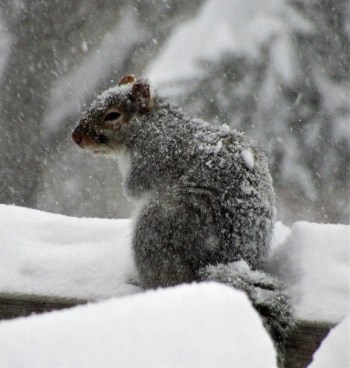
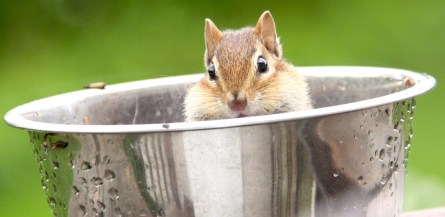
of chipmunks and squirrels,
of bird seed scattered
so others may survive.

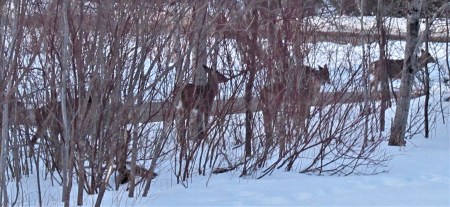
I dream of five deer
walking at midnight
through my garden.

IMG_1740 (2)

Magic,
their shadows
under moonlight
on the snow.

I skid into a snow bank
and my world shakes in shock.

A thirty-wheeler slithers by:
there are so many ways to die.

IMG_0266

Comment: Was it really only five years ago that I wrote those lines? I hadn’t even started this blog back then. So much melted snow, so much water under so many bridges. I look back at my journal and read that on April 1, 2020, in the USA, there were 3,800 dead from Covidis and 300,000 people affected. This morning, when I got up, those figures were higher, much higher: 63,019 dead and 1,070,032 affected. What a difference a month makes, let alone five years.

Affected, such a silly word when each individual person that these figures represent is, or was, a living, thinking, loving, human being, with an extended network of family and friends, each one of whom is in turn affected by the loss or sickness of a group member, be it a brother, a child, a sister, a mother, a father, a son, a daughter, or just a friend …  just a friend, another silly thing to say, as if just friends were not important, collateral damage, so to speak … and now, throughout our world, in macrocosm and in microcosm, we are, each one of us affected, in one way or another. Here in New Brunswick, Canada, we wash our hands, we wear masks, we stay home as much as possible, we maintain distancing when we go out on essential errands … I know it is different in other parts of Canada, and of the world, but we are all affected, and some so much more than others.

So, wherever you are, whoever you are, be strong, be brave, dance when and if you can, sing to yourself, sing for your family and friends, reach out to others, and above all take care of each other and survive. 

IMG_0171

My heart and these words go out to you: Byddwch lawen a chadwch eich ffyd a gwnewch y pethau bychain mewn bywyd / be joyful, keep your faith, and do the small things in life as Dewi Sant, St. David of Wales, a real person, is said to have said, almost 1500 years ago.