Waiting

Waiting

I remember pushing
my father around the ward.
Two weeks we had together.
He sat in his wheel chair
and I wheeled him
up and down.

“Cancer, ” they told me.
“But it’s kinder not to let him know.”

In those days, it was better to die,
without knowing why.
Did I betray him by not letting
him know what I now need to know?

One day, he begged for help
and I lifted him onto the toilet.
He strained and strained
but couldn’t go.

“Son,” he said, sitting there.
“Will you rub my back?”
How could I say no?

That strong man,
the man who had carried me
on his back,
and me standing there,
watching him,
trousers around his knees,
straining, hopelessly,
and me bent over him,
rubbing his back,
waiting,

for him to go.

Click here for Roger’s reading of
Waiting.

True Love

True Love

True love flows so much deeper
than an exchange of body fluids
or a handing over of ritual rings.

Our advancing lives are no longer
ruled by nature’s primal urges.
Our bodies have been taken over
by old age stiffness, aches, and pains.

Some nights, I wake up to find
she no longer breathes. I reach out
in panic, touch her gently, and when
she breathes again, I heave a sigh
redolent with love and relief.

Listen to podcast here.
True Love

Pianissimo

Pianissimo


            You sit at the piano, my old piano, still extant in my father’s house, yet soon to be given away, though we don’t know that yet. It’s an upright, iron-frame Bechstein, a piano that I was given when I was the same age as you are now. Handel’s Largo, the Harmonious Blacksmith, hours and hours of scales. They locked me in the front room, my mum and dad, and there I stayed for an hour, two hours, or more. I came to hate music. As soon as I could, I gave up the piano, I rejected piano practice, I turned my face away from the discipline of the lock up.
            Now, I listen to you. Your untaught fingers tickle the black keys, then the white keys, one after another. You are six years old. You’ve never had a lesson, but you have music in your blood and some residual instinct latches on to rhythm and sound. Your fingers are long and supple and your touch is light, so much lighter than mine used to be, and now, on the deep bass notes of the left hand, your stronger hand, you pound away, awakening the dark ghosts of soul music that pour through my memories awakening echoes in this piano.
            I think of you as a jazz musician. Thelonius Monk, perhaps, a tinkle here, a light touch there, now a chord or two, inexplicable, and who would want to explain. It is a joy to sit here, to see your smile of absolute absorption. Mood music you call it, and today your moods are as dark as the shadows that tug at my heart, and as light as the sunlight that floats through the windows and makes the dust motes sparkle. It also frames a halo round your head. You hum to yourself as the morning sunshine fragments into colored gems and you sculpt your rainbow of sound.
            “Stop that noise. You’re driving me mad,” your grandfather, my father, stumbles into the room. He has taken his last cigarette out of the packet and the white cylinder hangs down from his lips, like an extraneous chalk outcrop hanging from the lip of an errant teacher. He pats his pockets. “Where are my matches? Has anyone seen my matches?”
            “They’re on the table in the kitchen,” I reply. “Where you always put them.”
            “I thought I left them in here,” my father leans on his stick then turns and stumbles out of the living room and into the kitchen.
            You hop off the piano stool, take the matches from your pocket, and carefully place them on the arm of your grandfather’s favorite chair.
            “Sssssh!” you say, putting a finger on your lips. Then you skip back to the piano and start playing pianissimo on high notes that float like tiny raindrops of sound produced by miniscule angels.          
            Your grandfather returns, glances round the room, spots the match box, and pounces upon it, a caged tiger finally served his red meat.
            “That’s funny,” he mutters. “They weren’t there a moment ago.” He takes out a match, strikes it, lights up his cigarette, inhales a lungful of smoke, then exhales it in a great locomotive puff of cloud. He grimaces at you through a haze of smoke.
            “There’s nice music you’re playing.”
            Your young lungs, unaccustomed to a house of smokers, can’t cope with this thin, grey, choking cigarette waste. You stop playing, put a hand over your mouth, and start to gag.

Listen to the Podcast here:
Pianissimo

Blood and White Wash

Blood and Whitewash
A Thursday Thought

2-September-2021

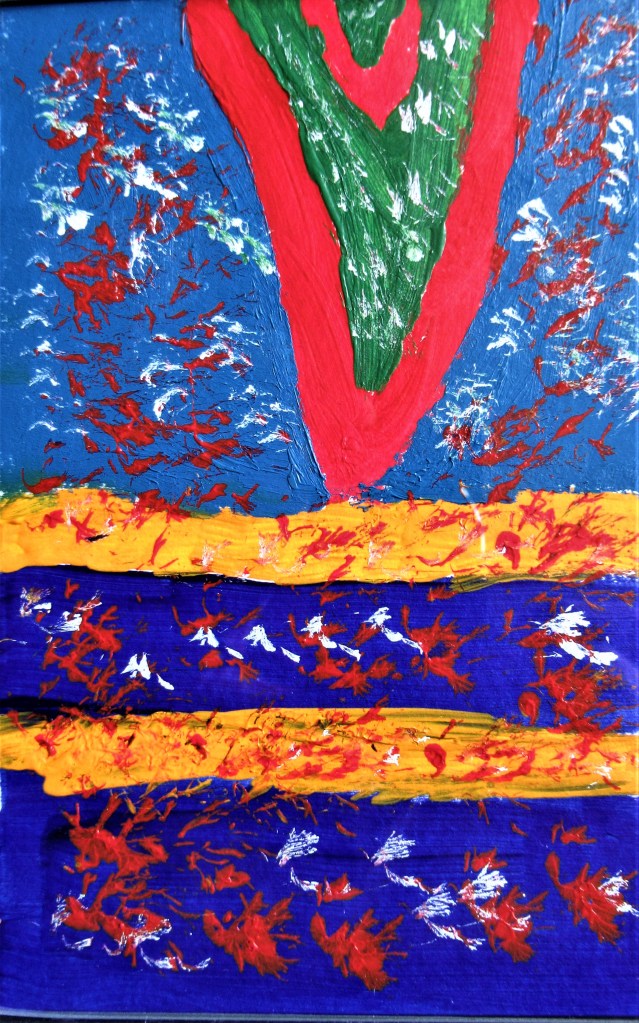
Blood and Whitewash is the title of this painting. It has a subtitle: My Plan of Attack.

The origins of the title, and hence of the painting, go back to the Goon Show, with Spike Milligan, Peter Sellers, and of course / wrth gwrs, Harry Secombe, the Swansea Comedian and Master Singer. Away in boarding school back in the late fifties, one of my greatest pleasures was listening to the Goon Show on one of the dormitory’s transistor radios. As a teenager, I found the jokes and the accents incredibly funny. Still do. That’s why I painted this painting. Alas, it is silent, and you cannot hear the accents.

The following snippet of dialog occurred on one such Goon Show, I cannot remember which.

“What are we going to do?”
“Well, this is my plan of attack.”
“That’s not a tack, it’s a nail.”
“No it’s not. It’s a tack.”

So above you have my painting of My Plan of Attack, resurrected after all those years. I throw my mind back to the First World War.

The General:
“He’s a cheerful Cove,” said Jimmy to Jack,
as he walked to Arras with his pack on his back.
But he did for them both, with his plan of attack.

And there in essence is the history of the painting. First, the plan of attack, then the failure and the blood-letting, and then the white-washing of the whole history, a white-washing that turns failure into success, defeat into victory, and loss into gain. But in WWI, it was the poor Tommies who bore the burden, and all the other front line troops who obeyed orders, went blindly over the top, and charged unbroken wire with fixed bayonets.

“If you want to find the sargent,
I know where he is, I know where he is,
If you want to find the sargent,
I know where he is.
He’s hanging on the old barbed wire.”

“If you want to find the chaplain,
I know where he is, I know where he is,
If you want to find the chaplain,
I know where he is.
He’s hanging on the old barbed wire.”

“If you want the whole battalion,
I know where they are, I know where they are,
If you want the whole battalion,
I know where they are.
They’re hanging on the old barbed wire.”

Singing as they marched to their deaths, obeying orders, like sheep, and nipped on by the eternal sheep dogs. Things were so bad at Verdun that instead of singing, the men marched, bleating, like sheep. “Sheep unto the slaughter.” There was so much ill-feeling and rebellion in the face of orders and certain slaughter, that French regiments were decimated, one man in ten shot for mutiny, as they marched bleating, instead of singing, to their deaths.

“Oh, we’ll hang out our washing on the Siegfried Line,
have you any dirty washing, Mother dear?”

“Those who do not learn from history are condemned to repeat it.” So, tell me, “where have all the young men gone, gone to graveyards everyone, when will they ever learn, when will they ever learn?”

And that, dear friends, is my thought for today: The History of My Plan of Attack. When, indeed, will we ever learn?

Waiting

The story of one man’s journey

Spotify
Scroll down to correct episode.

Waiting

I remember pushing
my father around the ward
in the hospital.
Two weeks we had together.

My father sat in his wheel chair
and I wheeled him
up and down.

“Cancer,” they told me.
“But it’s kinder not to let him know.”
In those days, it was better to die
without knowing why.
Did I betray him by not letting him
know what I now need to know?

One day, he begged me for help
and I lifted him out of his wheelchair
and placed him on the toilet.
He strained and strained
but could not, would not go.

“Son,” he said, sitting there,
“Will you rub my back?”
How could I say no?

That strong man,
the man who had carried me
in his arms, on his back,
and me standing there,
watching him,
his trousers around his knees,
straining hopelessly,
and me bent over him,
rubbing his back,
waiting,

for him to go.

Comment: Thank you, once again, Alejandro Botelho of Diverse TV. This was a great reading. If you, dear reader, are interested, you can listen to it HERE. Alejandro’s reading of my poem begins at 40.52 and ends at 42.33. But remember, the other poems are also well worth listening to and Alejandro has a great voice and wonderful interpretation. A further comment: first there is the text. Then there is Alejandro’s excellent reading. Then there is my own reading. From each of these the observant reader and / or listener will extract a slightly different emphasis and meaning. In my own case, following Alejandro’s reading of the original text, I have added some minor changes, to add to the intertextual rhythm of the words. Tolle, lege et vade mecum. A Cancer Chronicle is available HERE.

My Grandfather

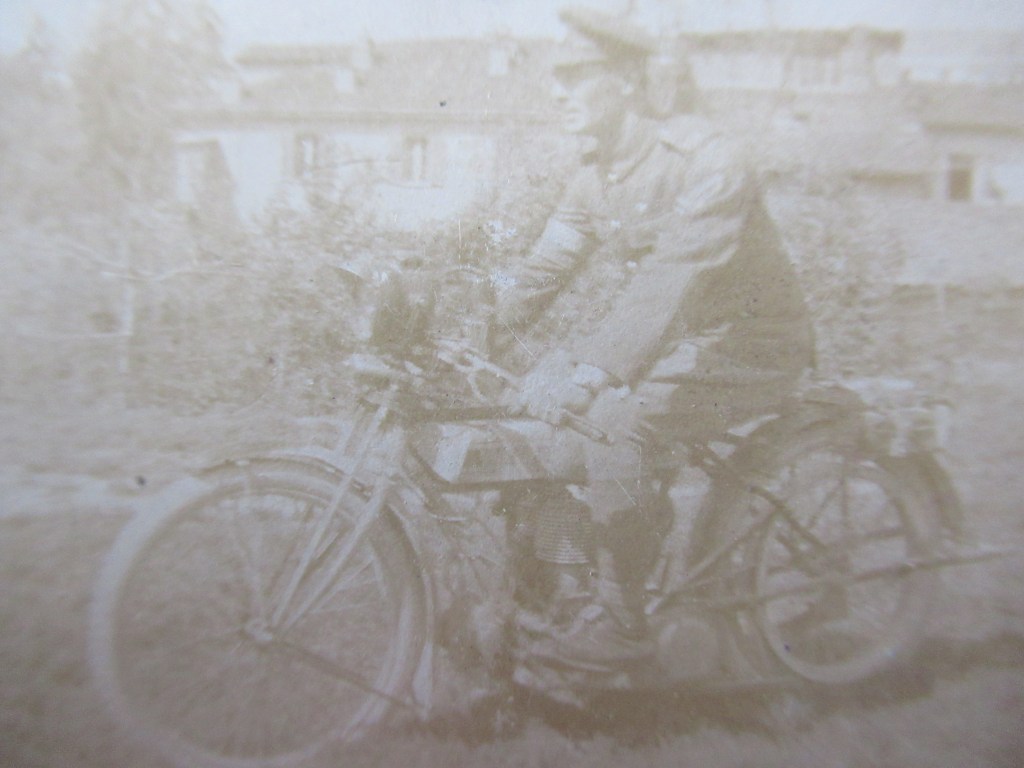
WWI Dispatch Rider. A friend of my grandfather’s.

Spotify
Remember to scroll down to correct episode.

My Grandfather

My grandfather gave me my first sewing lessons.
He sat before the kitchen fire and put a grey
wooden darning mushroom inside the sock,
stretching woolen threads to expose the hole.

He chose with care his colors: bright yellows,
oranges, reds, sky blues, anything that stood out
against the sock’s dark rainy-day drabness. If
the socks were thin, he split new wool, pulling it
into individual strands that he would dampen
with his tongue. Then he would thread the needle.

Wool in place, he would cross-hatch the sock’s hole,
slowly forming a life-raft that he’d fill with color.
All my life, I have darned socks, sewn buttons,
and mended my sweaters. I use bright colors,
to my friends’ dismay. I still have my grandfather’s
World War One sewing kit, all wrapped up in
a canvas bag with his needles and some wool.

It’s wonderful to touch where his strong hands were.
There are dark blood traces where he pricked his thumb
and deeper stains where he sewed up wounded friends.

Comment: My Grandfather, the poem, is available on DiversityTV where it is read by Alejandro Botelho. Thank you, Alejandro, for a great reading and a fine interpretation of this poem. Click here > My Grandfather < for Alejandro’s reading. Note that My Grandfather begins at 13.30. Note too that the other poems on this site are worth listening to as well.

A Theory of the Absurd

A Theory of the Absurd

I wonder what I’m doing here, so far from home, sitting
at the bar, with my beer before me, my face distorted
in half a dozen fairground mirrors, surrounded by
people half my age, or less, all smoking, cursing, using
foreign forms of meta-language, gestures I no longer recall:
the single finger on the nose, two fingers on the forehead,
the back of the hand rammed against the chin with a sort
of snort of disapproval. It’s way beyond my bedtime, yet
I am held here, captured, body and soul, by foreign rhythms,
unreal expectations of a daily ritual that runs on unbroken
cycles of time: morning brandy, pre-lunch wine and tapas,
home for the mid-day meal, a brief siesta, back to the café
for a post-prandial raising of spirits, more blanco, then back
to work at four and struggle on until seven or eight when
the bar routine begins again with pre-supper tapas and tinto.
Who am I? What am I? Where am I going? I wander, restless,
 streets and squares, enter other bars and restaurants, consume
verdejo, manzanilla, tinto de verano, the original and many
 falsifications, in corner bars, on patios, sampling liqueurs,
cognacs and coñac, Fundador, Carlos Quinto, Torres Diez,
sol y sombra, Cuarenta y Tres, pasteles con café quemado.
Time, comprehended in this new life-cycle, lacks meaning.
Time, in a cycle I have long abandoned, is meaningless too.

Man from Merthyr

Man from Merthyr

Memory loss punched holes in your head
and let in the dark, instead of the light.
Constellations faded from your sight,
erased by the arch-angel’s coal-dust wing.

 “I’m shrinking,” you said, the last time I saw you,
you, who had been taller, were now smaller than me.

 Tonight, when the harvest moon shines bright
and drowns the stars in its sea of light,
I will sit by my window and watch for your soul
as it rides its coal-fired rocket to eternity.

My eyes will be dry. I do not want pink runnels
running down this coal-miner’s unwashed face.
I’ll sing you a Welsh lullaby, to help you sleep.

“When the coal comes from the Rhondda
down the Merthyr-Taff Vale line,
when the coal comes from the Rhondda
I’ll be there.”

With you, my friend, shoulder to shoulder.
“With my golden pick and shovel, I’ll be there.”
Farewell, my friend, safe journey, sleep deep,
as deep as a Rhondda coal mine may you sleep.

Survivors

Survivors

Last night’s rainstorm shrank the house.
We closed down rooms
and now the walls are closing in.
There’s so much we no longer use, nor visit,
so many rooms we no longer enter.

Almost all our friends downsized long ago.
We are the holdouts. We love it here
in this big house with its lawns and trees
and flowerbeds with bees’ balm, butterflies, birds,
and the yard abuzz with sunshine and bees.

But now we are starting to throw things out.
Maybe we’ll move, next summer perhaps,
or maybe not. For now is the time of indecision.

Like friends of the same age,
we travel the lesser road of memory loss,
a name and a face here,
a date or phone number there.

Perhaps, when the time comes,
we will have forgotten how to move.
Meanwhile, the mandatory old man’s question:
‘where did I put my glasses?’

Why?

Why?

“Where are you going?” I ask again.
 “To see a man about a dog,” my father replies.
  “Why?” I ask.
  “Hair of the dog,” his voice ghosts through the rapidly closing crack as the front door shuts behind him.
  “Why?” I cry out.
 Years later I remember this episode. The mud nest nestles tight against a beam beneath our garage roof. Tiny yellow beaks flap ceaselessly open. Parent birds sit on a vantage point of electric cable, their beaks moving in silent encouragement. A sudden rush, a clamour of wing and claw, a small body thudding down a ladder of air to crash beak first on the concrete.
“Why?” I ask.
The age-old answer come back to me.
“Wye is a river. It flows through Ross-on-Wye and marks the boundary between England and Wales.”
The swallows perch on the rafters watching their fledgling as it struggles on the floor, the weakening wing flaps, the last slow kicks of the twitching legs.
“Why?” I ask.”
“Y is a crooked letter invented by the Green Man of Wye.”
“Why?” I repeat. “I want to know why.”
Silence hangs a question mark over the unsatisfied spaces of my questing mind.
A golden oldie. We would all like to know why. But there are no answers. Just riddles cast, like two trunk-less legs of stone, on the sands of time. Nothing beside remains. Yet still we ask the age old question: why? And still we receive the age-old answers from those ageing wise men who ruled our childhood and taught us everything they knew.
“Why?”
“Because.”

Comment:

Alas, we have lost our hollyhocks, not all of them, but most. They have been drowned in torrential rain, blown and bent, ravished by raging winds, and they have been scorched in a heat-warning scorched earth policy that left them and the garden all forlorn. As for the lawn, between chinch bug, crows, raccoons, and a surge in weeds and bugs, it is a desolation.

What is worse: they were so beautiful, those hollyhocks. Multi-coloured, stately, and tall. Hopefully, they will return next year. We do hope so. And equally hopefully next year will be a better year for them. And for you and me. Meanwhile, I savour the photos and mourn their loss. Meanwhile…

“Why?” I ask “Why?”

The answer echoes back across the years in well-known voices that have long been silenced.

“Because.”