Writing: Task or Multi-Task?

IMG_0262

Writing: Task or Multi-Task?

“To task or multi-task? That is the question.”

In the lonely world of creative writing, be it in poetry or in prose, is it better to continue with one text until the task of writing it is thoroughly finished? Or should we flit from text to text, developing several at once and thus multi-tasking in the best sense of the word? This is a key question in the revision process and relates directly to the concepts of write, re-write, revision, revisionism, and the creative process, all of which have been mentioned both in this blog and in the comments to this blog. However, there is no single answer to this seemingly either / or question as many factors must be considered.

  1. Deadlines:

Anyone who has worked with strict deadlines knows that they matter more than anything else. “I want this work on my desk by 4:00 pm today,” says the manager rubbing the magic bottle in which the genie is kept. “Yes, ma’am,” says the genie bowing before vanishing back into his bottle. Only one thing matters, the task in hand, and there can be no multi-tasking.

  1. Novellas and Novels:

With longer texts, while there might be room for manoeuver, provided no deadline is in sight, it is better by far to focus on the task in hand — the extended narrative — and to dedicate all tasking and multi-tasking to that prime task. The majority of writers who have written on the art of writing, including Stephen King, Graham Green, and E. M. Forster, emphasize the necessity of sticking at it, maintaining focus, and getting on with the task. Graham Green’s recommended approach is to write four to five pages a day, re-reading them and revising them the next day, before writing another four pages. That way the events, the action, the characters, are kept well in mind. In addition, Joan Clark and Norman Levine, in their workshops, advise writers to get to know their characters intimately, to think about them, and to write and rewrite until they come living from the page. Anyone who has taken a longish break and then returned to the writing of a novel knows just how difficult it is to get back into the mind of those characters. With an extended narrative, a dialog abandoned is a dialog lost. And one must learn to listen to one’s characters and to never forget what they have said, mustn’t one?

  1. Poems, Prose Poems, and Flash Fiction:

This is where multi-tasking can truly take place. The brevity of these pieces, and I classify epic and extended poetry with narrative rather than with poetry, allows the writer time to pick the pieces up and put them down again, to play around, to abandon the text and to return to it later. Being shorter pieces by definition, one can re-read them with ease, correct them at leisure, and research around them with impunity. In an extended narrative, or when writing to a deadline, focus is necessary. With shorter pieces, easily recalled, procrastination is a pleasure, not a crime. With poetry, focus is sharper but for shorter periods.

  1. From Poem to Poetry Book:

As the poems accumulate and the writing, or rather the putting together, of the collection becomes more important, so the need to concentrate and single-task, rather than to procrastinate and multi-task becomes paramount.

These are my initial thoughts on Task or Multi-Task. What happens when we apply them in real life to real questions?

  1. On Revision (Chuck):

Will this exercise (revision of older texts) provide you more gratification than starting new ones that may or may not be so important to you?

The question of revision is key. While I would like to avoid revisionism (Al: There is value in showing poetry as a snapshot in time (if only to avoid endless revisionism), the question of how to revise a text is of maximum importance. The text to be revised may be old or it may be recent, but the act of revision — how and why and what to revise — is one that must concern us as writers if we are to eschew automatic writing in a search for le mot et la phrase justes. If I can learn from the revision of older texts what I need to look for in order to revise newer texts, then my search for a way in which to recognize and achieve better form of writing can be justified, for the techniques discovered can surely be applied to future texts as well as to past ones.

  1. The young Roger who was once you is no more (Kevin):

This is a beautiful thought: thank you, Kevin. Much of that earlier writing must stand as it is (and was) as a monument to what and who I was back then. However, some thoughts and phrasings may well be weak and need revision. The recognition of weakness and the realization of how to strengthen and how to renew is surely a part of our ongoing growing writing process. That is what I would argue, anyway. I would argue further that revision is NOT multi-tasking, but is single-tasking in the sense that I, as reviser, am teaching myself how to revise: an ongoing process in the act of creativity.

  1. Conclusion:

In my current situation, I have five creative works (Echoes …, Waiting, Bistro, Stars … , People … ) lying fallow and waiting for their final touches. As I look back on what I have previously written and how I have written it, I am, in my opinion, multi-tasking. That is to say, I am working with many texts rather than concentrating on a single text. However, at the same time, I am working hard on a single task: that of teaching myself, once again, how to revise and how to rewrite. Hopefully I will put a little, objective distance between my current self and my recent texts. Then, when I return to them, I will be able to take them, one at a time, and revise them properly. That is my hope and my intention.

To task or to multi-task … writing or re-writing … each has its place in the creative process. To conclude: I thank all of you who contributed to this conversation (mentioned or not!), and I wish you joy in your (re-)creativity.

Comment: These questions are as relevant to my writing now as they were when I first posted them several years ago. The text names change, but the multi-tasking continues. There are about five manuscripts / typescripts on my desk right now, each one clamoring for attention. In a couple of cases, there are deadlines that I must meet. In others, overnight thought means an early morning return with new ideas. Most important of all, is to write, and to continue writing. And yes: unless there is an imminent deadline, I multi-task!

Why I Write


Time-Spirits

Why I Write

In the online creative writing course that I took last year, we were invited to read two articles on why I write, one written by George Orwell and the other by Joan Didion.  Both articles set me thinking: why do I write? My response to these articles, borrowed from my course notes and suitably doctored for my blog, follows.

George Orwell … where do I begin?

Homage to Catalonia is, in my opinion, one of the great personal memoirs written about the Spanish Civil War. Orwell fought on the side of the Republic, the legally-elected government, but fell foul of the Russian-backed Communists as they tried to unify the left under a banner of total Communism. The other side in the Spanish Civil War was, of course, the solidified right of the Spanish Falange and the Fascist Party. Orwell was targeted by the Communists and, wounded at the front, escaped across the French border with falsified papers. As he himself says in Why I Write, the political realization of the nature of totalitarianism led him to his stance as a writer. Animal Farm borrowed heavily from his Spanish experience, as did 1984.

Orwell sets out four reasons for writing. (1) Sheer egoism; (2) aesthetic enthusiasm; (3) historical impulse; and (4) political purpose. I personally identify most strongly with #2. Above all, in my case, I write my poetry in praise of nature and in sorrow for how I see us failing the natural world around us. However, I must admit that I also write out of sheer egoism (#1) and yes, I enjoy thumbing my nose at all those who have in one way or another slighted me and upon whom I want literary revenge, even if it be posthumous. Several of my older friends also write this way, though many of the younger ones seem to be more interested in writing for money than in art for art’s sake. I guess retirement and a small but relatively reliable pension added to the gradual onset of a blighting old age make me realize that there is not much time left in which to amass a fortune. This in turn also makes my professed credo of art for art and not for money more acceptable.

Having come to the conclusion that I never have, and never will, make any money through my writing, although publish or perish has walked side by side with me throughout my academic career, I now embrace the fact that I do not write for money. In fact, I usually give my independently published books away to my friends. Nor do I want the sort of fame that causes the paparazzi, with their microphones and videos, and camerasto flock to my doorstep, like starving sparrows or winter’s chickadees, in search of the breadcrumbs that fail to sufficiently nourish. To be appreciated, in my own small corner, like a well-loved local cheese or a craft beer, welcomed on a warm summer night for its fragrance and body … that is enough for me, although I must admit, that for one of my metaphors or images to be sniffed at, as if it were a glass of rare liqueur or a suitably aged port or a welcome Castillo de Monserans, also has its attractions.

This doesn’t mean that I am satisfied with who I am and how I write … I am not. I hope I never will be. I do want to be the very best that I can be. That’s why I keep writing and why I keep taking courses and workshops on writing. It’s also why I read and re-read, and why I keep reaching out to you and my other friends, and why I am so over-joyed when you, in your turn, reach out to me with the occasional word of praise for one of my stories or one of my poems.

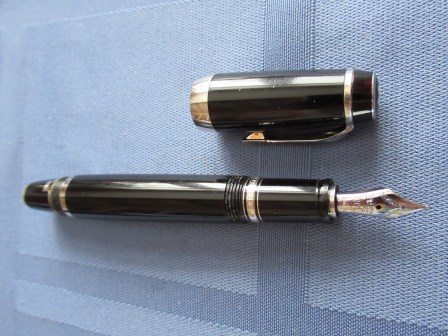
However, warm as is the friendship of the beginning, failed and faltering writers’ support groups to which I belong,  most, if not all, writing is done in isolation: me and my memories, me and my invention, me and my keyboard, me and my blank page, me and my pen, me and a-penny-for-my thoughts as I refill that pen with Royal Blue ink in the hopes that something regal will actually fall from the nib and grace one of my pages, even though I am really wondering yet again whether, like the budding author in Camus’s La Peste,  I should start that first paragraph all over, yet again, just once more.

Alas, me and the cat and the keyboard do not share a healthy working relationship, especially when she walks across the keys, sticks her kitty-littered rear end in my face, scratches her itchy chin against the computer’s sharp edge, and purrs wildly for kibble while adding oft-repeated letters and deleting so many of the wonderful words that I have so carefully accumulated. Last month, incidentally, she also unfriended a dozen of my Facebook friends. Unfortunately, I do not know which ones and none of them have got back to me. Oh dear.

One of the students in my current course asked me when I started to write. The answer is that I do not know. I have always written. I guess I have written from a deep inner urge to understand myself and the world in which I live. Going to a series of boarding schools was also a key part in the relationship between me and my writing. I was six or seven when I first went to boarding school and every Sunday I was plonked down on a wooden bench and ordered to write a Sunday letter home to my parents. Oh the wails and the take-me-aways that issued from my pen only to be deleted by the school censors. As a result, from early on, I shaped letters for the censoring audience. I also wrote other letters and they became a part of my writing style and my need for self-expression.

Mikhail Bakhtin, in his theory of Chronotopos, speaks of ‘man’s dialog with his time and place’ and that is exactly what I do. I hold a dialog with the things happening around me in the particular place I find myself.  Why do I write? To better understand my time, my place, and my own interactions with the world around me. Writing then is a means to an end and that end, for me, is self-understanding, self-betterment, and the better understanding of the world in which we all live.

IMG_0402 (1)

Codification

IMG_0068 (2)

Codification

For me, it is vital to see how others read and interpret my work … what comes across, what doesn’t, how things are understood and read, sometimes in the same way, sometimes in different ways. It is always easy to pick out some favorite phrases. However, deciphering, interpreting, and then reacting to, a poem’s inner code, is a very different matter.

I love the cut and thrust of dialog … I was at our Tuesday night writing group meeting last night from 7-9:30 pm and we had a great time, back and forth across the table pecking, like wild birds perched on a literary feeder, at each others’ texts. My own texts are thickly layered and highly codified and I have become very interested in the theory of literary codification.

My own ideas are a development of those of Northrop Frye as he expressed them in The Great Code. When we lose our common code, to what extent do we need to explain a private one? This is of great import to Frye’s studies on William Blake, perhaps (in spite of his seeming simplicity in certain poems) one of the most difficult of English poets.

Perhaps the answer lies in Karl Jung’s theories on the racial subconscious: that we all share deep, (human) racial symbols that transcend words and often appear as symbols and images. If this is true, then we communicate, at a non-speech level, through metaphor and symbol, and that is more powerful and outreaching than linear language, however well and clearly codified it may be.

This emphasis on symbol, image, and metaphor leads us, of course, into surrealism, free writing, concrete poetry, sound poetry, and all those efforts to abandon the linear and reach into the subconscious roots of ‘that which binds us together as human beings’ … in my humanistic theories, to find the links that behind is more productive than the reinforce the fears and misbeliefs that separate. Alas, not everyone thinks that way in the literary world, and private codes can easily be used as wedges to force people apart.

We need codes, preferably codes that we can share. The question is, how explicit would we be, as writers, in explaining those codes? How closely should we imitate the writing codes of other people?

The eternal mystery of Aladdin’s Lamp: “New codes for old.” And don’t forget the magic words “Open Sesame.”

Ah, the joys of codification.

Commentary
This is a golden oldie, a repeat of an earlier post.  I am creating furiously at present and cannot always spend the time to create for the blog. Hence the repetitions and the golden oldies. Codification is something that has interested me for some time: the Biblical Code, The Western Tradition, Courtly Love, the Icy Fires of Petrarchism, Romanticism,  Impressionism, Expressionsim, Surrealism, Existentialism, Modernism, Post-Modernism … the -isms, once started, are apparently endless. All of these -isms spiral round the ideas of verbal codes. In codification, I would like to start a discussion on what these codes are, how they affect us, what do they mean, especially when they can be so totally personal. By all means, join the discussion: what do you mean by codes? How do you use them? How do you interpret the codes of other people? By all means post here, but better by far, rech out and discuss these things with your friends and your writing or art groups.

Aliens

IMG_1663 (2).JPG

Aliens

“I’ve got photos,” I said.

“Fake,” they replied.
“Doctored in photo shop.”

“I’ve got witnesses.”

“Bribed,
and equally deluded.”

“I’ve got letters.”
‘Forged,
handwriting and words.”

“Look,” I pointed.
“They’re out there now.
Looking at you through the window,
dancing, changing color, waving.”

“I can’t see them,” one said.
The others all shook their heads.

And now, they’re going to take me away.
There’s nothing left to say.


A Gift

IMG_1652 (2).JPG

A birthday gift, hand made, by my five year old grand-daughter, in case I go gaga and forget who I am. I have no intention of doing so deliberately … but at my age … who knows? It can happen so quickly and so easily.

Robin Red Nest

That little red nest,
my heart,
hearth and home
to a galaxy of winged gods
who nest there,
year after year,
migratory spirits
blessing me with
hope renewed
in their spring nest’s
tangle of feather and twig.

Old now,
you thump to different rhythms
and schisms sprung from my body

Age winds you up like a watch spring
stretching my lifeline egg-shell thin.

When the wind of change
blows me away,
what will replace you
and your offer of sanctuary
to those you daily nourish?

So sad I will be
to abandon you,
your visions unfulfilled
as winter winds unravel you,
twig by twig,
until nothing remains
but the bare
white-boned cradle
in which I carried you,

so lovingly.

Sheep

IMG_1295 (2).JPG


Sheep

I wear the hide of the sheep
they slaughtered for me
twenty-three years ago
in Oaxaca, Mexico.

Like a sheep led to slaughter
I wait in the waiting room
along with other willing victims.
Heads down, silent, we clutch
open magazines, but do not
lift our heads or make eye contact.

In World War One, French troops
bleated like sheep as they marched
in tight columns towards Verdun.

They were disciplined and decimated,
one in ten shot for cowardice.
Is it cowardly to sit here, shivering,
glum faced, as we await
bad news and an uncertain fate?

I hate this uncertainty,
this inability to know what
is happening to my body.

Knowledge I can face, but
not doubt’s shadow dancing
like a will-o’-the wisp, and
leading who knows where,
keeping me awake as it did,
last night, stoking my fears
into this red-hot furnace
filled with burning coals
of fierce, fired-up doubt.

True bravery is to know fear,
to face it, and to face it down,
and to laugh in its face even
though your heart is breaking
and your gut tells you to run,
now, before it’s too late.


Words Overheard

IMG_0198

Words Overheard while Waiting

“Just one of those things,” an old woman whispers,
“my husband gone and me alone with all the grand
kids.” “Was it four years ago?” her friend says.

I remember his name, but I forget his face.”
“I’ll cope somehow, and the fourteen-year old,
with her belly 
starting to swell.” Silence wraps
a warning scarf around their flapping mouths.

Lives and worlds end and begin. Back turned
to their words, I listen to them talk. They chatter
about friends, family, acquaintances, giving
intimate details of childlessness from cancers
and sudden sicknesses, all laid out before me,
willy-nilly, to root and grow in my listening mind.

Never will I put a face to the girls with breast cancer,
the overweight women with diabetes, the old men
with their heart attacks, strokes, and damaged brains.

Fine dust dances in a sun ray.  Floating motes,
my lost loves, buried before their proper time.

On the outside

IMG_0192

On the Outside Looking In …

I walked home on my own. As usual. I’d hated the church Christmas party with all its trumped-up noise, childish games, and artificial gaiety.
The priest, formidable yet effeminate in his long black skirted robe, had made us sit in a circle on the floor, legs crossed. He stood inside that circle and placed a bar of chocolate on the wooden boards. Then he walked around the group and whispered a word in each boy’s ear.
“You must wait until you hear your secret word,” he explained. “Then one of you, when I speak that word, whoever it happens to be, may have the chocolate bar,” he stared at us, large, yellowed, horsey teeth, no hair, eyes golden, fierce, like an eagle’s, beneath bushy eye-brows. “When you hear your secret name, you must run and grab the chocolate bar. Understood?”
I had come to the party on my own as both my parents worked. The mums and dads who had brought their offspring to the party leaned forward in keen anticipation. The boys all nodded.
“Are you ready?” The priest watched us as we nodded and then he shouted “Alligator!”
Nobody moved.
“Elephant!” The boys shuffled forward, like inch worms, hands twitching, fingers flexing and grasping.
“Tiger!” A sigh emerged from multiple mouths. Some of the boys licked their lips.
“Lion!” One boy moved, but the priest shooed him away. “Sit down. That wasn’t your word.”
“M-m-mouse!” The boys heaved, a sea-wave about to crest and break.
“I do love this game,” said the priest to the parents. “And so do the boys, don’t you boys?”
“Yes, father …” came the chorus.
“Monkey!” All the boys, except one, leapt into springy action. They dived, crawled, leaped to their feet, ran … a surging heap of boys writhed on the floor as the chocolate bar was torn apart and the long-awaited fights ensued.
All the boys moved, except me. I just sat there.
“I said ‘Monkey,’” the priest frowned at me. “That’s your word. When I say ‘Monkey’, you join in with the other boys and fight for the chocolate bar.”
I shook my head.
“Have some Christmas fun. Join in the game.”
I again shook my head.
“Why not?”
“It’s not right. You’re just mocking us.  I want to go home,” I stood up and walked out of the church hall. I turned at the door and saw the priest glaring at me while a mound of boys continued to scrummage on the floor.
As I walked home, it started to snow. Not the pure white fluffy snow of a Merry Christmas Card, but the dodgy, slippery mixture of rain, snow, and ice pellets that turned the streets of my little seaside town into an ice rink. I turned up the collar of my coat, bowed my head, and stuffed my hands into my pockets. Two houses before my own, I stopped.
A neighbor’s house. With a window lit up in the gathering dark. I drew closer, pressed my nose against the window and looked in. A Christmas tree, decorated with lights, candles, more decorations, a fire burning on the hearth, two cats curled up warm before the fire, presents beneath the tree, stockings hanging from the mantelpiece. For a moment, my heart unfroze and I felt the spirit of Christmas. Then I thought of my own house. Cold and drafty. No lights, no decorations. No fire. The snowball snuggled back into my chest and refused to melt.
When I got home, our house stood chill and empty. My parents were out at work and the fire had died. Nothing was ready for Christmas. I sat at the kitchen table, took out my colouring book and began to draw.
When my mother came home, I showed her my drawing.
“Very nice,” she said, barely glancing at it.
“But mum, you haven’t really looked.”
She stared at the picture again. This time, she saw the Christmas tree and the lights, the cats and the candles, the decorations and the presents.
But she never noticed the little boy standing outside the house in the falling sleet, peering in through the window.

Railway Yards

IMG_0681 (3).JPG

Railway Yards

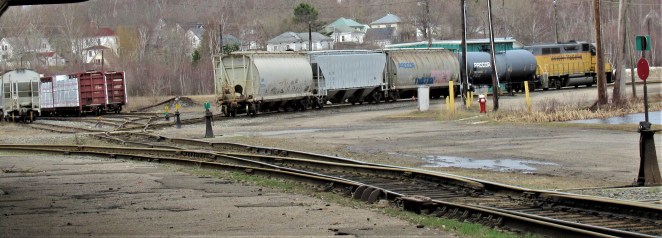
The enemy came to bomb them. And they did. Tracks rooted out, twisted like spaghetti. Engine sheds burned down. Rolling stock ruined. Many children that year lived with the fear of thunder and lightning as Swansea, my home town, burned, in spite of the black out curtains and the air raid precautions. My father’s father lived by the railway yards. When I stayed with him overnight, the shuffle and clank of steam engines and the clatter of coal trucks scarred my dreams.

My mother’s father lived by the sea and each night the ebb and flow of the tides rocked me to sleep when I stayed in his house. I told the time by the tides and I knew every ship that entered and left Swansea Docks. Standing on the front step, with field glasses to sweep the bay, I could read the ships’ names, painted on bow or stern, and then check their movements in the local paper, the South Wales Evening Post.

Timetables: they ruled my life: time tables for the trains, tide tables for the ships.
When they drove me away to boarding school, I was far removed from the rail yards and the sea. I was now summoned by bells, my every activity chimed in by bell after bell. Bells: wake up, get dressed, eat breakfast, be silent. Bells for each class, for the angelus, bells for dinner, supper, bed time, and baths. Bells on the altar as we knelt before tall candles that flickered light as the tinkling bells flicked sound across the chapel. The only escape from bells came during field games. No bells then, just whistles. But bells and whistles whittled the timetables of a carefully regulated working life.

When we moved from Swansea (Abertawe) to Cardiff (Caer Dydd), our new house also backed onto train tracks and railway yards. The rattle of rolling stock lulled me to sleep. Each day, I opened my eyes to the clash and clang of early-morning shunting. Each night, at exactly 3:10 a.m., the express train to London would rattle past my bedroom window and shake me awake as I lay in my bed. The one day I didn’t hear the train, I woke up anyway, listening for its sound. When silence stalked beneath the stars, I knew there had been an accident, and I couldn’t get back to sleep. Radio and newspapers, there was little television then, screamed the news, so many people dead and injured. We mourned for the unknown dead, just like we did in the mine disasters and the bombings.

Lights out at 9:30, prefects and house masters on patrol outside dormitory doors enforced the silence that ruled the night in those inland boarding schools that I was forced to inhabit. No trains, no ships, no tides, no rattling of rolling stock, no steam whistle, no salt smell of the incoming sea disturbed my dreams, just the snoring and whimpering of lonely little boys lost in their iron-frame beds and longing for the comforts of home.