Crow’s Feet


img_0146

Crow’s Feet

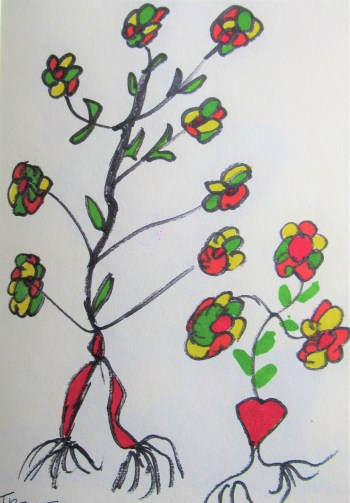
So many meanings, so many possibilities. I remember them round my grandmother’s eyes, wrinkles, laughter lines, crow’s feet. And then there are the real crows, sauntering, swaggering, two roadside hops, and take off. So bold, that sometimes they will stand there and defy you and your car, refusing to fly, but always leaving their footprints, crows’ feet in the snow.

We have a family of seven. They own our garden. Visit us every day. Check us out. Nothing like the whistle of the wind in their pinions as they sweep low over our roof, summer and winter, all year round. We belong to them, not them to us.

IMG_0147

Crows: such shadows, hovering  in our minds, casting their shadows over our lives and our deaths, for ‘the coward dies a thousand deaths, the hero dies but one’ and down, deep down, we are all cowards, in one way or another, and the crows await each one of our thousand deaths.

Eternity

IMG_0177.JPG

Eternity

Eternity: where can it be found? Not in these flowers that have already faded and gone. Where then? In mortal beings, condemned to dust? In wild words cast upon the wind? In friends and friendships, oh so perishable?

Oh where and oh where has my little dog gone?

Carved in Stone: that’s what people sometimes say … or it’s not carved in stone, as if words in stone lasted forever. They rarely do. Very little endures. Here today and gone tomorrow, or, like a stomach ache, gone with the wind.

Maybe the answer lies here, in this sequence I worked out a long time ago. Rock of Ages, cleft for me … oh where and oh where can we hide our mortality. Click on this link and you may have the answer. There again, you may not. Work it out for yourself: what are all  those anonymous marks, carved into stone and shadowed by a setting sun? If you know, please let me know. Quick now, before it’s too late, and we two too are gone.


Au Revoir

Au Revoir

Au Revoir

Commentary:

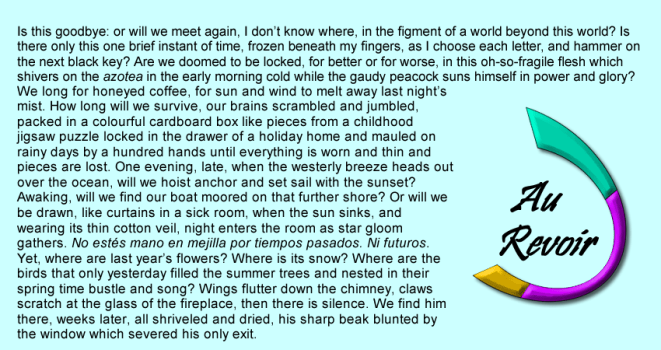
This construction (verbal and visual) dates back to my visits to Oaxaca, Mexico (1995-2001). So many friends, so many happy relationships, and then the world turned and I never went back. I remember doing yoga early in the morning on the azotea. Zopilote, the turkey vulture, wings motionless, flew high above the world, the sun lighting up his wings with its fiery flame. Zopilote, aka Trickster, the bird who stole fire from the gods and brought it back to earth so women could make men their morning chocolate over the old wood stoves or open fires. Or was that all a myth, fake news as some would say today when everything we touch is fake? So much has been lost, destroyed. So much beauty, verbal and visual, has been laid aside, destroyed, and forgotten. Au revoir, good-bye, will we ever see it again? Adieu, goodbye, we will never see it again, it’s gone for good. So much meaning in these brief French phrases, synonyms in English, yet carrying such different meanings in French.

Amarrada nuestra barca a otra ribera … Antono Machado wrote those words. We will awake one morning, he suggested, to find our boat moored on the other side of the river between life and death. And so we will. But in our daily lives, we try to ignore that fact. We seize the day, drowning our sorrows in a sea of forgetfulness: for tonight we’ll merry, merry be, we sing, but tomorrow we’ll be sober. Or will we? And nowadays, who cares anyway? As Seamus Heaney writes “my friends and neighbors, let it flow. We’ll be stood no rounds in eternity.”

Yesterday, I met a man in a wheel chair sitting outside the store where I was shopping. He asked me if I could spare some change and I told him I only carried plastic (true). Then next man who approached gave him a cigarette. My beloved was sitting in the car and I gave her a five dollar bill from the parking money and asked her to give it to the man in the wheel chair. So: how did we feel? Good for an act of charity? Bad for not responding immediately? Terrible that we see people living in poverty in a supposedly rich country? Fearful that one day the money would run out and that we too would be out there, begging for money, grateful for a cigarette, a hand out, a helping hand … happy for anything that would help postpone the inevitable end?

And then there was the bird that fell don the chimney and perished in the fireplace. We never even knew he was there until we found his feathers and his body, lifeless among cold ashes. So which is it to be: au revoir or adieu? Or even worse, the middle finger, the scowl, and the old ‘screw you’?

Thursday Thoughts Ubi sunt …

IMG_0576 (2).JPG

Thursday Thoughts
Ubi sunt …

Ubi sunt qui ante nos fuerunt? Where are they who went before us? As St. Augustine is said to have written: O homo, dic mihi, ubi sunt reges, ubi sunt principes, ubi imperatores, qui fuerunt ante nos… “O man, tell me, where are the kings, where are the princes, where the emperors, who had been before us” {Wikipedia]. Many philosophers have written on this theme, and many poets, including Villon in his famous ballade “Mais où sont les neiges d’antan?” Where is last year’s snow? Cervantes also echoes the theme with this slight variation “No hay pájaros en los nidos de antaño.” There are no birds in last year’s nests.

IMG_0573 (3).JPG

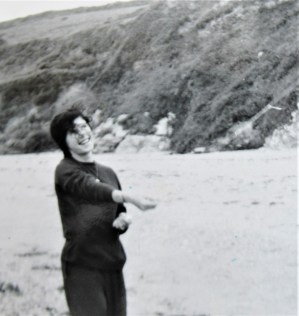
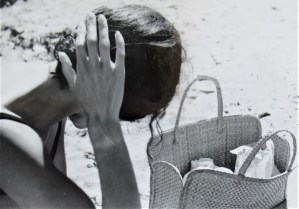
Goran Haven, Cornwall, July, 1966. I was waiting to receive the results of my final exams from Bristol University. Clare and I decided to spend a week in Cornwall and ended up in Goran Haven. When we came back, I made her a book of photos from the trip with hand-written poems beneath them. I discovered that book the other day and was taken back to a time when I wasn’t even thinking of coming to Canada. Fifty-three years later, looking at these photos, I ask myself ubi sunt … where did those days go? All those days, the old country, and everything that went with our youth … ubi sunt?

IMG_0574 (2).JPG

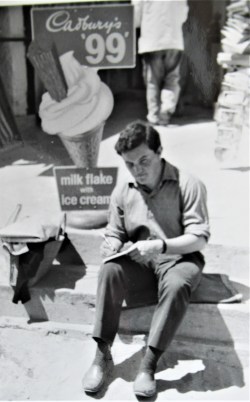
Same thing happened when I visited McAdam Railway Station: wonderful memories of all the steam trains of my youth. And those railway names: Great Western Railway [GWR], London Midlands Scotland [LMS] , London North Eastern Railway [LNER]. So many things that I can never forget: the smell of the old steam engines, the sound of their wheels going clackety-clack, the taste of smoke and ash when I thrust my head out of the window, in spite of the sign that said, Do not lean out of the window, the feel of those worn cloth seats beneath the fingers, and the sense of excitement and joy when an empty corner seat begged to be sat in. Something else I’ll never forget: the cold taste of a Cadbury’s Milk Flake stuck in an ice-cream on a warm summer’s day.

IMG_0570 (3).JPG


Keys

IMG_0841 (2).JPG


Keys

“Thirty-four doors and a key for each door,
sometimes two, and that’s only for the outside.
No master keys back then. A key for each lock,
if you please, and each door locked every night.
It’s still quite the task, a real responsibility. They
kept a turnkey, in those days, a full-time employee
whose job was to keep the keys and remember
which key fitted each door. Was it a double turn,
a single turn, a dead-bolt? The turnkey knew them
all. He also understood the interior doors and had
to wind the clocks, open and close cabinets, cloak
rooms, kitchens, desks, cupboards, drawers.

Others kept their own keys, and we often dismiss
them as lackeys, especially if they were black,
but they held the key to everything. Locksmiths
too, they could remove locks, take them apart,
cut keys, no job for a flunky. It took a smart man
to be a turnkey. He needed training, patience,
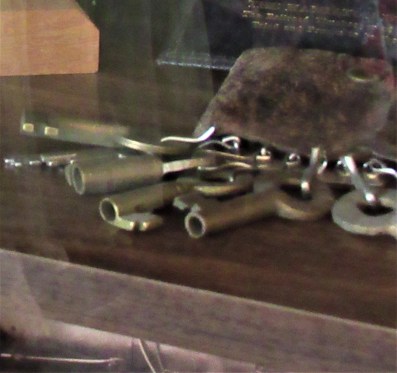
skills, knowledge, strength. Huge railway keys:
he knew how to look after them as well. Have you
seen the size of those old, brass carriage keys?”

Growing Up

IMG_0817 (4).JPG

Growing Up
in Brynmill

They drag the kids kicking and squealing
from childhood’s universe into an older
world of smoking and drinking, forbidden
fruits stolen after Christmas dinner when
drowsy grown-ups’ eyes are turned away.

Why do bigger boys follow smaller ones,
buying their sisters’ kisses then thrusting
their fingers into little girls’ knickers, or
invading Woolworth’s and tucking stolen
goods in shirts with their buttons undone?

The games they play: offering a little girl
a cigarette  or a sweet while two boys
wait behind the garden gate with a sharp
knife to  press against the victim’s throat.

Dies Irae

IMG_0139

Dies irae

Nowhere has she found peace, save
in the dregs at the bottle’s bottom.
She solves life’s dilemmas with single
malt or grape’s blood fresh-plucked.

Doctors tell her that she must stop drinking,
not stoop to conquer yet another bottle.
The remedies they suggest will never suit her.
Family and friends lecture her in vain. 

She knows she will not live forever,
that one day a higher power will call.
So she opens another bottle of Scotch,
just a drop before she goes. She falls

to the floor, and lies asleep. Three still
born babies cover her with their love
to keep her warm. “Sleep well,” they say,
“you’ll find greater peace in eternity.”

Commentary: Another poem that was not easy to write. The last line is a tribute to Seamus Heaney and his poem, Yellow Bittern, the inspiration for this one. “You’ll be stood no rounds in eternity.” In the literary theory of Intertextuality, texts talk to texts and a series of interlaced textual dialogs move across time and space. Hablo con mis ojos a los muertos, I speak through my eyes with the dead, as Francisco de Quevedo said in the 17th century. He was reading Seneca, another great writer born in Spain, when he wrote those words.
I restructured this poem three times. I began, following Seamus Heaney, with the first person singular [I]. Then I changed it to the second person singular [you], but you, in English, can never approximate to the intimacy of tu [versus vous] in French, or the multiplicity of [versus usted, vosotros, vosotras, ustedes} in Spanish. Finally I settled on the third person and settled on she [rather than he]. I guess when  a woman loses three children, she is entitled to lose herself in a bottle of Scotch and shut out the world.

Dreamer

IMG_0826 (3)

Dreamer
Maindy Road
Cardiff

Dressed in clothes spun from the thinnest of air
I gave my dreams to any who would listen.
“A gift,” they called it, “for words.”

Yet, when the winds blew wrong
my words changed to smoke that stained
or flames that blistered and scarred.

My tongue twisted and forked until lies
lay heavy in my mouth and my words
were weighed down with hooks, and sinkers.

My life became a night-mare ridden full‑tilt
at a windmill with a great wooden sail.
On certain nights, when the sky was sprinkled

with seeds of living gold, I rose upwards
to the moon and my words become stars;
on lesser nights, I lay broken in the gutter.

Rhondda Fawr

IMG_0689


Rhondda Fawr

To be Welsh on the coalfield
is to speak the language of steel and coal,
with an accent that grates like anthracite ‑‑
no plum in the mouth for us; no polish,
just spit and phlegm that cut through dust and grit,
pit‑head elocution lessons hacked from the coal‑face.

We sing arias and deep, rolling hymns
that surge from suffering and the eternal longing
for a light that never shines underground
where we live our lives and no owners roam.

Here “gas” and “fall” mean violent death
and the creaking of the pine pit‑prop is a song‑bird
suddenly silent in its cage warning of danger
soon to be upon us…

… words and music stop in our throats
as up above us the sad crowds gather.

Featured Image -- 7454

Village Bully

IMG_0114 (2).JPG

Village Bully
Pyle Corner,
Bishopston

“Shall I thump you one?” he asked.
And the fist that removed five teeth
from an opposition player hovered near my face.

He was always like that with smaller men:
a punch, an elbow, a kick, a threat so loud…
yet people his own size frightened him.

Many times I saw him back down from larger boys
and when someone was bigger,
well, that was always another story!

I’ll never forget him though: superb
against Cubs, Brownies, and Girl Guides,
but when the real Boys came to play,
why, he had one of his off days.

We called him “the million-pound body
with the one-shilling brain.”

Hate drove him. He lived off it, thrived on it,
until one day he discovered that the face
he really hated was staring back at him
every morning when he shaved.

He went downstairs, put his head in the oven,
and turned on the gas.