Friday is Fish …

IMG_0824 (2).JPG


Friday is Fish

There was nobody at the fish stall. I stood and waited. Then another customer, a young lady, arrived. We stood and talked together.
“Is nobody serving?” she asked.
“Nope,” I said. “Ain’t seen nobody.”
“Maybe we should ask?”
“Ask away. Won’t do any good.”
“Excuse me, young man …” a store assistant rushed past, paying no attention. I stood there playing my invisible violin.
“Excuse me, miss, is anyone …” same result, store assistant vanished into the distance.
“What’s that, over there?” I pointed. The young girl turned to look, and as she did, I placed finger and thumb between my lips and let out a shrill, piercing whistle. The young lady turned to look at me, half smiling, half shocked.
“Was that you?” I asked her and she started to laugh.
Within seconds three store assistants, two men and a woman, came over at a canter.
“You two go,” the woman assistant said. “I can look after this.” She put on a pair of plastic gloves.
“Do you have any halibut cut?” I asked her. “Or do you have to slice the big one?” I pointed to the huge halibut that lay stone cold dead, trying to hide in the ice cubes. The assistant ignored me and turned to the young lady.
“Can I help you?” she asked.
“He’s first,” the young lady pointed at me and the assistant scowled as I repeated my question.
“There is some on the fish counter waiting to be cut. How much do you want?”
“About half a pound,” I answered. “Please.”
“About this thick?” She gestured with forefinger and thumb.
“Looks good.”
She walked behind the fish counter, picked up a knife and started to hack. It looked as though nothing was happening.
“This knife is dull,” she announced. “Excuse me I’ll just be a moment. I’ll go get another one,” she hurried off in the direction of the meat counter.
“A dull knife?” the young lady raised her right eyebrow and lowered her left one.
“Can’t say I’ve ever met an intelligent knife,” I smiled back.
The assistant came back a minute later brandishing an even larger knife. She again attacked the halibut, once more with no visible effect. She muttered something and rushed off again, returning with a large hammer. She held the knife in one hand and started banging downwards on the back of the blade with the hammer that she held in the other.
“Are you actually going to eat that?” The young lady looked worried.
“Not the bits she’s hitting with a hammer,” I said.
“I’m off. They must have some frozen fish somewhere. I’ll go find it.”
Five minutes, the assistant held up a halibut steak, bone in.
“I’ll take it,” I said. “Thank you so much. I’m sorry to have put you to all that trouble.”

When I arrived home my beloved met me at the door.
“Okay,” she said. “What happened?”
“I’ve brought you a lovely bit of halibut,” I said.
“That’s great. Now come in, dear and tell me all about it.”
So I did.

Gower

Empress 070.jpg

Gower

To be Welsh in Gower is to spell it funny
and pronounce it worse: Gwyr.
It’s to know how to say Pwll Ddu.
It’s meeting the cows in the lane to Brandy Cove
and knowing them all by name and reputation,
which one kicks, which one gores,
when to walk in the middle of the lane,
and when to jump for the safety of the hedge.

It’s to know the difference between the twin farmers
Upper and Lower Jones.
It’s to recognize their sheepdogs, Floss and Jess,
and to call them with their different whistles.
It’s knowing the time of day by sun and shadow;
it’s knowing the tide is in or out
by the salt smell in the air
without ever needing to see the sea;

and now, in this far away land called Canada,
it’s hearing your stomach growl for crempog or teisen lap
whilst memory’s fish‑hook tugs at your heart
in the same way your father hauled in salmon bass
at Rhossili, Brandy Cove, Pennard, Oxwich, and Three Cliffs.

Commentary: I was checking Gwyr, the Welsh for Gower, where I was born, and found this interpretation of the name. <<G is for generous, your giving nature. W is for wise, more tomorrow than today. Y is for young, the years never show. R is for rapport, friends seek you.>> I don’t know if that’s me, but it certainly wouldn’t be a bad set of descriptors to live up to.


Dies Irae

IMG_0139

Dies irae

Nowhere has she found peace, save
in the dregs at the bottle’s bottom.
She solves life’s dilemmas with single
malt or grape’s blood fresh-plucked.

Doctors tell her that she must stop drinking,
not stoop to conquer yet another bottle.
The remedies they suggest will never suit her.
Family and friends lecture her in vain. 

She knows she will not live forever,
that one day a higher power will call.
So she opens another bottle of Scotch,
just a drop before she goes. She falls

to the floor, and lies asleep. Three still
born babies cover her with their love
to keep her warm. “Sleep well,” they say,
“you’ll find greater peace in eternity.”

Commentary: Another poem that was not easy to write. The last line is a tribute to Seamus Heaney and his poem, Yellow Bittern, the inspiration for this one. “You’ll be stood no rounds in eternity.” In the literary theory of Intertextuality, texts talk to texts and a series of interlaced textual dialogs move across time and space. Hablo con mis ojos a los muertos, I speak through my eyes with the dead, as Francisco de Quevedo said in the 17th century. He was reading Seneca, another great writer born in Spain, when he wrote those words.
I restructured this poem three times. I began, following Seamus Heaney, with the first person singular [I]. Then I changed it to the second person singular [you], but you, in English, can never approximate to the intimacy of tu [versus vous] in French, or the multiplicity of [versus usted, vosotros, vosotras, ustedes} in Spanish. Finally I settled on the third person and settled on she [rather than he]. I guess when  a woman loses three children, she is entitled to lose herself in a bottle of Scotch and shut out the world.

International Day

14633208_10207317214799871_1242532105939959170_o

International Day
St. Mary’s Street

To be Welsh in Cardiff on International Day
is to be decked entirely in red from deep
between your ribs where the Red Dragon
throbs pumping its blood through the Arms
Park along with your heart and bright blood
surges as you wear your scarlet jersey like
a flag as you step onto the grass ready to play.

You shed your grey hairs like a sheep
sheds its coat on the Wenallt or Caerphilly
Mountain or the Brecon Beacons and Boyo,
you know you’re unbeatable. So come
the four corners of the world to Cardiff
with a rugby ball and they shall be defeated,
ground into the Arms Park mud, humiliated.

Flower-power


IMG_0902 (2).JPG

Flower-power
or
Why should the young kids have all the fun?

So it’s children’s day at the local supermarket. As I push my shopping cart through the door, I see the face-painter with a young girl sitting before her, getting her face painted. Behind the willing victim, several young children wait, shuffling their feet in expectation. I go out to the car park, unload my cart, and push it back to the supermarket.
As I park my cart, I see that the line-up has disappeared and the face-painter sits alone, cleaning her brushes. I walk up to her table and ask “How much?”
“It’s free,” she tells me. “It’s children’s day.”
“Will you paint my face?” I ask her.
“You’re not a child,” she looks at me in astonishment.
“No, I’m not,” I reply, “but I’m in my second childhood.”
I pull out the chair and sit down.
“I’ve got some photos on my phone, or I can try and paint whatever you would like. Would you like to see some pictures?”
“No, thanks. Just  look at me and paint what you think I would like.”
“What are your favorite colors?” she looks at me and smiles.
“I don’t have any favorite colors, but I always avoid green, yellow, and gold.”
“Oh, well, how about a nice flower?”
“Great!” I say.
One of the trolley boys who return the shopping carts in great convoys walked by.
“You need a mirror,” he says, “so people can see themselves.”
“Great idea, stay here, I’ll go and get one.”
“Don’t worry. I’ve got a mirror in the car. I’ll have a look when I get there. Meanwhile, it’s a surprise. I’ll put a photo up on my blog when I get home.”
“Promise?”
“I promise.”

IMG_0903.JPG

I gave her my blog address and I kept my promise. Unlike many people I know, I usually do.

IMG_0903 (2).JPG

Commentary: with many thanks to Emily, the face-painter, who treated my second-childhood with humor and dignity. As I said to her at the time, ‘why should the young kids have all the fun?”


Bristol Temple Meads

IMG_0678 (2)

Bristol Temple Meads

Bristol Temple Meads

“Temple Meads, Temple Meads.”
Passengers on the platform shuffle
rearrange themselves to get closer
to opening carriage doors. Steam
hisses out from the engine in great
white and grey clouds. He gets out
asks a porter, “Is this Bristol Central?”
“No, son. This is Temple Meads.”
The young boy gets back on the train.

Next stop, Bath. “Is this Bristol?”
“No, son. This is Bath not Bristol.
You should have got off at the last stop.
You’ve over-run your ticket mate.
There’s a fine for that and you’ll have
to buy a new one to get back to Bristol.”

“But I asked them if it was Bristol Central
and they told me it wasn’t.” “Playing silly
buggers they was, son. Bristol Temple
Meads is Bristol Central, well, sort of.
And you’ll have to change platforms.
Go to the ticket office, over there, tell them
what happened, and maybe, just maybe,
they’ll let you take the next train for free.”

Commentary: Funny place, Bristol Temple Meads. I heard lots of funny things, all told in a West Country accent, or fluent Bristolese, while I was passing through there. Loved confusing passengers, they did, but more about that later. As for accents, well, the West Country accent and the Bristol accent are very different, but neither go well into prose, “coz, thee’ll never git a gurt big ‘ead like thine in a tiny l’il ‘at like this.” Thank you, the Wurzels. And as for reading and writing accents, click here.

Bristol Temple Meads
[Prose]

“Temple Meads, Temple Meads.”
The train slows, comes to a halt with a hissing of steam and a shuddering of brakes. Passengers waiting on the platform shuffle towards the edge of the platform, re-arranging themselves to get closer to opening carriage doors.

A young boy, not yet a teenager, gets out carrying his grand-father’s overlarge suitcase in his hand.
“Is this Bristol Central?” he asks a porter.
“No, son. This is Bristol Temple Meads.”
The young boy gets back on the train along with the other Bristol passengers who are travelling to Bath.

When he gets there, the young boy gets out of the train and again approaches a porter. “Is this Bristol?”
“No, son. This is Bath not Bristol. If you wanted to go to Bristol, you should have got off at the last stop.”
“But I asked if it was Bristol Central, and the porter told me it wasn’t. So I got back on the train.”
“Playing silly buggers he was, son. They’re like that in Bristle. Bristol Temple Meads is Bristol Central, well, sort of. He should have told you that.”
“What can I do now?”
“Well, you’ve over-run your ticket, mate. You’ll have to pay extra for coming on to Bath. And you’ll need a ticket to get back to Bristol. But it’s Temple Meads, mind. Don’t let them fool you again.”
“I won’t.”
“And you’ll have to change platforms. Tell you what, just go to the ticket office, over there, tell them what happened, just like you told me, and maybe, just maybe, they’ll take pity on you and let you take the next train for free.”

A question: Is the piece better in poetry or prose? Each version serves a different purpose, but I think the narrative rules. I’ll welcome any opinions you care to share.


Sheep

IMG_0126 (2).JPG

Sheep                               

Wales is whales to my daughter
who has only been there once on holiday,
very young, to see her grandparents,
a grim old man and a wrinkled woman
who wrapped her in a red shawl
and squeezed her and hugged her
till she cried herself to sleep
lunging for lack of space and air,
suffocating in a straitjacket
of warm Welsh wool so tightly bound.

So how do I explain the sheep?
They are everywhere, I say.
On lawns, in gardens. I once knew
a man, a friend of my father’s,
whose every prize tulip was devoured
by a sheep, one single sheep
who sneaked into the garden
on market day when they left the gate ajar.

Sheep are everywhere, I say, everywhere.
I remember riding on a passenger train
and seeing sheep leering like tourists
peering from dark coal wagons travelling
God knows where and bleating
fiercely as we passed them by.

In Wales, I say, sheep are magic.
When you travel to Paddington
on the train, just before you leave Wales
at Severn Tunnel Junction,
you must lean from the carriage window
and loudly call “Good morning, Mister Sheep!”
and if the one you greet looks up,
why, provided you’re good and quiet
for the rest of the journey,
your mum and dad will buy you
something nice in London.

My daughter shows disbelief. And “Look
at that poster there:” I say, “a hillside
of white on green, and every sheep
as still as a stone,
and each white stone a roche moutonnée.”

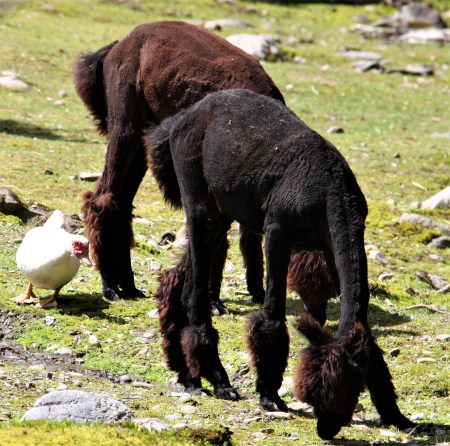
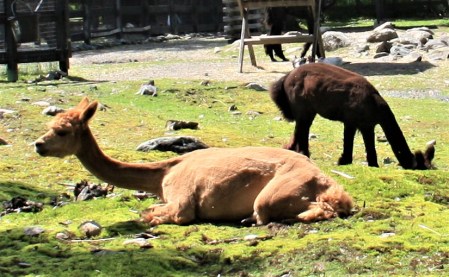
Commentary: I couldn’t find a Welsh sheep in my photo collection, so I used this photo of Pre-Columbian Incan sheep substitutes instead. Llamas is probably a Freudian slip or a typo for lambs. See: there’s reason for everything and a link between all things, even llamas, vicuñas, and alpacas, like this pair from Kingsbrae Garden Barber Shop Shorn Quartet. The other two from the Barber Shop Alpaca Quartet are around somewhere. I’ll go and look. Ah yes, here they are. Listen carefully, and you may hear them sing.

IMG_0119 (2).JPG

Time-Spirits

IMG_0868.JPG

Time-Spirits

Zeitgeist

Zeitgeist is a concept from 18th- to 19th-century German philosophy, translated as “spirit of the age” or “spirit of the times”. It refers to an invisible agent or force dominating the characteristics of a given epoch.
Wikipedia

Those who cannot learn from history are doomed to repeat it.

“Plus ça change, plus c’est la même chose.”

Poems for troubled times.

Introduction

Our world finds itself in an incredible mess right now. Somehow, we have to sort it out. Images and metaphors tie past, present, and future together. We must pick our ways through the difficulties of these troubled times, as you must pick your way through the intricacies of these poems. Many of you will give up. Some of you, the chosen few, will make your way to the heart of each poem.

These poems are deliberately cryptic. Each one is a mind game I am playing with you. I do not underestimate you. I have placed clues throughout each poem and if you follow the clues you will arrive at many of the poem’s hidden meanings. Some poems are more difficult than others, their meaning more recondite. Others seem very straightforward, yet still contain secrets.

            This style of poetry has a long history going back to Anglo-Saxon riddles and way beyond, back into the mists of time. Luis de Góngora (1561-1627) and Francisco de Quevedo (1580-1645) specialized in similar forms of recondite poetry, often based on metaphor and the juego alusivo-elusivo, the game of alluding to something while eluding the act of saying what it is. Jorge Guillén (1893-1984) and Federico García Lorca (1898-1936) also played this game, as did Octavio Paz (1914-1998). In the works of all of these poets, the clues may rest in the poem or they may be found in a generic knowledge of the mythology of the poem’s exterior world.

             Always remember that “those who cannot learn from history are doomed to repeat it” (George Santayana). Otherwise expressed, in the words of T. S. Eliot: “Time present and time past / are both perhaps present in time future / and time future contained in time past” (Burnt Norton). The seeming anachronisms in these poems suggest that all time is ever-present and that each new day presents us with events that have already occurred on many occasions.

Commentary: The idea for Time-Spirits aka Zeitgeist was born around the kitchen table in Island View on Saturday, 22 December 2018, during a literary conversation between Gwen, Victor, and Roger. A poem at a time, one after another, grew from that table top chat. The result: 70 poems, not easy to read, deliberately difficult, that reflect our troubled times. My thanks to Geoff Slater, line-painter, who drew the cover picture: Robin Red in Claw and Breast, a symbol of nature ‘red in tooth and claw’. So are we in the words of Albert Camus who writes ‘nous sommes ou les meurtriers ou les victimes’ . Is it the early bird that catches the worm? Or is it the late worm that gets caught by the bird? Whichever: it’s the worm that gets eaten, until the robin bites the dust, when he is eaten in his turn. Just think of it as nature doing its regular recycling …


IMG_0865 (2).JPG


Elevator Pitch

IMG_0627 (2)


Elevator Pitch
Jean Chrétien

His enormous presence filled that tiny
space. His corkscrew smile, well-known tic,
semi-frozen face, that trick of wild speech

butchering language, misunderstood in
both English and French. “Bonjour,” he said. “Good
day.” I nodded, didn’t know what to say,

just shuffled my feet. I remember he
talked on the radio about our land,
how, in winter, with car stuck in snow,

we spin our wheels, forward and back, a bit
at a time until we emerge, content,
victorious. Time and the floors slipped by.

I thought of the elevator pitches
I had written for my films. Should I pitch
him about my latest film or should I

just keep quiet. The elevator stopped.
Jean Chrétien got out. “You’ll be back,” I
said. “Damn right,” he grinned, lop-sided.

Renaissance Hotel. Toronto. Nine-teen
eighty-five. Tongue-tied I had stood there.
Later I thought of all I might have said.