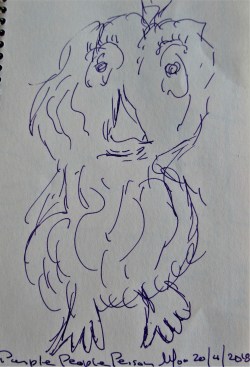
Spooky

IMG_1335 (2).JPG

Spooky

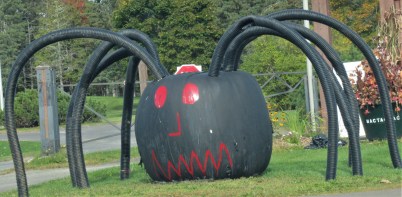
As Halloween draws near, the people at the park, Mactaquac Park, begin to spookify the countryside. Here’s the giant spider, coming to get you. It is the first in a series of spookified spookies.

IMG_1333 (2).JPG

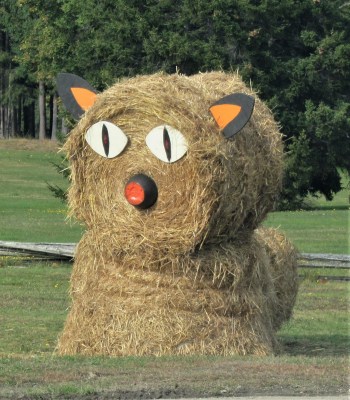
And here’s the spookified ‘what will it be”? Might be a spookified pussy dog or a spookified puppy cat. Who knows? Right now it looks more cute than wicked. Keep it that way, I say.


IMG_1186 (2).JPG

No, they’re not here yet, but watch out for the boogies and the boogeymen. They’re not far away. And they may just be out to get you. So, when someone says ‘Trick of treat’? Be sure to say ‘treat!” You want the dog biscuit, not the Rottweiler. And don’t forget to drool and say ‘pretty please’.

IMG_1338 (2)

What we do know is that when autumn leaves, strange things creep in to fill our minds and take autumn’s place. It’s that creepy-crawly time, that time of night mists and strange visions, that season of mellow mists and fruitiness when things that go bump in the night suddenly do just that.

IMG_0169


On Editing

IMG_1095 (2).JPG

On Editing

Some editors are really very good. They take the initial idea of the artist and polish it, turning what was an average piece into a great one. Others are not so good and turn an average piece into an automatic rejection.
On my kitchen wall hangs a line-painting by Geoff Slater representing one of last year’s hollyhocks from my garden. He gave it to us as a Christmas present, and I am very proud of it. Finley loved it too. She followed with great glee the white line that starts and ends Geoff’s painting. Then she stared at me.

“What are you doing?”
“I’m writing a story.”
“What’s it about?”
“A thin red line.”
“Oh!”

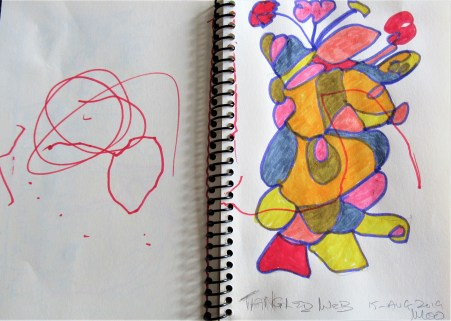
A little bit later, I saw my pens and pencils strewn across the table. My sketch book lay open and I noticed that an editor had edited some of my work. My thin red line had morphed from illusion to reality and there it lay, twisting in and out of the tangled web I had created the day before. Clearly, my average creation needed the touch of a four year old editor and apprentice line-drawer to move from average to genius.

Oh the joy and creativity of a four year old! It took Picasso nearly fifty years to learn to draw like that again. And here’s another painting by this prodigious four year old. I got this one for Christmas last year, too. Alas, it is not signed.

“Don’t you want to add some more?” My daughter asked her daughter.
“No. It’s finished.”
And so have I.

IMG_0228 (2)


Beach Heat

IMG_0572 (2).JPG

Beach Heat

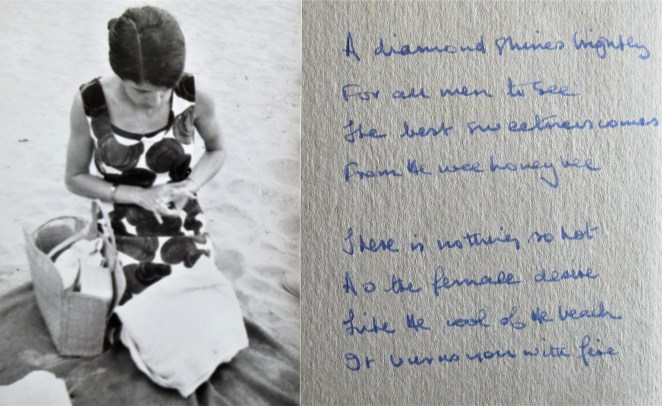
This is the beach at Goran Haven, with Clare, on the sands, trying not to lose her engagement ring. It’s still with us, in spite of having left it in a washroom on the 401. When one of the support columns of the solitaire broke, we found the stone lying on the floor of the car … that was another close call. As for the poem, well, I suppose it is one of mine.

The enlightened may recognize its structure as belonging to The Book of Good Love / El Libro de Buen Amor, written in the 14th Century (1330-1343, according to some, though it may be a little later, 1347?), by Juan Ruiz, El Arcipreste de Hita. This early verse imitates the rhythms and sequences of Juan Ruiz’s poem: In praise of small women. Not that Clare is small: she is taller than me, and always has been. She is also younger than me and hasn’t manage to catch me up yet. She is cleverer too, but don’t ever tell her that I told you that. Life might become unbearable. Not admitting that little secret is what keeps me going.

I take it you can read my handwriting. If not, ask politely, and I will add a typed version that is more understandable. Ask nicely, mind! None of that “yore ‘andritin’ is atrooshus’ stuff, sort of, loike.”

PS: I didn’t have a very good camera in those days. As for my current cameras: wow! How the world has changed. As we have changed with it.

PPS: Indeed I have received comments, not very complimentary, on my handwriting. Oh dear. Don’t worry I can’t always decipher it myself, even with my glasses on. Thank you all my friends and anonymous correspondents. So, here comes the translation into print.

A diamond shines brightly
for all men to see
the best sweetness comes
from the wee honeybee

There is nothing so hot
as the female desire
like the cool of the beach
it burns you with fire


bpnichol

IMG_1002 (2)

The day I met bpnichol

I picked him up at Freddy airport,
drove him home for lunch, Clare’s
home made Lasagna, discussed
on the phone. He wasn’t Vegan

Tousled, tangled hair, mangled maps,
Toronto streets and squares drummed
up with coded words wrapped in magic,
he signed my copy of his Martyrology.

His saintly street speech spoke like
grid-locked gears grinding on downtown
city streets, one step at a time, where no
apocalyptic horsemen ever rode.
Oh, the root, toot, hoot, flurry, scurry,
sounds simmering, spurring them on.

After lunch, we drove to the Beaver
Pond in Mactaquac. Swallows dipped
and dived, wetting their beaks. Crows
perched on barren ship mast tree-trunks
stripped of all foliage, coughing warnings.

Strong wing-pulse of the flying osprey
homing to the nest. A great blue heron
walked silent, stilting its grey way through
cool, green shade and shallow waters.

A wordy wilderness tumbled wild from
our questing minds. Images grew starry
flowers. Magic metaphors mushroomed
along tangled New Brunswick trails. No
trace of tarmac and Toronto, the big city.

Comment:

bp was a Toronto poet, still is in my books.
Hence the blue jay.
A good friend.
I miss him.

Humming Birds


IMG_1257 (2).JPG

Humming Birds

Do humming birds hum? Of course they do. Well, mine do anyway. Here is my drawing of them, humming their way across the page. Miracles of nature, they are, caught with their wings in slow motion, and listen to them as they hum. I think they are humming the ‘Song of Joy’ from Beethoven’s Ninth. They certainly are joyful creatures. And, speaking f joyful creatures, look at this photo.

IMG_1210.JPG

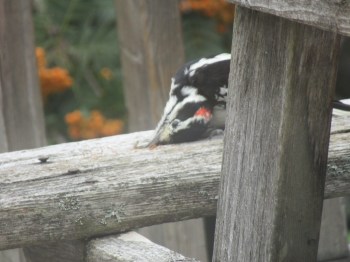
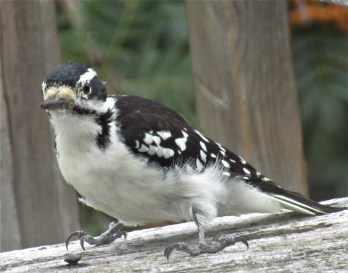
An uninvited breakfast guest, this little guy has been measuring up the picnic table on our back porch for several days now. He is having fun.

IMG_1212.JPG

He reminds me of my dentist, probing my mouth with his toothpick as he searches for cavities. The tiniest excuse and out comes the drill and away he goes, enlarging the hole, and digging down for his pirate treasure. I told him one day that if he found oil down there, all that drilling, I hoped he’d share it with me. I don’t think he was amused.

IMG_1209 (2).JPG

Ah well, we can’t win them all. But it certainly is a busy time of year for all those little creatures preparing themselves for the winter to come. The hummingbirds have gone, incidentally, and I must make do now with drawings of them. The woodpeckers are still with us and will winter over. The geese are gathering at Mactaquac and will soon be winging their way south. The land will soon fall silent and then Fall will be over and winter with all its snowy finery will be upon us. I look forward to that too. Meanwhile, summer lingers on, but only in my memory.

IMG_1058 (2)


Shower (A Selfie)

IMG_1256 (2).JPG

Shower
(A Selfie)

I smell. I whiff. I gloriously stink.
My arms, my feet, my crotch, reek with beauty.
This is me. I am still alive. I’m rank.
The time has come, the Walrus said, to take
a shower. I strip. I weigh. I obey.

Hot water streams. Bathroom steams up. I draw
faces on grey glass, smiling, glum. Soft soap
works its miracle turning Japanese
nylon into a rough body cloth that
rubs and cajoles all putrid dirt away.

Butterfly from its chrysalis, I step
from the shower, sniff with caution, and stench
no more. I am clean. I no longer pong.
My body has been taken over by
perfumes no longer mine. Who am I now?

I am no more myself. I am no more
my own gorgeous underarm muscular
ripeness. I have left my odor circling
in the soap suds and drifting down the drain.
What a pain. It will take me a week or
more to start smelling like myself again.

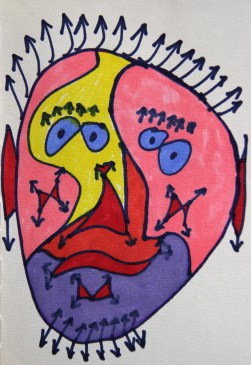
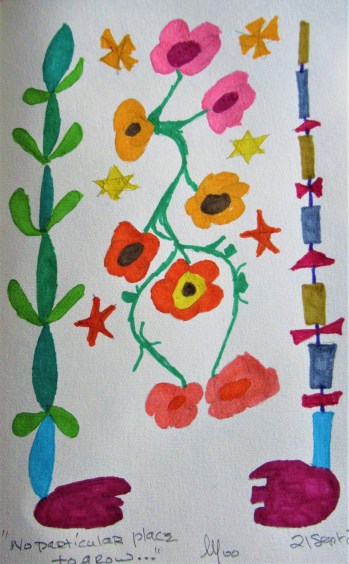
Comment: The cartoon is today’s effort. I looked out of the window and saw all the garden plants with ‘no particular place to go’ and that’s how it is sometimes, especially at this time of year, the summer behind, us fall present , and the winter ahead. We are left with the tiding up, the readying for next year, a sense of sorrow, and a feeling of hope that yes, the garden will return and yes, we will be here to witness it.

So, what are the figures in my cartoon saying to each other? Well, they have been reading the wise words of my olde friend, Oscar Wilde. “Be yourself,” he told them, ” everybody else is taken.” What are they you ask? They are themselves, as I am myself, and you are yourself, and yes, I am very happy to be who I am. And of course, everybody else is taken, so who and what is there left for us to be?

Westbury White Horse

Chaos

Westbury White Horse

Winter in Somerset. No trains from Frome.
They sit in the engine sheds, boilers frozen.

Clare drives me to Westbury, in Wiltshire,
the neighboring county. She leaves me there

and I stand on a platform as white with snow
as Westbury White Horse towering above.

People arrive, flapping their arms, stamping
their feet, walking around trying to stay warm.

Finally, to shouts, cheers, and laughter, a train
arrives, its boiler successfully thawed. People

rush forward, open doors, claim their seats.
It’s a corridor, not a compartment train.

“Is this the eight-fifteen to Temple Meads?”
I ask the porter. “Nope,” he says. “That’ll

be arriving later.” “When?” “About ten
or eleven, I expect.” “What train is this?”

“Ah, now this is the six-thirty to Bristol.
Running about two hours late. Better be quick.

The guard’s waving his flag. She’s about to leave.”
I open a door, climb on the train.  All

the seats are taken. I stand in the corridor,
shivering, all the way to Temple Meads.

Old Pal

IMG_1002 (2).JPG

Old Pal
It’s as easy as ‘Bob’s your uncle,’ as we say in Wales. Yet Bob is my uncle and life with him is never easy. On Saturdays I drive him to the local supermarket so he can purchase his groceries. He also buys cans of Old Pal dog food for Paddy, his ageing and eccentric Cocker Spaniel.
Bob always strips the labels off the cans he brings home. He trades them in for stamps so he can buy cigarettes and things. However, this stripping reduces the cans to bright, shiny aluminum canisters that sit together on the pantry shelf. He claims he knows in which order he stacks them, but I think he’s playing Russian Roulette, because he can’t tell the difference between soup, rice pudding, and dog food. They’re all locked in look-alike cans. Bob doesn’t care. His diet is a lottery anyway. He shoves the can’s contents into one end and as long as they come out the other, he’s happy.
“That’s what life is all about,” he tells me. “Munchies in and munchies out.”
            Bob’s quite happy with mushroom soup for lunch, or eating rice pudding. If he opens a mystery can and finds dog food in it, he just adds a spoonful of curry powder and heats it up on the stove. He stressed out about eating the meat in dog food when Mad Cow Disease hit Wales and consumers avoided beef, but his family doctor told him not to worry.
            “You’ll never get Mad Cow Disease from dog food,” the doctor told him.
“Why not?” Bob asked.
“Because dog food’s made from horse meat.  You can’t get Mad Cow Disease from a horse.
Bob loves dogs, but he hates Welsh Corgis. One day, he asked me to take him out for a drive. He put Paddy in the back seat, on an old blanket then patted him on the head before closing the car door.
I was already in the driving seat. I had taken the precaution of placing a plastic garbage bag over the passenger seat, in case Bob had an old man’s accident, but he told me not to worry.
“I’ll be all right. “I’ve got my Old Pal with me,” he pointed to the canvas bag at his feet. It rattled when he kicked it.
“Where do you want to go?” I asked Bob.
“Down the road,” he replied. “Let’s visit the Corgis.”
Down the road we went, driving happily, until Bob’s face came alive with joy.
“Turn right,” he cried. “There’s a Corgi down that street. Drive slowly now.”
I slowed down while Bob counted the houses.
“Stop,” he told me. “Now. Stop now.”
I stopped and Bob turned around and started slapping Paddy until the dog began to howl. Then Bob rolled down the window, pulled an empty can of Old Pal dog food from the canvas bag, unzipped his fly, stuck his old man’s magic screwdriver into it, and peed.
“The Corgi’s coming. He’s nearly here,” I could hear Bob’s chest wheezing.
“There he is,” Bob screeched with delight as a black-and-tan Corgi appeared at the gateway to the house. Bob whistled at the Corgi and, as the dog looked up, he threw the contents of the can … whoosh! … all over the dog. The Corgi jumped back, blinked, shook himself, and growled and snarled as the can drenched him in a sticky, smelly, golden shower.
“Take that, you dirty dog,” Bob cried. “Quick, drive away, now, before anyone sees us.”
I put the car into gear and accelerated away.
“This is so much fun. I’m so excited. I’m so excited I want to pee again,” Bob pulled a second empty can from the canvas bag. “Turn left. Third house up. Get ready, Paddy. There’s another Corgi on the way.”

Bilingualism

IMG_1092 (2).JPG

Bilingualism

I went on a French immersion course last week. The instructor asked each one of us to address the class for ten minutes in French. When my turn came, I stood up and announced that I didn’t know what to say.

The instructor then suggested I tell the class about my dreams. What do you dream of? I said that I didn’t have any dreams, I just had nightmares, not rêves but cauchemars, you know, nightmares. She asked me to describe my nightmares and I said I couldn’t. So, she repeated, describe your dreams. I don’t have any. Do you dream about your mother? Yes, I said, but I don’t call them rêves / dreams I call them night-mères / cauche-mères, sometimes couche-mères. Couche-mères, the instructor repeated the word.

The look she gave me: finger-nails scraping down a chalkboard. She turned her headlights on me and I sat there, frozen in the twin beams emanating from her eyes. Yes, night-mères, I repeated, because I set myself goals, not just dreams, achievable goals, and then I have night-mères, inspired by my mother, who says I will never achieve any of my dreams, because they are not her dreams, the ones she has for me, and they are the only ones that count.

You are here to speak in French, the instructor said, and you must speak French for another five minutes. So I told the class about the seals in the Parc du Bic in Quebec. The seals are like a plague, I said, like mosquitoes, only bigger and nastier, quite vicious, in fact. So the people who made Off to keep the mosquitoes away designed a new chemical spray that would keep the seals away. Now the French for seals is phoques, and since this is mainly a problem in Quebec, at the Parc du Bic, and not elsewhere, they called their product, you guessed it, PhoqueOff.

It’s quite simple to use, I said. It’s a spray, not an ointment, and you point the spray in the general direction of the seals. Then you squeeze the button and loudly say “PhoqueOff” at which point all the seals slide off their rocks with a little splash and vanish into the sea, leaving you alone on the beach.  I have tried it myself, I tell them, and I know it works so I highly recommend it to anyone who is plagued by seals.

I still don’t know why she threw me out of the class.
On Learning Welsh

IMG_1238 (2).JPG

On Learning Welsh
            Here I sit, an old man now, in front of my computer, learning at last my mother tongue, Welsh. English is the language of the invaders, the mine-owners, the men who own the steel works and foundries, and who rule this land with a fist of coal inside an iron glove. Welsh is the tongue of farmers and fishermen, of the villagers who live on the hills and tend the sheep and plant potatoes in tiny small holdings where only the fittest children survive.
My mother’s father was the last of us to speak Welsh. It was banned in our house because it was bad for the kids. In a working-class household, Welsh, be it language or accent, was a barrier to success. And success came from imitating your English betters, and climbing upwards, like a vine, or Jack on his beanstalk, until you achieved the impossible and talked and looked and dressed like them.
Sitting here, I have discovered the beauty of simple words, not so much their meaning as their sound, the way they flow, the poetry of remembered rhythms:
Cwmrhydyceirw, the Valley of the Leaping Stag, though legend has it that ceirw was really cwrw, and cwrw is beer, and its real name was the Valley of the Brown Stream Frothing like Beer.
Words have their own music, even if you cannot pronounce them properly: Mae hi’n bwrw glaw nawr yn Abertawe / it’s raining now in Swansea. Mae’r tywydd yn waeth heddiw / the weather’s worse today. Bydd hi’n dwym ddydd Llun / it will be warm on Monday. Why, oh why, in Wales, do we always talk about the weather?
Place names also have their own magic: Llantrisant, Llandaff, Dinas Powis, Gelligaer, Abertawe, Cas Newydd, Pen-y-bont … Meaning changes when you switch from one language to another:  gwyraig ty / a housewife, gwr ty / a househusband, a concept of equality that has ruled Welsh lives since Julius Caesar invaded Albion, coming from Gaul with his legions in 55 BC.
            Un deg chwech, dau deg saith, tri deg wyth, naw deg naw … The photographer asks me to speak in English, then in French, then in Spanish, then in Latin, and lastly in Welsh. He checks the memory card in his camera and looks puzzled.
“You put on a new face each time you speak a different language,” he tells me. “Look, this is when you spoke French.” He shows me the photo and yes, I look happy.
“And this is when you spoke Latin.” He holds out the camera and I see myself on the screen. I look ever so grim. English, French, Spanish, Latin, Spanish, and Welsh: all different and each language is a new a map carved into my face.  Am I a clown, then, a comedian, a chameleon to wear so many masks and to slip so easily from one to another? Which, then, is my language and where is the Old Red Sandstone from Wales into which I can carve my memories and my dreams? More important, which of those many tongues will shape my story as I sculpt each letter of my tale?